|


Welcome to the 230th edition of The Week in Polls (TWIP), a polling newsletter that always welcomes new readers. So please don’t keep TWIP a secret; share it with your friends and colleagues:
With more news breaking about the regulation of polling this week, we are at a crisis point for the current approach. So this week’s edition majors on this topic, for the fourth week in a row - and I’d encourage the many recently subscribed readers to read those three previous pieces for the full background (1, 2 and 3).
This is followed by summaries of the latest national voting intention polls, seat projections from MRPs and the most recent party leader ratings.
Subscribers who pay for the full edition can also read ten insights from the latest polls and analyses, including:
The first early polling signs of the impact of the Reform donations scandal on the party’s standing;
New polling on attitudes towards Brexit; and
What people get wrong about London.
If you are not yet a paid subscriber, you can read all ten by starting a free trial now:
For more polling news as it comes in ahead of next week’s edition, you can also follow The Week in Polls on Bluesky.
Before we get to the main business, a fond farewell to my 103-year-old reader who has just decided it’s time to scale back his reading a little. May you have many more years of other reading to come!
My usual reminder too: please do hit reply if you’ve spotted a poll, focus group or new piece of poll-based research that you think should be in contention for coverage in a future edition. Thank you!
And with that, on with the show.
More revelations, more questions about the future of polling
The past week has seen another media scoop about political polling as well as news of a regulator ruling against a polling firm. Plus I’ve caught up on an odd story about takeaways and trains which highlights some of the related issues too.
Let’s start with the scoop, and kudos to Politico for following up the Channel 4/Verbatim story about Reform, donations and polls with further examples of things going wrong with political polling.
Breaking down the details in its full story, first we have another example of the funding for a poll being kept back from the public, again involving the polling firm which featured in the Channel 4/Verbatim revelations, JL Partners:
JL Partners director [James] Johnson wrote an op-ed in the Telegraph earlier this year discussing a shift in public opinion against assisted dying without mentioning the poll cited in the piece was paid for by the Christian lobbying group CARE.
Then there are further examples of polls appearing in the media without appropriate transparency, and where they may have been funded by people with a particular political agenda but whose identity was concealed:
Johnson’s firm conducted polls on three occasions during the Tory leadership elections in 2022 and 2024 which received press coverage without disclosing who paid for them either in the media reports or in the company’s published tables.
It’s possible, in theory, that the pollster simply ran the polls itself, covering the costs internally, as a marketing move. But the evidence in the piece suggests this was not the case.
One of those polls appeared in the Daily Telegraph with no indication of its origin other than the pollster. (No client or funder is named in the newspaper’s coverage.) Moreover, Politico reports:
A person familiar with the Telegraph’s publication process said they didn’t have any record of being given any more information than what was published.
If that recollection is accurate, the newspaper ran a story without asking ‘where has this really come from?’.
Another appeared in the Daily Express (subject of a complaint on a different polling matter from me to IPSO), and the paper simply declined to comment to Politico on what it had known about the poll it too had published without giving any client or funder details.
Finally, there are more examples of the sloppiness about publishing data tables which I’ve commented on before. Politico reports that:
A recent Opinium poll carried by the website Guido Fawkes which highlighted Londoners would rather have an entrepreneur than an ex-minister as mayor did not state the poll was commissioned by London mayoral hopeful Festus Akinbusoye. While this information was included in an Evening Standard write-up of the poll, it was only published belatedly by Opinium…
In another case in January 2023, the Liberal Democrats commissioned Savanta to ask voters who was responsible for the problems the country faces … some of its results were briefed to The Observer newspaper, which brought it under the British Polling Council’s transparency rules. Despite this, Savanta did not upload the full tables - confirming the client, sample size and details of the questions and answers - until Politico contacted the firm this week.
Missing tables are a regular issue. I fairly regularly email polling firms to chase up the non-appearance of data tables within the British Polling Council’s two-day deadline, for example. I don’t think there’s anything nefarious about these cases, but still, it shows that the rules are not being zealously followed.
Moreover, the other problems that have come to light make this sloppiness more problematic as, innocent though it may be, it still creates a pattern of delayed or missing transparency within which nefarious people can seek to deliberately obscure information.
Likewise, the widespread assumption (which I’ve made too) that when a client is not mentioned by a polling firm, the firm has paid for it itself in order to promote or assist its work, is often true. But as the recent stories show, this also has created a space which can be exploited by the less well-intentioned.
As I told Politico:
This is a moment of reckoning for the polling sector. Who has arranged for a polling firm to carry out a poll and who has paid for the poll need to become standard information released at the time a poll is published.
British Polling Council rules against Whitestone Insight
To add to all that, the pressure group Campaign for Dignity in Dying have published a piece headlined:
Anti-assisted dying polls breached rules, British Polling Council finds
The British Polling Council has upheld a complaint about Whitestone Insight. Polls intended to influence assisted dying debates in the House of Lords and Holyrood did not meet the industry’s professional standards.
It goes on to explain that:
In March, the polling company Whitestone Insight published findings from two polls on assisted dying involving 1,004 adults in Scotland and 2,080 adults across the UK. The polls included questions commissioned by anti-assisted dying campaign groups, such as Care Not Killing and Not Dead Yet. Findings from the polls were reported in the media and cited by Parliamentarians opposed to law change…
Rule 2.3 of the BPC’s Objects and Rules states clearly that when polling results enter the public domain, its members must publish the wording of “any prior questions on the same or related topics” that were put to respondents.
It appeared that Whitestone Insight repeatedly failed to do this and acted without appropriate transparency. Instead, it published questions from its polls separately, which meant there was no way for people to know respondents in the polls had already been presented with other questions on the same subject. This is known as priming and doing this without full transparency is exactly what rule 2.3 is designed to prevent.
The most famous example of how priming people can skew results came in the second episode of Yes, Prime Minister, in which Humphrey Appleby explains to his more junior colleague Bernard Woolley how the ordering and wording of polling questions can be used to get the answer you want:
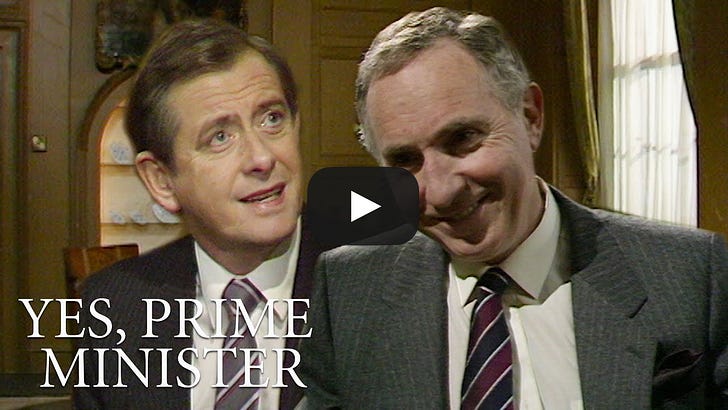
This was not just fanciful satire; Ipsos replicated the fictional questions in some real polling and found that yes, the results do get skewed.
Have you ordered a takeaway to your train seat?
 |
Finally, I’ve been catching up this week on an odd little story from The Independent in late August:
Domino’s launches pizza delivery service for train passengers…
A majority (57 per cent) of travellers thought that food on offer at stations and on board UK trains was lacking.A third (35 per cent) said they had attempted to get a takeaway delivered while on board a train - but only one in five (20 per cent) managed it successfully.
35%?!
Now, I often say to others when they have expressed incredulity about a polling result that a great thing about polling is that it not only tells you about people who are just like you, it also tells you about other people who are different from you.
What’s more, a bit of careful reading starts to make that 35% seem a little more plausible to me.
The figure comes from a publicity campaign organised by the agency Hope&Glory and which featured Domino’s, Lumo and The Trainline.
The latter got the 35% figure wrong, claiming it was 35% “of Brits”. Given not everyone uses trains, that would have been a sky-high figure indeed.
But as The Independent piece implies, and as The Trainline confirmed to me, the poll filtered out people who have “never travelled by train”, who were 10% of the sample, leaving 90% as train travellers. That 35% is 35% of the 90% who have travelled by train.
That 90% number, though, seems on the high side as the 2025 National Travel Survey for England puts it at 61% using surface rail at least once a year - though of course some people will have used the train more than a year ago (and the poll was of the UK, not just England).
Then the takeaway ordering question has two nuances to note. It includes people who have tried to order takeaways while on a train for delivery to a “train carriage” and also to a “train station”. Moreover, there is no time limit on how far in the past someone has tried to do this and they may have done it just the once.
Even so, the idea that over a third of train travellers have tried to order a takeaway like this strikes me as… surprising.
Not only because of my own personal experience of not seeing, hearing or smelling this activity, but also because of my failure to notice the likely consequences of such ordering being a regular occurrence: seeing people receiving the takeaways, regular abandoned takeaways on trains or platforms, delivery drivers waiting to meet a train, complaints at some stations about increased litter or obstructions from delivery bikes, the train YouTuber doing a piece about the station that has the most takeaways delivered to it, the traveller tips or marketing promoting the best delivery firm to use, etc.
It all, still, seems implausible. Perhaps you are about to fill my inbox with emails about how you got prawn crackers delivered to Bristol Parkway last Friday night. Perhaps I’m about to be tagged in social media posts showing folk tucking into their pizzas on the West Coast Mainline. Perhaps… but I’m still sceptical.
Yet in several key respects the poll passes muster. It is from an established, widely used polling firm - Censuswide. The data tables are online for all to see. The firm is a member of the Market Research Society (MRS) and the British Polling Council (BPC).
Why then mention this food-meets-transport poll in a newsletter about political polling?
Because it shows the limitation of polling transparency. It can still leave you a long way short of enough information to judge whether or not a poll is accurate. This is one reason why some British Polling Council members are keen that BPC membership isn’t seen as a quality mark, because obeying the rules, desirable though that is, isn’t a guarantee of a poll being conducted well using a high-quality sample.
Moreover, while you might hope that a national newspaper reporting on such a poll would do some digging to check out the numbers, that isn’t what we find in The Independent’s story. Rather, its wording is extremely similar to the wording used by The Trainline and Lumo in their own marketing material, strongly suggesting a high degree of churnalism by the newspaper. Moreover, there is no surrounding information added by the newspaper, such as reports from a train station operator of their frustrations at extra litter on platforms or an accessibility lobby group complaining about disabled parking bays getting blocked by delivery bikes. In other words, none of the additional information you would expect to come to light if the poll were right and if the newspaper also had (the time and money to) put in some extra research to check out if the story stands up.
So it’s a story that shows the limitations of polling transparency and of how polls get covered by the media, both of which are problems for getting political polling out of its current pickle.
Elsewhere from me…

If you spot a factual error…
Borrowing an idea from Stuart Ritchie and others, if you spot a factual error in an edition of this newsletter, I will give you a free 12-month subscription to the paid-for version (or an extra 12 months on your existing one). Factual errors qualify, but grammatical errors or disagreements over interpretation do not, and my decision is final. Messages about both of those are always welcome, though.
Voting intention and leadership ratings
Here are the latest voting intention polls from different pollsters. They have settled into a pattern of generally showing Labour a small handful of points ahead of Reform and the Greens have slipped back from being consistently ahead of the Liberal Democrats.
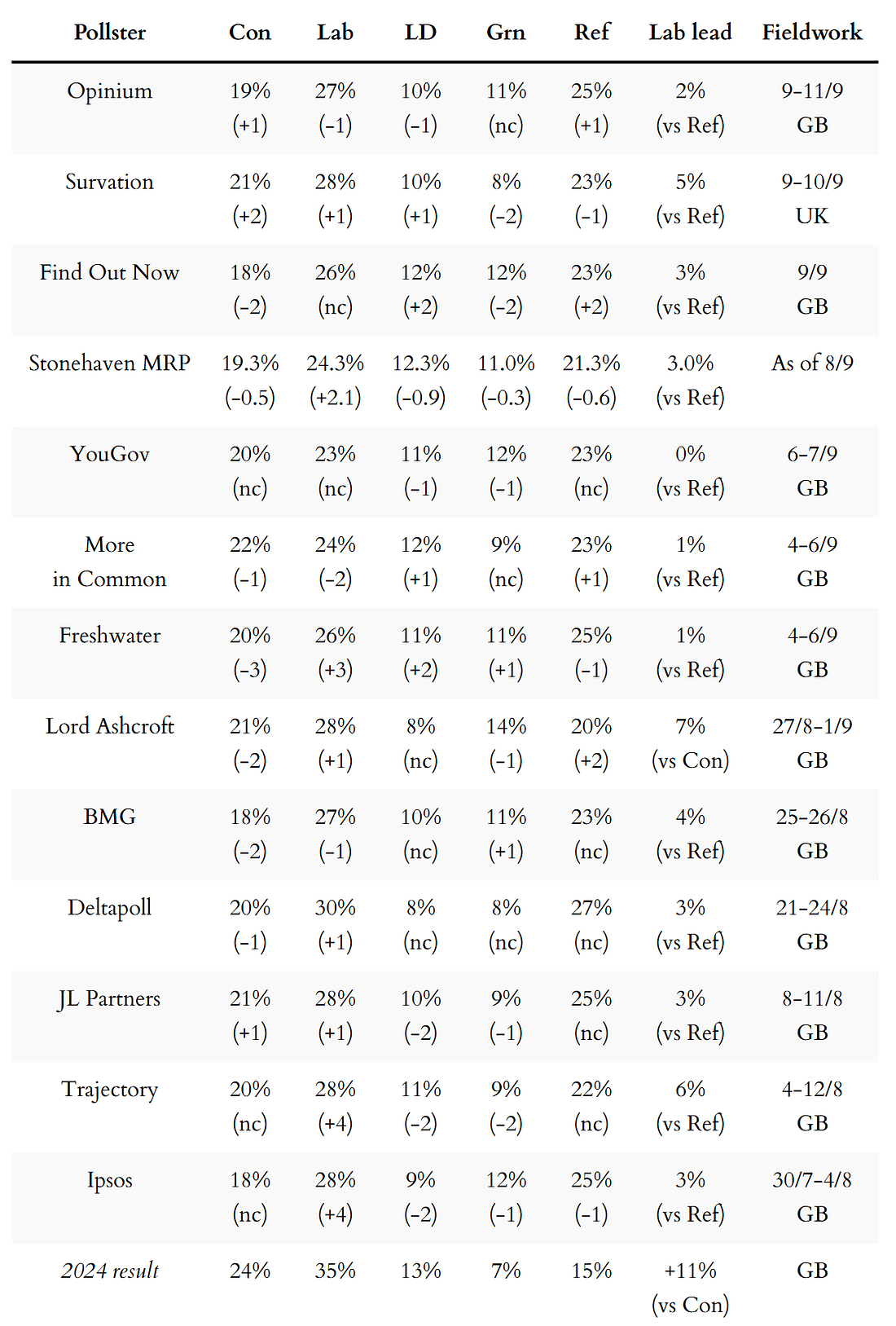 |
The table is also online here, along with explanations about what is included. It is updated regularly throughout the week as new polls are released.
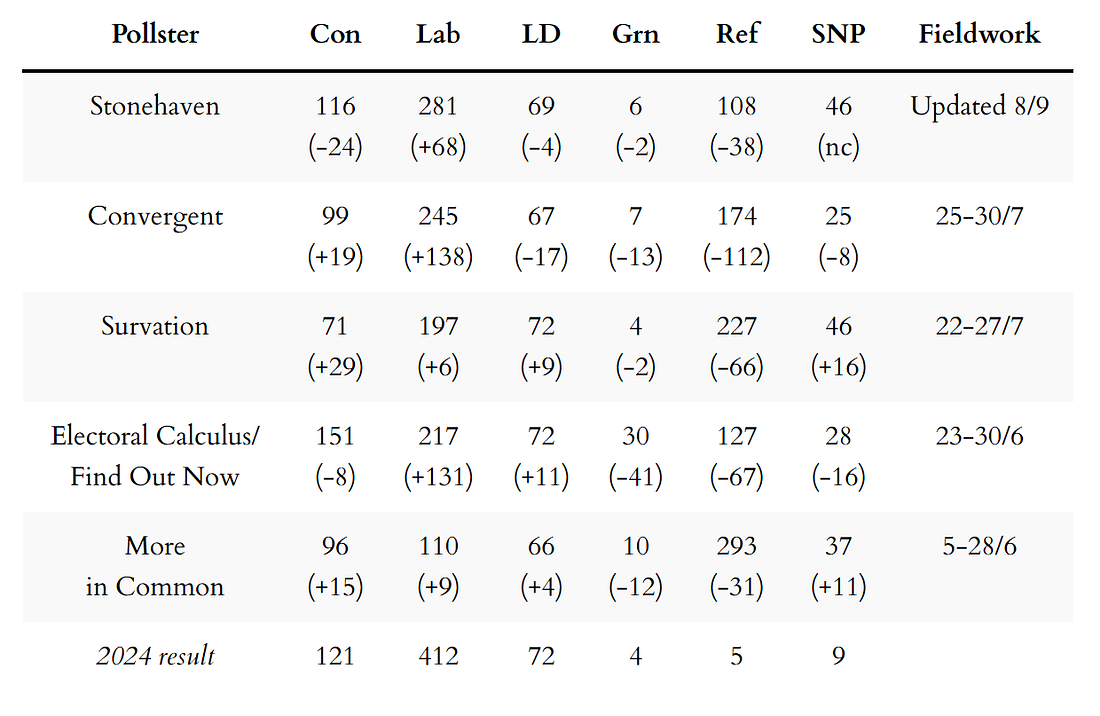
Next are the seat projections from MRPs, also sorted by fieldwork dates, listing those which are based on dedicated fieldwork (rather than models based on averages of other polls). Because such MRPs are published infrequently, some of the entries below are quite old. There is though a new MRP from Stonehaven this time.
 |
Finally, here is a summary of the latest leadership ratings, sorted by pollster name. The established pattern here is of Burnham having the best ratings, with both Polanski and Farage not having recovered from the previous falls in their ratings. They have not fallen further, but nor have they bounced back.
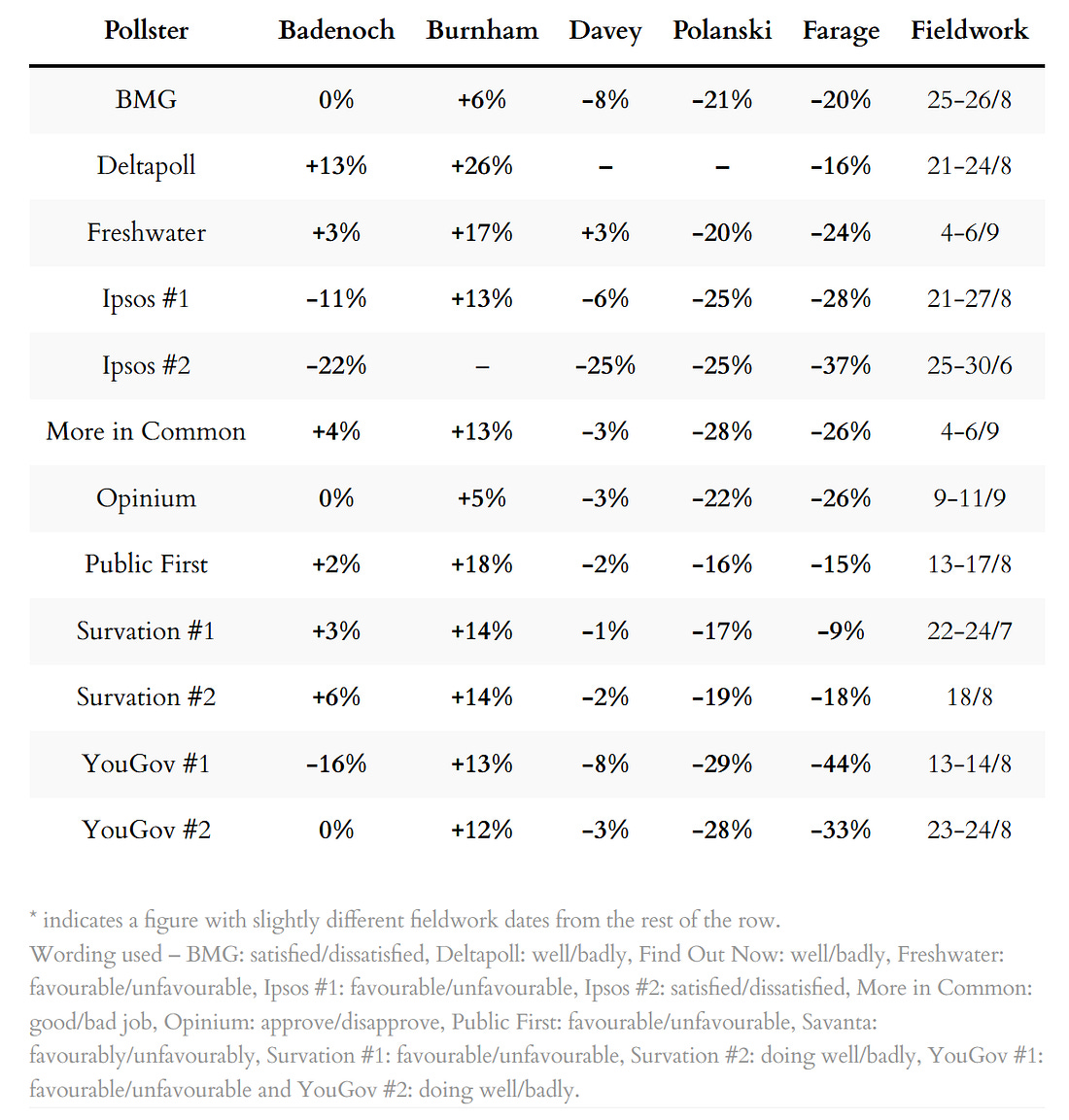 |
The table is also online here with additional details, and is updated regularly throughout the week as new data comes out.
For historical figures on both voting intention and leader approval stretching back to the 1930s, including Parliamentary by-election polls, see PollBase.
Catch up on the previous two editions
 |
|
 |
|
My privacy policy and other legal information are available here. Links to purchase books or other items are usually affiliate links which pay a commission for each sale.
Quotes from social media messages are occasionally lightly edited for punctuation and clarity.
If you are subscribed to other email lists of mine, please note that unsubscribing from this one will not automatically remove you from the others. If you wish to be removed from all my lists, simply reply to this email to let me know.
Is there a political cost to Reform for the controversies over their donations?, and 9 other polling insights you shouldn’t miss
The following ten findings from the most recent polls and analyses are only for subscribers who pay for the full edition, but you can sign up for a free trial to read them straight away.
The full impact of a (claimed) political scandal on a party or politician can take months to properly play out in the polls. But we do now have some early signs of...

Continue reading this post for free in the Substack app
| ||||||||||

