|


Welcome to the 182nd edition of The Week in Polls (TWIP), which takes a look at polling related to whether it would be okay for the House of Lords to vote down legislation for assisted dying. I also give a couple of AI platforms a go to see if they can do better than the newspaper report.
This is followed by a summary of the latest national voting intention polls, seat projections from MRPs and the most recent party leader ratings.
Subscribers who pay for the full edition can also read ten insights from the latest polling and analysis. These include:
Which political parties are people’s top two picks on favourability?
New research into the quality and reliability of online pollster panels; and
How voting intention varies by supermarket choice.
If you are not yet a paying subscriber, you can read all the answers by starting a free trial now:
Quite a few people’s eyebrows were raised this week by the report in the Daily Telegraph headlined “Revealed: The Left-wing bias of Britain’s establishment”.
It comes from polling by Find Out Now and Electoral Calculus, with the latter having a helpfully clear explanation on their website of the methodology (and thanks also to them for the swift reply to a query from me).
It’s worth noting, and coming to your own view on, two key decisions made for the poll. One is that ‘the establishment’ is defined by a series of professions which excludes, for example, bank CEOs but includes primary school teachers. The other is that it includes junior members of the professions judged to be part of the establishment. Indeed, the poll tables have just over half of the weighted sample aged under 35. This therefore means that, for example, an 18-year-old working in a museum shop counts as establishment (culture and media workers are included) while property tycoons do not (those working in the property sector are not included).
Of course, the concept of ‘the establishment’ is not easy to define and in the end a poll does need to have a hard definition to use. It is not pedantry to look at the definition as, for example, there are some very sharp age breaks on the questions between those under 35 and over 35. Having half the weighted sample under 35 makes a significant impact on the results.
I think the results are interesting (particularly if you think of the poll as being one of a group of people who mostly have been to university). But given the above, you may or may not view ‘the establishment’ as a good way to describe who was polled.
Want to know more about political polling? Get my book - Polling UnPacked: the history, uses and abuses of political opinion polling.
Quarterly by-elections summary
Another quarter has rolled by, so here’s the latest quarterly summary of council by-election results:
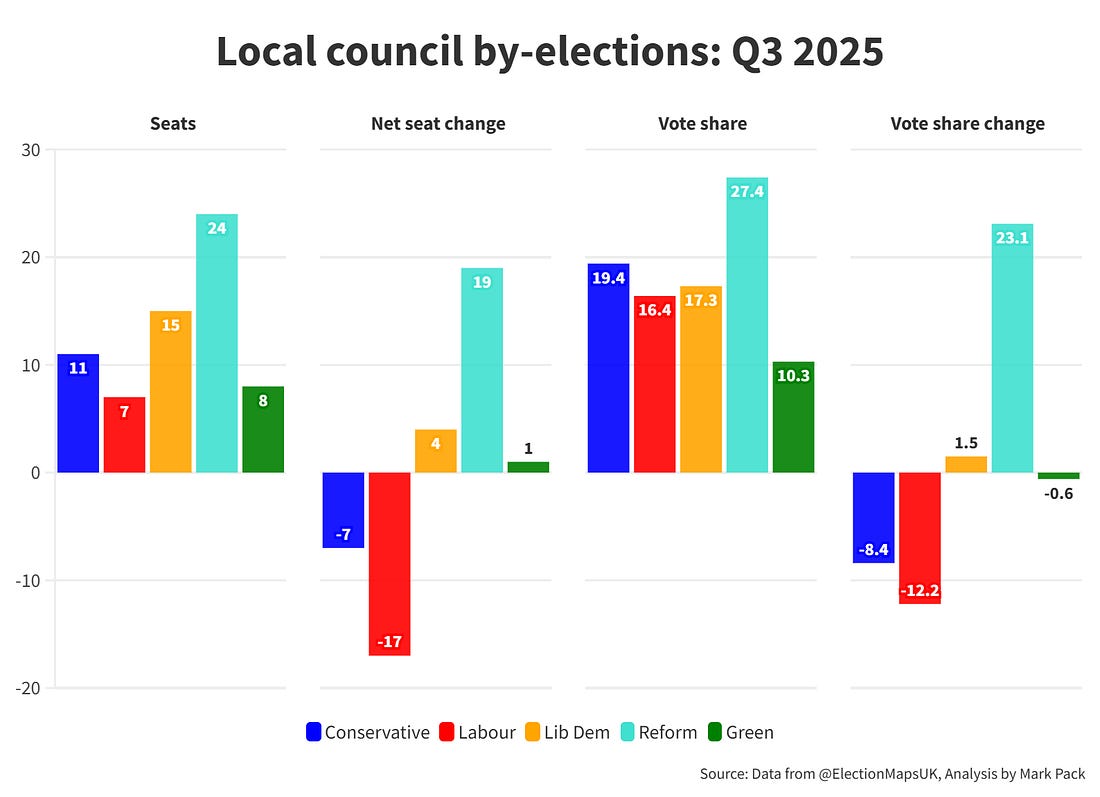 |
There is, rightly, a lot of talk about the old two-party system fragmenting. Perhaps there are signs that it is more a question of a new two-party system emerging. Or as Rob Ford puts it:

It’s also an example of why although some like to denigrate looking at council by-election results for national trends and others like to denigrate looking at polls far out from an election, I think both views are wrong.
There’s something very different from the norm happening in British politics and if we had no polls and ignored by-elections, you wouldn’t have much evidence at all to make your case that it’s happening.
Does the public think it would be acceptable for the Lords to vote down assisted dying legislation?
 |
I usually write about my work in the Lords over on A Lord’s Eye View, but there is a new poll out about how peers should, or shouldn’t, behave.
One of the side-effects of the Lords being unelected is a widely accepted attitude in the Lords that, when push comes to shove, it should defer to the House of Commons as the latter is democratically elected.
Some of this is formalised in rules such as the Parliament Acts. Some of it comes from tradition and convention, such as the way that both Labour and the Conservatives are, when in opposition, extremely reluctant to support a ‘fatal motion’ on secondary legislation (which would stop it becoming law).
The principle of letting the House of Commons prevail is easiest to justify in cases such as legislation that was in the manifesto of a party that won a general election. Where it gets more clouded is situations such as non-government legislation on matters of conscience. Should a member of the Lords stick with their conscience and vote against a measure even if the Commons passed such a measure?
I find the argument that the democratic will of the House of Commons should in the end prevail a very powerful one, with the role of the Lords being to scrutinise and to ask the government to think again. (Of course, I also think the Lords itself should be democratic, which would make such scrutiny more powerful as the Lords could then push points further without having to worry about overriding democracy.)
But it is not a surprise that this is an area that generates debate, particularly in the light of the discussions over assisted dying with the Terminally Ill Adults (End of Life) Bill currently going through Parliament. It is not a government bill and was passed by the House of Commons by clear, if not overwhelming, majorities (330-275 at Second Reading and 314-291 at Third Reading).
The Independent recently ran a report on just this topic, based on an opinion poll: “New poll suggests public back peers in voting down assisted dying bill”.
Connoisseurs of newspaper headlines will note the use of “suggest” which is frequent newspaper code for ‘we don’t quite stand by what follows’.
The report went on to say that:
Peers opposed to the controversial legislation which narrowly passed in the Commons have been emboldened by a new poll which suggests that 70 per cent think they have the right to vote it down…
The poll of 2,071 British adults by Whitestone Insight found that 70 per cent of those who take an opinion believe that peers have every right to vote against non-government legislation if they consider that it poses a significant risk to vulnerable lives.
But what does the poll actually say? Dig into the details and you find two problems: with the numbers from the newspaper report and with the polling question.
(Thank you to the pollster, Whitestone Insight, for letting me dig into the details by promptly providing the tables when I could not find them on their website, and thank you also to Professor Meg Russell for initially highlighting the story to me.)
What the pollster asked was:
In your view, should members of the House of Lords be free to choose whether or not to vote against proposed laws that they believe to be harmful to vulnerable people, if those laws:
were part of the manifesto promises made at election time by the party now in Government
were not part of the manifesto promises made at election time by the party now in Government
were put forward by an individual Member of Parliament rather than the government
The answers to that third option - the one relevant to the Terminally Ill Adults (End of Life) Bill - were:
Yes: 45%
No: 20%
Don’t know: 35%
There is no 70% figure, which you only get by excluding the don’t knows. To be fair, the newspaper report did use the phrase “of those who take an opinion” and went on to give the 45% figure. Even so, leading with the 70% figure and wording the headline the way the paper did strongly tempt any reader into misunderstanding what the poll says.
Then there is the question of the wording used. It puts the case on one side of the argument - “they believe to be harmful to vulnerable people” - but not the case on the other side of the argument - such as “even if this means unelected peers overriding elected MPs”.
You can argue over the relative merits of each point, certainly, but to present a point on one side of the debate is risky in a polling question.
All the more so as there is a rather under-polled topic. There is, for example, a YouGov poll from 2018 about whether it would be right for the Lords to block or amend Brexit plans, though those results were likely heavily influenced by the specific context of a referendum having been held first. Other polling goes back a couple of decades.
Moreover, it is a common finding from polling that asking people about an abstract proposition gets different answers from asking people about a specific real world choice. The specifics of the policy and the people promoting or opposing it often triggers different answers. (On which point, see the impact of attaching a party name to a policy in the top 10 round-up at the end of this newsletter.)
So all in all this new poll is both welcome in giving us new information but also open to people drawing misleading conclusions - particularly given how the poll results have ended up being used. The Christian Institute, for example, led its report of the poll with “The public believes the House of Lords should be allowed to reject Kim Leadbeater’s assisted suicide Bill, a poll has revealed.” Although it went on to give more details, that initial presentation skews understanding from the off.
I also tried asking a couple of AI services, “Give me UK opinion polls on whether people think it is ok for the House of Lords to vote down legislation.” Both Perplexity and Copilot based their answers almost wholly on the Whitestone poll, and presented conclusions from it with a certainty that my analysis above shows is unwarranted. Co-pilot, for example, kicked off with, “Recent UK opinion polls show that a majority of people support the House of Lords voting down legislation.”
To be fair to the artificial intelligences, this is not worse than what humans writing about polls frequently do. But that does not make it a good answer. What would really impress is AI that does not duplicate the sort of reporting that tempts the audience to be misled. Rather, what would really impress is AI that understood how to report polls well and then did just that. But so far, based on my admittedly limited experiments, that is not what AI tools manage.
As for what public opinion thinks of the possibility of the Lords voting down the Terminally Ill Adults (End of Life) Bill, we can say with certainty that saying 70% of people would be ok with this is not an accurate reading of public opinion.
What would be an accurate reading is something this polling so far has not revealed, though, as with that polling about Brexit, it is likely to align heavily with whether or not people support assisted dying in the first place.
If you spot a factual error…
Borrowing an idea from Stuart Ritchie and others, if you spot a factual error in an edition of this newsletter, I will give you 12 months free subscription to the paid-for version of this newsletter (or an extra 12 months on your existing one). Factual rather than grammatical errors, and factual errors rather than disagreements over interpretation. Though messages about both of those are always very welcome.
Voting intentions and leadership ratings
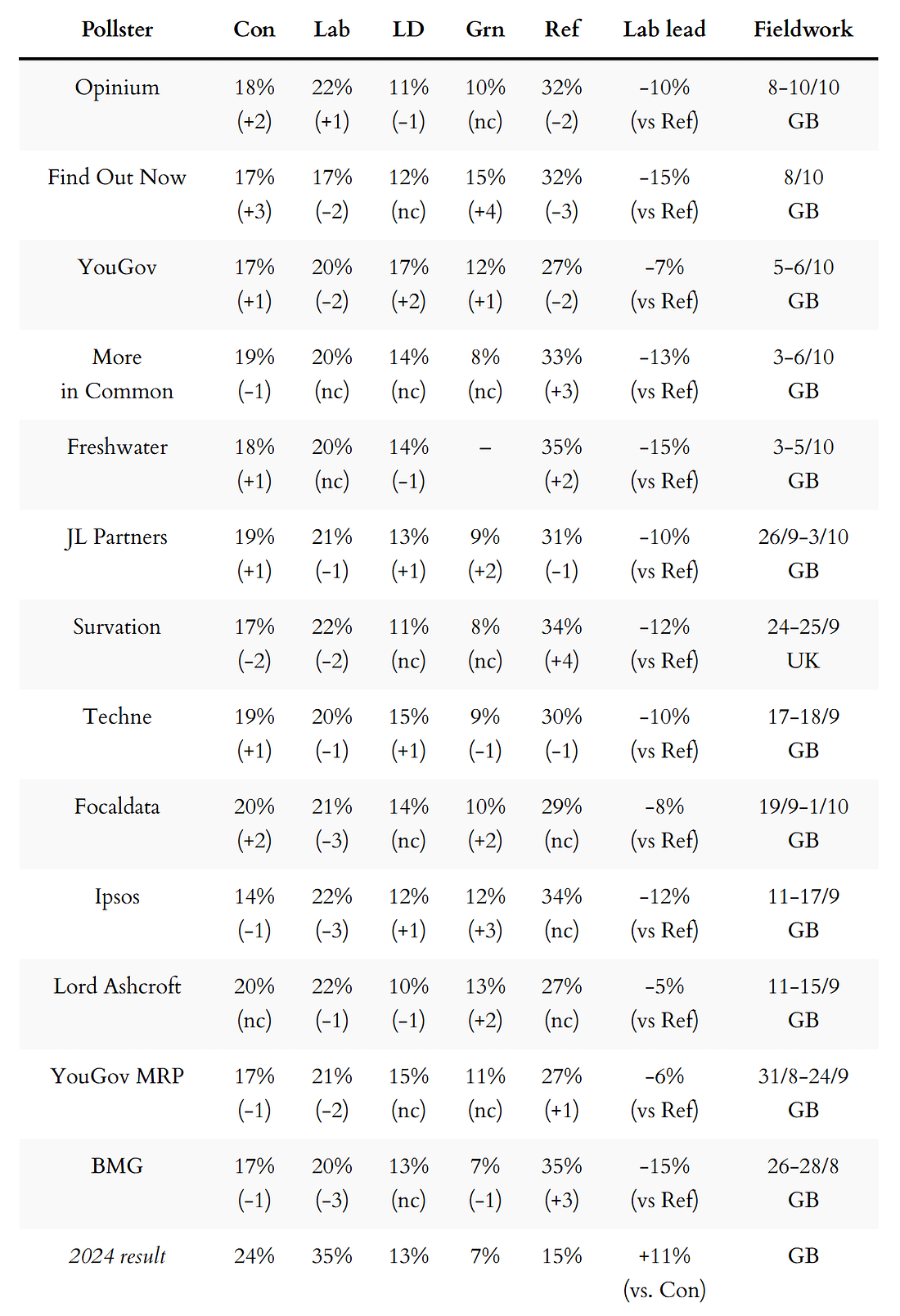
Here are the latest national voting intention figures from each of the pollsters currently active.
Find Out Now is back to being a significant outlier from other pollsters, but let’s see what more polls tell us.
The latest three polls all find a bump for the Conservatives and a fall for Reform. The movements are small but plausible given the timing of the Conservative Party conference. That, however, may also mean that the bump subsides in the way that conference bumps often have in the past.
 |
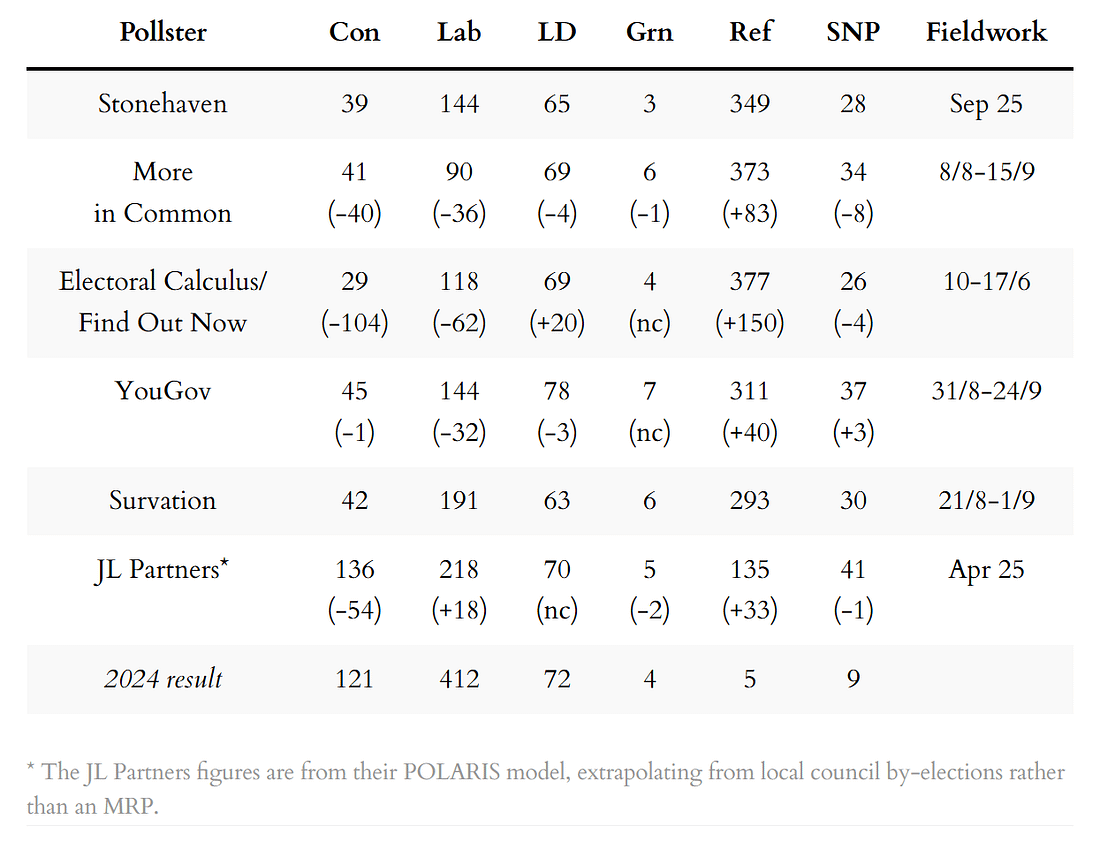
Next, the latest seat projections from MRP models and similar, also sorted by fieldwork dates. As these are infrequent, note how old the ‘latest’ data is.
 |
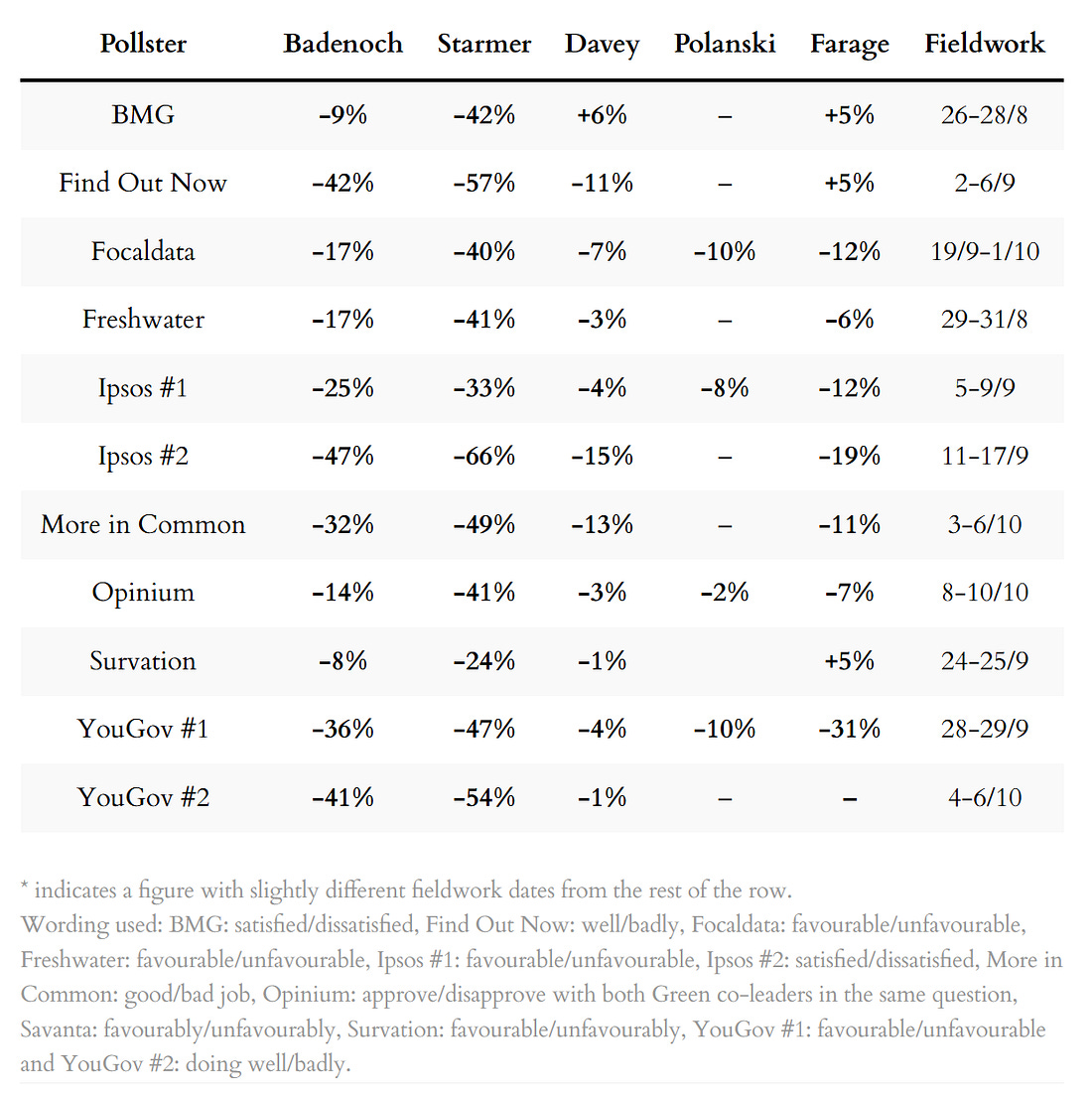
Finally, a summary of the latest leadership ratings, sorted by pollster name:
 |
For more details, and updates during the week as each new poll comes out, see my regularly updated tables here and follow The Week in Polls on Bluesky.
For the historic figures, including Parliamentary by-election polls, see PollBase.
Catch up on the previous two editions
 |
|
 |
|
My privacy policy and other legal information are available here. Links to purchase books online are usually affiliate links which pay a commission for each sale.
Quotes from social media messages are occasionally lightly edited for punctuation and clarity.
If you are subscribed to other email lists of mine, please note that unsubscribing from this one won’t automatically remove you from the others. If you wish to be removed from all my lists, simply reply to this email to let me know.
Which parties are in people’s top two picks?, and other polling news
The following 10 findings from the most recent polls and analysis are only for subscribers who pay for the full edition, but you can sign up for a free trial to read them straight away.
Although we will almost certainly still have first past the post for the next Westminster general election, the likelihood of widespread tactical voting means people’s second preferences are of interest. Handily, YouGov has just done...

Continue reading this post for free in the Substack app
| ||||||||||

