|


Welcome to the 210th edition of The Week in Polls (TWIP), a polling newsletter that always welcomes new readers. So please don’t keep TWIP secret; please share it with your friends and colleagues:
This time I have a warning about the local election MRPs that have been published.
This is followed by a summary of the latest national voting intention polls, seat projections from MRPs and the most recent party leader ratings.
Subscribers who pay for the full edition can also read ten insights from the latest polls and analysis, including:
An Ipsos polling record on the economy is broken;
A big gender gap in attitudes to nuclear power; and
(Even) lobbyists want better regulation of lobbying.
If you are not yet a paid subscriber, you can read all ten by starting a free trial now:
For more polling news as it comes in ahead of next week’s edition, you can also follow The Week in Polls on Bluesky.
A quick update on my raised eyebrows three editions ago at The Independent over its reporting of an opinion poll. Another week on, the paper has now sent me an acknowledgement. No news on correcting the story yet, however.
A reminder too that my page of local council election predictions is continuing to be updated, with new figures added this week.
Two excellent long-reads on the local elections are by fellow newsletter authors Sam Freedman and Dylan Difford:


And with that, on with the show.
Vote predictions are not necessarily good seat predictions
 |
Regular readers will know what to expect from me when it comes to MRP-based election predictions:
Polls are good; most problems with polls are solved by having more polls.
We don’t get enough polls about local elections.
MRPs are sophisticated, and YouGov has one of the best track records at both general and local elections.
Whatever the limitations of MRPs, they are much better than what can count for serious political punditry in the mainstream media.
So with MRPs and other polling appearing for the local elections, in greater volume than I can remember previously for non-mayoral elections, and including data from YouGov, why aren’t I celebrating?
One reason I covered last week:
My eyebrows have been kept raised by the ITV/More in Common poll for the local elections in Birmingham. More local election polling is good news. But ITV headlined on how many seats Labour are set to lose, with a calculation based on “a uniform swing model, applying changes in vote share evenly across all wards.” The impact of independent candidates, tactical voting, the evidence from recent elections… all subsumed by a uniform swing model. That is… brave.
The other reason is that both the JL Partners¹ and the YouGov local election MRPs seek only to predict vote shares across different councils. They don’t try to predict individual ward results or seat tallies on each council.
That is understandable. Doing an MRP well for a general election, where there is now a good few rounds of experience, is hard enough. It is even tougher to do it for local elections with the complications of lower turnout, multi-member wards, more parties and much more widespread serious challenges from independents. It is great that two polling firms are willing to put their reputations on the line by rising to the challenge.
But but but…
The local council elections are being run under first-past-the-post, in a multi-party, tactical voting world. Vote shares across a council may well be a pretty poor guide to seat numbers and council control.
It’s very easy to go from accurately recounting what the MRP says to describing it in a way that a casual reader will misunderstand and so slip into error.
Take this example from Dan Bloom at Politico (and I’m picking on you Dan because your coverage of political detail is so good, so take this as a compliment, honest!):
England’s two insurgent populist parties will break through in London’s May elections and are likely to take the lead in several of the capital’s 32 council areas, an extensive new poll suggests.
The left-wing Green Party is projected to win the highest vote share on four authorities long held by the Labour Party — Hackney, Lambeth, Lewisham and Waltham Forest — according to a YouGov polling model shared with POLITICO.
The same model projects that the right-wing Reform UK will become the largest party on three suburban councils: Labour-run Barking and Dagenham, Conservative-run Bromley, and Havering, which is currently in no overall control.
Let’s look at how that wording breaks down:
First paragraph: good caveat with the use of “likely”, and “take the lead” is compatible with talking of vote share, though a casual reader may not realise that this is not a prediction about who will have the most seats.
Second paragraph: all clear and accurate, which then also makes the first paragraph a reasonable shortcut before the clarifying detail in the second.
Third paragraph: alas, here we regress for “Reform UK will become the largest party on three suburban councils” is less than ideal; that reads like a seat numbers prediction.
And nowhere in that opener is the clarity of ‘this is about votes while seats may turn out rather differently’.
Hence my concern that the MRPs are being widely misunderstood.
(And before one of my readers from Politico WhatsApps me, yes deep into the story it says, “[The MRP] is designed to map results at a more granular level but does not predict the number of seats won or who will end up running each council.” But when the truth lies so far down a story, we all know it’s often going to be missed.)
But let’s return to my key point - that vote share may well be a poor guide to seats.
If you have been reading my stuff about elections since before this newsletter started you may be readying a ‘gotcha’ message to me about that. Because haven’t I written in the past about how the much-maligned uniform swing (UNS) model based on national vote shares actually works pretty well for the big picture at general elections most of the time? Indeed I have.
But that was for two main parties in a three-and-a-bit party world at a general election in the pre-2024 world.
For local elections at the moment, it would be a huge leap to assume council vote share is a clear guide to seat numbers.
Let’s use the YouGov MRP as an example to flesh out what that means. It takes a vote share gap between the top two parties of five points or less to mean it is “neck-and-neck” and to colour in the council in a hatched pattern mixing the colours of both those parties. YouGov finds that 16 out of 32 councils in its poll are that close. (JL Partners also has many councils close on vote share, with 54 out of the 136 councils on its figures having the top two five points or less apart).
Yet here are some examples from the 2025 local elections, using the data from the Thrasher and Rallings annual local election handbook:
Cambridgeshire: Lib Dems just 3.9% ahead of the Conservatives on votes but 31-10 ahead on seats, with Reform, slightly behind the Conservatives on votes, also on 10. That made for a 1-seat overall majority for the Lib Dems and a large lead over the Conservatives on seats.
Devon: Lib Dems only 1.8% ahead of Reform UK on votes but 27-18 ahead on seats. That 27 was not quite enough for outright control, but nor was it close on seats between Lib Dem and Reform as to who would be the largest party.
Leicestershire: Reform came in 4.6% ahead of the Conservatives on votes, but 25-15 ahead on seats. Once again, close on votes was not close on seats and again Reform was by some margin the largest party.
West Northamptonshire: a 4.2% lead for Reform over the Conservatives translated into a 42-17 lead in number of councillors elected.
In fact, Cornwall and Northumberland rather stand out for having results that were close on both votes and seats. Otherwise being close on votes was not a sign of being close on seats.
This shows how predicting close vote share tallies between two parties is rather different from predicting how the seats will come out. Presenting many council elections as being ‘close’ due to close predicted vote share totals risks being rather misleading, as it doesn’t mean those results are necessarily likely to be close in terms of seats.
So beware. All that coverage of how close polls are showing things to be may be wrong, not only because polls are not always spot on but also because, even if the polls are right, the results, in terms of seats, may not be close at all.
There are also predictions being made about net seat changes for each party. My round-up of them is here.
Elsewhere from me…
I have so far been unsuccessful when raising in Parliament the Home Office’s social media use policy, which encourages people to use Elon Musk’s X. So I was excited to receive a notification that the web page for the policy had been updated. But…

If you spot a factual error…
Borrowing an idea from Stuart Ritchie and others, if you spot a factual error in an edition of this newsletter, I will give you a free 12-month subscription to the paid-for version (or an extra 12 months on your existing one). Factual errors qualify; grammatical errors or disagreements over interpretation do not and my decision is final. Messages about both of those are always very welcome, though.
Voting intention and leadership ratings
Here are the latest voting intention polls from different pollsters. Is that a hint that Reform’s slip in the polls is coming to an end? We’ll need some more data to be sure and anyway the May election results will be a reset opportunity for the standings of all the parties.
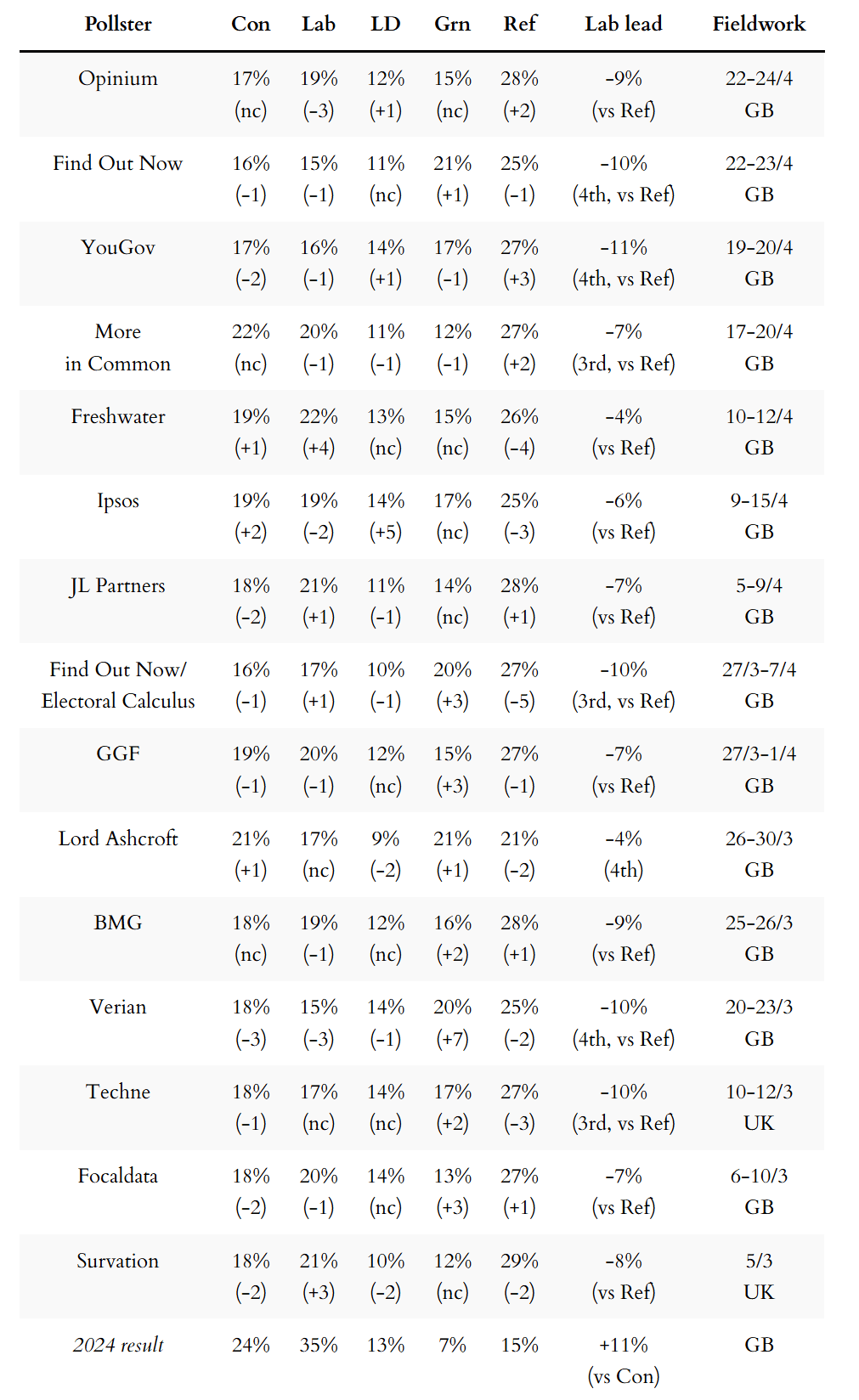 |
The table is also online here, along with explanations about what is included. It is updated regularly through the week with new polls.
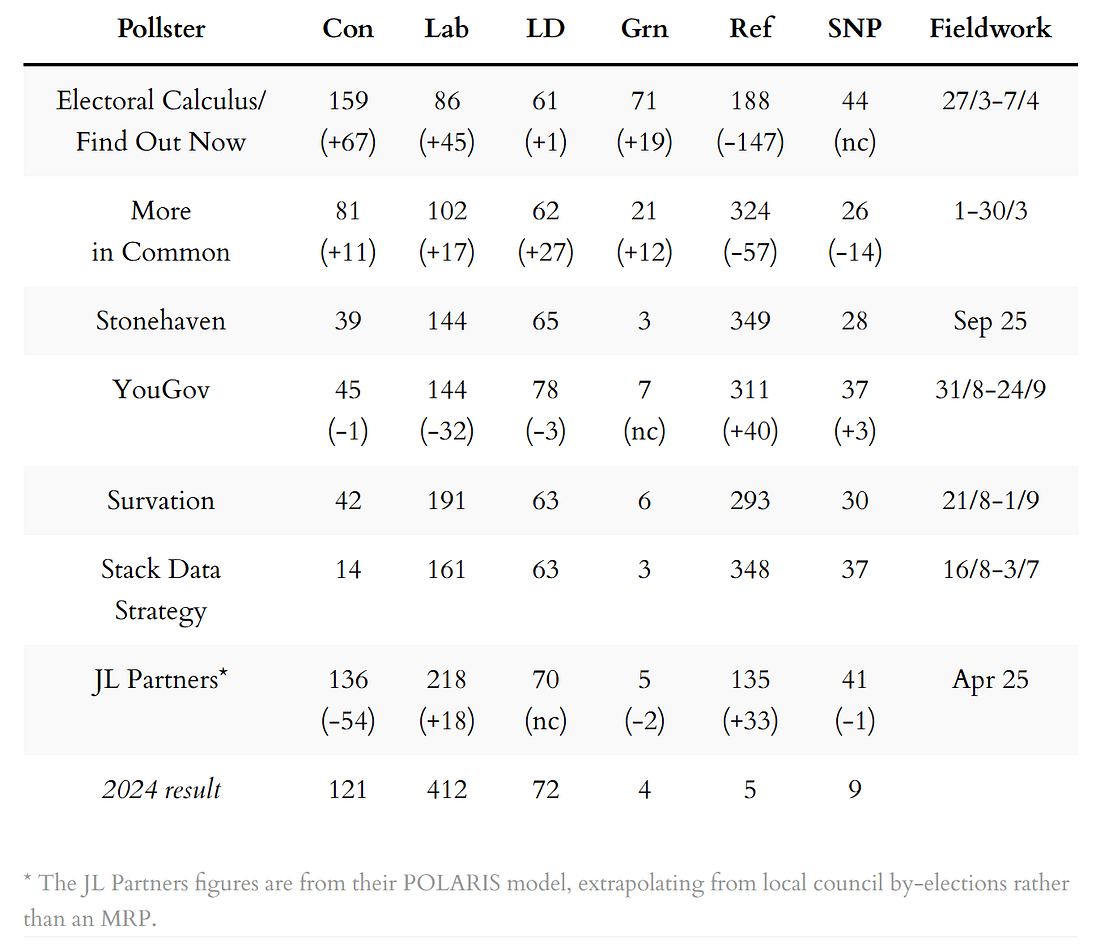
Next, the seat projections from MRPs and similar models, also sorted by fieldwork dates. Note that only two of these are from this year.
 |
Finally, a summary of the latest leadership ratings, sorted by pollster name. YouGov now asks about all five leaders on both their wordings, which is a welcome change.
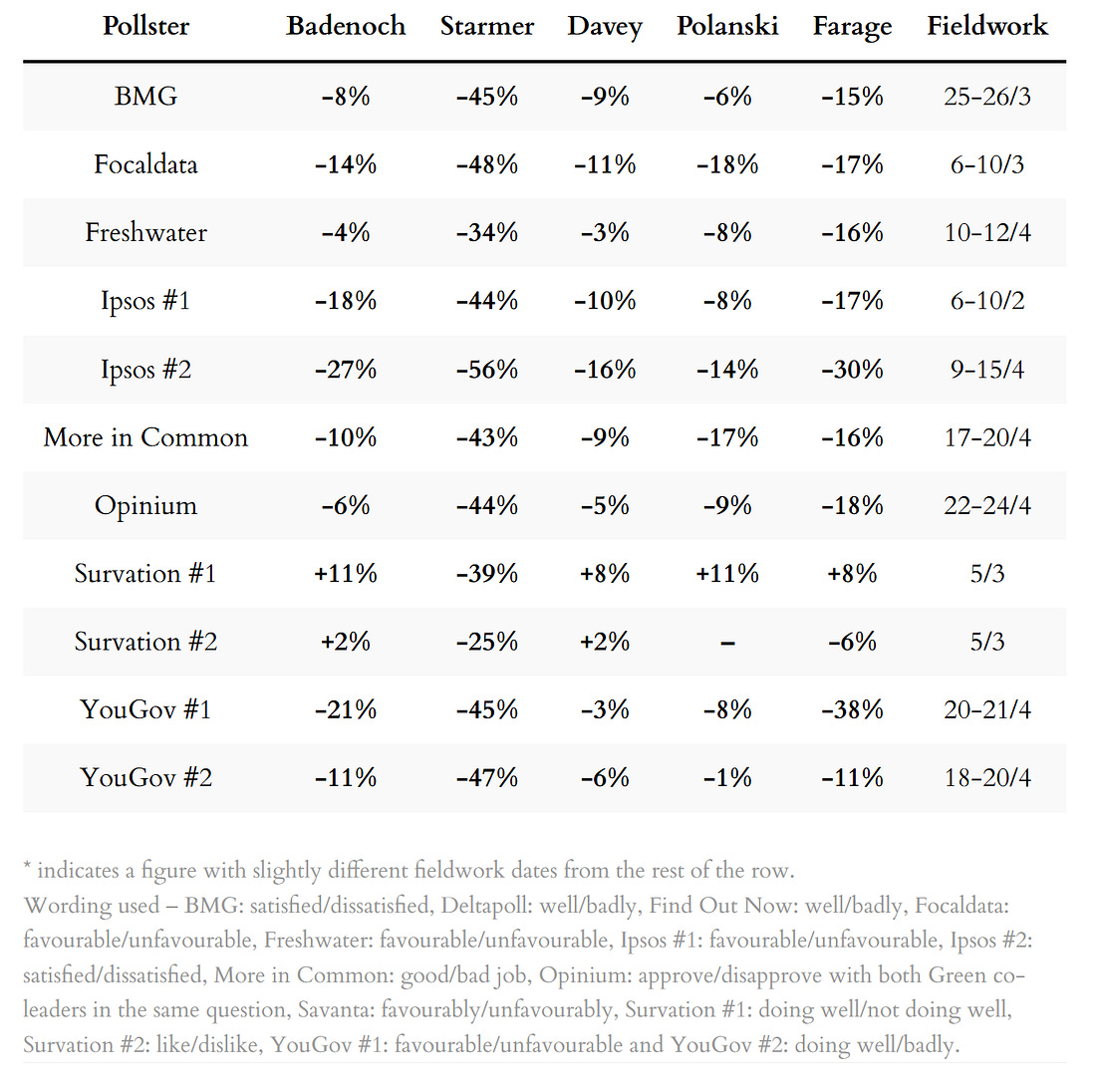 |
The table is also online here with additional details and is updated regularly through the week as new data comes out.
For the historic figures on both voting intention and leader approval, including Parliamentary by-election polls, see PollBase.
Catch up on the previous two editions
 |
|
 |
|
My privacy policy and other legal information are available here. Links to purchase books or other items are usually affiliate links which pay a commission for each sale.
Quotes from social media messages are occasionally lightly edited for punctuation and clarity.
If you are subscribed to other email lists of mine, please note that unsubscribing from this one will not automatically remove you from the others. If you wish to be removed from all my lists, simply reply to this email to let me know.
Economic optimism at a record low, and 9 other polling insights you shouldn’t miss
The following 10 findings from the most recent polls and analysis are only for subscribers who pay for the full edition, but you can sign up for a free trial to read them straight away.
Economic optimism has fallen to the lowest level recorded by Ipsos in its 48 years of polling this measure: “This current net figure of -72 is four points below the...

Continue reading this post for free in the Substack app
| ||||||||||

