|


Welcome to the 221st edition of The Week in Polls (TWIP), a polling newsletter that always welcomes new readers. So please don’t keep TWIP a secret; share it with your friends and colleagues:
This time, let’s see if the polls can help us make sense of what the political significance is of an anthropomorphised bin that passes as an alien and changed its name after a US legal threat.¹
This is followed by a summary of the latest national voting intention polls, seat projections from MRPs and the most recent party leader ratings.
Subscribers who pay for the full edition can also read ten insights from the latest polls and analyses, including:
Who do people view as sleazy?
Has the data started changing over concerns about immigration?
How Rachel Reeves scores only one point worse with Labour members than Ed Miliband
If you are not yet a paid subscriber, you can read all ten by starting a free trial now:
For more polling news as it comes in ahead of next week’s edition, you can also follow The Week in Polls on Bluesky.
One preliminary little bit of news to highlight to you: there’s a new polling aggregator in town, from Calum Weir. It includes some tempting features to look at accumulated crosstab information from multiple polls.
In addition, the latest quarterly update to my polling database, Pollbase, is now out. As well as containing data from the latest quarter that has just gone by it also includes:
Backfilled Stonehaven MRP data for this Parliament, with thanks to Luke Betham for the missing data.
Additional Gallup data from the 1951 Parliament from the Bodleian Library’s set of Gallup/BIPO reports in the Conservative Central Office archives. Thank you to Marcus Collins for sharing his copies of this data with me.
Grab the new and old data here.
And with that, on with the show.
Nigel Farage, Count Binface and the opinion polls
Binface vs Farage
Ipsos have given us the evidence-based bar chart we all wanted:
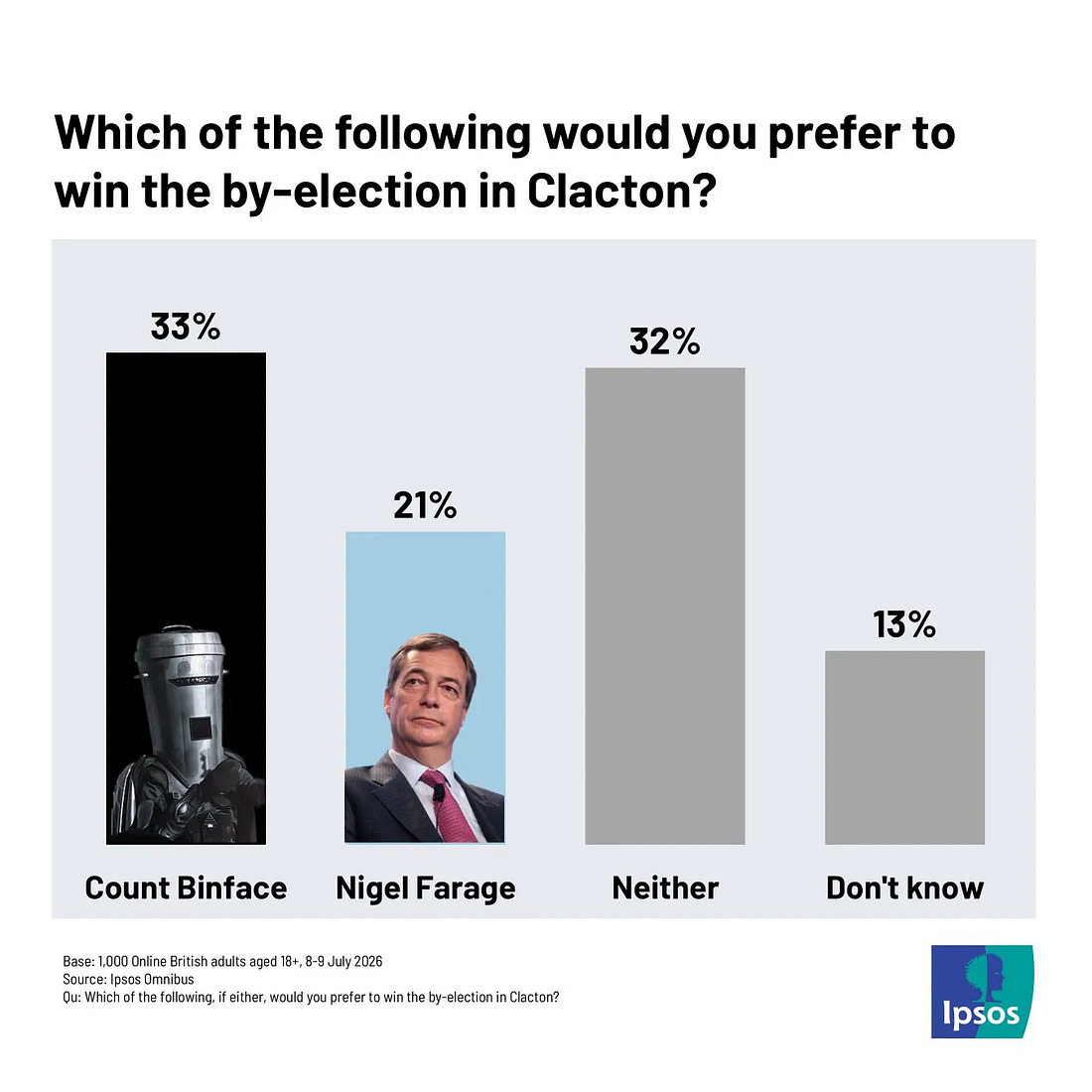 |
This polling result builds on Binface’s previous decent polling figures compared with political leaders. Of course, some important caveats apply beyond this only being the one poll. One is that it is a poll of Britain, not Clacton. Another is that it does not follow the usual Ipsos methodology for voting intention polls, including that this poll only surveys those up to the age of 75, while the usual Ipsos voting intention polls do not have an upper age limit on their sample. Nor is there the usual turnout modelling, squeezing of don’t knows etc. Ipsos also appear not to have got into past vote recall for previous Count Binface supporters.²
But we do have the crosstabs, which show a big variation between those who say they voted Remain and those who voted Leave in 2016. Among Remainers, Binface’s lead extends to 46%-10% while among Leavers he slips behind (18%-46%).
It is perhaps notable that under half, 46%, of Leave voters say they prefer to see Nigel Farage win, with 27% picking neither and 9% picking don’t know. Leave voters are also split in their support for Nigel Farage when asked by Opinium whether or not they find his defence of his actions convincing - they split 39%-31% against him, though those figures are more favourable than the 73%-13% split among Remainers.
What people think of Farage’s actions
Ipsos also finds that:
16% think Nigel Farage is right to resign as an MP and stand for re-election to Parliament in the resulting by-election. 16% think he should have continued as an MP. 54% think he should resign and leave Parliament.
74% state the Standards Commissioner should be investigating whether Nigel Farage broke rules by failing to declare a £5 million gift received from a Reform UK donor before his election.
73% of the public believe the investigation should continue even if Farage wins the upcoming by-election, compared to 15% who think it should not continue in these circumstances.
32% think other main political parties should not stand candidates in the Clacton by-election, whereas 31% believe they should stand.
However, on that last point, YouGov paint a different picture. Asking the different question of whether “the other major political parties are right or wrong to boycott the Clacton by‑election triggered by Nigel Farage?”, YouGov has people picking right over wrong by 37%-25%.
A 12-point lead worded one way (YouGov) or a mere 1-point lead worded the other way (Ipsos) suggests that public opinion is open to persuasion still on this point.
Opinium meanwhile highlight a cynical realism among people with leads for both the view that Farage was right to call the by-election and that he’s doing it for his own ends:
While more people think Farage was right to call a by-election (44%) than wrong (31%), the public remains sceptical about his motivations. Two in five (42%) believe the move is primarily a political strategy to strengthen his position, while just 19% think it is mainly about allowing voters to judge his actions directly. The polling also shows that majorities find the allegations surrounding financial support unacceptable, are unconvinced by Farage’s defence, and believe Clacton should not re-elect him.
The Conservative swing voters?
The Conservatives finished second in Clacton in 2024 and have previously won the seat. Moreover, the crosstabs in polls such as those above typically show that Reform voters give the most pro-Farage answers, that Labour, Lib Dems and Greens cluster with the most anti-Farage answers and that Conservatives are somewhere between the two.
That suggests a key role for current and former Conservatives in deciding Nigel Farage’s fate. More in Common, however, have a more nuanced segmentation, splitting people into three groups:
The first group is those who already dislike Farage, and they’re hardening in their opposition. Overall, the public has grown more critical since the story first broke: the share saying the £5 million gift reflects badly on Farage has risen from 48 per cent in May to 57 per cent in July…
The second is his base - those who voted for him in 2024, when Reform’s national support was half of what it is today. On this scandal at least, it looks like these voters haven’t moved. Three-quarters of 2024 Reform voters (74 per cent) say it hasn’t hurt their view of him…
Nationally, the group that might worry Farage most beyond his immediate by-election are - the movable middle - voters who might consider Reform but could be put off by scandals like this. This includes many 2024 Conservatives who Reform will need to run up the score with, in a General Election - but half of these voters now say that the Farage scandal has damaged their view of him.
However, at least some YouGov data is less promising for Nigel Farage, even among his base. This pollster has it that, by 60%-12%, people think Reform UK’s leader has not been honest about his financial affairs. That 12% rises to 40%, though only 40%, among 2024 Reform voters. 39% of them say ‘don’t know’, which suggests a greater potential brittleness for Farage’s reputation among his core supporters than in the More in Common data.
Is this all being overhyped?
For those who follow politics closely, this story has grabbed their attention. But what about the wider public?
Opinium asked: “It has recently been reported that Nigel Farage is being investigated by Parliament’s Standards Commissioner over whether he should have declared gifts and other support he received before becoming an MP, including a £5 million gift from businessman Christopher Harborne. Nigel Farage has denied wrongdoing, saying the gifts and support were unrelated to his political activity with Reform UK. How much, if anything, have you heard about this?”
Overall, 78% say they have heard of the story, with 33% picking “heard a lot” and 45% “heard a little”. Only 15% say they have not heard of the story until getting this question. In similar results, YouGov have 17% saying they are not aware of the story about donations made to Nigel Farage.
Returning to the Opinium data, those who say they haven’t heard of it are more likely to be women than men (18% versus 11%, though it’s common for men to be less likely to admit ignorance in such polls) and are more likely to be younger than older people (25% for 18-34s versus 8% for the 65+).
Also of note is how little partisan split there is in answers by voting intention, so this isn’t a case of Reform supporters trying to downplay the issue by saying they’ve heard less of the story than they really have.
Beware the vox pops
Even setting aside the usual risks with vox pops, the Clacton ones seem particularly unhelpful as a guide to what people are actually thinking:


One of the other places Jim and June appeared was in The Sun and another was The Independent.
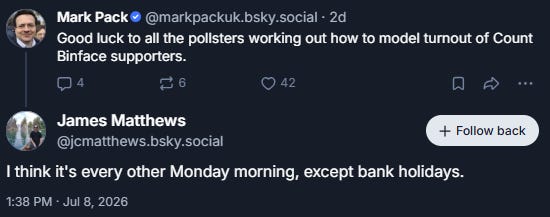
Good luck, pollsters
 |
Summer reading for polling enthusiasts
 |
Polling UnPacked is available from Bookshop.org (independent bookshops), Waterstones, Amazon (including Kindle version) or direct from the publisher.
Elsewhere from me…

If you spot a factual error…
Borrowing an idea from Stuart Ritchie and others, if you spot a factual error in an edition of this newsletter, I will give you a free 12-month subscription to the paid-for version (or an extra 12 months on your existing one). Factual errors qualify; grammatical errors or disagreements over interpretation do not and my decision is final. Messages about both of those are always welcome, though.
Voting intention and leadership ratings
Here are the latest voting intention polls from different pollsters. There has likely been a small continued fall in Reform’s vote share, with more polls than not in the last couple of weeks showing its support down on the previous comparable poll from that pollster. But the latest news about Nigel Farage does not (yet?) look to have altered the picture.
Labour’s bump in the polls may perhaps have come to an end, as its run of consistent such comparable increases in late June has now become a more mixed picture. With the Conservatives also generally up, we’ve seen a small revival of traditional two-party politics, but just a small one, and it’s only the occasional poll that has them both on more than 20%.
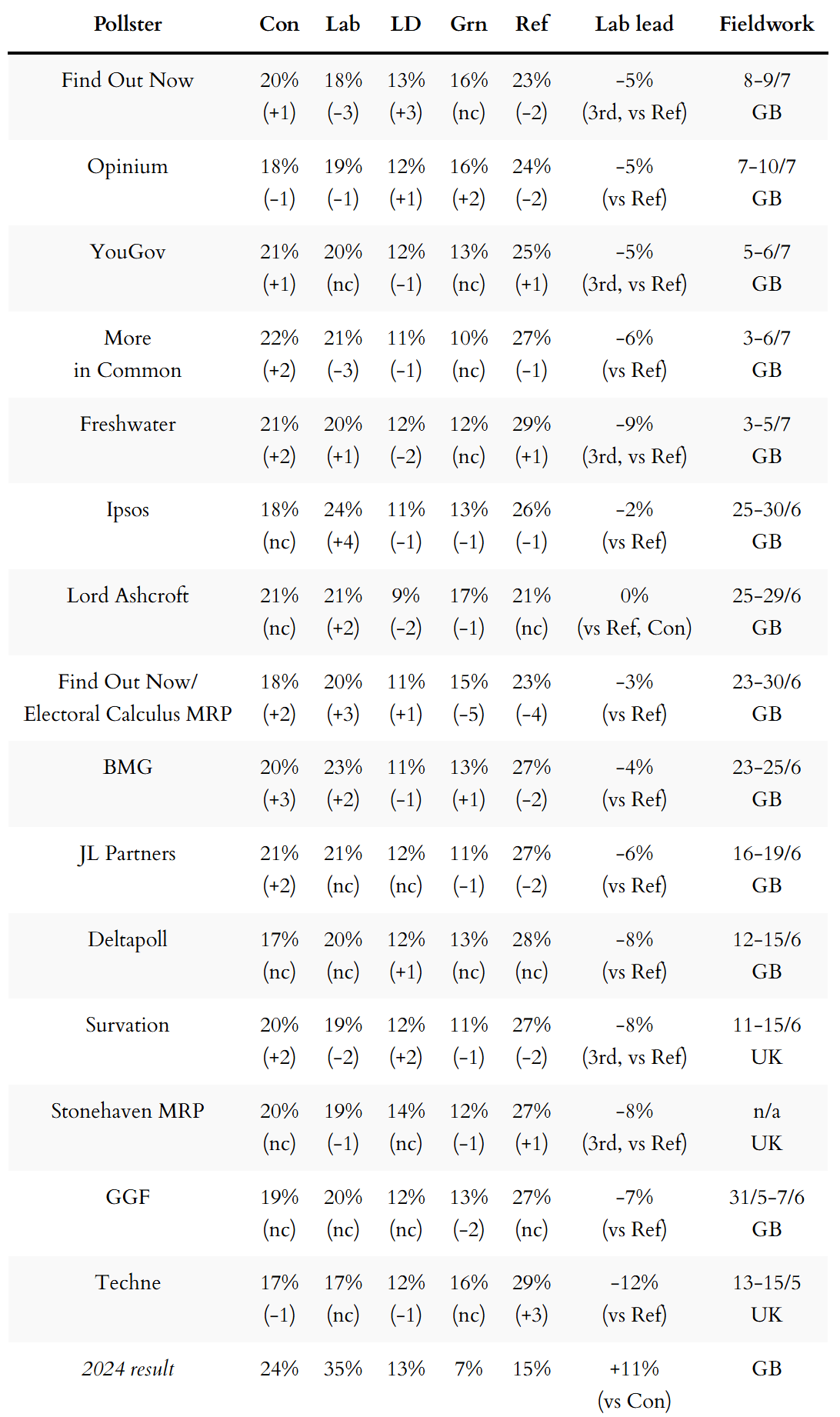 |
The table is also online here, along with explanations about what is included. It is updated regularly throughout the week as new polls are released.
Next are the seat projections from MRPs, also sorted by fieldwork dates. Because they are published infrequently, most of these are somewhat dated. This time there is a new MRP from Electoral Calculus and Find Out Now for PLMR.
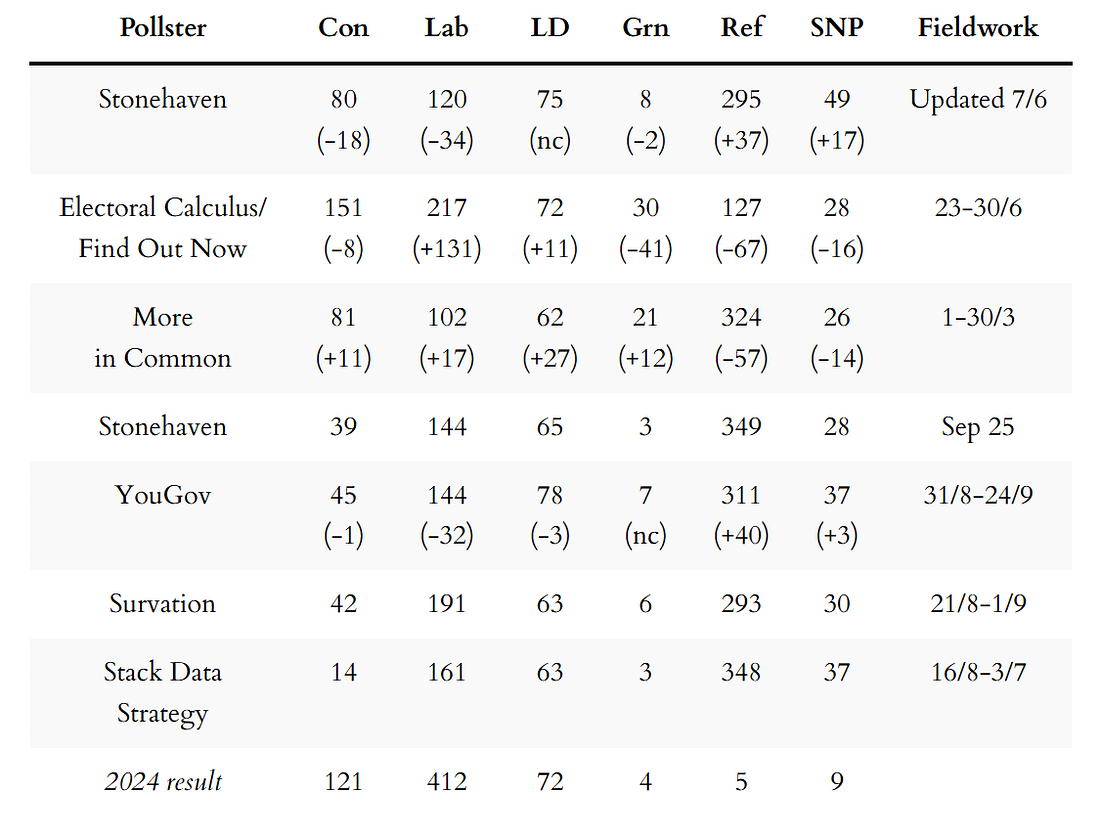 |
Finally, here is a summary of the latest leadership ratings, sorted by pollster name. Once there has been a formal change of Labour leader, I will swap in the new person for Starmer.
The very latest Opinium poll shows Nigel Farage’s ratings taking a big hit, but the other poll with fieldwork from this month - from More in Common - doesn’t. More data needed.
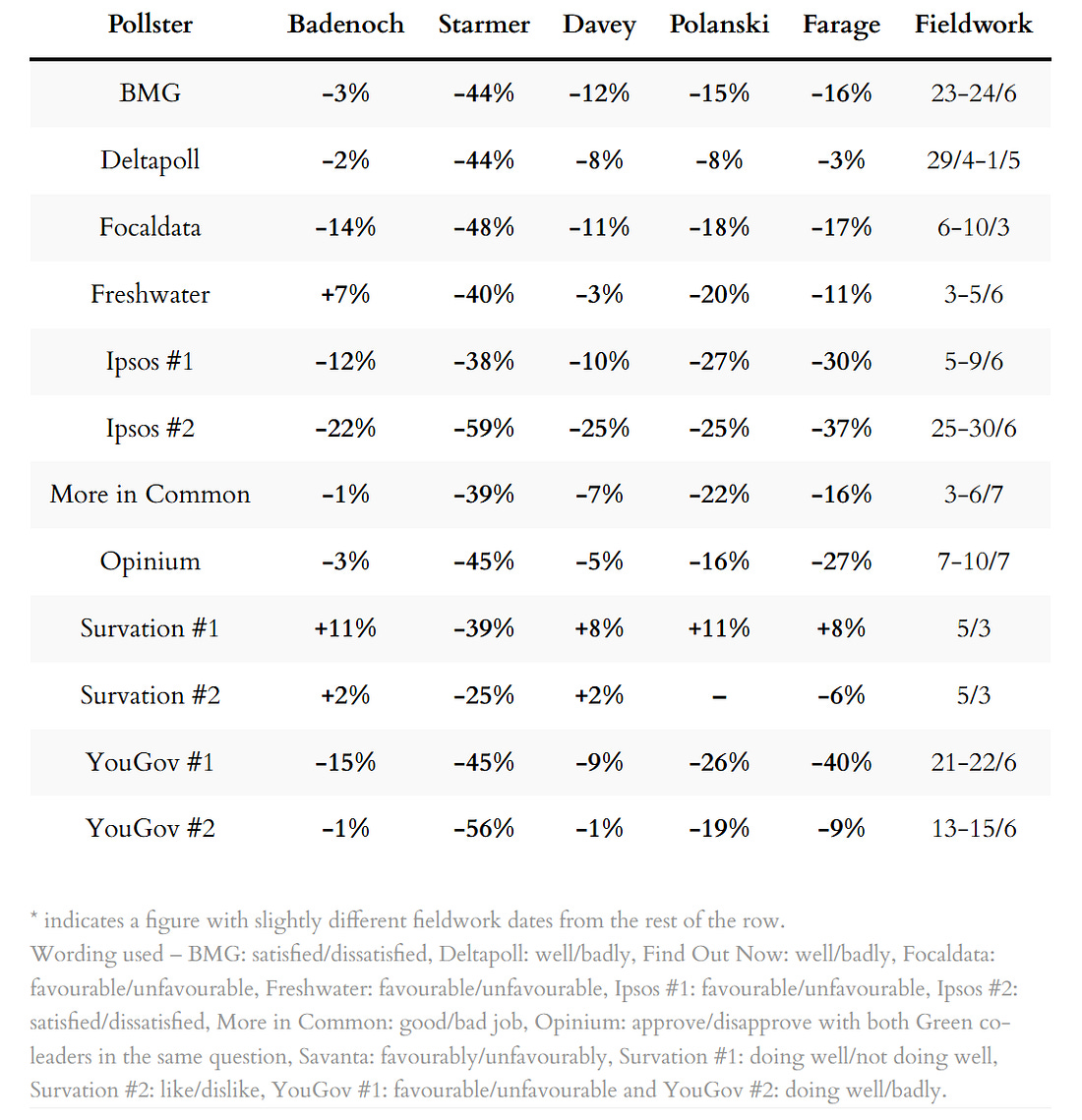 |
The table is also online here with additional details and is updated regularly throughout the week as new data comes out.
For historical figures on both voting intention and leader approval stretching back to the 1930s, including Parliamentary by-election polls, see PollBase.
Catch up on the previous two editions
 |
|

My privacy policy and other legal information are available here. Links to purchase books or other items are usually affiliate links which pay a commission for each sale.
Quotes from social media messages are occasionally lightly edited for punctuation and clarity.
If you are subscribed to other email lists of mine, please note that unsubscribing from this one will not automatically remove you from the others. If you wish to be removed from all my lists, simply reply to this email to let me know.
Which people and parties do people view as sleaziest, and 9 other polling insights you shouldn’t miss
The following 10 findings from the most recent polls and analyses are only for subscribers who pay for the full edition, but you can sign up for a free trial to read them straight away.
There is new data from YouGov on how sleazy people think various leaders and parties are. It’s handily summarised in this graphic:...

Continue reading this post for free in the Substack app
| ||||||||||

