|


Welcome to the 225th edition of The Week in Polls (TWIP), a polling newsletter that always welcomes new readers. So please don’t keep TWIP a secret; share it with your friends and colleagues:
This time, I’m taking a look at new evidence about the accuracy of opinion polls, focusing on the long-running debate over whether polls systematically exaggerate support for parties of the left.
This is followed by summaries of the latest national voting intention polls, seat projections from MRPs and the most recent party leader ratings.
Subscribers who pay for the full edition can also read ten insights from the latest polls and analyses, including:
Which party leaders are getting noticed on social media?
A big fall in Rupert Lowe’s ratings with the public; and
How many, or rather how few, people have been following the Jason Arday story (and if you have been then, like me, you may be puzzled by quite how small the fundraising total was on his original marathon fundraising page).¹
If you are not yet a paid subscriber, you can read all ten by starting a free trial now:
For more polling news as it comes in ahead of next week’s edition, you can also follow The Week in Polls on Bluesky.
Before all that, an update to last week’s edition, in which I wrote:
My eyebrows were raised this week by the Daily Express’s headline, “Andy Burnham dealt huge blow as new bombshell poll reveals who people truly want as PM”. Yet as the story went on to reveal, his ratings in this poll are better than those of any other party leader and better than the initial ratings of Starmer, Johnson and Sunak. (His ratings also beat Liz Truss, although those came later in her premiership.)
Some bombshell.
The paper has now replied to me, standing by its story, arguing, firstly, that an improvement in Kemi Badenoch’s ratings justifies the headline and, secondly, that “headlines should not be read in isolation”.
On the former, it does not bring my eyebrows back down as an improvement in her ratings while Burnham newly entered the ratings in first place is hardly a “huge blow” to Burnham. And who is meant to be revealed as the person “people truly want as PM”? If it’s the person who tops the poll… well, that’s Burnham again.
On the latter, while it’s true that headlines may simplify a story that follows (and mine can do so too, of course), that’s not a justification for having a headline that says the opposite of the story that follows. Indeed, the code from the relevant press regulator (IPSO) warns against “headlines not supported by the text.” Such a response therefore doesn’t give reassurance about how seriously the newspaper takes the code.
So let’s see what IPSO make of my follow-up complaint to them.
One other preliminary piece of news. Due to the disproportionate interest politicos in the UK take in the details of UK politics (myself included),² I suspect the big polling miss in the Michigan Democratic primary will have been noticed by a fair few readers. So this explanation from G. Elliott Morris is worth quoting:
Michigan’s primary polls missed by 12 points on Tuesday night. That is, in fact, better than the typical primary poll. The pre-election average had Abdul El-Sayed up about 13, but he barely skated by with just a 1-point win. When Elliott looked at Senate and governor primaries going back to 2014 earlier this year, he found the average poll was off by 13 points on the margin between the top two candidates—and about 20% of the time the candidate trailing in the polls won outright. Evergreen reminder: Polling primaries is hard!
Thankfully there isn’t a strand of political polling in the UK that has as patchy a record as primary polling has in the US. Polls for local government, mayoral and party leadership contests, for example, all have their own challenges, as I’ve covered in previous editions. But in all of them the record of pollsters is rather better. US primaries very much stand out as being the exception in the polling universe.
My usual reminder too: please do hit reply if you’ve spotted a poll, focus group or new piece of poll-based research that you think should be in contention for coverage in a future edition. Thank you!
And with that, on with the show.
Do polls underestimate support for right-wing parties?
Long-time readers will be familiar with my basic approach to political opinion polls:
The evidence is they are pretty accurate (US primaries aside, see above);
Many apparent problems with them are due to how they are reported (hello Daily Express, see above);
The answer to other problems is almost always to have more polls and pay more attention to them; and
The genuine occasional polling disasters are not enough to outweigh all the benefits they bring.
But aside from the occasional dramatic polling miss, there is also a longer-term pattern that causes pollsters concern. In the UK, Martin Boon has been particularly associated with highlighting the problem - which is that over time and across countries, voting intention polls tend to overestimate the left and underestimate the right.
A new working paper on this issue has just been released by Stuart Perrett, Will Jennings, Jonathan Mellon, Christopher Prosser and Christopher Wlezien.
As they summarise it, with my emphasis added:
Pollsters have underestimated support for notable right-wing electoral outcomes, including Donald Trump’s vote share in 2016, 2020, and 2024, the UK Conservative Party in 2015 and 2024, and Leave in the 2016 EU referendum.
Do these outcomes reflect isolated polling failures, or a persistent partisan asymmetry in polling error across democracies?
We provide the first comparative analysis of partisan polling error. Drawing on over 38,500 election-poll-party observations across 32 countries and 372 elections between 1945 and 2025, we use a Bayesian hierarchical modeling framework to estimate latent election-party polling error.
We find that, on average, support for parties on the left is overestimated,while support for parties on the right is underestimated. This pattern is evident across countries, party classifications, and vote intention polling dating to the 1940s.
In their dataset, polls the month before an election on average overstated the left by about 1.4 points. The right tends to be understated, by a slightly smaller amount, while for liberal parties there is almost no persistent bias.
That’s an important finding, though it also prompts the question of how big or small 1.4 points is. In one sense, it is certainly a big number because:
Across elections the average directional bias in the right-left lead is equivalent to approximately 45% of average absolute polling error.
Something that explains nearly half the average error in such voting intention polls is not small.
However, if the polls are close enough for a 1.4-point error to matter, they are close enough anyway to be cautious about who is ahead. Moreover, the 1.4-point average has a lot of variation behind it.
So this is an important finding for helping identify ways that pollsters can improve their performance. Yet it is also a small factor to bear in mind when looking at polls in a very close contest (because there are so many other ways polls can be out too and you can’t rely on a poll to the nearest percentage point or two anyway). So my four basic rules stay intact.
You can read the research in full here.
A murder mystery set in Parliament, written by a pioneering MP
The latest edition of my podcast Political Fictions features a murder mystery set in Parliament, written by the first female Minister of Education, Ellen Wilkinson:
Mark and Cory are joined by Elinor Taylor for our first book! It is Ellen Wilkinson’s The Division Bell Mystery, a political thriller disguised as a golden age detective story.
It is written by one of the country’s first female MPs and is full of convincing and vivid political detail about what it is like being a bag carrier for an important minister.
The plot’s setting is accurate right down to some key architectural detail on which it all hinges.
But is it also a good murder mystery? Find out as they discuss ridiculous murder plots, why politicians should beware of the weekend, and what this novel tells us about class, sex and empire.
You can find The Division Bell Mystery on Goodreads here.
Cory’s email newsletter is Paperback Rioter and Mark has a family of email newsletters.
Subscribe to our newsletter for some additional bonus content and to get alerted whenever a new episode comes out.
Our theme tune is “Monkeys Spinning Monkeys” by Kevin MacLeod (incompetech.com) and licensed under the Creative Commons: By Attribution 4.0 License (creativecommons.org/licenses/by/4.0/).
|
The Division Bell Mystery, with Elinor Taylor Cory Hazlehurst / Mark Pack |

You can also listen to the episode on Apple Podcasts, Spotify, the web, or YouTube.
Elsewhere from me…

If you spot a factual error…
Borrowing an idea from Stuart Ritchie and others, if you spot a factual error in an edition of this newsletter, I will give you a free 12-month subscription to the paid-for version (or an extra 12 months on your existing one). Factual errors qualify but grammatical errors or disagreements over interpretation do not, and my decision is final. Messages about both of those are always welcome, though.
Voting intention and leadership ratings
Here are the latest voting intention polls from different pollsters, confirming that Reform’s lead in the polls has given way to the party generally being in second place.
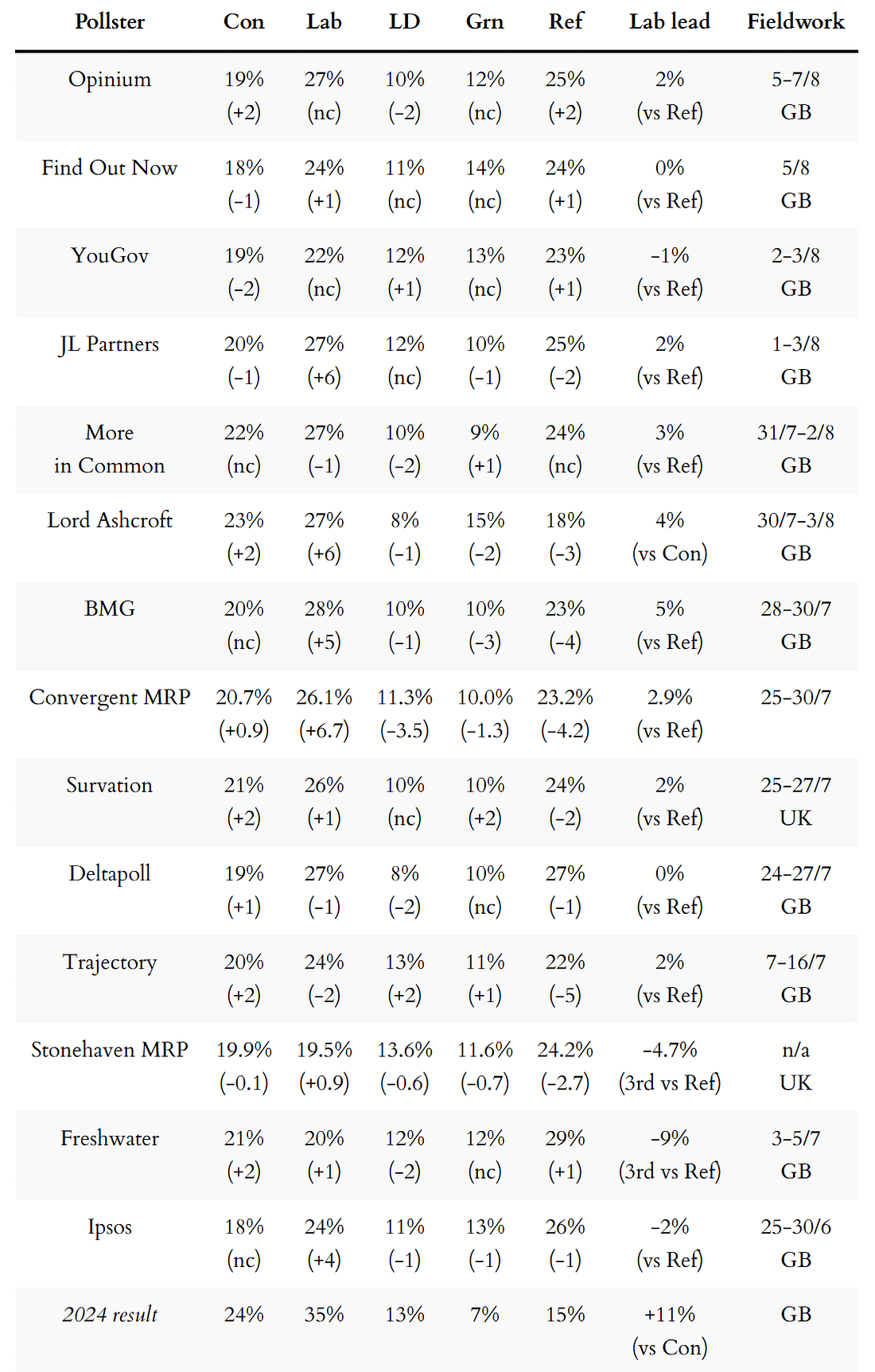 |
The table is also online here, along with explanations about what is included. It is updated regularly throughout the week as new polls are released.
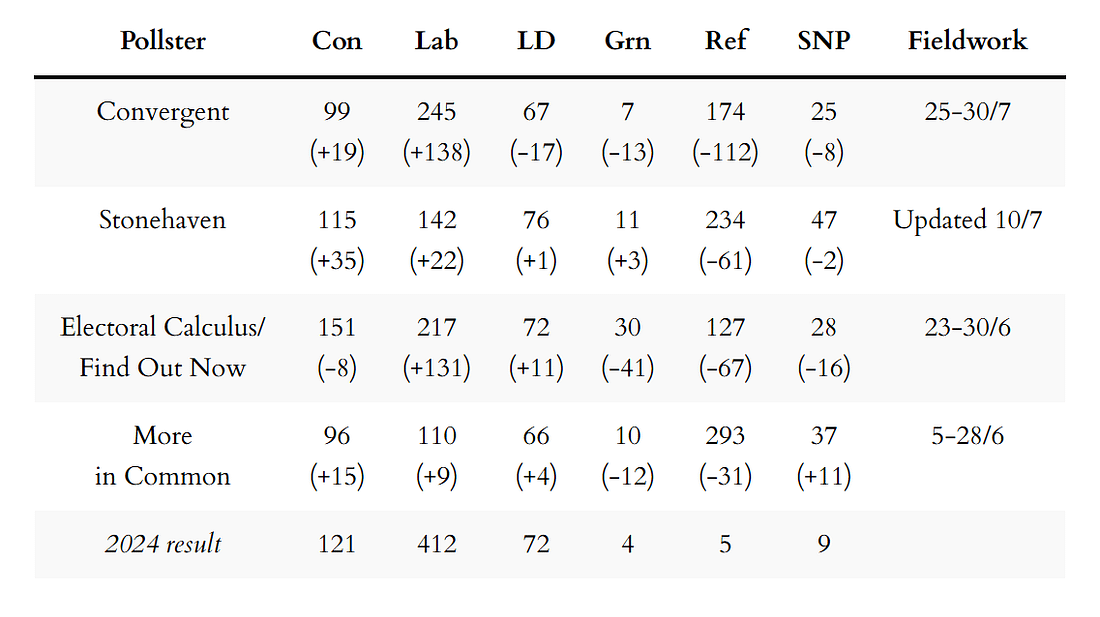
Next are the seat projections from MRPs, also sorted by fieldwork dates. Because they are published infrequently, most of these are somewhat dated, but we do now have the first MRP of Andy Burnham’s premiership. I have also trimmed the list to remove any MRPs from before the start of this year.
 |
Finally, here is a summary of the latest leadership ratings, sorted by pollster name.
The new BMG figures included in the table are Farage’s worst since he took over as Reform leader in 2024, as are those from Ipsos. The More in Common figures are his joint second-worst result (with the worst coming in the More in Common poll a few days earlier). The Opinium figures are his third-worst, with the other two having come in the last month. In other words, the Reform leader’s ratings have or had fallen to their worst level, though there may be some signs now of a small bounce back.
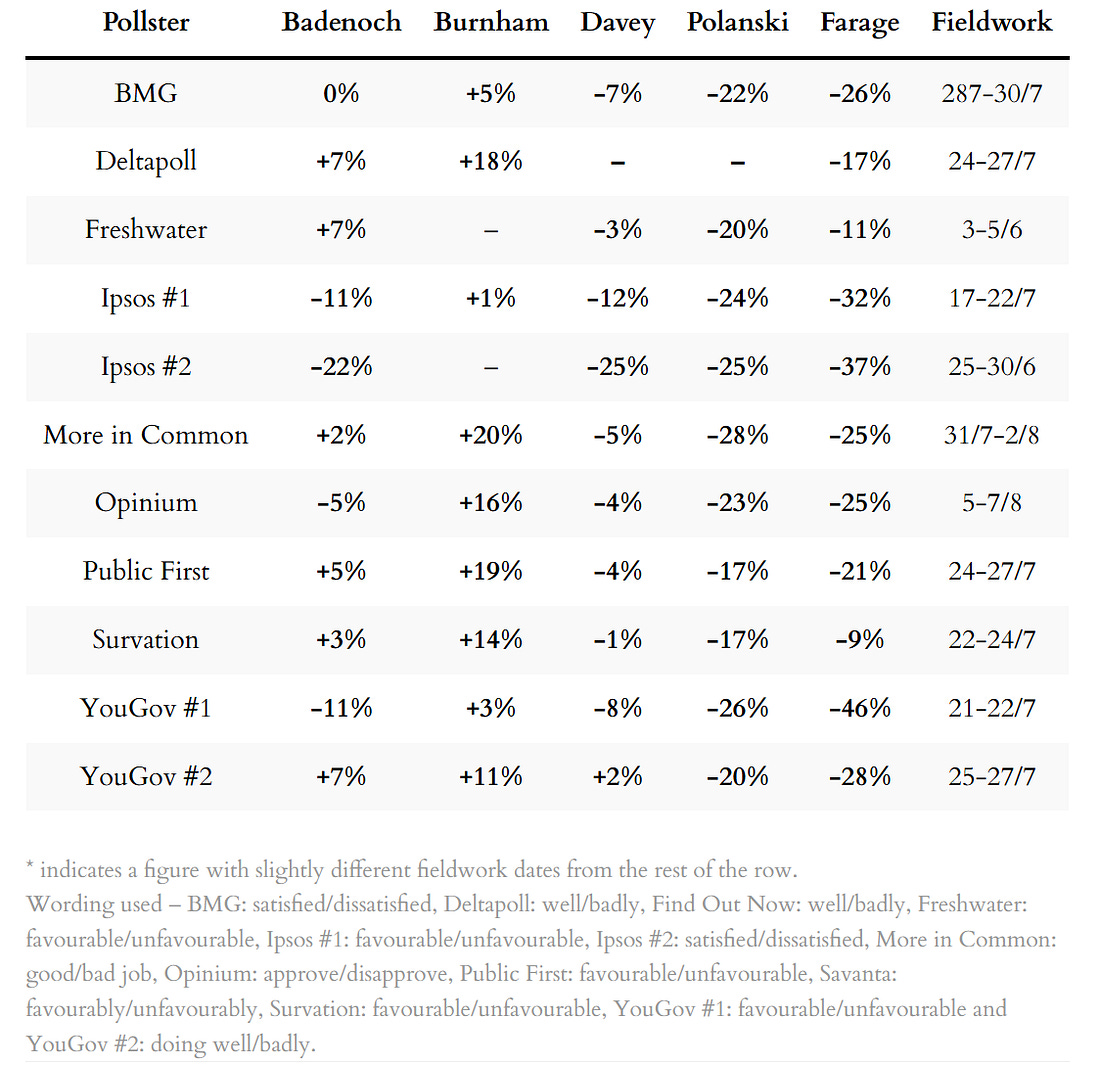 |
The table is also online here with additional details and is updated regularly throughout the week as new data comes out.
For historical figures on both voting intention and leader approval stretching back to the 1930s, including Parliamentary by-election polls, see PollBase.
Count Binface does not feature in any of that, so here is his latest data from Ipsos:
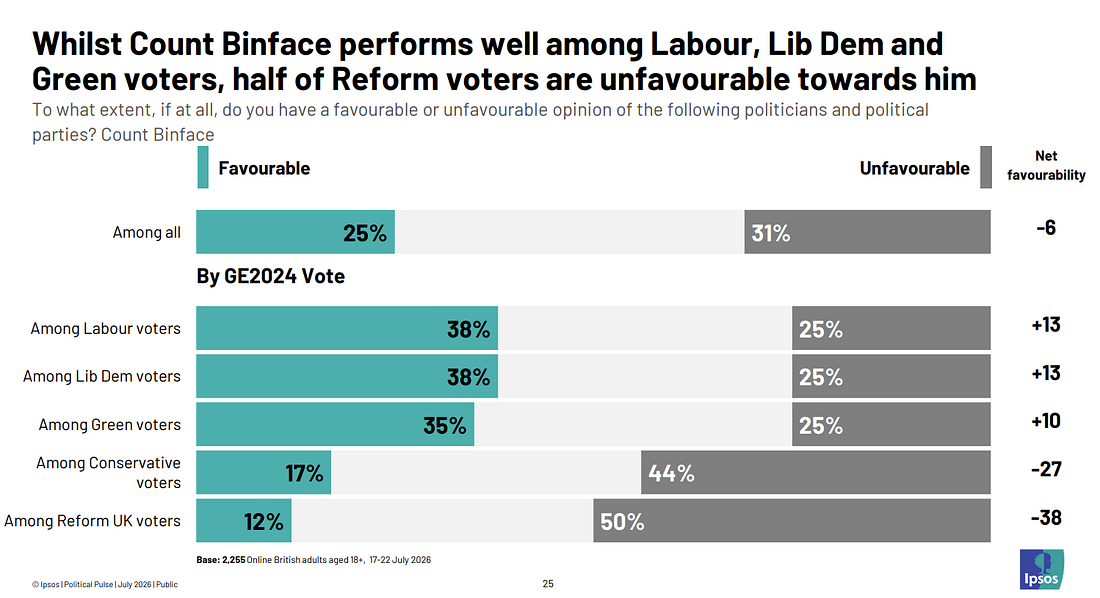 |
Related to this, by 32%-25%, people have a negative rather than a positive opinion of joke or satirical candidates in elections, according to YouGov. Conservative and Reform 2024 voters are the most negative.
Catch up on the previous two editions

 |
|
My privacy policy and other legal information are available here. Links to purchase books or other items are usually affiliate links which pay a commission for each sale.
Quotes from social media messages are occasionally lightly edited for punctuation and clarity.
If you are subscribed to other email lists of mine, please note that unsubscribing from this one will not automatically remove you from the others. If you wish to be removed from all my lists, simply reply to this email to let me know.
Which party leaders are getting noticed on social media?, and 9 other polling insights you shouldn’t miss
The following ten findings from the most recent polls and analyses are only for subscribers who pay for the full edition, but you can sign up for a free trial to read them straight away.
Andy Burnham’s use of social media has been generating plenty of commentary, but are the public noticing? Here’s what new data from More in Common shows:...

Continue reading this post for free in the Substack app
| ||||||||||

