|


Welcome to the 181st edition of The Week in Polls (TWIP), which takes a look at polling about the Lib Dems and whether what worked in 2024 will work again for the party.
This is followed by a summary of the latest national voting intention polls, seat projections from MRPs and the most recent party leader ratings.
Subscribers who pay for the full edition can also read ten insights from the latest polling and analysis. These include:
What Conservative members think of Net Zero;
Why support for ID cards has dropped in the polls; and
The latest polling for the Labour Deputy Leadership.
If you are not yet a paying subscriber, you can read all the answers by starting a free trial now:
This weekend’s raised eyebrows came courtesy of the Daily Record who reported that, “A poll found 67% believe purchasing sexual services should be an offence.” The tables from the pollster show that the figure is actually 43%. As Mark McGeoghegan pointed out, the 67% is only reached by excluding those who said they neither supported nor opposed the idea. The newspaper story only mentioned this after making the wrong claim three times.
More positively, thank you to both Survation and More in Common for their super-speedy replies to my queries this week. Congratulations also to James Breckwoldt, whose work I’ve cited before, on getting his PhD.
Want to know more about political polling? Get my book - Polling UnPacked: the history, uses and abuses of political opinion polling.
What the polls say about the Lib Dems
There is a great new graph from Ben Ansell which is packed with insight into the current state of British politics:
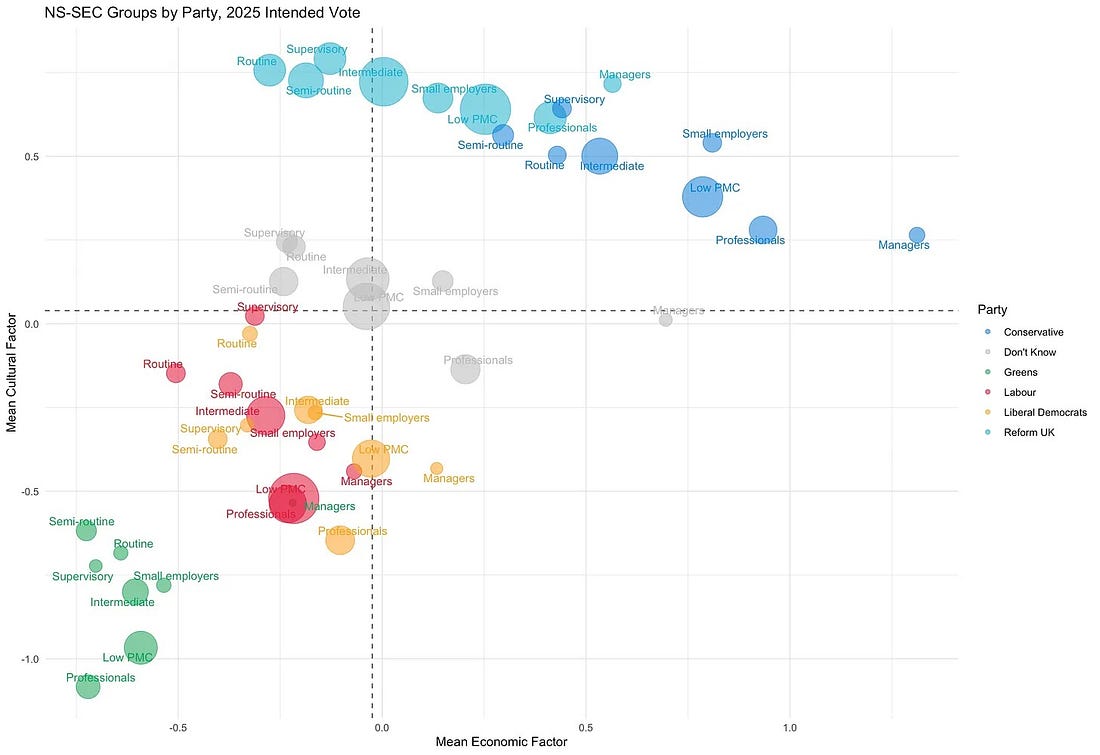 |
His article (which you should go read) is about the varying socio-economic basis for support for different parties, and hence the graph breaking out voters by socio-economic status. The two axes measure the traditional pair of spectrums: one left-right on economic issues (e.g. tax cuts or public spending) and one liberal-authoritarian on social issues.
It clearly illustrates, once again, how appealing the ‘two-bloc’ model of British politics is to understand what is going on. There are Reform and the Conservatives off in one corner, don’t knows in the middle and everyone else in another corner. Note too how both blocs have, as I commented on last week using different data, quite a spread among themselves. Even if you are only trying to succeed within your own bloc, you need to spread out to a range of different voters.
But note too that, broadly speaking, Labour is united on economic issues and divided on cultural issues. While Reform - and the right overall all the more so - is divided on economic issues while united on cultural issues. Which makes the enthusiasm of some Labour strategists to make politics about cultural issues… puzzling.
For the Lib Dems, however, there is another important point: the similarity in the party’s support and that of Labour. As Jim Williams and I wrote last year, using different data that came to the same conclusion:
On the one hand, the limited distinctive nature of our support base is a risk. If tactical voting recedes then many of our voters might seem demographically suited to support Labour at a future election. But on the other hand, it is also an opportunity. The many similarities mean that, particularly if the government hits serious unpopularity, then the sort of voters who become disappointed with Labour will be surprisingly similar to those who voted for the Liberal Democrats in 2024 and elected 72 MPs.
This is, perhaps, the most under-appreciated point about the contemporary nature of Lib Dem support. Because the party’s general election efforts were so focused on winning Parliamentary seats from the Conservatives, people often wrongly assume that meant it was all about appealing to voters who are very different from those who supported Labour. In fact, the sort of voter coalitions that did so well in target seats when there was an unpopular Conservative government are pretty similar to the sort of voter coalitions that the party needs to do well in a new era of an unpopular Labour government.
But what about non-voters? Part of the story of Reform’s rise seems to be an ability to convert non-voters into Reform voters. Although ‘mobilise the non-voters’ is usually a losing political strategy in British politics, the evidence both from polls and local elections is that Reform may be making this work.
However, new research from Jane Green and Marta Miori gives an important twist to this. Non-voters overall do not skew towards Reform. Rather, the proportion of non-voters who rate themselves 5 or higher on a scale of 1-10 indicating their likelihood to vote for that party is - at 32.7% - only a bit higher than the Labour, Green and Lib Dem scores:
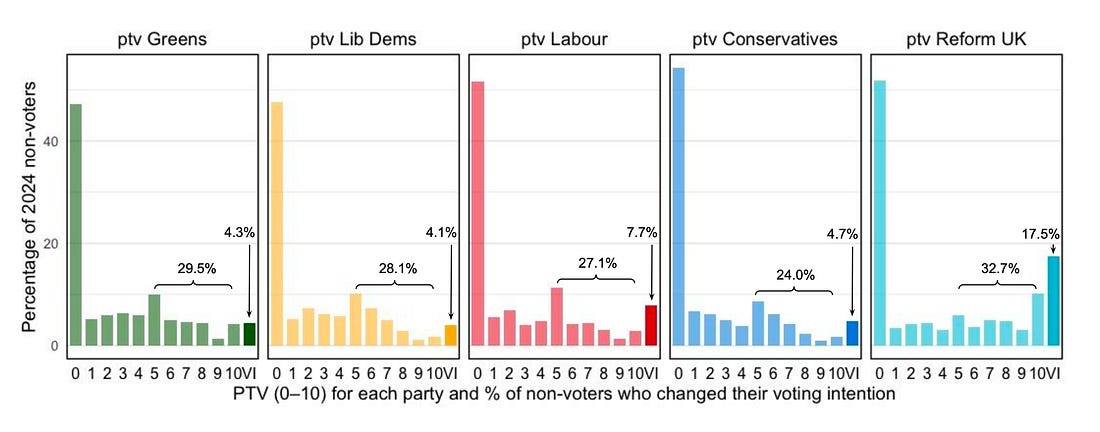 |
Hence it’s not that Reform particularly appeals to non-voters but rather that Reform does much better at converting those non-voters who lean towards it than other parties do at converting the non-voters who lean towards them (and hence the 17.5% bar for Reform standing out).
As Green and Miori put it:
While Reform are currently mobilising recent non-voters, the potential for other parties to do so remains untapped, at least as of 2025. That could change in a future general election where the electoral stakes are seen as very high.
Finally, let’s look at the Lib Dems and stunts, with some data from YouGov:
New YouGov polling examines the barriers which stand in the party’s way by asking more than 1,800 Britons who do not currently intend to vote Lib Dem their reasons for not doing so …
While some have suggested that the Lib Dem leader’s PR stunts are putting the public off, just six respondents from our sample cared enough about them to write them in to our “Something else” box.
If you look at those non-Lib Dems most open to voting for the party (8 or higher on a 1-10 scale), the top two reasons people gave for not voting Lib Dem are “they have no chance of winning an election and forming a government” (38%) and “the Lib Dem candidate in my own constituency has no chance of winning” (33%). Tied back at 18% are reasons to do with not knowing enough about the party or the legacy of the coalition years.
Data from More in Common points to a similar conclusion with slightly different questions and categories, always a reassuring cross-check. (The More in Common data is also more negative about the impact of Ed Davey’s stunts. However, I’m not convinced by the questing wording used because people tend to give the ‘virtuous citizen’ answer to questions, such as being more likely to say they will vote than reality delivers. So asking people whether the stunts make the party look “less serious and are inappropriate at a time when there are so many big issues” leads people to give the virtuous answer, about how, of course, politicians should be serious and substantive. But when you look at what happens to both the party’s and Ed Davey’s ratings when the stunts grab media attention, the party’s and his ratings on other metrics have not in fact slipped back in the way you’d expect if that stunt question wording was getting at reality.)
As with the Ben Ansell data, all this points towards future Lib Dem success coming in ways similar to how the party succeeded in 2024, rather than requiring a radical change of approach. In this case, it points to the continuing importance of building local credibility and profile through concentrated grassroots efforts to overcome the ‘you can’t win here’ hurdle. More on that in the pamphlet from last year, What next for the Liberal Democrats?.
Or as Opinium puts it, coming at this from a different angle:
The public perception of the Liberal Democrats [is] as calm, decent, and well-meaning. Polling shows that voters see the party as tolerant (net score of +15), united (+14), and acting in the national interest (+9). Davey’s mild, sometimes jokey persona has reinforced this image. He’s made the party feel approachable and, crucially, unthreatening. In a time when much of British politics is dominated by polarisation and division, there is something quietly appealing about a party that simply seems nice … So it appears his steady hand has helped the Lib Dems carve out a rare position in British politics: “how bad could it be being represented by a Lib Dem?”. In a climate where trust is scarce and electoral volatility is the story of recent years, that is the Liberal Democrats’ most powerful asset.
If you spot a factual error…
Borrowing an idea from Stuart Ritchie and others, if you spot a factual error in an edition of this newsletter, I will give you 12 months free subscription to the paid-for version of this newsletter (or an extra 12 months on your existing one). Factual rather than grammatical errors, and factual errors rather than disagreements over interpretation. Though messages about both of those are always very welcome.
Voting intentions and leadership ratings
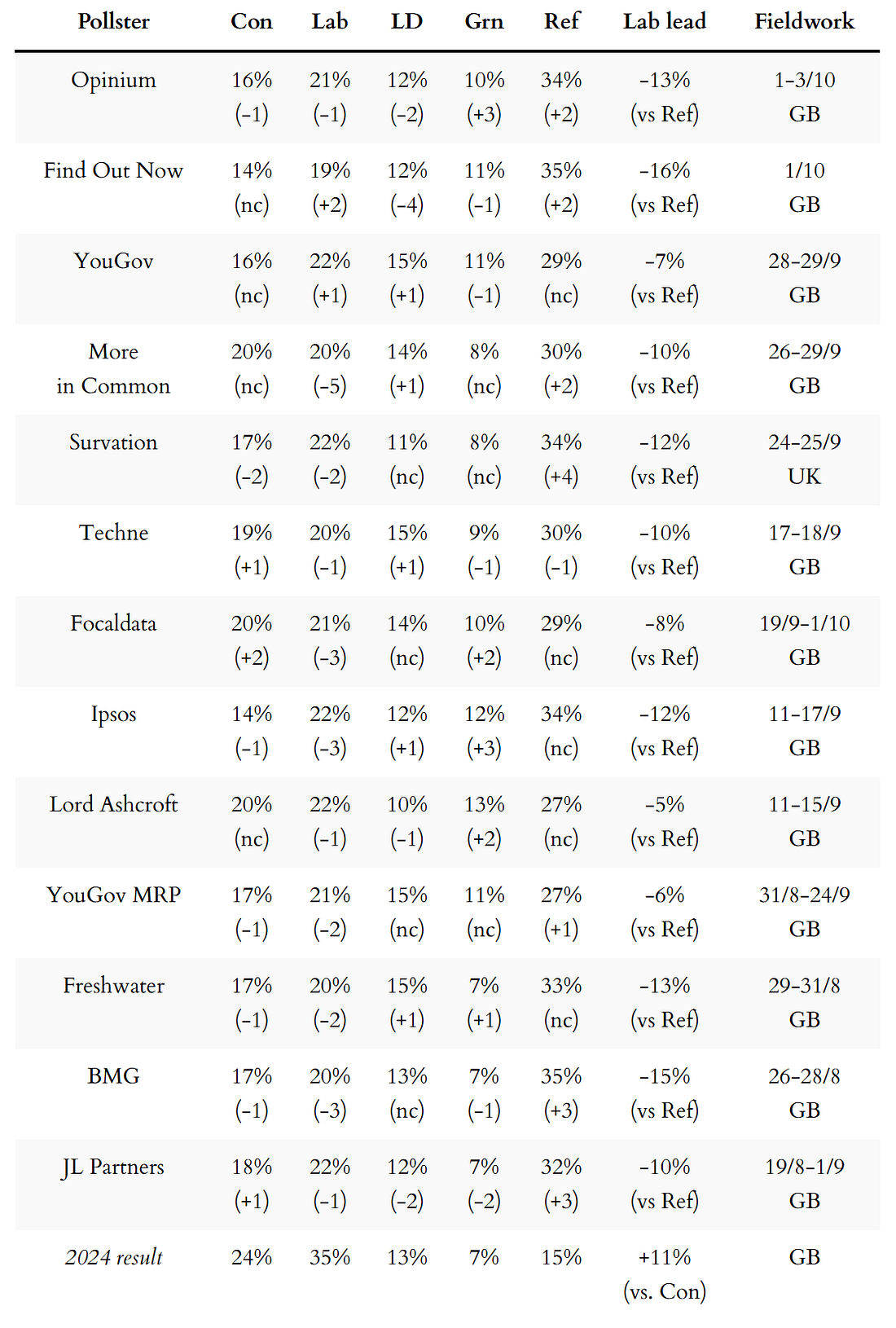
Here are the latest national voting intention figures from each of the pollsters currently active. Having been largely static for a while, there is perhaps a hint of the Reform vote starting to rise slowly through September and the early October polls, while the Conservative vote is even more marooned at under 20%.
 |
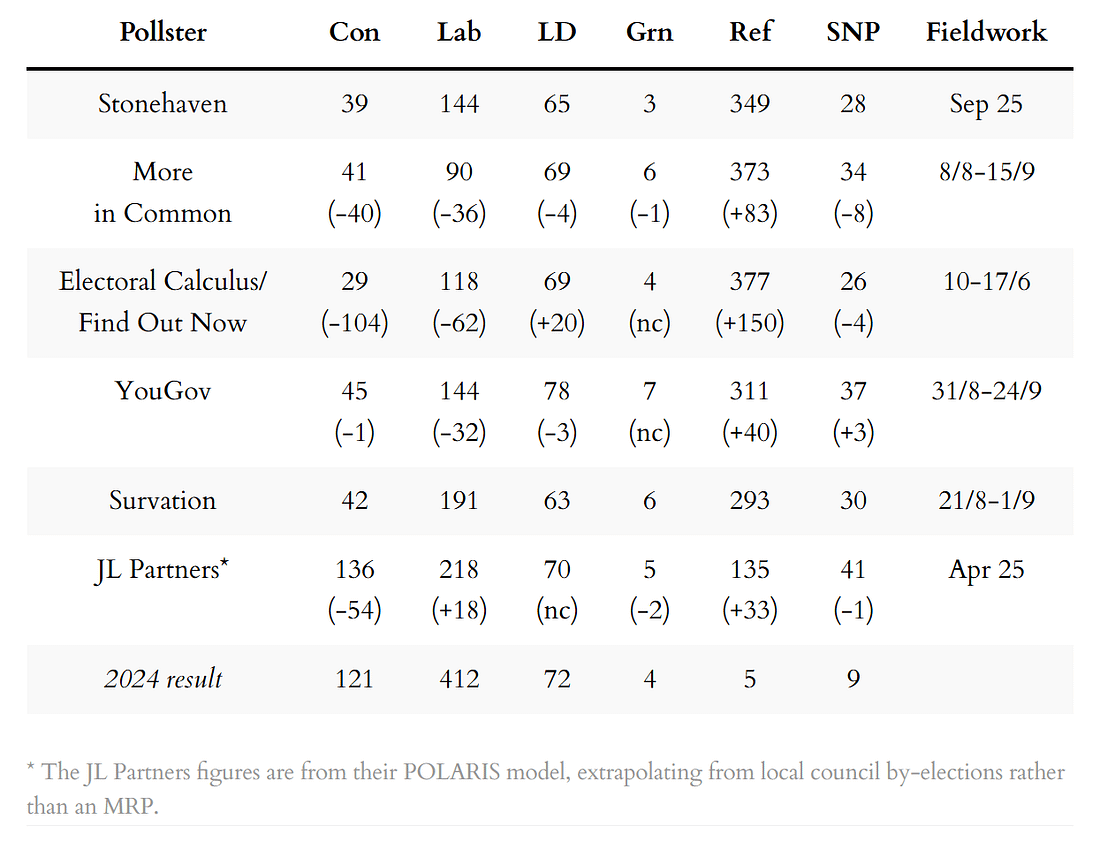
Next, the latest seat projections from MRP models and similar, also sorted by fieldwork dates. As these are infrequent, note how old the ‘latest’ data is.
 |
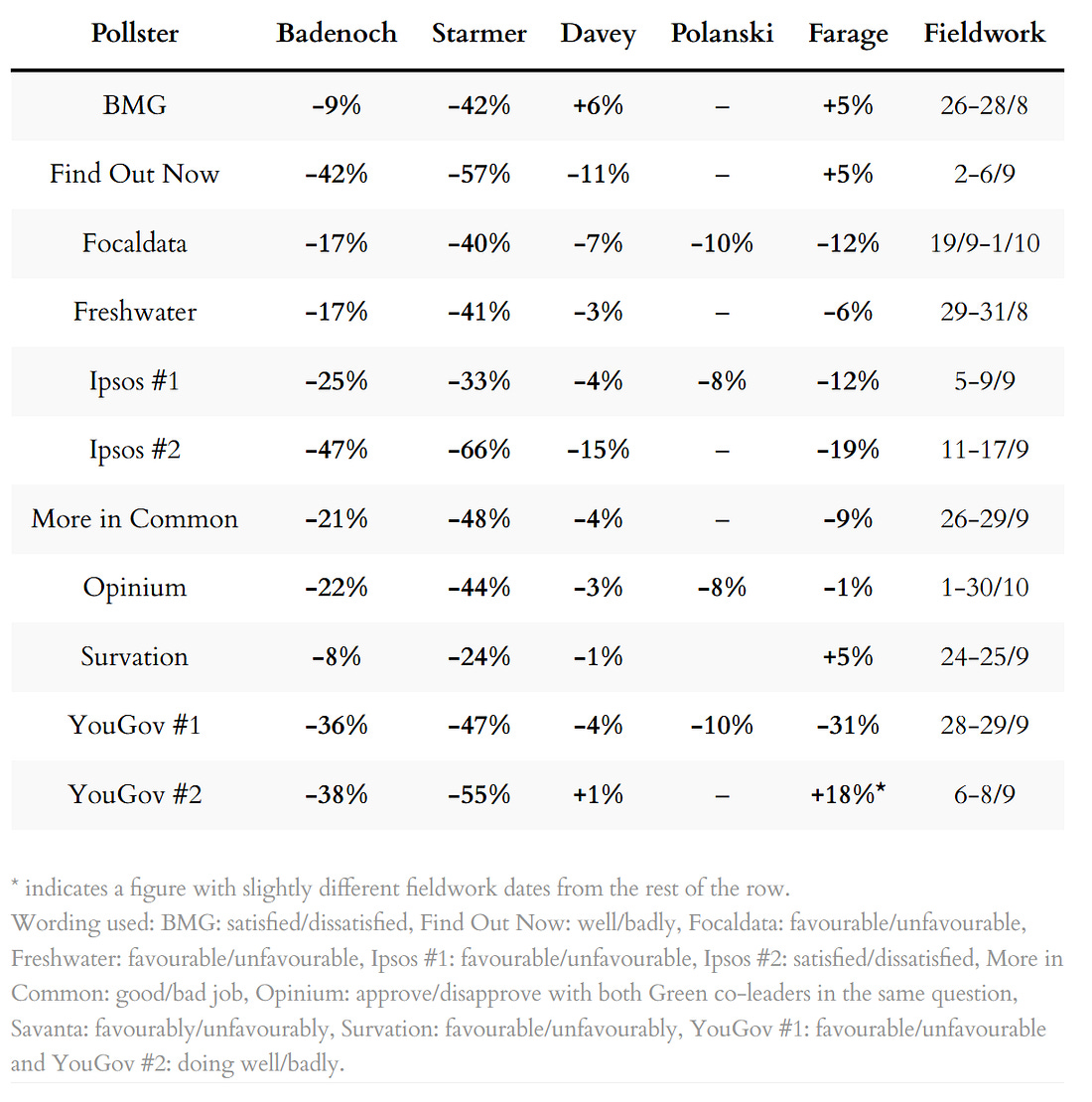
Finally, a summary of the latest leadership ratings, sorted by pollster name and with data for Zack Polanski starting to appear:
 |
For more details, and updates during the week as each new poll comes out, see my regularly updated tables here and follow The Week in Polls on Bluesky.
For the historic figures, including Parliamentary by-election polls, see PollBase.
Catch up on the previous two editions
 |
|

My privacy policy and other legal information are available here. Links to purchase books online are usually affiliate links which pay a commission for each sale.
Quotes from social media messages are occasionally lightly edited for punctuation and clarity.
If you are subscribed to other email lists of mine, please note that unsubscribing from this one won’t automatically remove you from the others. If you wish to be removed from all my lists, simply reply to this email to let me know.
Which party leaders do the public think are most optimistic?, and other polling news
The following 10 findings from the most recent polls and analysis are only for subscribers who pay for the full edition, but you can sign up for a free trial to read them straight away.
Depending on how you measure it, the most optimistic party leader is either ...

Continue reading this post for free in the Substack app
| ||||||||||

