|


Welcome to the 191st edition of The Week in Polls (TWIP), which takes a swerve from my previous piece about how Reform’s vote is slipping in the polls and instead looks to the future: are we seeing a ceiling to Reform’s vote or, if they get out of this current trend, might they go even higher?
That is followed by a summary of the latest national voting intentions polls, seat projections from MRPs, and the most recent party leader ratings.
Subscribers who pay for the full edition can also read a set of ten insights from the latest polling and analysis, including:
Which party leader people most trust;
Attitudes towards cutting the use of juries; and
An uptick in Kemi Badenoch’s approval ratings.
If you are not yet a paid subscriber, you can read all ten by starting a free trial now:
For more polling news as it comes in during the week, you can also follow The Week in Polls on Bluesky.
Before that an update on that misleading story about the views of resident doctors, which appeared in The Times and for which the newspaper has now published a minimalistic correction.
Stand up and applaud this stonewalling by the government in Parliament over its part in the story:
Written question from Lord Pack - To ask His Majesty’s Government whether the recent decision to pass details from a government-commissioned opinion poll of resident doctors by Savanta to The Times newspaper was made by ministers or by civil servants.
Written question from Lord Pack - To ask His Majesty’s Government why the decision was made to pass the results of question 10 of the government-commissioned opinion poll of resident doctors by Savanta to The Times, while withholding the results of question 9.
Baroness Meron - The Government holds contracts with polling companies to conduct research on public opinion. Savanta is a member of the British Polling Council and as such is required to abide by its rules. The results of polling by Savanta of resident doctors are published online and can be found on their website.
I don’t think a government with a good excuse for what happened would feel it necessary to stonewall so blatantly…
And with that, on with the show.
Has Reform hit a ceiling or could its support go higher?
The combination of Jane Green and Marta Miori has been churning out great analysis drawing on the British Election Study. The starting point for their latest piece is that British party political competition is largely a story of two political blocs, a left/liberal one and a right/populist one.
Even in as volatile a general election as that of 2024, we saw relatively little movement between the blocs. Rather, political competition now is much more within each bloc and a relative race to mobilise the supporters of each bloc. For Labour, for example, the data points to their challenges being much more about worrying over losing support to the Lib Dems and Greens, and to don’t know or not voting, rather than to the Conservatives or Reform.
What then of the competition between the Conservatives and Reform within one of those blocs: has Reform’s plateau, even slide, in the polls shown there is a ceiling to their support, or might they go further, cannibalising the Conservative support and making their recent poll ratings look like just a pause in their ascent?
Jane Green and Marta Miori write:
The following graphs use the British Election Study internet panel which follows the same people over time and can also be used in each time point as a cross-section of the British voting eligible population, showing the ‘propensity to vote’ for Reform among three groups. This uses a scale where 0 = very unlikely and 10 = very likely, with those who said ‘don’t know’ removed. The first (left-hand-side) is our comparison group. These are the ‘propensity to vote for Reform’ scores for 2024 Conservatives who eventually did switch to Reform in May 2025. This tells us what these ‘propensity to vote’ scores may indicate, given the caveat that people don’t always know or report what they will do later and much is changing politically in a short period. Around 70% of 2024 Conservatives who later switched to Reform (by May 2025) had reported that they were likely to do so (gave scores between 5-10). However, a smaller but significant proportion of those Conservative to Reform switchers (around 15%) had said they were very unlikely to do so and yet reported a Reform voting intention by May 2025. So this type of data is informative, but can underestimate subsequent switching.
Turning to the middle panel, we focus on 2024 Conservatives who still hold a Conservative vote intention (by May 2025). 37% of those people say they may vote for Reform, and half of the group who moved from Conservative to undecided (16% of 2024 Conservatives) may vote for Reform. Together, we see that the remaining Conservatives currently have a lower likelihood of voting for Reform than last year’s switchers, but still very high likelihoods. If we assume that these 5-10 scores can underestimate switching, the potential for Reform appears to be at least 40% of remaining Conservatives (49% of 2024 Conservative voters), and over half of those who have switched from the Conservatives in 2024 to undecided by May 2025 (16% of 2024 Conservative voters).
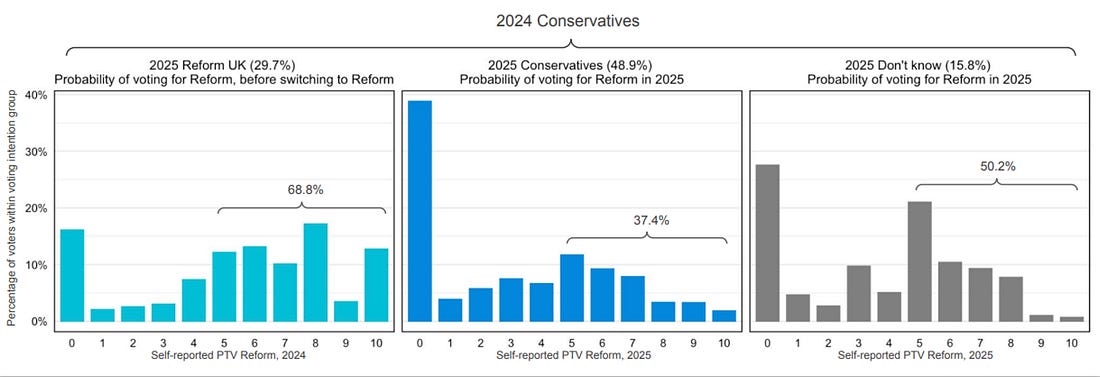 |
Two things are striking about these figures. One is the point buried in the middle of the quote above and so worth repeating:
A smaller but significant proportion of those Conservative to Reform switchers (around 15%) had said they were very unlikely to do so and yet reported a Reform voting intention by May 2025.
As with polling about hypothetical new parties, even polling about existing parties runs into the problem that people are not always that good at predicting their future likely political behaviour.¹
It is why I like to look at data such as views of party leaders or favourability ratings for parties as that gives more of a sense of how likely it is that people might switch to them. (On which see the see the final section of this newsletter and note what Ed Davey’s ratings with Labour supporters might mean for the future.)
The second thing that is striking about these figures is that for all the Conservative Party’s dominance of the modern democratic era in the UK, for all their record of winning two elections out of three since before almost any reader of this newsletter was born,² they are vulnerable to falling even further in the polls.
Though, to give Conservative readers some hope too, such a decline is by no means guaranteed. It is worth bearing in mind how often parties led by Nigel Farage have surged but then fallen away. (And again see the final section of this newsletter to see how changing topic salience may hit Reform’s support.)
Uncertain political times await us in 2026.
 |
Skip the boring socks.³ Instead, this Christmas give the gift of polling insight, crosstab wisdom and raised eyebrows at media coverage with a gift subscription to The Week in Polls.
You can buy a gift subscription here.
Elsewhere from me…

If you spot a factual error…
Borrowing an idea from Stuart Ritchie and others, if you spot a factual error in an edition of this newsletter, I will give you a 12-month free subscription to the paid-for version of this newsletter (or an extra 12 months on your existing one). Factual rather than grammatical errors, and factual errors rather than disagreements over interpretation. Though messages about both of those are always very welcome.
Voting intentions and leadership ratings
Here are the latest national voting intentions figures, and as a sign of Reform’s slippage, it is now 22 polls since they last hit 33% (and their peak earlier in the year was 36%).
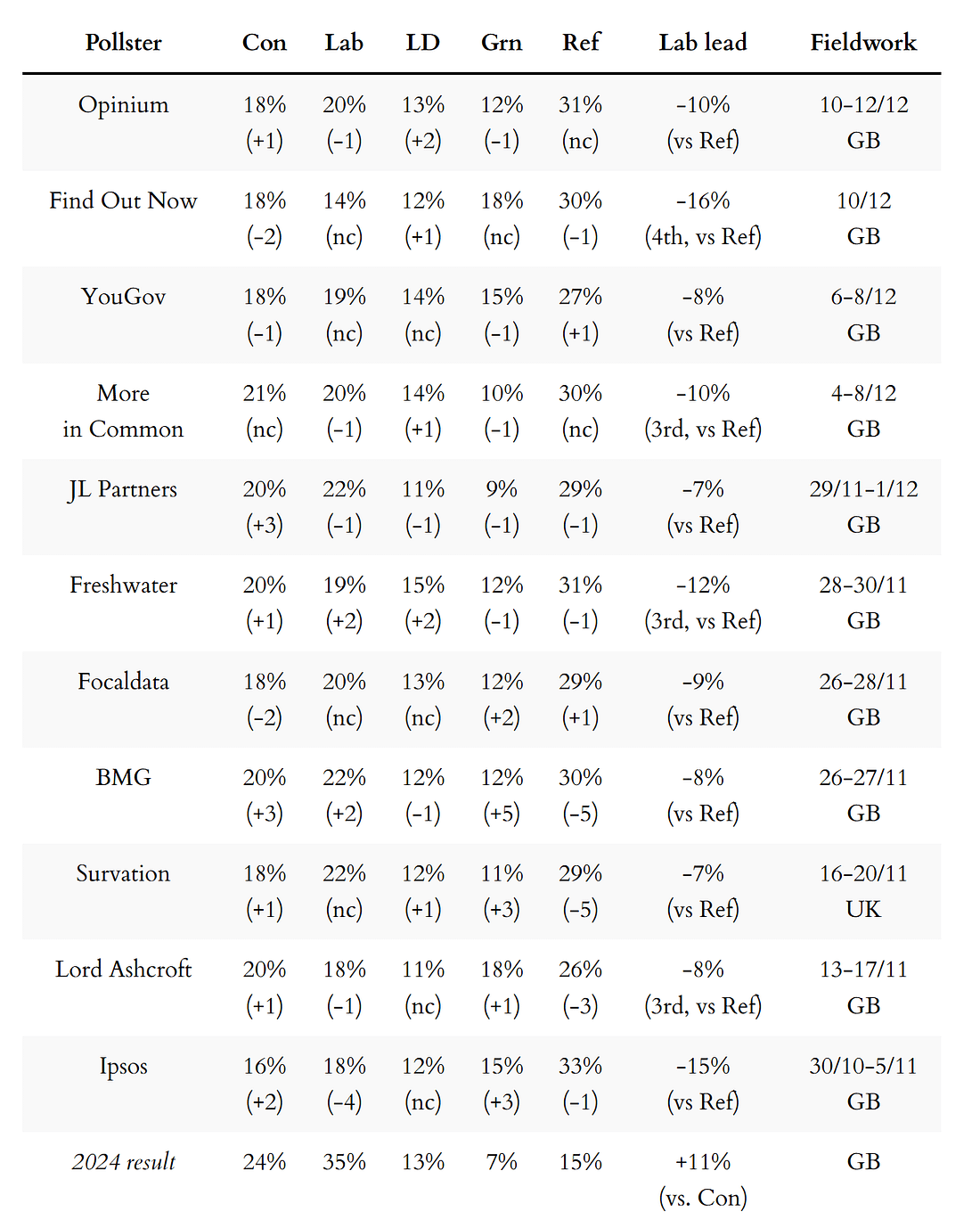 |
The table is also online here and is updated regularly through the week with new polls.
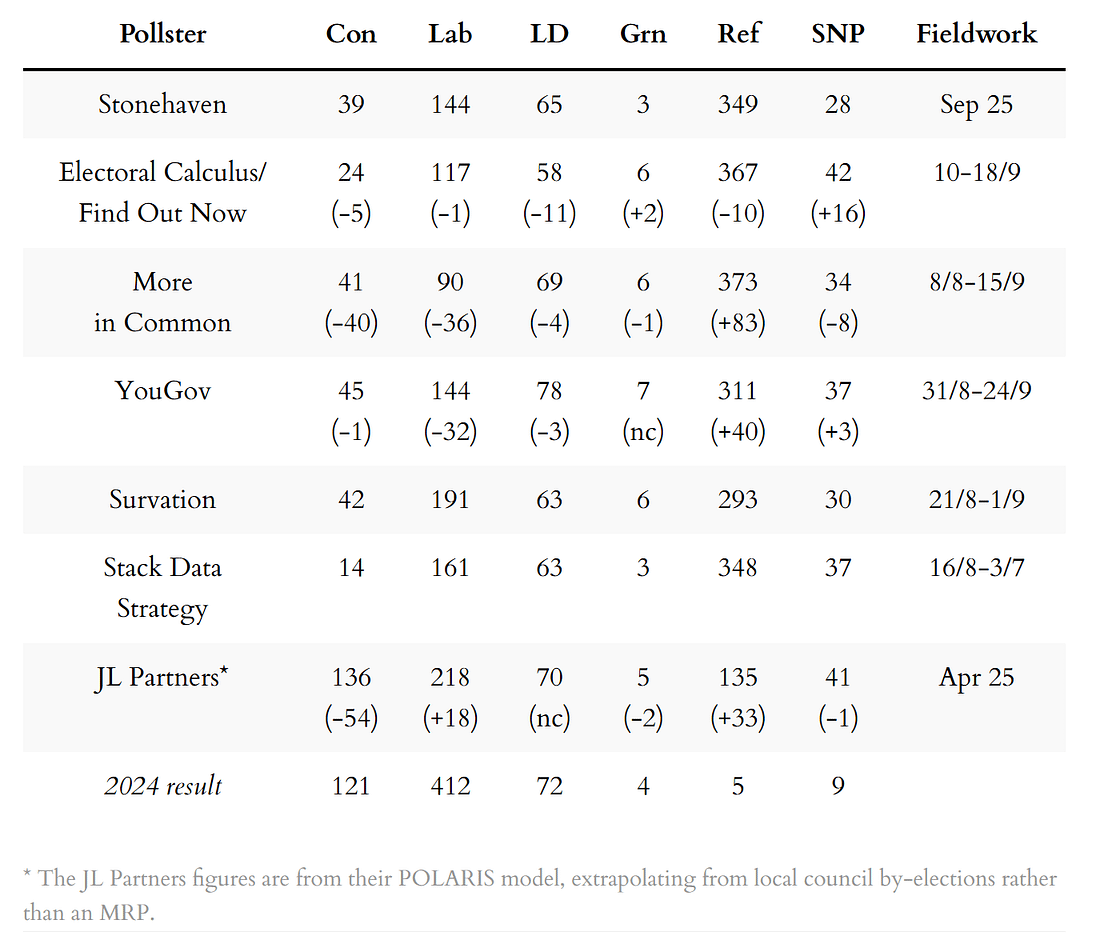
Next, the latest seat projections from MRP models and similar, also sorted by fieldwork dates. As these are infrequent, note how old the ‘latest’ data is.
The one update to the table this week is the full information being added for the Stack Data Strategy MRP over the summer. I have also kept in the JL Partners POLARIS figures as they intend to produce more figures from this model in the future.
 |
Finally, a summary of the latest leadership ratings, sorted by pollster name.
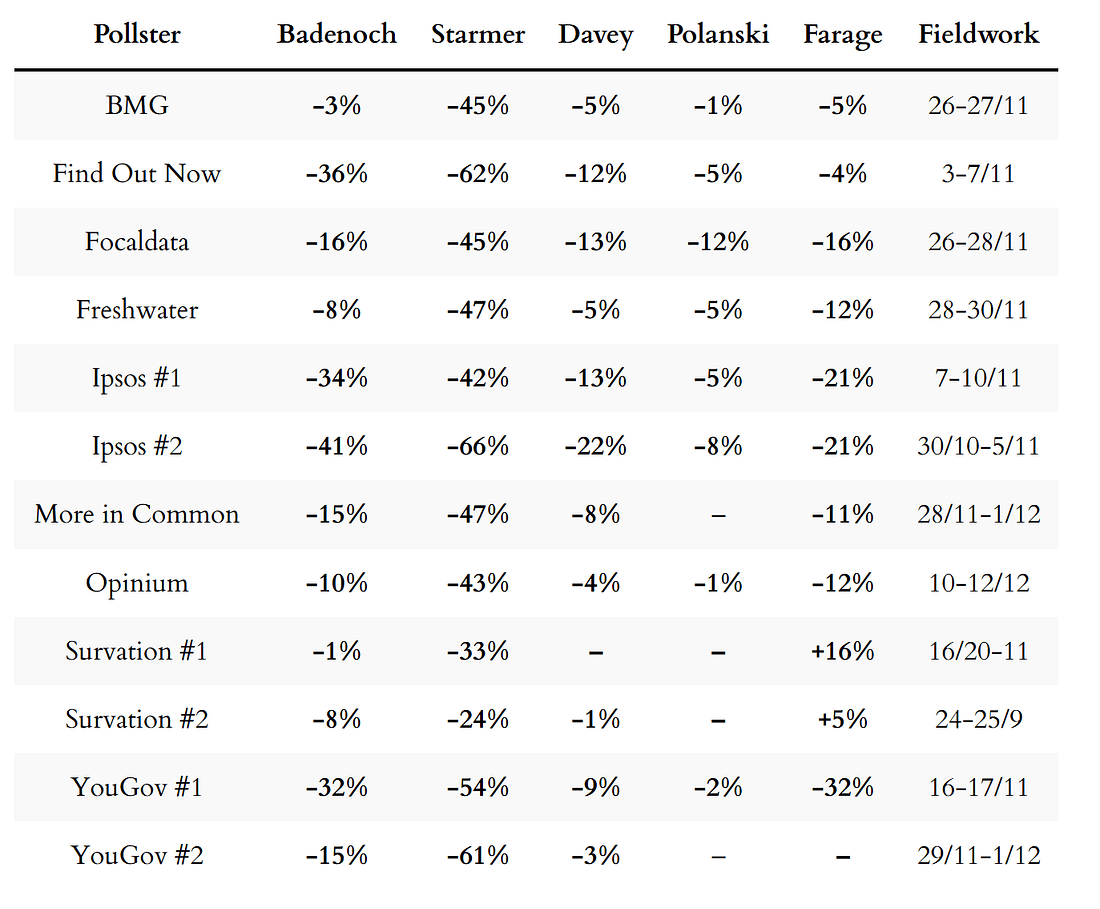 |
The table is also online here with additional details and is updated regularly through the week as new data comes out.
For the historic figures for both voting intentions and leader approval, including Parliamentary by-election polls, see PollBase.
Catch up on the previous two editions
 |
|
|
|
My privacy policy and other legal information are available here. Links to purchase books online are usually affiliate links which pay a commission for each sale.
Quotes from social media messages are occasionally edited lightly for punctuation and clarity.
If you are subscribed to other email lists of mine, please note that unsubscribing from this one won’t automatically remove you from the others. If you wish to be removed from all my lists, simply reply to this email to let me know.
Photo of newspaper by Andrys Stienstra from Pixabay.
The most trusted party leader, and 9 other polling insights you shouldn’t miss
The following 10 findings from the most recent polls and analysis are only for subscribers who pay for the full edition, but you can sign up for a free trial to read them straight away.
YouGov has been asking people, “How much, if at all, do you trust the following?” The list that follows is, rather prosaically, a list of party leaders rather than schools of philosophy. Who comes out on top? Let’s start with Ed Davey’s...

Continue reading this post for free in the Substack app
| ||||||||||

