|


Welcome to the 223rd edition of The Week in Polls (TWIP), a polling newsletter that always welcomes new readers. So please don’t keep TWIP a secret; share it with your friends and colleagues:
This time, I am going for something short and polling adjacent: a graph showing how our turnover in Prime Ministers has varied over time.
This is followed by summaries of the latest national voting intention polls, seat projections from MRPs and the most recent party leader ratings.
Subscribers who pay for the full edition can also read ten insights from the latest polls and analyses, including:
More on Net Zero after last week’s edition: the views of MPs and the problems that Kemi Badenoch may be storing up for the Conservatives;
Dan Neidle dissects a poll about wealth taxes; and
One of the worst polling question wordings I’ve seen in a very long time.
If you are not yet a paid subscriber, you can read all ten by starting a free trial now:
For more polling news as it comes in ahead of next week’s edition, you can also follow The Week in Polls on Bluesky.
You will see that the voting intention table below now includes figures from Trajectory Partnership, a member of the British Polling Council (BPC). A description of their methodology is here.
As sometimes happens, my table and PollBase dataset differ slightly from the figures in Wikipedia. In this case, for the May Trajectory poll (the one before the latest), the numbers in Wikipedia come up several points lower in total than expected due, I think, to an error in the Trajectory data table which gives the unweighted total for ‘all likely to vote’ as 1,170 when it should be 1,075. I have used the latter figure.
And with that, on with the show.
Have we had an unusually large number of Prime Ministers recently?
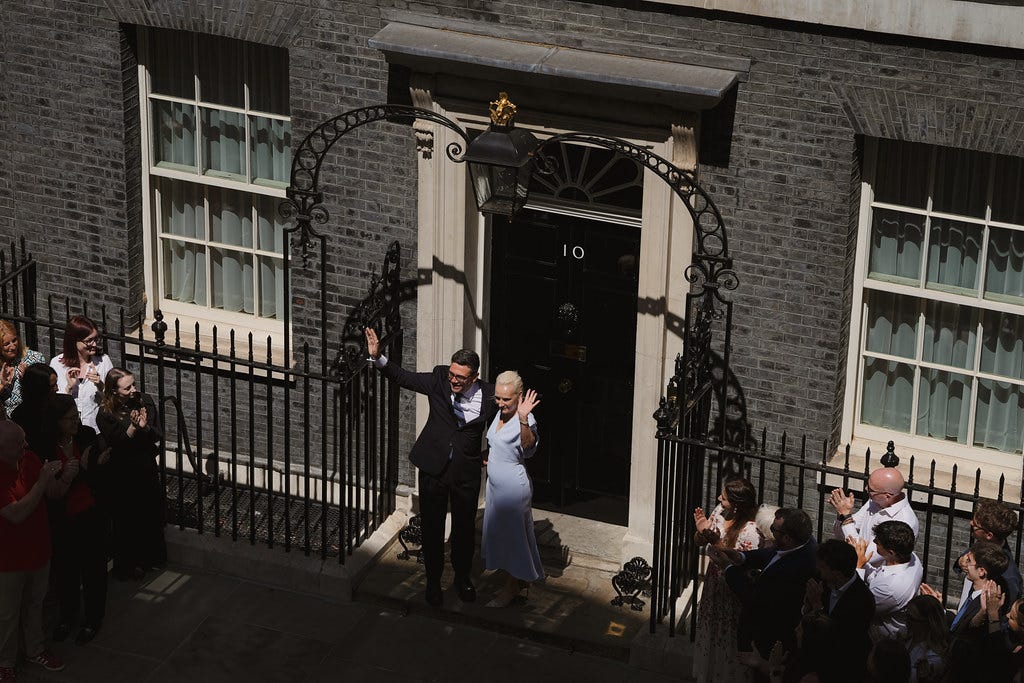 |
It’s become a commonplace comment that we have got through a lot of Prime Ministers recently.
So much so that people as varied as Lord Ashcroft, CNN and the Institute for Government are just a few of those who have recently done pieces on the question of whether the country is now ungovernable.
But is the number of recent Prime Ministers really that unusual? Let’s look at the data:
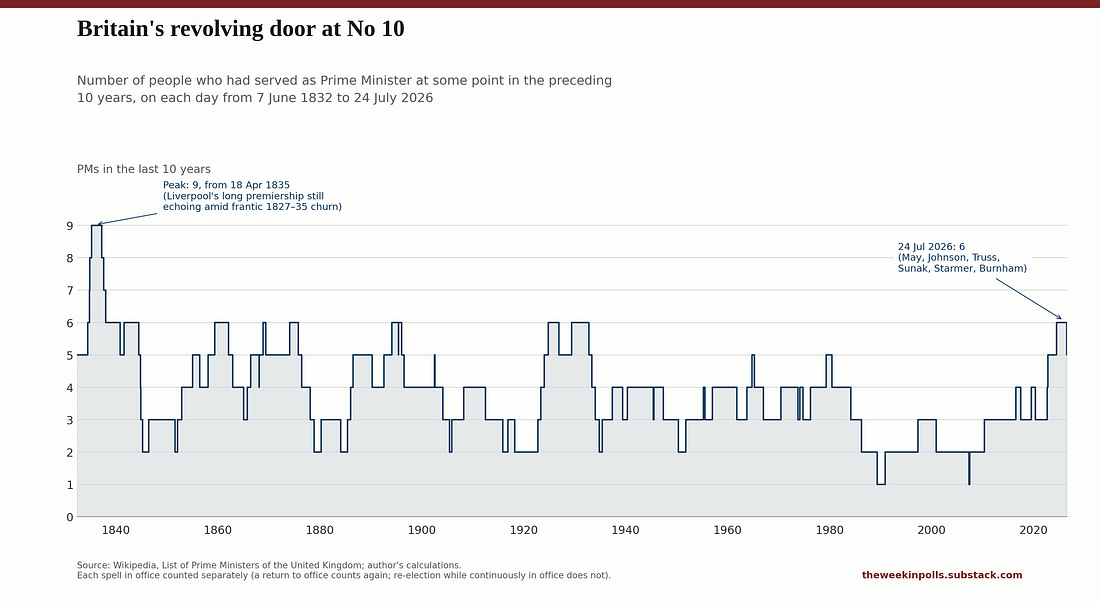 |
Three things strike me about the graph. First, yes, the graph does pick up in recent times.
But, second, the current bump up is not particularly notable in the long historical perspective. (This is another excuse for me to highlight how wild the 1920s were and how little attention they get in current political discourse even though they were a previous period of economic stress, international worries and a traditional two-party system under huge strain.)
Moreover, third, if you want to explain the recent rise in the graph, it’s as important to look at how low the graph was from the mid-1980s for around three decades. If you want to explain why churn is now higher than it was then, part of the story has to be about why it was so low in that three-decade run.
Simply ascribing the current higher churn to recent changes (e.g. rise of social media) can never be the full picture as such factors don’t explain why previously the figures were so low. And certainly beware any pundit who speculates on why we’ve had a higher churn of PMs recently while treating that previous lower churn run as if it was the norm. It wasn’t; it was an outlier in its own way too.
Summer reading for polling enthusiasts
 |
Polling UnPacked is available from Bookshop.org (independent bookshops), Waterstones, Amazon (including Kindle version) or direct from the publisher.
Elsewhere from me…


If you spot a factual error…
Borrowing an idea from Stuart Ritchie and others, if you spot a factual error in an edition of this newsletter, I will give you a free 12-month subscription to the paid-for version (or an extra 12 months on your existing one). Factual errors qualify; grammatical errors or disagreements over interpretation do not and my decision is final. Messages about both of those are always welcome, though.
Voting intention and leadership ratings
Here are the latest voting intention polls from different pollsters and we now have two further polls without Reform in the lead: Deltapoll have a Labour/Reform tie, while newer pollster Trajectory has Labour two points ahead, with these adding to the three-way tie in Lord Ashcroft’s poll. (Trajectory also had Labour ahead back in March while the other recent Survation poll, slightly older than the one in the table, had the parties tied.)
All in all, Reform’s poll lead has not gone yet, but it is getting very close to going.
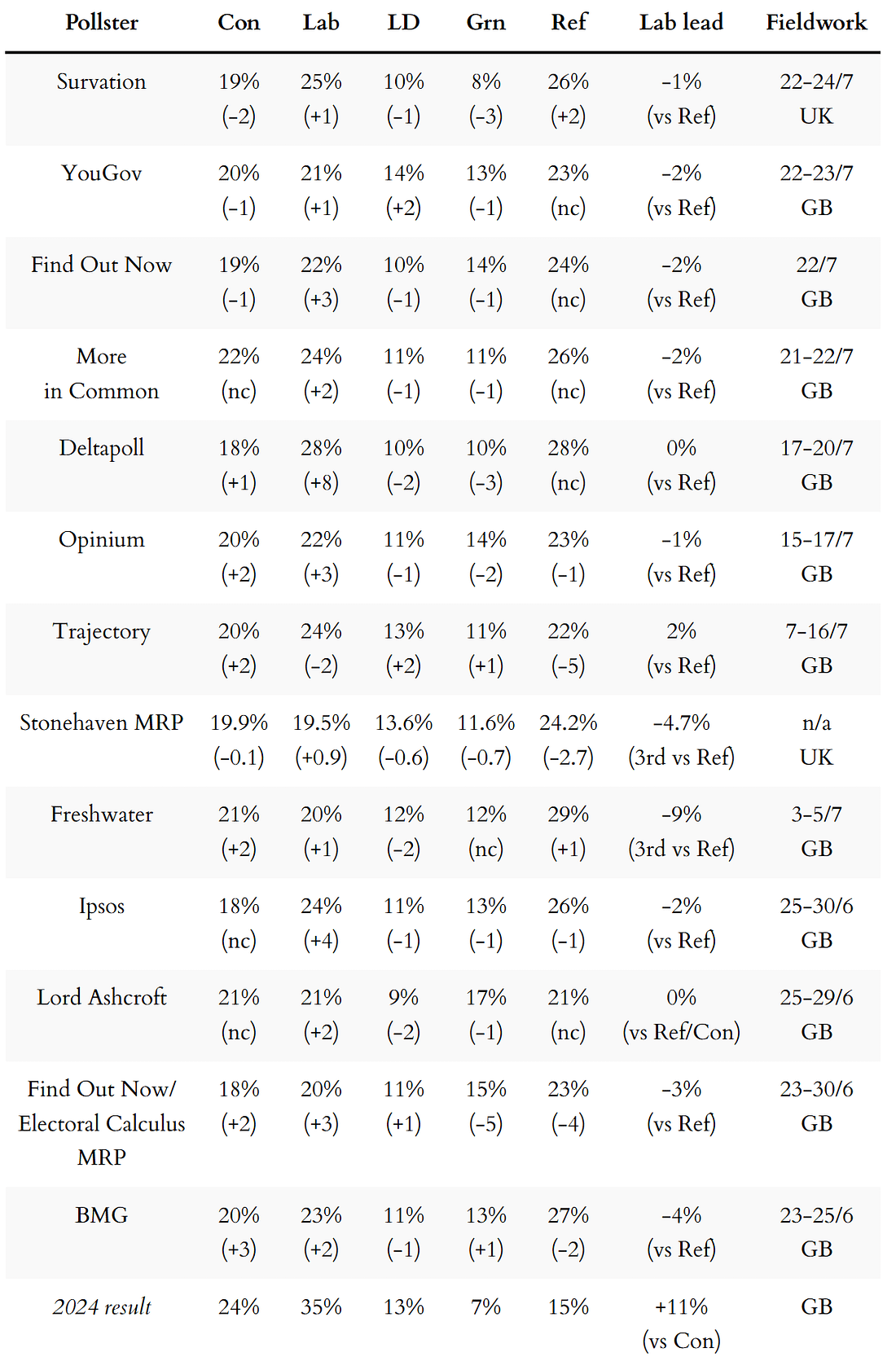 |
The table is also online here, along with explanations about what is included. It is updated regularly throughout the week as new polls are released.
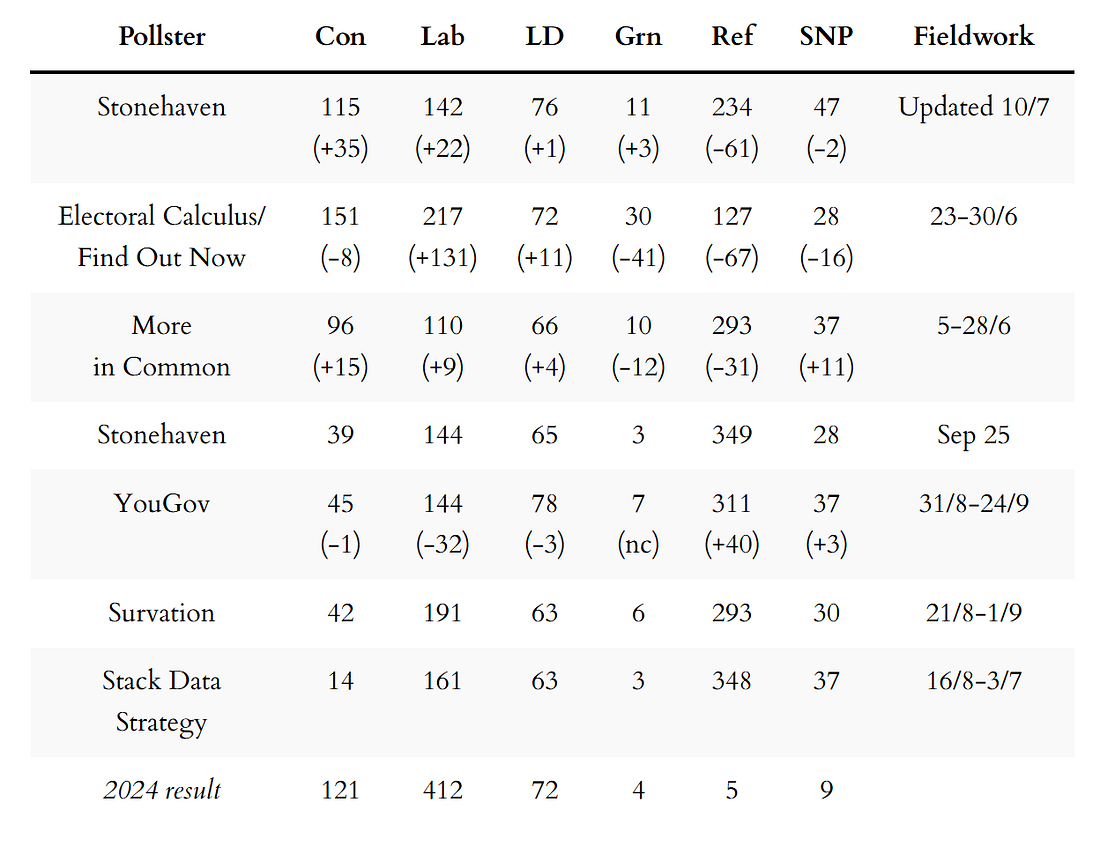
Next are the seat projections from MRPs, also sorted by fieldwork dates. Because they are published infrequently, most of these are somewhat dated. This time, there is a new More in Common MRP.
 |
Finally, here is a summary of the latest leadership ratings, sorted by pollster name. Andy Burnham has jumped into the best net figures though we don’t yet have data from his premiership from most of the pollsters in the table.
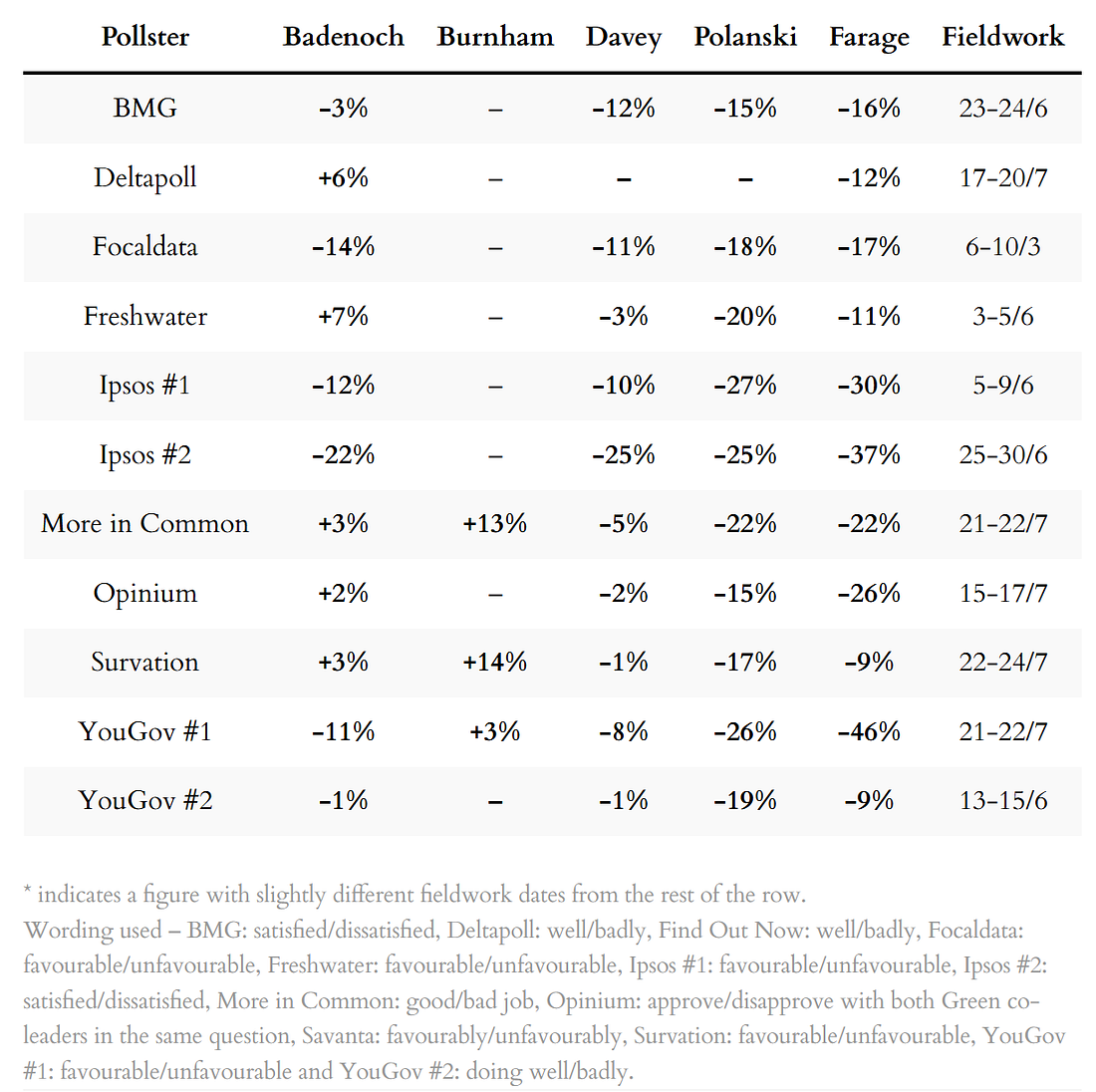 |
The table is also online here with additional details and is updated regularly throughout the week as new data comes out.
And to give those numbers a little more context:


For historical figures on both voting intention and leader approval stretching back to the 1930s, including Parliamentary by-election polls, see PollBase.
Catch up on the previous two editions
 |
|
 |
|
My privacy policy and other legal information are available here. Links to purchase books or other items are usually affiliate links which pay a commission for each sale.
Quotes from social media messages are occasionally lightly edited for punctuation and clarity.
If you are subscribed to other email lists of mine, please note that unsubscribing from this one will not automatically remove you from the others. If you wish to be removed from all my lists, simply reply to this email to let me know.
Is Kemi Badenoch setting the Conservatives up for failure?, and 9 other polling insights you shouldn’t miss
The following 10 findings from the most recent polls and analyses are only for subscribers who pay for the full edition, but you can sign up for a free trial to read them straight away.
YouGov’s Patrick English has been looking at the potential electoral consequences of Kemi Badenoch’s anti-Net Zero and anti-ECHR stances. He...

Continue reading this post for free in the Substack app
| ||||||||||

