|


Welcome to the 179th edition of The Week in Polls (TWIP), which may make you wonder whether all those snap post-Budget polls are worth it. That’s because I am taking a look at how the government’s controversial rise in employers’ National Insurance did in the snap polls carried out after the last Budget.
Next comes a summary of the latest national voting intention polls, seat projections from MRPs and the most recent party leader ratings.
Subscribers who pay for the full edition can also read ten insights from the latest polling and analysis. These include:
British attitudes towards the conflict in Israel and Gaza;
Polling for the Labour Deputy Leader contest; and
The continuing electoral footprint of King Alfred the Great.
If you are not yet a paying subscriber, you can read all the answers by starting a free trial now:
This weekend’s raised eyebrows came courtesy of a Daily Mail/JL Partners poll on Donald Trump’s approval ratings. The figures are not like those from other pollsters.
A reminder also that The British General Election of 2024 by Rob Ford, Tim Bale, Will Jennings and Paula Surridge is available to pre-order. Their work often features in The Week in Polls, and the book is sure to be popular with readers of this newsletter. Pre-order your copy here: Amazon, Waterstones.
And with that, on with the show.
Want to know more about political polling? Get my book - Polling UnPacked: the history, uses and abuses of political opinion polling.
Did the National Insurance tax rise seem popular at first?
Writing in the Financial Times this week, the ever excellent Stephen Bush made the case that Labour’s unpopularity has been wasted:
Its unpopularity has not really bought it anything — Labour has had a strategy for avoiding taking unpopular actions, rather than a strategy for actually improving outcomes or becoming popular by 2029. Everything has been reactive and negative.
As part of his argument about Labour trying (unsuccessfully!) to avoid unpopular policies he mentioned that, “even increasing employers’ National Insurance contributions was ‘popular’ the day after the Budget.”
That surprised me a little as my memory of the polling on National Insurance after the 30 October Budget was a little different. So let’s dig out the data and see what the immediate post-Budget polls said.
More in Common (fieldwork 30 October - 1 November 20204) found that 77% had heard of the employer’s NI increase policy and that the public split exactly 39%-39% on whether it was the right or wrong decision. The question wording was, “This week, the Government announced that they would be increasing the amount of National Insurance contributions paid by employers, and lowering the threshold at which employers have to start paying these contributions. Under these changes, employers will have to pay an additional £900 for each employee on an average wage. The contributions paid by employees will remain unchanged. Do you think this is...”
In addition they reported that:
A focus group of voters in Scunthorpe on Thursday evening, described Labour’s decision to put up employers National Insurance as “sneaky” as they knew it would be passed on to them in the form of lower wages and so was an indirect tax.
Turning to Ipsos (fieldwork 30-31 October), they had another near equal split, this time 34% support and 36% opposition when asking people for their view on the announcement of “Raising the rate at which employers pay National Insurance on workers’ earnings from 13.8% to 15%, and for firms to start paying them on earnings above £5,000 instead of £9,100.”
YouGov (fieldwork 30-31 October) had more clearly negative figures for the increase: 29% thinking it was the right thing to do and 47% the wrong thing when asked about, “Increasing the amount of National Insurance that employers have to pay on workers' earnings”.
Opinium (fieldwork also 30-31 October) had a similarly negative result, getting 28% thinking it a good idea and 48% a bad idea when asked “Considering all of the different priorities the government has, do you think each of the following are a good or bad idea? Employers’ National Insurance to rise from 13.8% to 15%.”
Overall, I think it’s fair to score that as a win for my memory, although what’s perhaps of more interest is the variation in those figures. Four reputable pollsters, two very different sets of results.
It’s a healthy warning against reading too much into any single poll question on a policy issue, particularly if it is one that people have not given much thought to or heard much debate about previously. In those cases not only are answers more susceptible to being influenced by question wording, they are also more susceptible to the realities of implementation resulting in views changing.
Looking back on it now, what I wrote in The Week in Polls at the time about the immediate post-Budget polls has aged okay:
It all adds up to a sense of ‘I don’t like some of the details but I may end up happy with the overall picture’ … If the government goes on to be seen to be improving people’s lives, then the Budget will be seen as sneaky but necessary. If it doesn’t improve people’s lives, it will get recategorised as dishonest and wrong.
And it has certainly aged better than do some post-Budget takes:
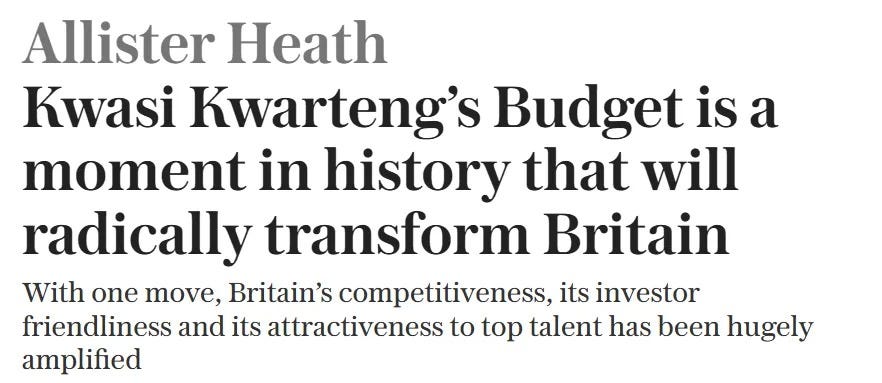 |
To which he added:
This was the best Budget I have ever heard a British Chancellor deliver, by a massive margin … It wasn’t merely the policies that were astonishingly good: just as remarkable was Kwarteng’s language, the arguments he deployed to explain his decisions, the lucid free-market philosophy from which they emanated … At a stroke of a pen, Britain’s competitiveness, its attractiveness to investors and top talent, has been transformed. Money and jobs will flow in.
You know the rest of the story.
If you spot a factual error…
Borrowing an idea from Stuart Ritchie and others, if you spot a factual error in an edition of this newsletter, I will give you 12 months free subscription to the paid-for version of this newsletter (or an extra 12 months on your existing one). Factual rather than grammatical errors, and factual errors rather than disagreements over interpretation. Though messages about both of those are always very welcome.
Voting intentions and leadership ratings
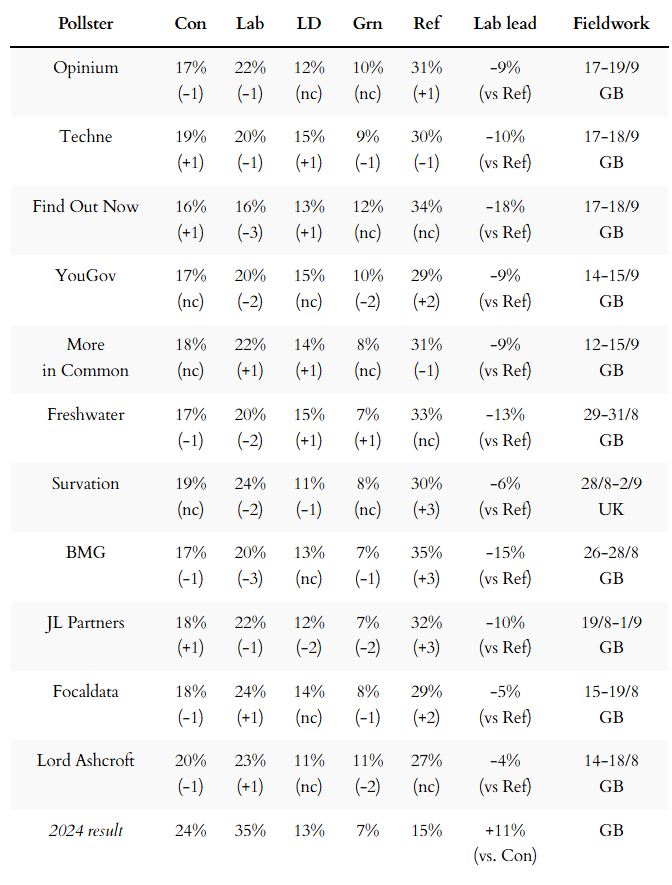
Here are the latest national voting intention figures from each of the pollsters currently active.
 |
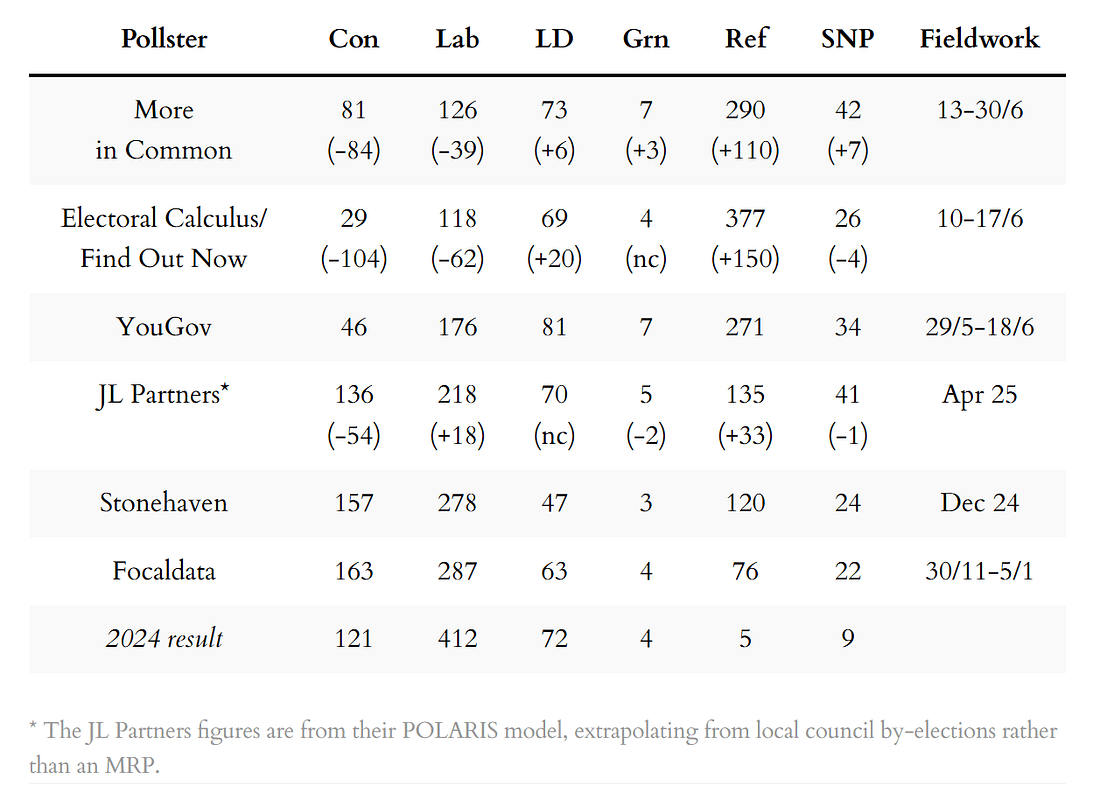
Next, the latest seat projections from MRP models and similar, also sorted by fieldwork dates. As these are infrequent, note how old the ‘latest’ data is.
 |
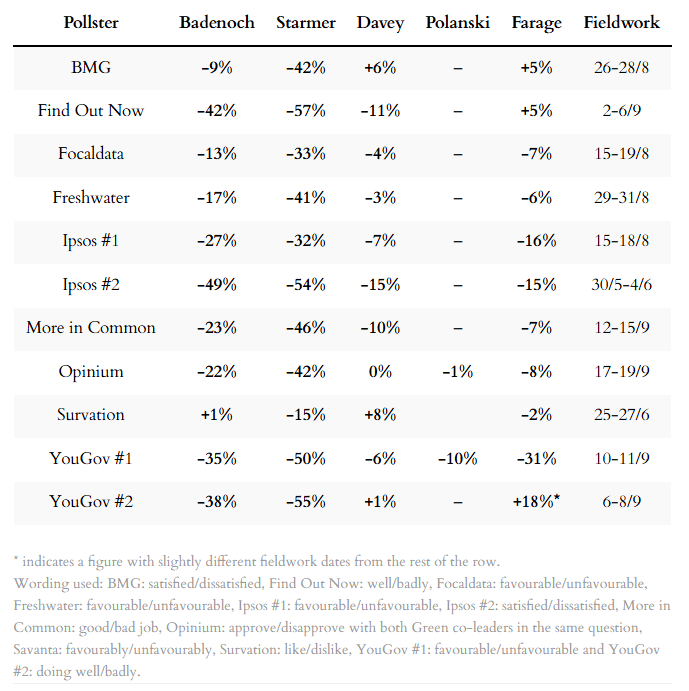
Finally, a summary of the latest leadership ratings, sorted by pollster name and with data for Zack Polanski starting to appear:
 |
For more details, and updates during the week as each new poll comes out, see my regularly updated tables here and follow The Week in Polls on Bluesky.
For the historic figures, including Parliamentary by-election polls, see PollBase.
Catch up on the previous two editions

 |
|
My privacy policy and other legal information are available here. Links to purchase books online are usually affiliate links which pay a commission for each sale.
Quotes from social media messages are occasionally lightly edited for punctuation and clarity.
If you are subscribed to other email lists of mine, please note that unsubscribing from this one won’t automatically remove you from the others. If you wish to be removed from all my lists, simply reply to this email to let me know.
British attitudes towards the conflict in Israel and Gaza, and other polling news
The following 10 findings from the most recent polls and analysis are only for subscribers who pay for the full edition, but you can sign up for a free trial to read them straight away.
Polling from Ipsos reports that, “While 44% of Britons support the UK ...

Continue reading this post for free in the Substack app
| ||||||||||

