|


Welcome to the 238th edition of The Week in Polls (TWIP), a polling newsletter that always welcomes new readers. So please don’t keep TWIP a secret; share it with your friends and colleagues:
This time, I’m returning to the topic of question wording, courtesy of a helpful piece from More in Common showing the impact of different question wordings when polling about freedom of movement.
This is followed by summaries of the latest national voting intention polls, seat projections from MRPs and the most recent party leader ratings.
Subscribers who pay for the full edition can also read ten insights from the latest polls and analyses, including:
How the pollsters did in the US midterms;
Whether or not people think employers should have to include pay details such as salaries in job adverts; and
More polling on reactions to the Budget.
If you are not yet a paid subscriber, you can read all ten by starting a free trial now:
For more polling news as it comes in ahead of next week’s edition, you can also follow The Week in Polls on Bluesky.
Before we get to all that, some updates on last week’s piece on whether 58% of people think Sherlock Holmes was real. Thank you for all the messages arguing over whether fictional people were real and whether real people have become so mythical as to be fictional. As well as taking me down some fun historical rabbit holes, it all demonstrates how important question wording is - and we don’t know the wording of the question that was asked.
I’ve also asked the same question again of a variety of AI services to see if my piece has improved their answers. Here is what I found when prompting them, not logged in and on the free tier where possible, with “Do 58% of people think Sherlock Holmes was real?”:
ChatGPT: its answer still starts with “Yes” but what follows is now better, including going on to say that “a 2026 investigation by polling expert Mark Pack revisited the claim and found that its reliability couldn’t be established.”
Perplexity: now starts its answer with “No” but it still misses much of the picture I painted last time. Although its answer has changed, it didn’t seem to draw on my piece.
Gemini: still unremittingly wrong with its answer starting “Yes”.
Meta AI (asked via my WhatsApp so it may have learnt a little from answering the question before): now starts with “Not really” but goes on to think the only issue is the adults-versus-teenagers confusion.
Claude: bafflingly, has a worse answer than last time, degrading from “No” to “Not as a general statement.” That is particularly surprising as Claude is the one service I had to test logged in with a paid account with memory turned on, and that’s an account I used to test out proofreading and fact-checking this newsletter - so it really should have known better.
But before anyone gets too censorious about AIs, how has Wikipedia done? It still wrongly presents the 58% figure with confidence and without caveats. Get editing, people!
Meanwhile, my eyebrows were raised by The Independent’s headline “Tories dramatically close gap on Labour in best polling since general election” as the poll cited only had movements within the margin of error and the Tory/Labour gap has been equalled or bettered in 23 other polls by that pollster this Parliament. The story also didn’t mention another poll published the same day which showed Labour increasing (within the margin of error) their lead over the Conservatives.
I think its justification for the headline would be that the level of Conservative support in that poll was the highest since the general election, which is a fair point to report. But given the wider context, the headline is much more likely to mislead than to inform in my view.
A Christmas gift idea
 |
Skip the boring socks. Pass on yet another box of chocolates. Forget the ‘amusing’ mug. Instead, this Christmas give the gift of polling insight, crosstab wisdom and raised eyebrows at media coverage with a paid-for subscription to The Week in Polls.
You can buy a gift subscription here.
How question wording matters in opinion polls
 |
I often comment on how question wording matters. Tweak the wording one way or the other and you can get a very different answer on many topics, especially those that are either not much on the public’s mind or involve strong conflicting arguments, in which case the arguments you give prominence to sway the answers.
But trying to craft one perfect neutral question can be misleading too. Because that’s not how issues come across to people when they are up for grabs. Rather, they hear and see the arguments put forward by different people. So testing out a variety of arguments is more useful than trying to find the one ‘perfect’ question to ask.
My recent piece about polling on Europe showed this: testing out different arguments for and against undoing Brexit gets a much closer final result than simply asking a neutral question about whether Britain should be in the EU.
One part of those arguments is freedom of movement, and More in Common handily have a piece out showing how much question wording can matter even on that high-profile, long-debated topic.
I’m going to quote it at some length, so first a plug for their own weekly email newsletter, which you can sign up to on their website.
Here is that piece:
Every pollster knows that how you ask a question can shape the answer. With the EU debate reignited, many polls (including our own) have suggested that many Britons would be open to rejoining the EU, even if it meant restoring freedom of movement. But our latest polling experiment looks at how framing the question can change the result - and how opinion could flip depending on how trade offs and choices are presented.
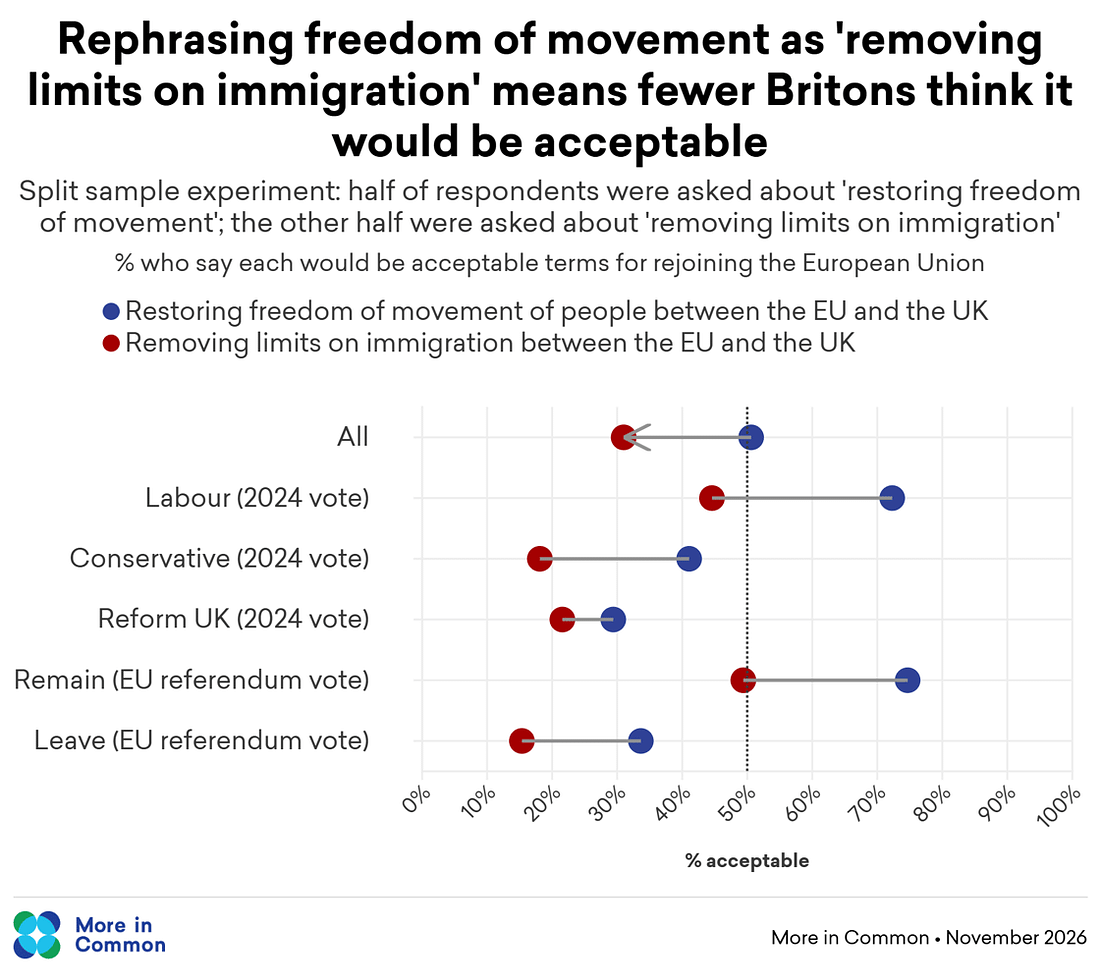
Asked in the abstract, Britons support freedom of movement by 44 per cent to 24 per cent. Asked about it as a term of rejoining the EU, 51 per cent find ‘restoring freedom of movement’ acceptable. But when you describe the same policy as ‘removing limits on immigration’, and that falls to 31 per cent. The drop in acceptability is actually largest among 2024 Labour voters (from 72 to 45 per cent) and Remain voters (from 75 to 49 per cent).
 |
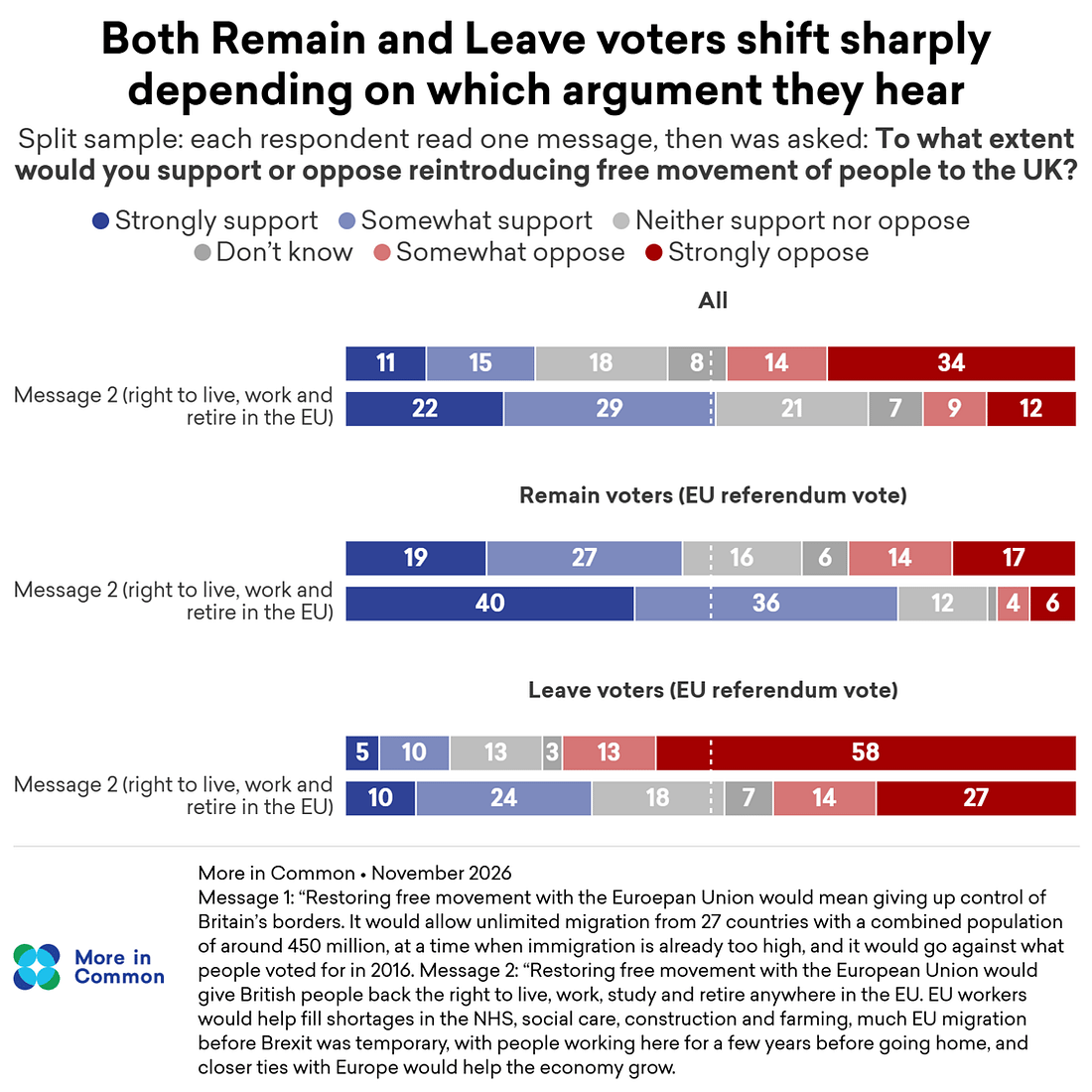
The arguments you hear can make an even bigger impact. We wanted to test the strength of different messages that voters would likely hear during a re-join referendum campaign. When we showed Britons a message about how freedom of movement means giving up control of our borders, just 26 per cent support it; told that it restores the right to live, work and retire in the EU, 51 per cent do. Even among those who voted Leave in 2016, support can more than double depending on which argument they hear.
 |
It’s a great case study in why poll question wording is so important, and it also offers an insight into how unstable public opinion is, particularly on issues that unlike those who are very engaged, most people aren’t thinking about day to day. Our polling suggests that, if there were a second referendum announced tomorrow, re-join would start with an advantage. But with opinion so sensitive to framings and arguments, things could shift very quickly - in either direction!
The (original) Manchurian Candidate
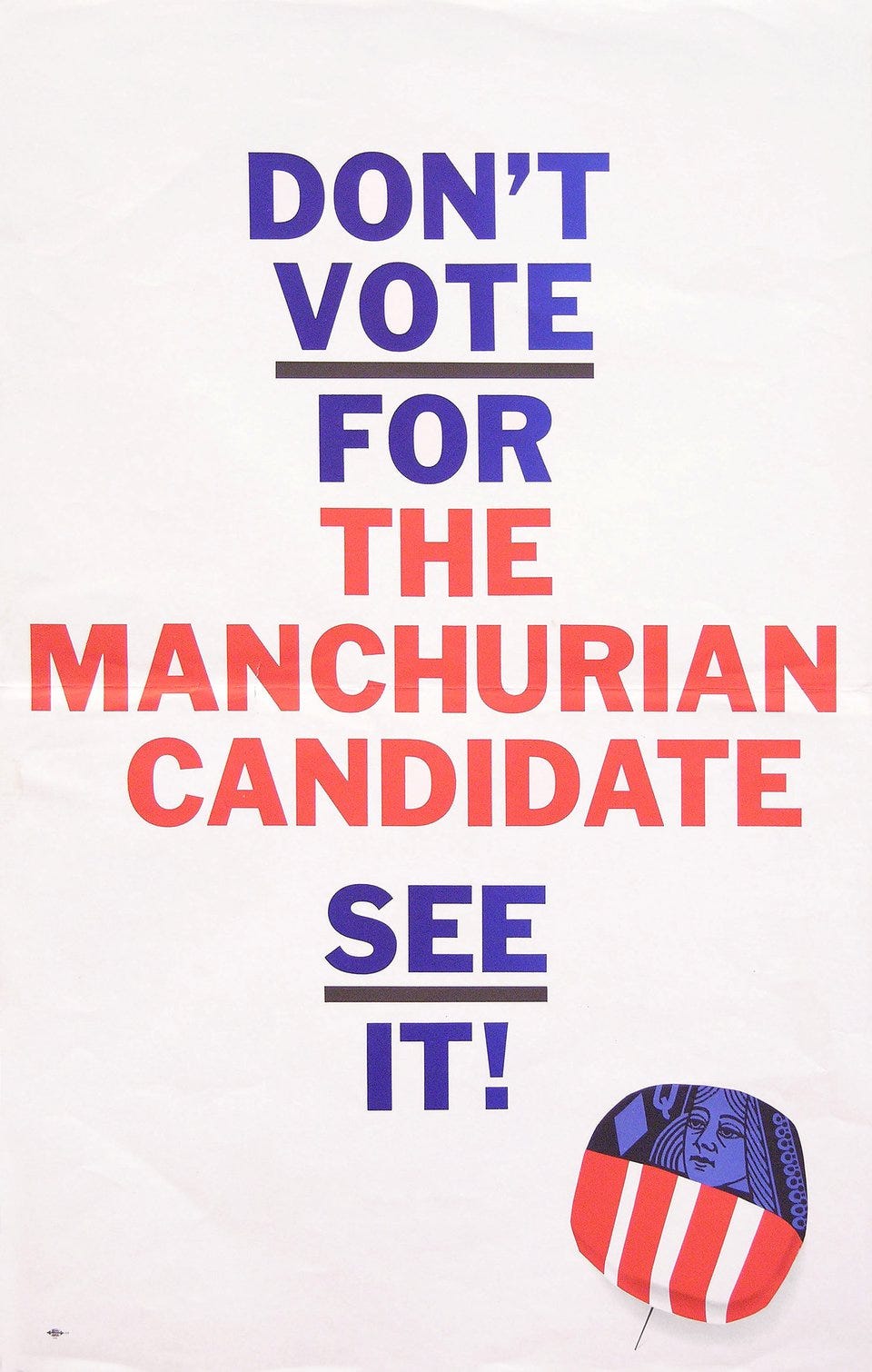 |
Over on my podcast, Political Fictions, it was time for a classic - perhaps the classic - of political paranoia this time - the original 1962 film version of The Manchurian Candidate:
Cory has gone rogue and changed the running order of the episode! Is that because he was kidnapped and brainwashed while out fighting in Korea? Or because we’re talking about that classic of Cold War paranoia, The Manchurian Candidate?
Mark and Cory talk about why it’s important for Communist front companies to make a profit, highlight how the film skewers both left and right, and debate whether the dastardly conspiracy at the heart of the plot actually makes any sense.
The Roger Ebert reviews which are referenced in the episode can be read here and here.
Cory’s email newsletter is Paperback Rioter and Mark has a family of email newsletters.
Subscribe to our newsletter for some additional bonus content and to get alerted whenever a new episode comes out.
Our theme tune is “Monkeys Spinning Monkeys” by Kevin MacLeod/incompetech.com and licensed under the Creative Commons: By Attribution 4.0 License.
|
The Manchurian Candidate, 1962 (#22) Cory Hazlehurst / Mark Pack |

You can also listen to our episode on Apple Podcasts, Spotify, the web or YouTube.
If you spot a factual error…
Borrowing an idea from Stuart Ritchie and others, if you spot a factual error in an edition of this newsletter, I will give you a free 12-month subscription to the paid-for version (or an extra 12 months on your existing one). Factual errors qualify, but grammatical errors or disagreements over interpretation do not, and my decision is final. Messages about both of those are always welcome, though.
Voting intention and leadership ratings
Here are the latest voting intention polls from different pollsters, and, as I said last week, although it is too soon to see if the Budget moved the polls, bear in mind that Budgets don’t usually do much to the voting intention polls anyway.
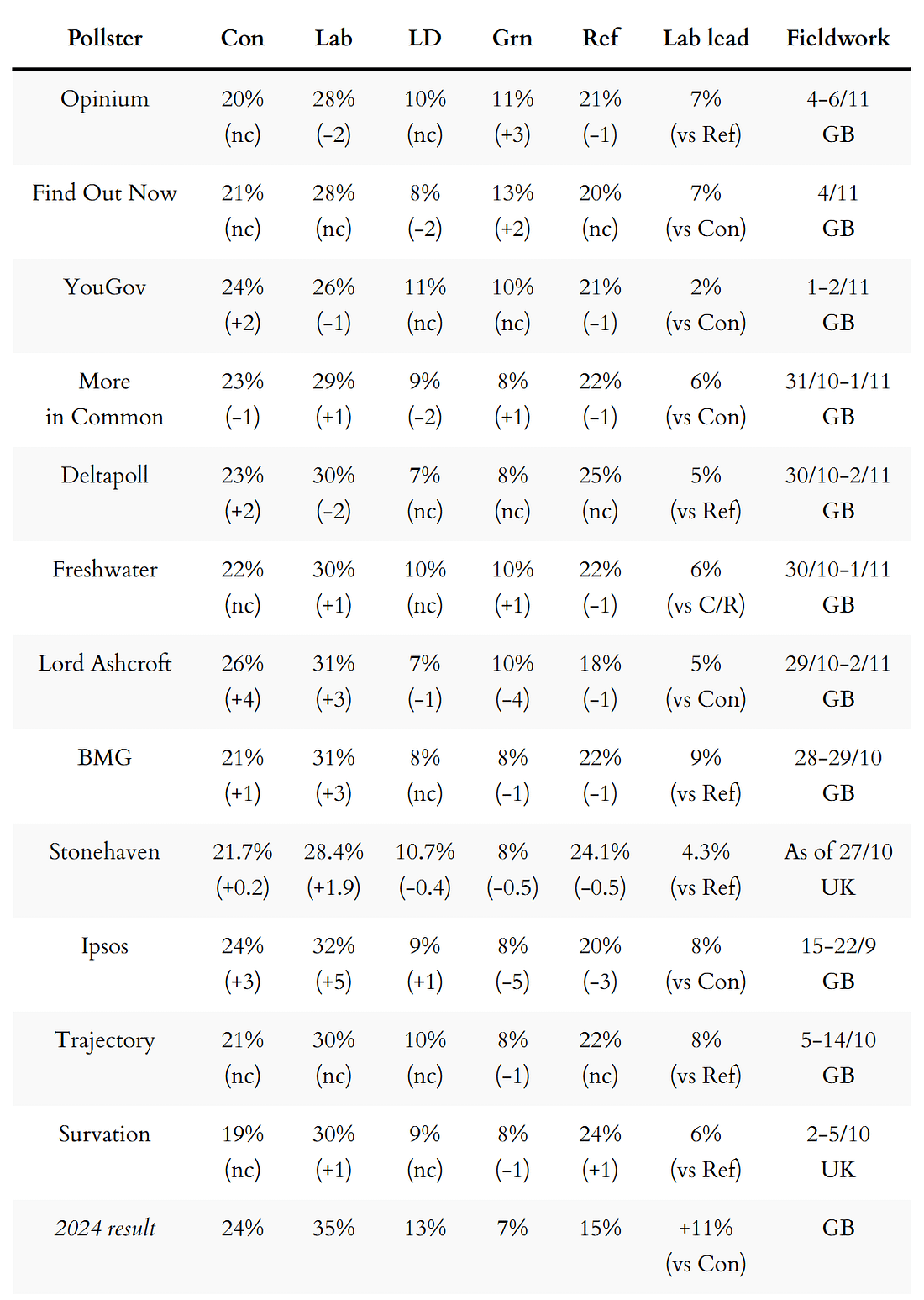 |
The table is also online here, along with a more detailed explanation of its content. It is updated regularly throughout the week as new polls are released.
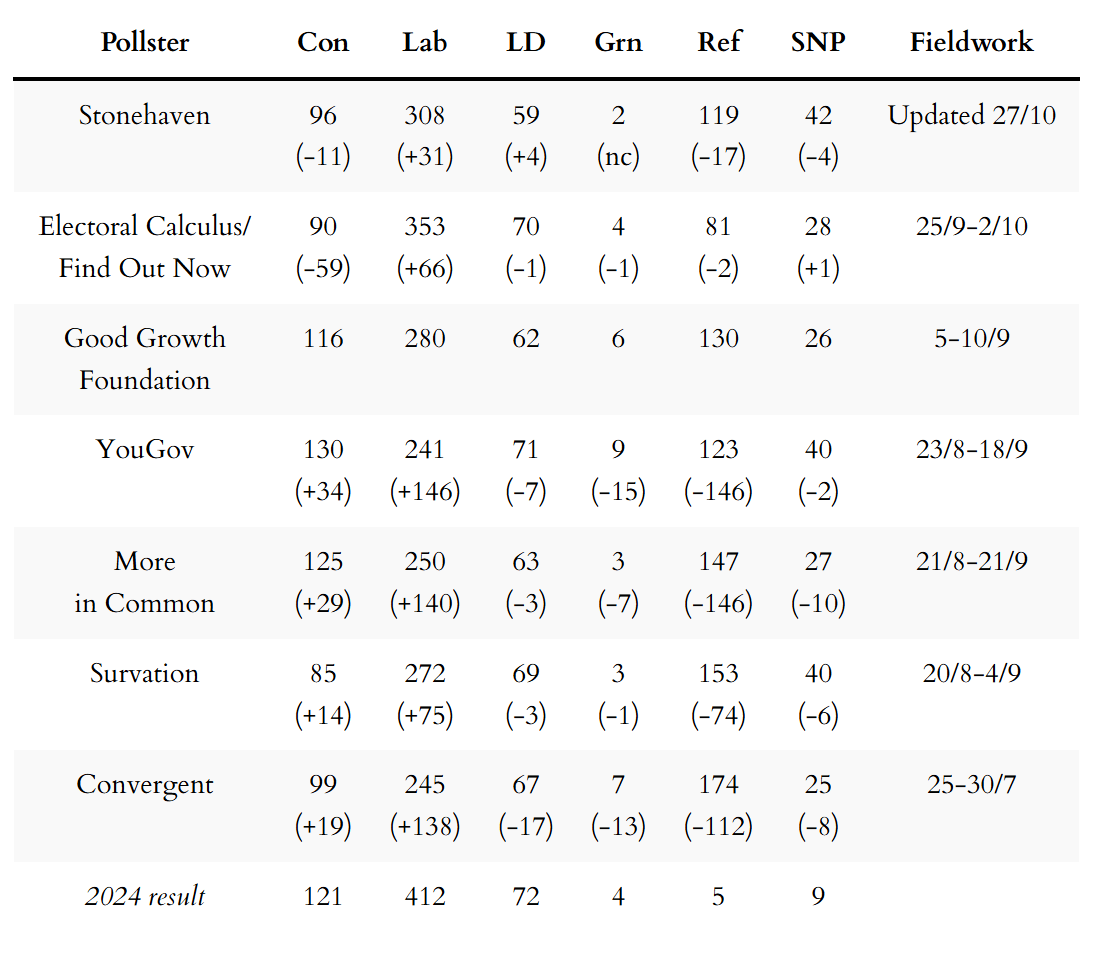
Next are the seat projections from MRPs, also sorted by fieldwork dates, listing those which are based on dedicated fieldwork (rather than models built on averages of other polls).
 |
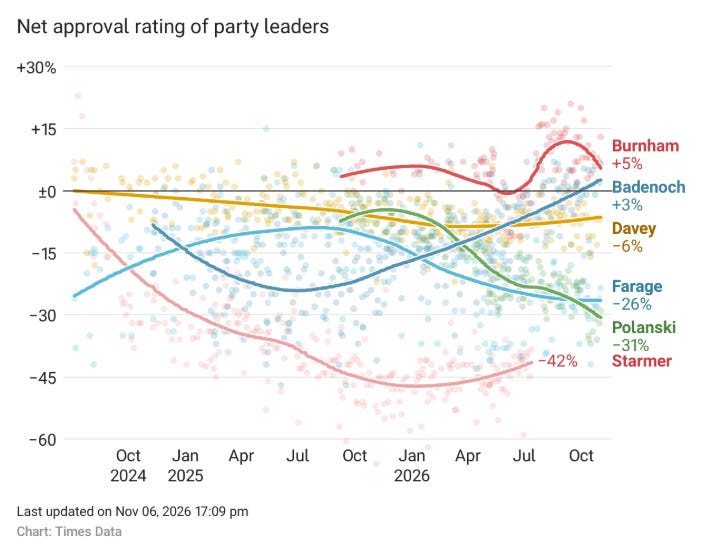
Finally, here is a summary of leadership ratings, with a graph from The Times:
 |
Detailed numbers from the latest polls are updated regularly throughout the week on my website here.
For historical figures on both voting intention and leadership ratings stretching back to the 1930s, including Parliamentary by-election polls, see PollBase.
Catch up on the previous two editions
 |
|
 |
|
My privacy policy and other legal information are available here. Links to purchase books or other items are usually affiliate links which pay a commission for each sale.
Quotes from social media messages are occasionally lightly edited for punctuation and clarity.
If you are subscribed to other email lists of mine, please note that unsubscribing from this one will not automatically remove you from the others. If you wish to be removed from all my lists, simply reply to this email to let me know.
How did the polls do in the US midterms?, and other polling insights you shouldn’t miss
The following ten findings from the most recent polls and analyses are only for subscribers who pay for the full edition, but you can sign up for a free trial to read them straight away.
US politics has an outsized influence on British politics, and in turn the performance of US pollsters has an outsized influence on the reputation of polling in the UK. So how did the pollsters do in the US midterms?...

Continue reading this post for free in the Substack app
| ||||||||||