|


Welcome to the 228th edition of The Week in Polls (TWIP), a polling newsletter that always welcomes new readers. So please don’t keep TWIP a secret; share it with your friends and colleagues:
This time, I’m looking again at the regulation of political polling - and the regulator I didn’t cover last time, the Market Research Society.
This is followed by summaries of the latest national voting intention polls, seat projections from MRPs and the most recent party leader ratings.
Subscribers who pay for the full edition can also read ten insights from the latest polls and analyses, including:
Reform voters are most likely to think that the majority of people share their views when they don’t;
New polling of Labour Party members; and
What people think of public service broadcasters such as the BBC.
If you are not yet a paid subscriber, you can read all ten by starting a free trial now:
For more polling news as it comes in ahead of next week’s edition, you can also follow The Week in Polls on Bluesky.
One other piece of news related to polling transparency: I’m quoted this week in a news piece about Reform’s polling operation, an obscure pollster and missing invoices. As I say in that piece, “Reform are doing themselves no favours with the lack of transparency over the campaign spending.”
My usual reminder too: please do hit reply if you’ve spotted a poll, focus group or new piece of poll-based research that you think should be in contention for coverage in a future edition. Thank you!
And with that, on with the show.
The Market Research Society
Last week I wrote about how recent polling scandals in the US should warn us against complacency over how polling is (self-)regulated here in the UK.
Probably the part that works best is the basic transparency over polling questions and related detail. It’s not perfect. It is not uncommon for it to be a matter of weeks and a couple of emails from me before poll tables appear for a poll that has had coverage in the media. (I currently have one email query awaiting resolution and a second email query to send shortly.) But generally, we can expect a level of transparency that is not matched in the US - and to be fair to pollsters, my emails often get prompt replies even over weekends.
There was a handy reminder recently of the importance of such transparency with a test poll from YouGov showing the importance of question wording when asking about views of the government:
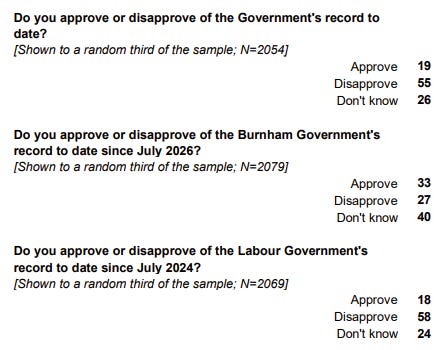 |
Is government approval at 19% or 33%? Wording matters, and hence knowing the wording matters for knowing what to make of polling results.
But to keep the piece to a reasonable length when writing about all this last week, I only talked about the British Polling Council (BPC). There is, however, another relevant regulator, the Market Research Society (MRS):
The Market Research Society (MRS) is the UK professional body for research, insight and analytics. We recognise 5,000 individual members and over 500 accredited Company Partners in over 50 countries who are committed to delivering outstanding insight. As the regulator, we promote the highest professional standards throughout the sector via the MRS Code of Conduct.
Its Code of Conduct is considerably more wide-ranging than the BPC’s own rules, reflecting the different nature of the two organisations.
While the BPC’s rules concentrate on disclosure of information about polls, the MRS goes more widely, including the potential catch-all of principle number 11 for its members:
Protect the reputation and integrity of the profession.
Many of the polling firms you are used to hearing about regarding political polling in this country appear in both the BPC and MRS member lists. YouGov and Survation, for example, appear in both. But there are some exceptions, with the pattern being that the more narrowly focused an outfit’s activities are, or the newer it is, the less likely it is also to be a member of the MRS. More in Common and Convergent, for example, are BPC members but not MRS members.
So the MRS’s standards provide additional, albeit incomplete, cover for political polling.
My one previous direct experience of it was not great. Many years back the MRS rejected a complaint from me that a pollster undermined the reputation of the profession by asking questions which included false information about a politician. The MRS’s argument, at least back then, was that such message testing was acceptable, and they didn’t think that safeguards such as subsequently telling the sample that they’d been told untrue things were necessary. While I have sympathy with the idea of letting people research the impact of untrue claims, I think it is reasonable to have safeguards alongside that. Whether the MRS’s views on this have changed in the interim is a topic I hope to return to.
But for the moment, its recent ruling about a pollster is worth considering:
MRS MARKET RESEARCH STANDARDS BOARD (MRSB) STATEMENT
MRS received a complaint about Savanta an MRS Company Partner. The complainant alleged that, in conducting the data collection activity complained about, Savanta did not ensure that participants were not led to a particular point of view. The complainant also alleged that, in conducting the data collection activity complained about, Savanta did not ensure that responses and/or data collected are capable of being interpreted in an unambiguous way.
Having conducted its investigation, MRSB found that Savanta did not take reasonable action when undertaking data collection to ensure that participants were not led to a particular point of view, in breach of rule 28 (d) of the MRS Code of Conduct. MRSB also found that Savanta did not take reasonable action when undertaking data collection to ensure that that [sic] responses and/or data collected are capable of being interpreted in an unambiguous way, in breach of rule 28 (e) of the MRS Code of Conduct.
In reaching this conclusion, MRSB notes that Savanta fully co-operated with the MRSB investigation.
MRSB concluded that it was appropriate that Savanta was formally advised of the breach in accordance with paragraph 43 c (i) of the MRS Company Partner Complaints Procedure.
Compared with the BPC’s remit and approach, this ruling shows how the MRS goes further: it polices a broader set of standards and, unlike the BPC, it publishes its rulings. It also shows that the MRS is, despite the failure of that previous complaint of mine, willing to get into broader questions about how a poll has been conducted. That is welcome.
But the ruling is also rather cryptic. Reading it, I know that I may have come across some polling results from this firm which have misled me due to the way they were conducted. But which poll and in what way? Something I think I know may be wrong, but I don’t know what.
I asked the MRS why they don’t publish more details and they explained to me that:
1. It would breach confidentiality between our members and their clients. We typically do not have regulatory agreements in place with the client organisations commissioning research (given these are not necessarily MRS members) and therefore we are not in a position to involve them publicly in a complaint.
2. Companies and individuals which sign up to the MRS Code of Conduct make a public and voluntary commitment to a set of professional standards. The MRS Company Partner Complaints Procedure is focused on allowing scrutiny of the research sector’s work and ensuring improvements are made where they need to be.
There is an internal logic to those reasons, though the result is that other people - like you or me - will be left in the dark. (I did also ask Savanta if they wished to say anything further about this ruling.)
This is not, for example, the approach which press regulators take. For all their other controversies, their rulings are published and corrections made. You may not see the correction, but if you do see a ruling or a correction you then do know what was wrong about what you may have previously read. You are not left in the dark in the way that MRS rulings leave you.
It’s also not the approach taken elsewhere, such as in this recent ruling against a pollster from Research Association New Zealand (RANZ). (Thank you to my reader Murray for highlighting it to me.)
I think it’s reasonable to conclude that this situation in the UK is an unsatisfactory one - and one that pollsters should want to see changed for the long-term protection of their reputation.
Elsewhere from me…


If you spot a factual error…
Borrowing an idea from Stuart Ritchie and others, if you spot a factual error in an edition of this newsletter, I will give you a free 12-month subscription to the paid-for version (or an extra 12 months on your existing one). Factual errors qualify, but grammatical errors or disagreements over interpretation do not, and my decision is final. Messages about both of those are always welcome, though.
Voting intention and leadership ratings
As More in Common’s Luke Tryl has explained, that pollster this week started prompting for Restore in its voting intentions questions, as did BMG. Where pollsters report figures for them, I include Restore (and also Your Party) in the full version of PollBase. I don’t include them, currently, in the summary table below because of the low level of support found for them (repeatedly in low single digits in the polls that have asked about them in the last couple of months or so). It was the same with the Greens and Reform, who only started appearing in the summary table when their support started being consistently higher than that. If another party starts consistently scoring higher support, then I’ll add them in too.
Here are the latest voting intention polls from different pollsters, continuing the recent pattern of Labour being generally, though not universally, in the lead over Reform:
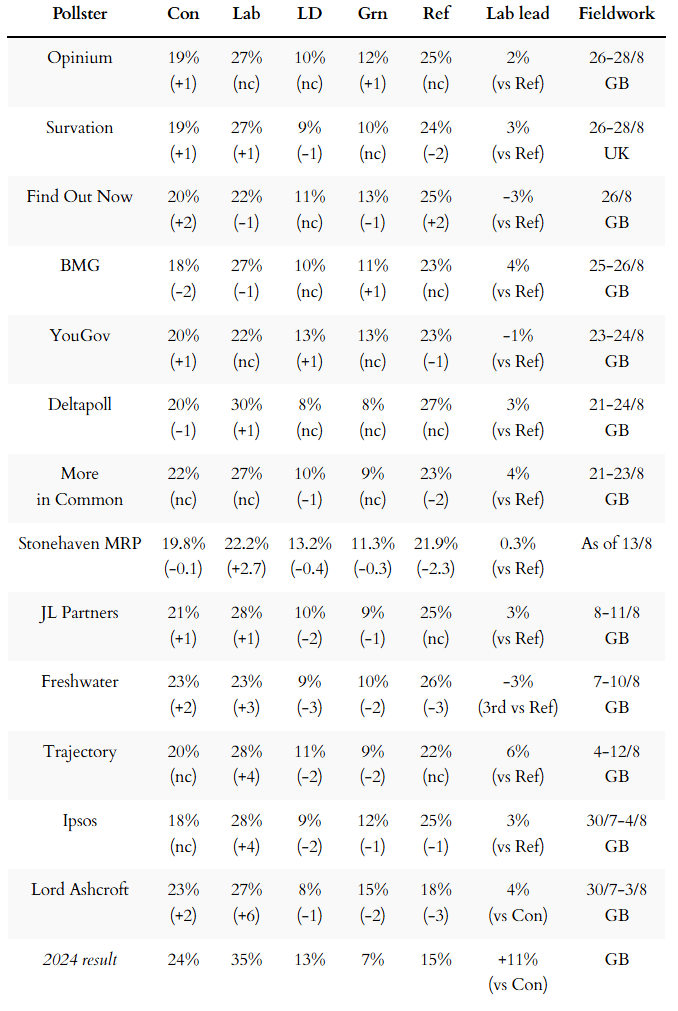 |
The table is also online here, along with explanations about what is included. It is updated regularly throughout the week as new polls are released.
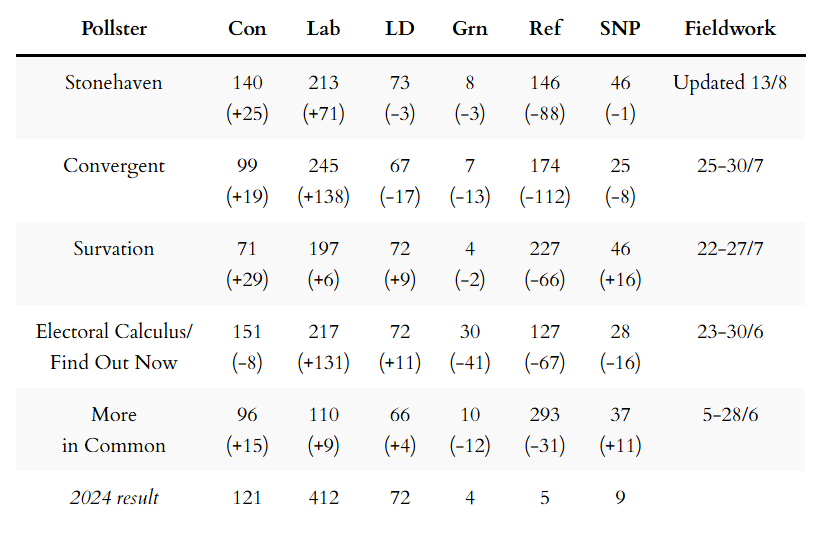
Next are the seat projections from MRPs, also sorted by fieldwork dates. Because they are published infrequently, some of the entries below are quite old. But note that there is new data this time and also how we’re starting to see Labour regularly ahead of Reform on seat numbers:
 |
Finally, here is a summary of the latest leadership ratings, sorted by pollster name.
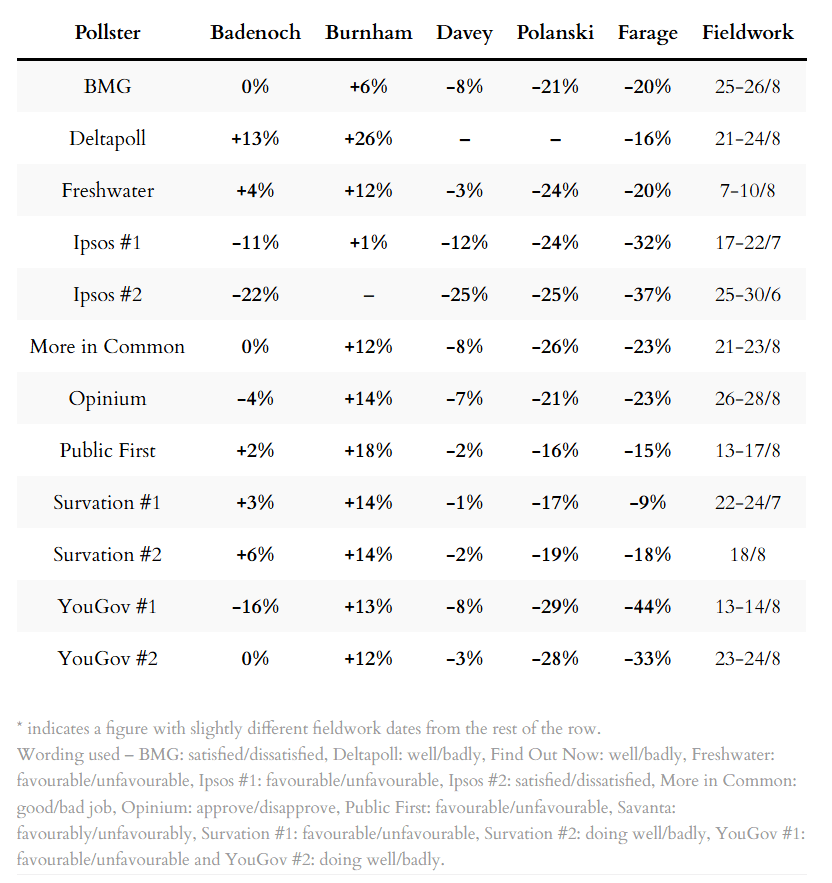 |
The table is also online here with additional details and is updated regularly throughout the week as new data comes out.
For historical figures on both voting intention and leader approval stretching back to the 1930s, including Parliamentary by-election polls, see PollBase.
Catch up on the previous two editions
 |
|
 |
|
My privacy policy and other legal information are available here. Links to purchase books or other items are usually affiliate links which pay a commission for each sale.
Quotes from social media messages are occasionally lightly edited for punctuation and clarity.
If you are subscribed to other email lists of mine, please note that unsubscribing from this one will not automatically remove you from the others. If you wish to be removed from all my lists, simply reply to this email to let me know.
Reform voters are the most likely to wrongly think their view is the most common one, and 9 other polling insights you shouldn’t miss
The following ten findings from the most recent polls and analyses are only for subscribers who pay for the full edition, but you can sign up for a free trial to read them straight away.
A new YouGov poll “examines how many Britons think their own views are similar to those of the wider public, both in general and specific cases, whether they are right, and how groups differ in their perceptions.” Here is what it finds:...

Continue reading this post for free in the Substack app
| ||||||||||

