|


Welcome to the 185th edition of The Week in Polls (TWIP), which returns to the question of how polling on assisted dying is being presented.
That is followed by a summary of the latest national voting intention polls, seat projections from MRPs and the most recent party leader ratings.
Subscribers who pay for the full edition can then also read ten insights from the latest polling and analysis. These include:
Attitudes towards the monarchy;
What people think about the possibility of Labour breaking manifesto promises on tax; and
Which party leaders scare the public most.
If you are not yet a paying subscriber, you can read all of those ten insights by starting a free trial now:
For more polling news as it comes through the week, you can also follow The Week in Polls on Bluesky.
And with that, on with the show.
Corrections and clarifications
Some follow-ups to last week’s piece about polling for the Labour Deputy Leader contest are in order.
First, apologies for a simple factual error. In calculating the figures for the size of Lucy Powell’s lead in the Survation polls, I used some data that had already been rounded to the nearest whole number. That meant that by the time I had done my own calculations to remove don’t knows and work out the lead, the result was different from what it would have been if I’d used precise numbers all the way through. The final Survation figure was a 15% Powell lead, not an 18% one.
Second, last time I said that:
The polls … were of Labour Party members, but the contest had a wider electorate. To quote the Labour Party, “Affiliated supporters who are not otherwise members of the Labour Party as defined above shall be eligible to vote provided that they meet the following criteria…
Even so, I think it is fair to compare these polls with the result in that the polls were presented as being guides to what was happening in the election overall. (I also have not come across any examples of the camp that was behind knocking the polls for excluding these other voters.)
I had missed that Survation’s Damian Lyons Lowe had tweeted that (my emphasis):
Voting is now over in the Labour Deputy Leadership election, we think Lucy Powell has won the membership section.
I think my overall point is still fair - that in general the polls were seen as polls of the race rather than polls of part of the race - but apologies to Damian for missing his wise specificity.
Third, Survation has made a case that using some estimates of likely relative vote numbers from the membership and affiliate sections, the result in their poll and in the actual votes in the membership section may have been the same. Those estimates come from Labour activist Charlie Mansell, though I have heard differing views expressed too. See what you think of Survation’s case here.
As per my usual offer of a free subscription for spotting factual errors, one is on its way to the Survation team who pointed out the factual slips.
More misleading presentation of polling on assisted dying?
Both Peter Kellner and I have written about the glossy leaflet appearing anonymously in the post for members of the House of Lords, which reprints a story from The Independent presented as being a poll about assisted dying.
As Peter put it:
It reads like the real thing: a report in a widely-respected newspaper adding new polling data about a serious controversy that is raging in Parliament.
Indeed, in a way, it is all those things. The paper is The Independent. The headline is genuine and so is the poll.
The trouble is that the headline is misleading, the poll not what it seems, and the larger truth about public opinion sadly absent.
I was reminded of this when an email landed in my Parliamentary inbox a few days ago from CARE, who oppose the legislation on this topic currently before the Lords.
The email once again plugged that problematic polling and also had this to say:
Detailed polling reveals support for assisted suicide dramatically falls when terms are more clearly defined and further information is given. Only 11% of respondents remained completely committed to assisted dying by the close of questions.
It provided a link to a press release from Care Not Killing who commissioned that polling. The press release provided details of the pollster which therefore allows us, thanks to the transparency of political polling in the UK, to get the full details and tables from the pollster.
The poll was carried out in November 2024 by Focaldata. A little dated then, but on this topic and in the circumstances still new enough to be valid. The polling firm itself is a reputable one and performed decently at the last general election.
Crucially, however, as the pollster itself highlights right at the top of the story on its website:
The poll assessed which arguments and messages are most likely to prevent “The Terminally Ill Adults (End of Life)” Bill passing through the House of Commons this month.
This was not a poll seeing how opinion moves in response to arguments for and against the Bill. It only tested arguments against the Bill.
The poll tells us that at the start, 72% strongly or somewhat support, “making it legal for someone to seek ‘assisted dying’ in the UK.”
A series of 10 arguments against the Bill are then put to people. They look to me all reasonable points to test as they are the sort of points being made in debates over the Bill. But note both that it is only arguments against the Bill tested, and some of those arguments are tested using wording that is contested, e.g. “Many elderly and vulnerable people would likely opt for assisted dying because they fear being a burden on others.”
That is all fair enough for testing arguments to see which ones work.
But, but, but…
What the poll shows us is that if people only hear a series of arguments against something, many of the original supporters switch. As Care Not Killing puts it, “Only 11 per cent of the public are immune” to the arguments in the polls.
What the poll does not show us is what the effect is if people also hear a series of arguments in favour.
That would be genuinely useful, showing the public’s view after hearing points both for and against. Indeed, Focaldata has just published new polling data on the possibility of electoral reform for the House of Commons. That data tests out arguments both for and against PR, making for an insightful piece of analysis - even if the conclusion is not wholly comfortable for a supporter of electoral reform like myself:
When respondents are given an explanation of First Past the Post vs Proportional Representation, a plurality choose PR as their preferred system by a very narrow margin of 41% to 36% (with 24% unsure)…
[But] our analysis found that arguments against proportional representation had a greater impact on system preference than those in support of it. Anti-PR messages reduce support for proportional representation by an average of 3.8 percentage points, but pro-PR messages only increase support by an average of 1.2 points.
It is easy to see from this how misleading the picture could have been if the pollster had only tested the messaging on one side of the issue and then written up the poll as if being about the issue overall.
But going back to the CARE email, read again how it presented the findings on assisted dying:
Detailed polling reveals support for assisted suicide dramatically falls when terms are more clearly defined and further information is given.
I think it is fair to say that talking about giving “further information” and “clearly defined terms” falls quite a long way short of accurately presenting the poll.
Add that to the repeated promotion of the problematic story from The Independent and the conclusion, at least for me, is that if you are repeatedly presenting polling in this sort of way, you are damaging your own credibility, weakening your own arguments - and perhaps also revealing the absence of stronger data?
I should of course add that though this is a topic on which it is useful to know where public opinion stands, it is not a topic that should be decided simply by the latest poll. This, however, is a polling rather than a policy newsletter and hence the concentration on the polling aspects of the topic.
Elsewhere from me…

If you spot a factual error…
Borrowing an idea from Stuart Ritchie and others, if you spot a factual error in an edition of this newsletter, I will give you a 12-month free subscription to the paid-for version of this newsletter (or an extra 12 months on your existing one). Factual rather than grammatical errors, and factual errors rather than disagreements over interpretation. Though messages about both of those are always very welcome.
Voting intentions and leadership ratings
Here are the latest national voting intention figures from each of the pollsters currently active, and perhaps the most important new trend emerging in the figures is the narrow spread between the parties in second, third, fourth and fifth.
In the most recent polls, that spread varies from 2 points (!) to 8 points. Take a step back and even that 8 points is a remarkably small number for the spread between four parties:
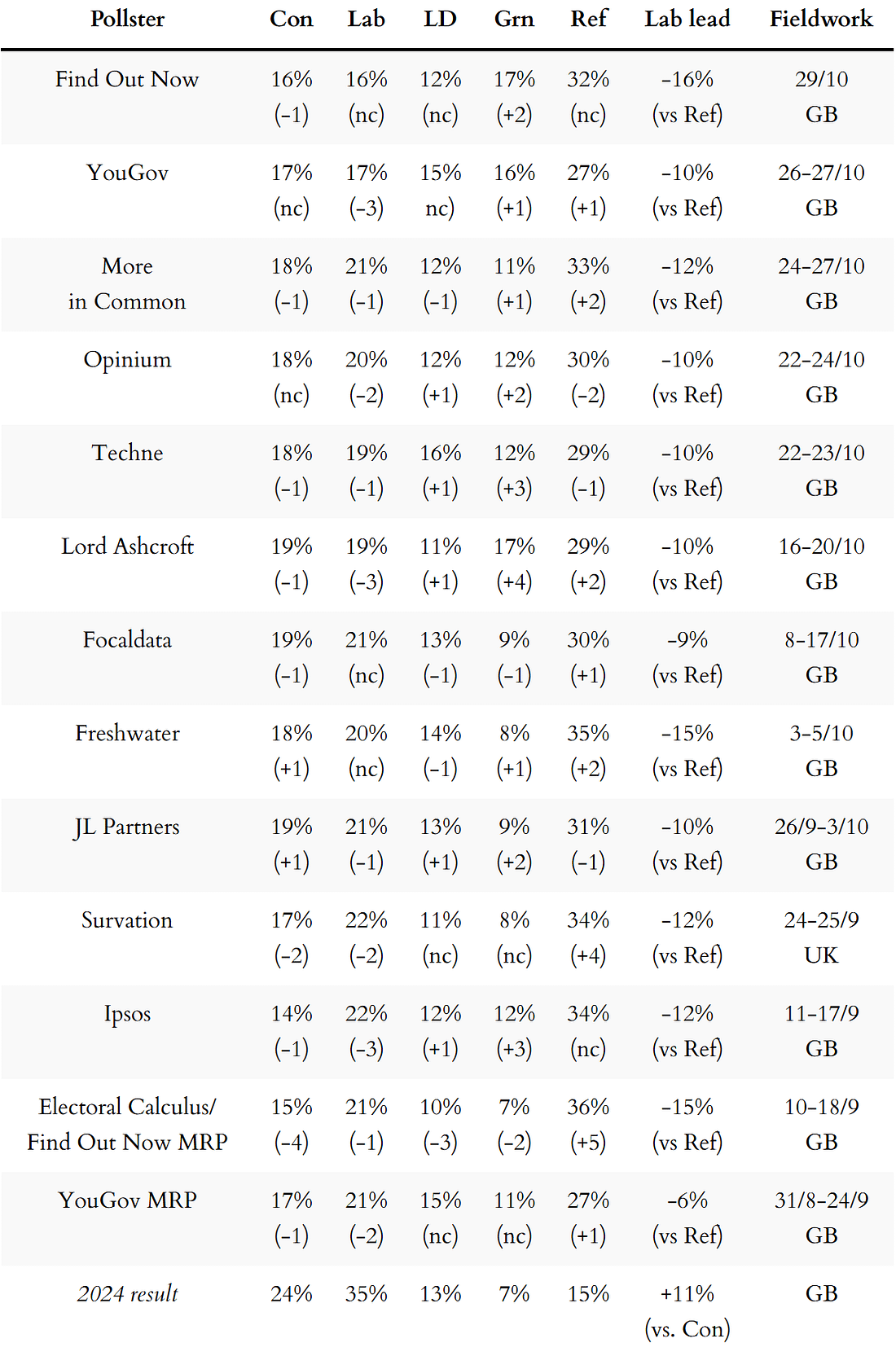 |
The table is also online here and is updated regularly through the week with new polls.
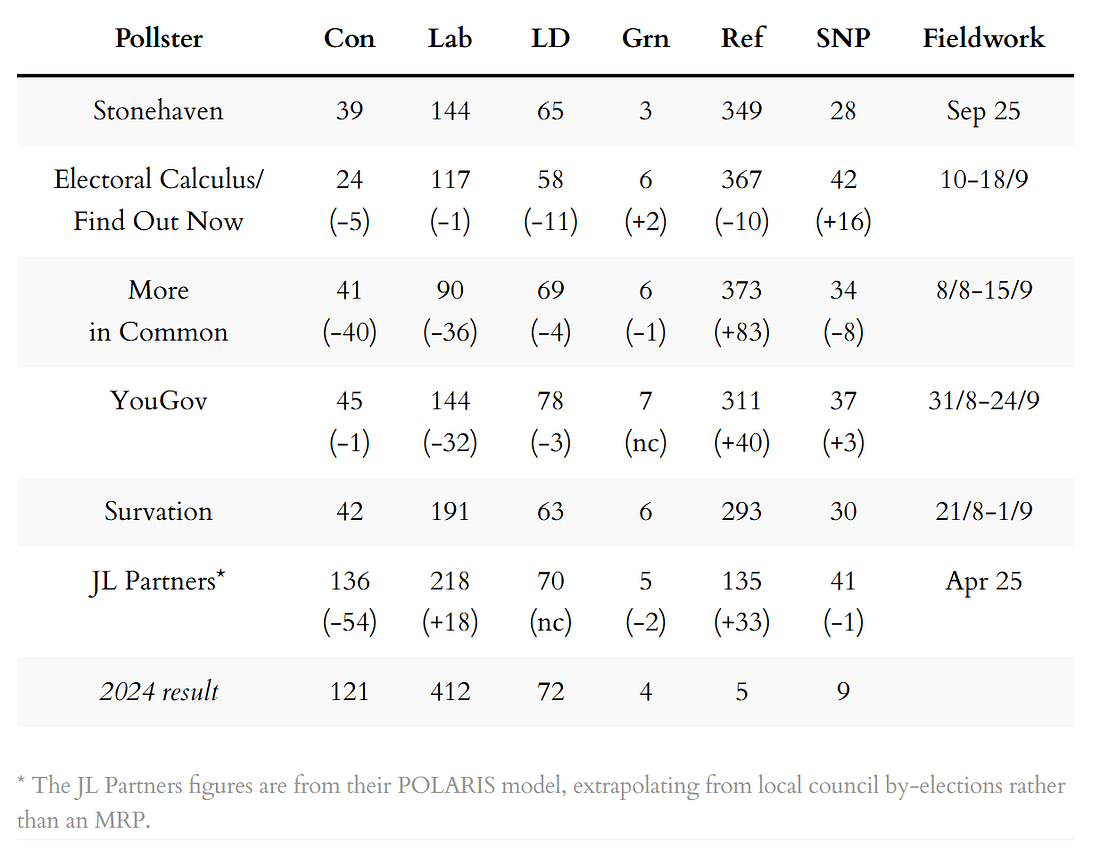
Next, the latest seat projections from MRP models and similar, also sorted by fieldwork dates. As these are infrequent, note how old the ‘latest’ data is.
 |
Finally, a summary of the latest leadership ratings, sorted by pollster name:
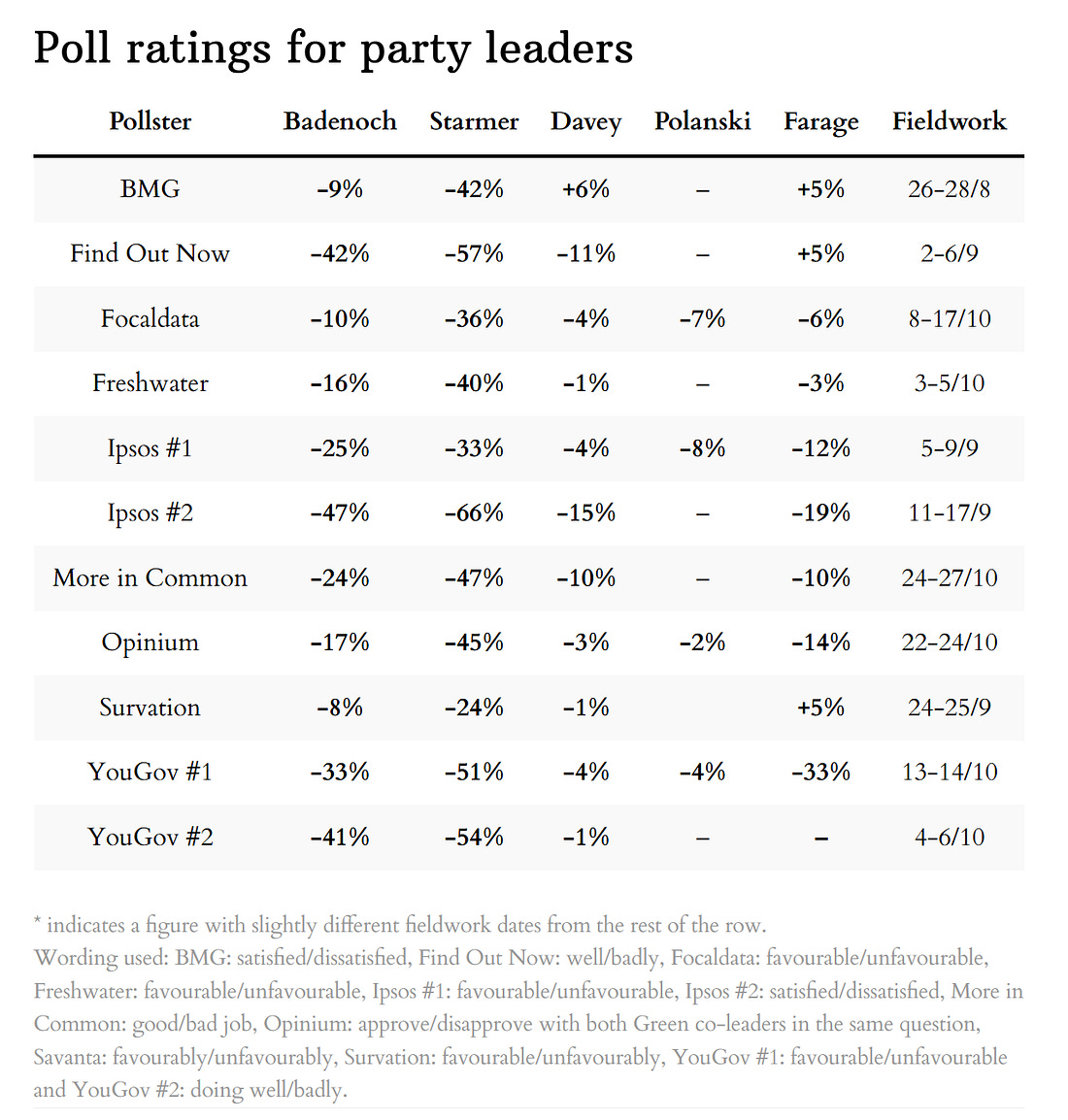 |
The table is also online here with additional details and is updated regularly through the week as new data comes out.
For the historic figures for both voting intention and leader approval, including Parliamentary by-election polls, see PollBase.
Catch up on the previous two editions
 |
|

My privacy policy and other legal information are available here. Links to purchase books online are usually affiliate links which pay a commission for each sale.
Quotes from social media messages are occasionally edited lightly for punctuation and clarity.
If you are subscribed to other email lists of mine, please note that unsubscribing from this one won’t automatically remove you from the others. If you wish to be removed from all my lists, simply reply to this email to let me know.
Who gets the fairest deal in terms of government spending?, and other polling news
The following 10 findings from the most recent polls and analysis are only for subscribers who pay for the full edition, but you can sign up for a free trial to read them straight away.
YouGov asked, “Who gets the fairest deal in terms of government spending?” and the age breaks on the answers are striking:...

Continue reading this post for free in the Substack app
| ||||||||||

