|


Welcome to the 170th edition of The Week in Polls (TWIP), which is mainly about things you should read other than this newsletter.
It’s a dangerous list of summer reading recommendations for anyone interested in polling. Why dangerous? Because there are so many authors of books not mentioned below who are, however, readers of this newsletter. Wish me luck dealing with the incoming correspondence…
Next comes a summary of the latest national voting intention polls, seat numbers from the latest MRPs and a round-up of party leader ratings.
Those are followed, for paying subscribers, by 10 insights from the latest polling and analysis.
This time, those ten include new research into which attack messages might make Reform vulnerable.
One last thing before we get to the main business. Last time I set a little quiz:
In March 1940, while Neville Chamberlain was still Prime Minister, Gallup asked people who they would most like to see in a smaller war cabinet, if one was formed. Churchill and Anthony Eden were the two most popular picks, with Chamberlain tied for fourth with Lord Halifax. But who came third?
Thank you to everyone who made a guess, with suggestions including Clement Attlee, David Lloyd George¹ and Archibald Sinclair.
The correct answer… Leslie Hore-Belisha, he of the Belisha Beacon, but also War Secretary in 1937-40.
And with that, on with the show.
Want to know more about political polling? Get my book - Polling UnPacked: the history, uses and abuses of political opinion polling.
A Lord’s Eye View
I have a new email list about my work in the House of Lords. If you are interested enough in political polling to be reading The Week in Polls, chances are you will also be interested in my pieces on topics such as political finance reform:

Summer reading book recommendations
 |
What to read on your holidays? Here are some political polling related suggestions.
Strength in Numbers
Published around the same time as my own book on political polling, this account is more US-centric than mine and goes into greater detail on the philosophical concepts behind what public opinion represents and how it can be measured.
Yet the underlying story it tells about how polls work, and the value they can bring, applies well beyond the US or philosophical circles too.
Strength in Numbers: How Polls Work and Why We Need Them by G. Elliott Morris: Amazon, Bookshop.org or Waterstones.
Polling UnPacked
My own account of the history of political polling goes less into philosophy and more into quirky corners, including the first attempts to regulate political polling, the myths about George Gallup and gives you a league table of how different British pollsters perform.
Polling UnPacked: The History, Uses and Abuses of Political Opinion Polls by Mark Pack: Amazon, Bookshop.org or Waterstones.
Talking to a Brick Wall
I have long eulogised pollster turned peer Deborah Mattinson’s account of polling for New Labour. It is an entertaining read that paints a vivid picture of the utterly dysfunctional way Labour operated for years, as if emulating a group of sulky teenagers was the blueprint to follow. She had a close-up view of much that happened in 1983-2010, and the book tells it from the perspective of the voters she frequently focus grouped rather than from the more traditional perspective of Westminster bubble gossip. That makes it also a powerful insight into how to use focus groups and polls well, that is as a way to connect politicians and the public.
Talking to a Brick Wall: How New Labour stopped listening to the voter and why we need a new politics by Deborah Mattinson: Amazon or eBay.
Polling at a Crossroads
As reviewed in detail in TWIP #151 this book clearly sets out how modern political opinion polling has diverged from the would-be theoretical purity of random sampling. It goes into the problems that come from that, and examines solutions - particularly emerging advanced statistical techniques to deal with non-response bias. It gets very technical, but there is plenty in the book for the non-technical reader to learn from too.
Polling at a Crossroads: Rethinking Modern Survey Research by Michael A. Bailey: Amazon, Bookshop.org or Waterstones.
Not really about polling
Partly due to Nate Silver, polling commentary increasingly refers to people’s “priors”. What is a “prior”? And why don’t people just use “assumption” or “belief”? It’s all to do with Thomas Bayes and his famous theorem. Whether or not you should be a Bayesian or a frequentist is up there with PC vs Mac, Coke vs Pepsi, or Marvel vs DC.
This book by Tom Chivers, however, gives a clear, entertaining and informative tour through the background and the debates. It also features a short but powerful little section defending people who set their own views by what their favoured politician says.
Everything Is Predictable: How Bayes' Remarkable Theorem Explains the World by Tom Chivers: Amazon, Bookshop.org or Waterstones.
Happy reading!
Voting intentions and leadership ratings
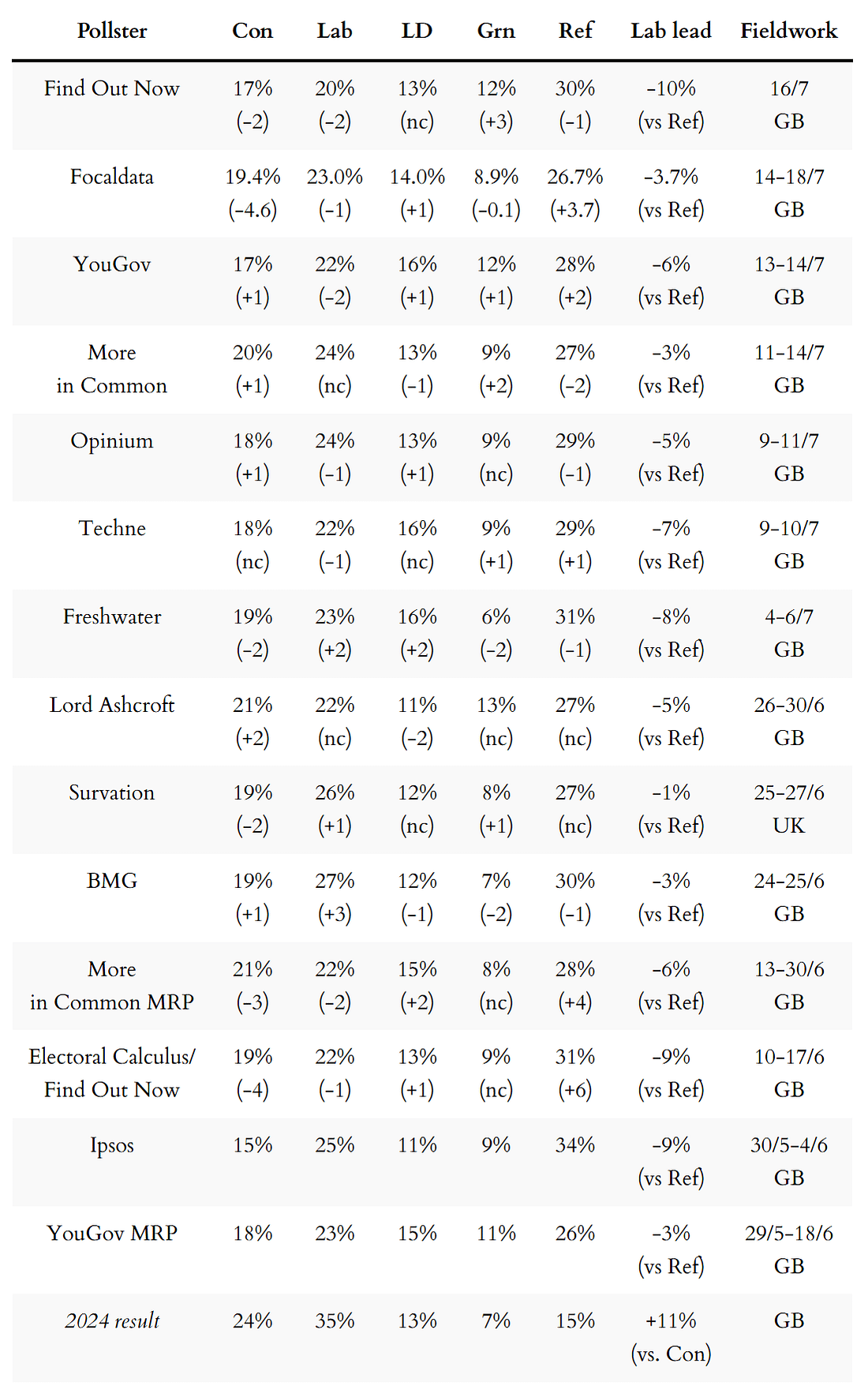
Here are the latest national voting intention figures from each of the pollsters currently active, with the plateau in Reform support continuing:
 |
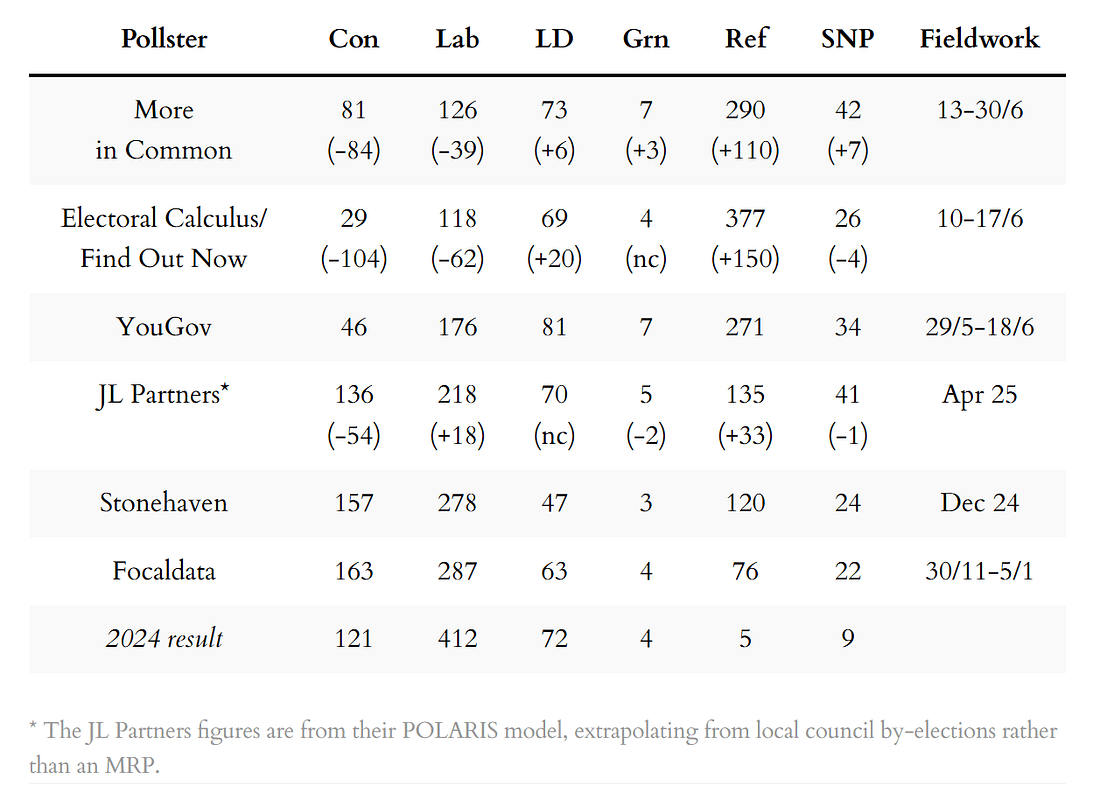
Next, the latest seat projections from MRP models and similar, also sorted by fieldwork dates. As these are infrequent, note how old some of the ‘latest’ data is. Note also how close the Conservative Party is to falling to fourth or even, with some models, fifth (!) on seats.
 |
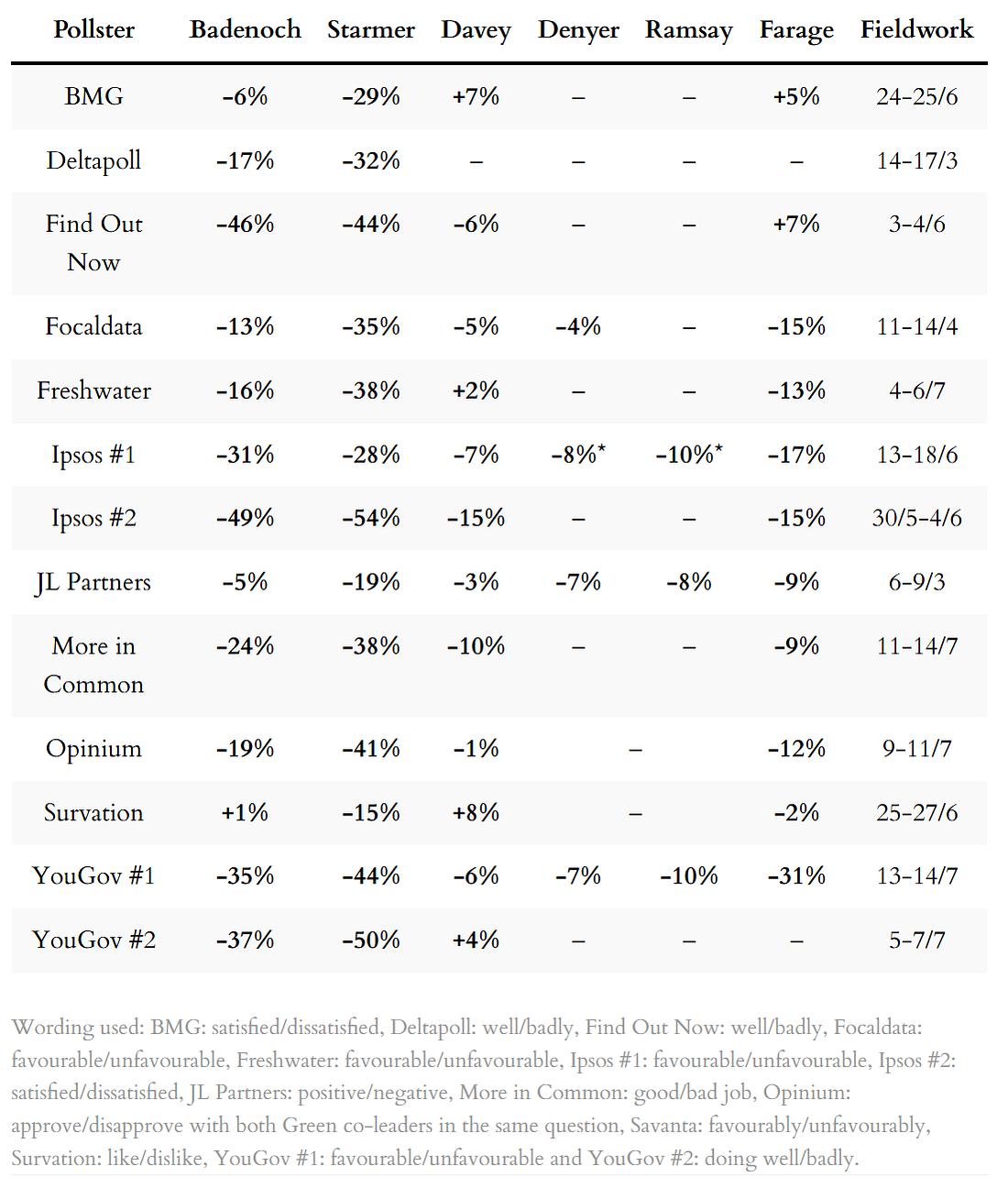
Finally, a summary of the latest leadership ratings, sorted by name of pollster. Little change in the pattern of the figures this time, though note what a big difference question wording makes to whether Starmer’s ratings are in the same region as Badenoch’s, or much worse:
 |
For more details, and updates during the week as each new poll comes out, see my regularly updated tables here and follow The Week in Polls on Bluesky.
For the historic figures, including Parliamentary by-election polls, see PollBase.
Catch-up: the previous two editions
 |
|
 |
|
My privacy policy and other legal information are available here. Links to purchase books online are usually affiliate links which pay a commission for each sale. For content from YouGov the copyright information is: “YouGov Plc, 2018, © All rights reserved”.²
Quotes from social media messages are sometimes lightly edited for punctuation and clarity.
If you are subscribed to other email lists of mine, please note that unsubscribing from this one won’t automatically remove you from the others. If you wish to be removed from all lists, simply hit reply and let me know.
What messages might Reform be vulnerable to?, and other polling news
The following 10 findings from the most recent polls and analysis are for paying subscribers only, but you can sign up for a free trial to read them straight away.
Steve Akehurst is back with yet more insightful research, this time into Reform...

Continue reading this post for free in the Substack app
| ||||||||||

