|


Welcome to the 220th edition of The Week in Polls (TWIP), a polling newsletter that always welcomes new readers. So please don’t keep TWIP a secret; share it with your friends and colleagues:
This time, I return to some polling history, with the truth about pioneering pollster George Gallup’s famous polling success. The full story is rather different from the myth that he so successfully spread.
This is followed by a summary of the latest national voting intention polls, seat projections from MRPs and the most recent party leader ratings.
Subscribers who pay for the full edition can also read ten insights from the latest polls and analyses, including:
Public attitudes towards how political parties are funded;
How Britain’s attitude towards the USA has changed; and
What heat waves do to our attitudes towards climate change.
If you are not yet a paid subscriber, you can read all ten by starting a free trial now:
For more polling news as it comes in ahead of next week’s edition, you can also follow The Week in Polls on Bluesky.
And with that, on with the show.
George Gallup: self-publicising polling pioneer
One of my favourite pieces of research for my book about polling - Polling UnPacked: The History, Uses and Abuses of Political Opinion Polls - was examining the full story of George Gallup. As the readership of this newsletter has more than doubled since I last wrote about the Gallup myth, here again for your enjoyment is how reality differed from the hype, updated since last time.
If you know a little bit about the history of polling, you probably know something like the following. In 1936, a magazine - The Literary Digest - asked its readers to write in to say who they were going to back for President of the United States. The result was a predicted Republican landslide.
But George Gallup also ran the first modern scientific poll at an election. He said the Democrats would win in a landslide. Not only that, he predicted how wrong the magazine’s figures would be before they came out.
The result? Gallup was right about the election and right about the magazine’s error. Modern polling had shown its superiority and reader self-surveys died off as a way of calling elections. The Literary Digest was reduced to running a headline, “Is our face red!”.
In this story, Gallup is the scientific pioneer who got it right. Yet it’s also a story that is as much, if not more, public relations puffery from Gallup as it is truth.
Even sources that are as sceptical of PR and spin doctors as the Wikipedia editing community give you an uncritical version of Gallup’s self-aggrandisement. (I clearly don’t have enough Wikipedia editors among my readers as that’s still as true now as it was when I pointed it out three years ago!)
It’s the story I used to believe too, until I started researching and asking simple questions such as, ‘what vote shares did Gallup’s polls show?’ and ‘how did they compare with the result?’
Let’s start with how Gallup predicted how wrong The Literary Digest would be. Gallup did his own poll and, claiming to know how the magazine would err, then produced adjusted figures predicting its error. That sounds impressive. Yet as I wrote in that book, Polling UnPacked, Gallup was lucky in getting so close:
Gallup produced his figures six weeks before The Literary Digest survey had yet started, and the magazine’s gathering of responses for its poll lasted several weeks. Therefore, for Gallup to be so close required a large degree of luck, as the support for candidates can change over time.
Even had Gallup’s polling been perfect and his understanding of The Literary Digest’s flaws been spot on, there was no way he could be sure that reality would not change between his poll and the conclusion of that of the magazine. It was not so much a brilliant prediction as a lucky guess. Data made it an informed guess. But a lucky guess it still was, turned by luck and a flair for publicity into apparent brilliance.
Turning to the overall election result, Gallup did correctly predict a clear victory for FDR, something the magazine had failed to do.
But he predicted the Democratic candidate winning 54%, which was seven points off his actual winning vote share of 61%. A seven-point polling miss can also be seen as a pretty big miss (though in this respect Gallup set an early tradition for polls - missing by a lot doesn’t bother people that much if both the wrong figures and the real ones show a landslide win).
Nor was Gallup the only pollster with modern methods to be polling the election. In fact, he wasn’t even the one with the best results as I recount in my book:
He had two rivals who, like him, had developed polling expertise for business research and also applied it to politics: the Fortune survey, masterminded by Elmo Roper (whose commencement of polling for the magazine pre-dated Gallup by a few months), and Archibald Crossley, who masterminded surveys for Hearst Publications. Ironically, Crossley was formerly of The Literary Digest. He had then gone on to pioneer random sampling by telephone to generate radio audience data.
These two rivals of Gallup both also got the 1936 election result right. But Gallup, with his flair for publicity, scooped the attention despite Fortune being closer on the vote shares.
Roper was ahead of Gallup both in adopting modern polling for public consumption and in the accuracy of his 1936 election prediction.
The reality then was that Gallup’s prediction of how wrong The Literary Digest would be was lucky, his own figures were not particularly close - and others got closer than he did. But he was the best self-publicist.
There’s a darker side to the Gallup myth too, which I dig into in more detail in the book. As academic research has shown, he presented his polls as the voice of America, but his methods deliberately downplayed the views of women and of Black Americans. The roots of that may have been in relative turnout at elections (with physical intimidation and legal obstacles reducing turnout among Black Americans, for example). But the down-weighting of their views went wider than that and featured in polls that were presented without caveat as representing the views of all Americans. What he called the voice of America was too much the voice of white, male America.
Of course, Gallup does deserve credit for his 1936 breakthrough. He correctly predicted the winner. His methodology was much better than The Literary Digest’s, and the 1936 US election did mark a turning point in how we try to measure public opinion ahead of an election. He provides a human interest encapsulation of a genuine change for the better.
But in doing so, he’s also become a figure of myth, a myth that doesn’t withstand scrutiny of the evidence.
You can find out more in Polling UnPacked, which is available from Bookshop.org (independent bookshops), Waterstones, Amazon (including Kindle version) or direct from the publisher.
Elsewhere from me…

If you spot a factual error…
Borrowing an idea from Stuart Ritchie and others, if you spot a factual error in an edition of this newsletter, I will give you a free 12-month subscription to the paid-for version (or an extra 12 months on your existing one). Factual errors qualify; grammatical errors or disagreements over interpretation do not and my decision is final. Messages about both of those are always welcome, though.
Voting intention and leadership ratings
Here are the latest voting intention polls from different pollsters. There has continued to be a small improvement in Labour’s poll position, with the party now regularly in second place, behind Reform by single digits. The Greens have also slipped, starting to appear in many polls behind or level with the Lib Dems rather than ahead of them.
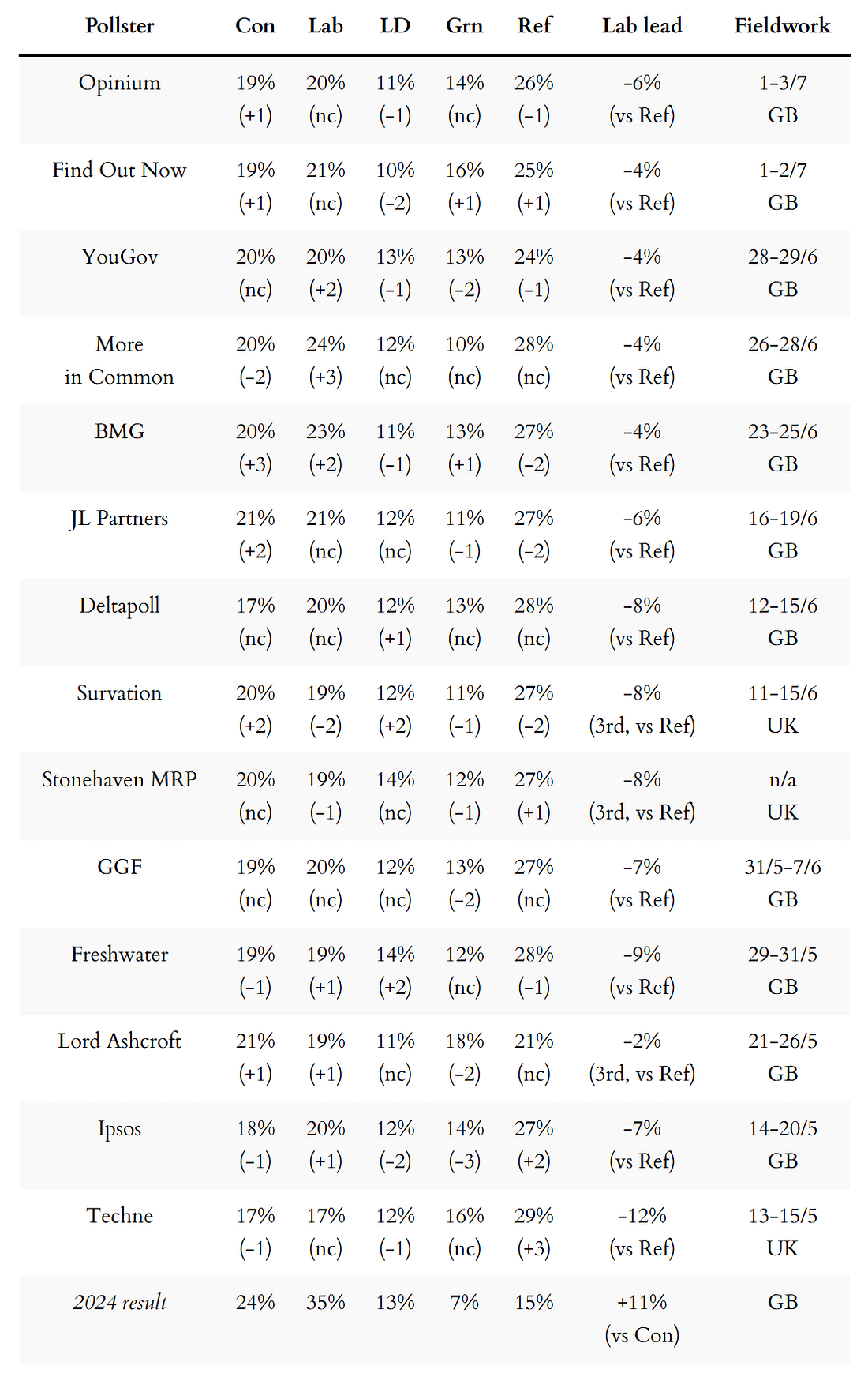 |
Note: the Opinium vote share changes are from their previous poll using the same methodology. There was also an intervening one with a different methodology (prompting for Restore).
The table is also online here, along with explanations about what is included. It is updated regularly throughout the week as new polls are released.
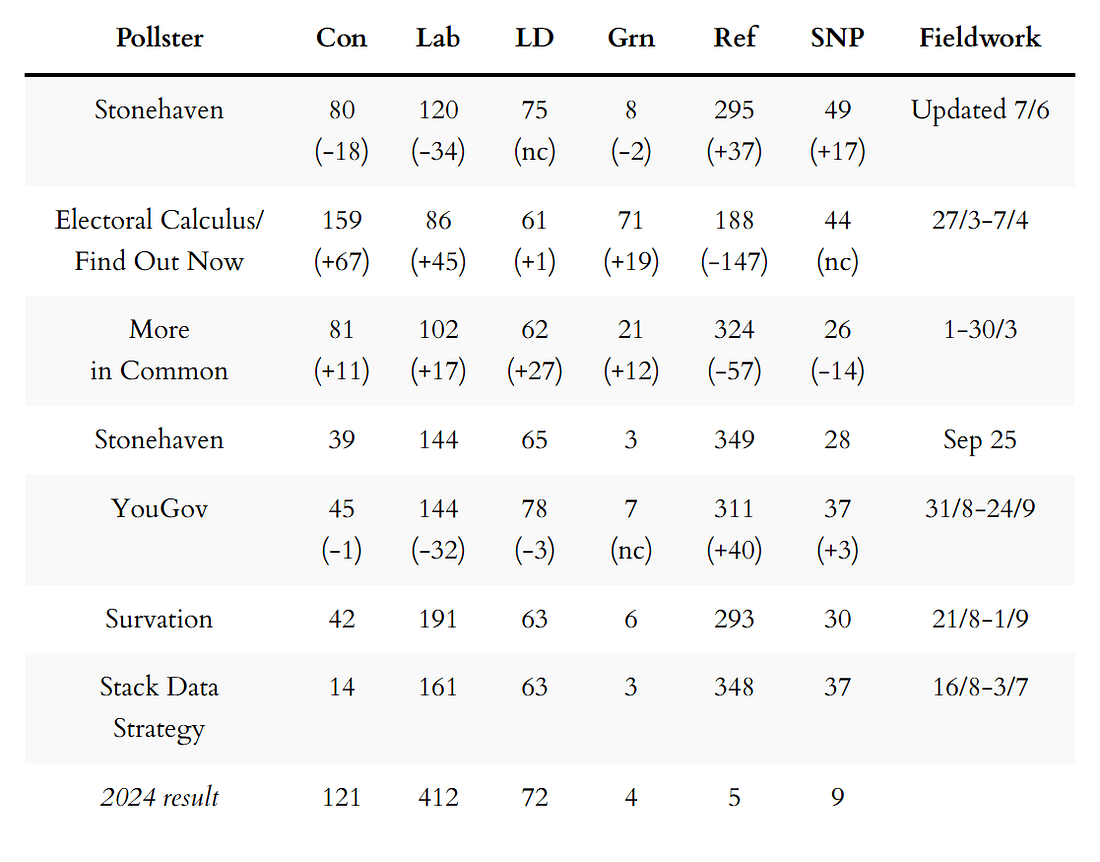
Next are the seat projections from MRPs, also sorted by fieldwork dates. Because they are published infrequently, most of these are somewhat dated.
 |
Finally, here is a summary of the latest leadership ratings, sorted by pollster name. Once there has been a formal change of Labour leader, I will swap in the new person for Starmer.
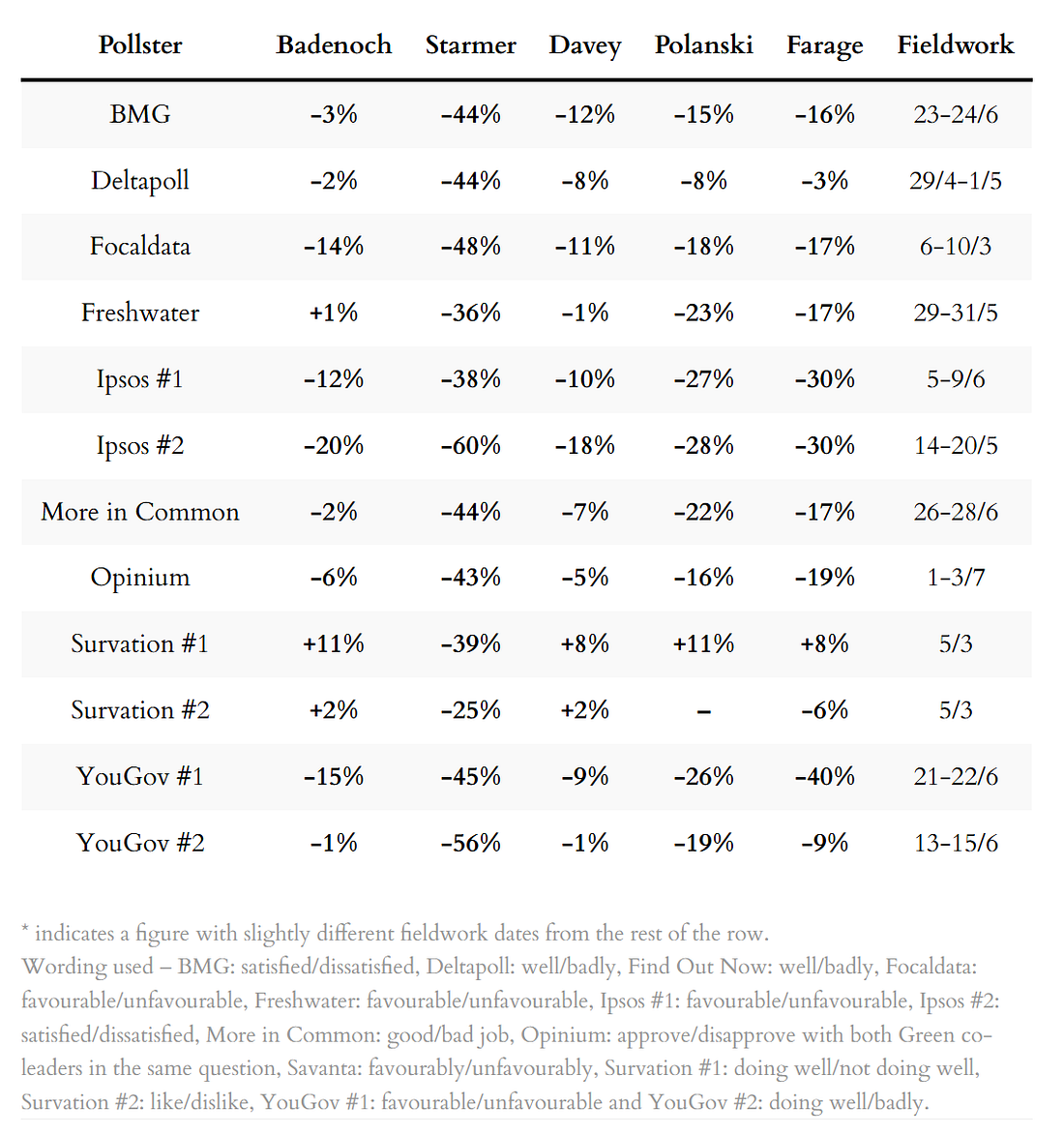 |
The table is also online here with additional details and is updated regularly through the week as new data comes out.
For historical figures on both voting intention and leader approval stretching back to the 1930s, including Parliamentary by-election polls, see PollBase.
Catch up on the previous two editions

 |
|
My privacy policy and other legal information are available here. Links to purchase books or other items are usually affiliate links which pay a commission for each sale.
Quotes from social media messages are occasionally lightly edited for punctuation and clarity.
If you are subscribed to other email lists of mine, please note that unsubscribing from this one will not automatically remove you from the others. If you wish to be removed from all my lists, simply reply to this email to let me know.
Public attitudes to how political parties are funded, and 9 other polling insights you shouldn’t miss
The following 10 findings from the most recent polls and analyses are only for subscribers who pay for the full edition, but you can sign up for a free trial to read them straight away.
The Electoral Commission has some great new research out on public attitudes towards the funding of political parties, which I particularly like because rather than just using the superficial answers from a quickly completed poll, it uses...

Continue reading this post for free in the Substack app
| ||||||||||

