|


Welcome to the 187th edition of The Week in Polls (TWIP), which takes a look at “internal polling” and why a media scoop about Labour’s internal polling is not nearly as insightful as it may seem.
That is followed by a summary of the latest national voting intention polls, seat projections from MRPs, and the most recent party leader ratings.
Subscribers who pay for the full edition can then also read ten insights from the latest polling and analysis. These include:
What critics of NIMBYS often get wrong;
Whether the public thinks the BBC is biased; and
What people say their biggest local issue is.
If you are not yet a paying subscriber, you can read all ten of those insights by starting a free trial now:
For more polling news as it comes through the week, you can also follow The Week in Polls on Bluesky.
This week my eyebrows have been raised by media reports of a poll of junior doctors. The Times headline was, apparently, clear:
Junior doctors’ strike: most don’t back BMA walkout, poll reveals
But down in paragraphs 16 and 17 of the story we get:
The poll involved a sample of 202 junior doctors, including 102 BMA members, who were surveyed over the past week … Of the full sample, 44 per cent agreed strikes should be called off while 35 per cent disagreed and the rest were unsure.
A nine point lead in a poll of 202 people is a much more fragile conclusion than the headline or the rest of the story would reasonably lead you to believe. (Your typical margin of error on this would be around +/-7%, that 9% lead falls within the zone of uncertainty, even if everything else about the poll is perfect.)
And of course as the story has travelled through the media, the caveats have gone from being buried in a story to being missing altogether, as with the Daily Telegraph’s coverage and also that in the Daily Mail.
Peter Kellner has also been writing about this poll and questions raised by the coverage.
Update - On Saturday, Savanta published the data tables on their website which includes the additional information that the results were not weighted. This is not unusual for such a poll but highlights how much it relies on the original sample being representative, particularly as the proportion of BMA members in the sample appears to be off by around twenty percentage points.¹ The poll was commissioned by DHSC, presumably the Department of Health and Social Care. (I have asked the pollster to confirm if this is right.) That in itself does not mean a poll is biased, but if this was a government-commissioned poll, that is a surprising omission from the news coverage.
The question used for the press reports looks to be, “To what extent do you agree or disagree that the BMA should call off the planned strikes, if the following measures were introduced by the Government?” (three measures are then listed which I think match what the government has offered to settle the strike, though I am not an expert on the details of that).
But another question, also asked, has not had its results released: “Do you support or oppose the strike action planned for November 2025 by the British Medical Association Resident Doctor Committee?” It is tempting to speculate - though this is only speculation - that the answers to this question were less helpful to those who commissioned the poll, and hence the answers not being released by the client. Yet it is this, still unpublished, question which is the one that would most directly substantiate - or contradict - The Times’s headline, “… most don’t back BMA walkout …” Again, that makes it a surprising omission from the article.
Peter Kellner has also written a further piece about the poll.
The misleading mystique of “internal polling”
This week PoliticsHome ran a scoop, citing internal Labour poll data:
Half of 2024 Labour Voters Have Gone Elsewhere, Party Privately Tells MPs…
According to the research, carried out by the party and seen by PoliticsHome, of those who have gone elsewhere, 14 per cent say they are undecided how they would vote.
On Labour’s right flank, 11 per cent of people who supported Labour last year now back Reform UK, while three per cent would vote for the Conservatives.
Meanwhile, on its left flank, nine per cent say they would vote for the Liberal Democrats, while six per cent would back Zack Polanski’s Green Party, and four per cent would vote for independents.
The figures suggest Labour’s lost 2024 vote is broadly split between the right and the left.
But… confidential internal polling data, leaked to the media, has a greatly inflated mystique and apparent solidity.
As I wrote in my book, Polling UnPacked:
Internal political polls are not some magical, superior source of information.
Internal political polls generally ask the same or similar questions as public polls. Moreover, the budgets political parties or candidates allocate to such polls are frequently modest, at least outside the USA – and even at many levels of election in the USA.
Yet the problems and risks internal political polls have to grapple with are the same as for public polls, and in fact in some ways worse.
Being private polls for a particular client, there is a risk that the lack of transparency results in skewed findings that favour the client, deliberately or inadvertently.
Likewise, it is much easier for reporting to slip up on what a poll really says if it is a report on a private poll, perhaps only briefly or partially seen by a journalist, and often a general political journalist rather than a polling expert. (The journalistic skills you need to get leaks of internal political information are very different from the skills you need to make sense of a pdf of opinion poll data. One is about charming humans, the other is about analysing data.)…
You also do not have to be too cynical to wonder if sometimes figures are made up, or at least generously weighted and rounded off. It is smarter to be quizzical than to be excited when hearing of reports of internal polls.
Internal polls, where genuine, can nonetheless be useful, to tease out extra information that those running parties and campaigns need to know, such as tracking voting intention in particular areas of the country or society, adding greater detail than national polls provide or testing out different policy ideas ahead of deciding which to select and campaign on.
But if they tell a significantly different story from the public polls, that is almost always because they are wrong.
I go on to give examples of the secret insider polls that contradict public polling also turning out to contradict the truth.
But my favourite example of the undue mystique given to internal polling is slightly different, and comes from 2020:
A superb example of the absurd reverence given to ‘internal’ polling came less than a month before the 2020 U.S. presidential election. The Sunday Times reported that in Britain… , “Boris Johnson has been warned that … private polling and computer models shown to No 10 last month put Biden’s chances of victory at more than 70 per cent.”
That election was very heavily polled with hundreds of published polls, multiple aggregations and projections made public, and the latest news from the polls and models was a regular feature of news in countries worldwide. In that context, ‘private polling’ had nothing to add to what you could glean from reading the U.S. polling page on Wikipedia.
But ‘here are some exclusive private polls, Prime Minister’ certainly sounds more impressive than ‘here is a page printed from Wikipedia, Prime Minister’.
So what about the data given to PoliticsHome this time around?
Rather like my ‘look at Wikipedia’ example, there is nothing special, new or revelatory about it. Because every national voting intention poll that gets published also gives us, in its crosstabs, figures for how votes have flowed since 2024.
While the story touts one poll, we the public already have had 249 such polls this year.
We already have plenty, more than plenty some would (wrongly) say, of data that replicates what this special, secret, exciting, exclusive data is about. And it has been public for months, with several new sets of data being published every week.
This is very much in the territory of ‘leaked Prime Minister’s diary reveals that Wednesday to come after Tuesday next week’.
I don’t really begrudge a journalist writing such a story as, given my general plea for there to be more and better coverage of what political polls really tell us, finding hooks like this to write a longer piece about polling certainly has benefits, even if I’d rather that more of the context from public polling had featured. Making polling newsworthy has advantages.
However, this story has already been told so often in public that I already wrote about it back in July. You can read that piece in full here (and note that it also adds in some reasons to perhaps doubt whether the figures in the internal Labour poll are accurate, though on balance the evidence points towards it being roughly right).
An exclusive, perhaps. Insider data, perhaps. But all we have learnt is what we all already knew.²
Though at least it’s an excuse to plug my book which I quoted from above.
Elsewhere from me…

If you spot a factual error…
Borrowing an idea from Stuart Ritchie and others, if you spot a factual error in an edition of this newsletter, I will give you a 12-month free subscription to the paid-for version of this newsletter (or an extra 12 months on your existing one). Factual rather than grammatical errors, and factual errors rather than disagreements over interpretation. Though messages about both of those are always very welcome.
Voting intentions and leadership ratings
Here are the latest national voting intention figures:
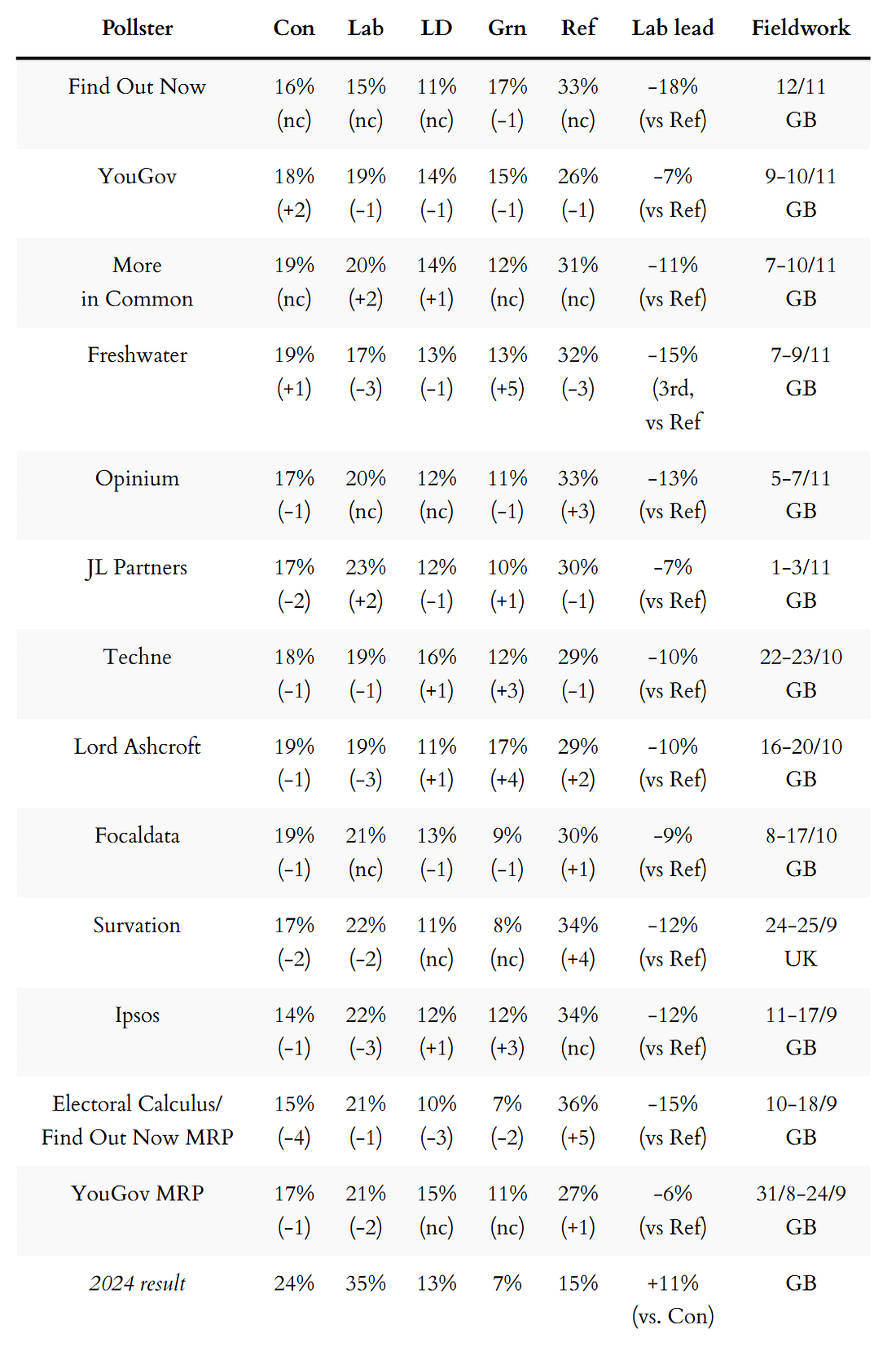 |
The table is also online here and is updated regularly through the week with new polls.
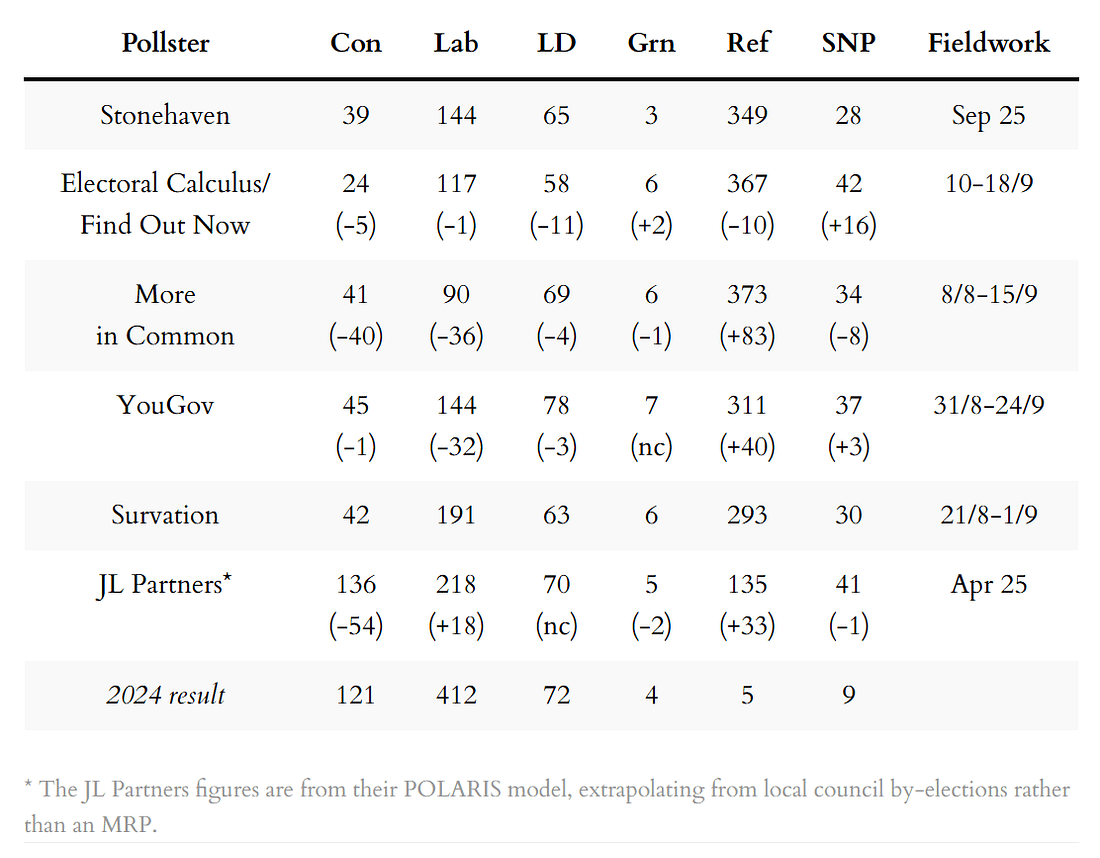
Next, the latest seat projections from MRP models and similar, also sorted by fieldwork dates. As these are infrequent, note how old the ‘latest’ data is.
 |
Finally, a summary of the latest leadership ratings, sorted by pollster name:
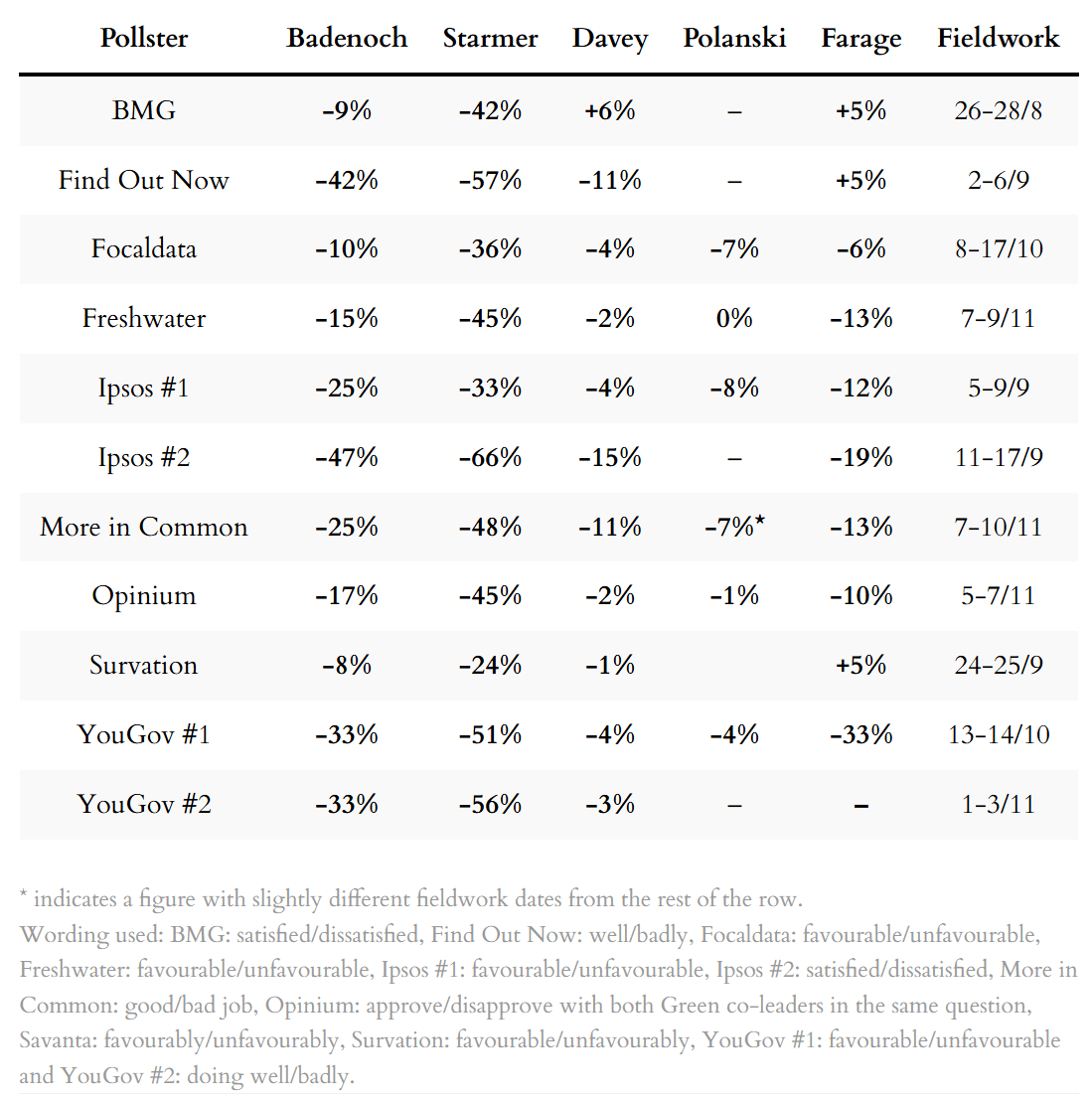 |
The table is also online here with additional details and is updated regularly through the week as new data comes out.
For the historic figures for both voting intention and leader approval, including Parliamentary by-election polls, see PollBase.
Catch up on the previous two editions
 |
|
 |
|
My privacy policy and other legal information are available here. Links to purchase books online are usually affiliate links which pay a commission for each sale.
Quotes from social media messages are occasionally edited lightly for punctuation and clarity.
If you are subscribed to other email lists of mine, please note that unsubscribing from this one won’t automatically remove you from the others. If you wish to be removed from all my lists, simply reply to this email to let me know.
Does a NIMBY/YIMBY divide really exist?, and other polling news
The following 10 findings from the most recent polls and analysis are only for subscribers who pay for the full edition, but you can sign up for a free trial to read them straight away.
Luke Tryl reports of polling by More in Common into attitudes towards house building showing there is a common mistake that people make when thinking...

Continue reading this post for free in the Substack app
| ||||||||||

