|


Welcome to the 232nd edition of The Week in Polls (TWIP), a polling newsletter that always welcomes new readers. So please don’t keep TWIP a secret; share it with your friends and colleagues:
This time, I’m taking a look at the batch of new MRPs, and what the pattern across them all tells us about the state of politics.
This is followed by summaries of the latest national voting intention polls, seat projections from MRPs and the most recent party leader ratings.
Subscribers who pay for the full edition can also read ten insights from the latest polls and analyses, including:
Where people got their news about the May elections from, including how leaflets compared with social media;
A tactical voting handicap for the Conservatives and Reform; and
Which party’s supporters use AI the most.
If you are not yet a paid subscriber, you can read all ten by starting a free trial now:
For more polling news as it comes in ahead of next week’s edition, you can also follow The Week in Polls on Bluesky.
Before we get to all that, two little pieces of news about the troubles polling has been in, one good and one bad.
The good news came from the Daily Telegraph, the paper caught up in the Reform donors exposé as it had wrongly claimed a JL Partners poll had been carried out for it when instead the poll originated via Reform. But a few days ago, I spotted transparency about a poll’s origins above and beyond what’s been the norm in the past in the media: “The polling company Find Out Now (FON) has kindly shared a wealth of data from its own regular monitoring of public opinion about politics, research the firm funds itself.” Let’s hope that is more than a one-off.
The bad news came from IPSO, which describes itself as “the independent regulator for the UK digital and print news industry” and says “we uphold high editorial standards”. I covered earlier in the year a Daily Express story about the polls, with a headline that was not substantiated, indeed was contradicted, by the story that followed. The Express rejected my complaint and now IPSO has also decided not even to investigate it, despite it being such a clear case of misleading coverage and despite the Express’s own response to me strongly implying that it doesn’t think the IPSO Code’s requirements about headlines apply to it. IPSO did not even provide a reason for the rejection.
That’s not upholding high editorial standards; it is giving the green light to misleading headlines.
My usual reminder as well: please do hit reply if you’ve spotted a poll, focus group or new piece of poll-based research that you think should be in contention for coverage in a future edition. Thank you!
And with that, on with the show.
What five MRPs agree on, and where they differ
Four (four!) MRPs have been released in recent days. Given how coverage of political polling usually goes, though, while the MRPs have collectively had a good chunk of coverage, nearly all of it has been about one or another rather than looking at the full set. Yet of course pollsters and polling pundits repeatedly remind us not to pay attention to just the one poll. So let’s put that right, and look at all four.
Or rather, let’s look at five, because the fieldwork dates for the four new ones also straddle the release, a few weeks back, of a fifth from Stonehaven:
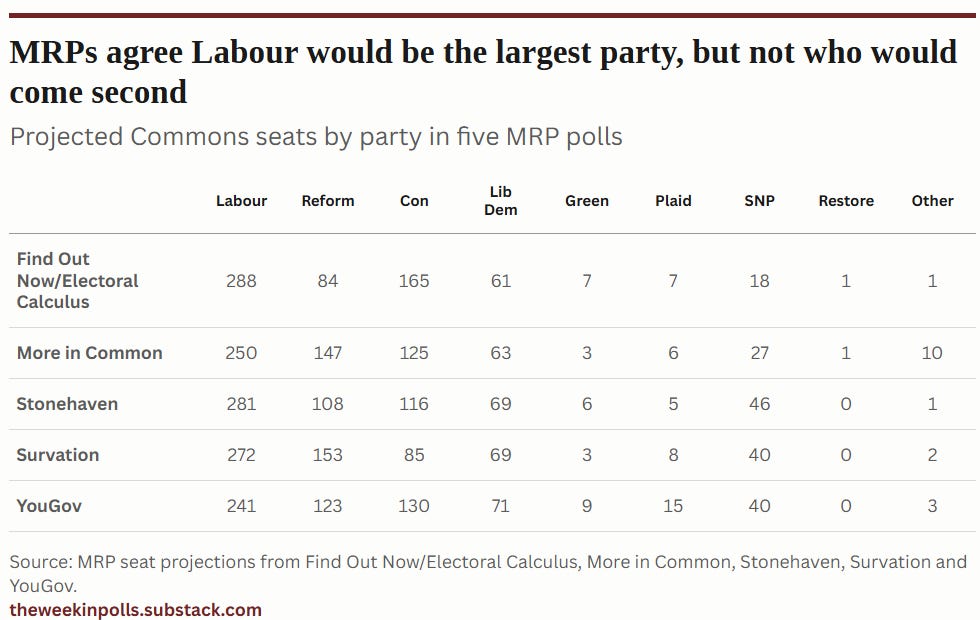 |
Where an MRP has excluded the Speaker’s seat from its calculations, I have added one to the ‘other’ column. The Electoral Calculus/Find Out Now MRP was carried out for Restore, but Martin Baxter has confirmed that the methodology was very similar to that used for their quarterly MRPs with PLMR and that the results are directly comparable.
Four things strike me about this.
First, the similarity of seat numbers across all the MRPs for Labour, the Lib Dems and the Greens. The political story is also the same for each party across the MRPs. Labour is consistently the largest party, though well short of a majority (a big net loss of seats, but a huge improvement on the situation under Starmer), the Lib Dems are on figures very similar to their general election result (which, given the party’s traditional mid-term dip in such things, is promising) and the Greens are performing around, or a little better, than their 2024 general election result (enough to give reasonable hope for making gains but also well down on their boom earlier this year).
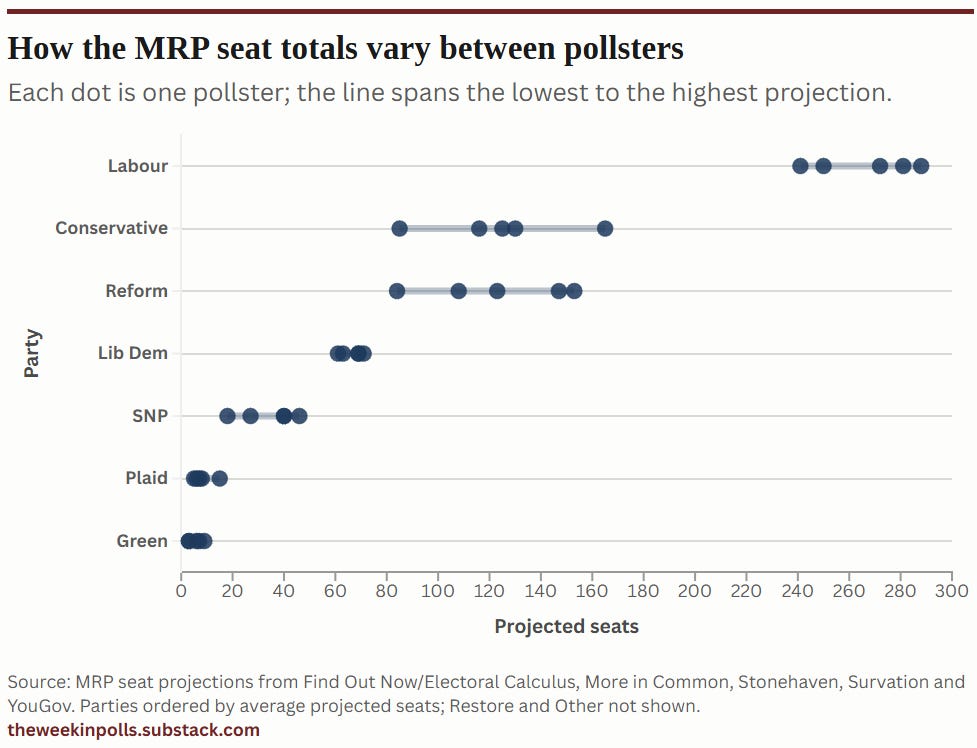
Second, there is a big range for both the Conservatives and Reform, and these encompass rather different stories as to which is largest and so has the upper hand on the right.
The Conservative plus Reform total, however, varies modestly, in large part due to the significant number of seats that have Reform and Conservatives finishing in the top two regardless of which one is the winner. The big political significance is that the combined total, however it breaks down between the two parties, consistently comes in a long way short of what is required for a majority.
 |
Third, in two respects, the MRP figures need treating with even more caution than usual. The pollsters are split over their picture for the SNP and, in addition, the resolution of MRPs is not high enough to reliably document Restore’s fortunes given its current levels of support and geographic concentration. Three of them ‘showing’ that Rupert Lowe would lose his seat is not meaningful; identifying the size of any personal vote for him in his own constituency is more than an MRP can do. (Nor should you pay too much attention to the MRP figures in the constituencies for the high-profile Conservative to Reform defectors as again, that’s beyond the resolution of these MRPs.)
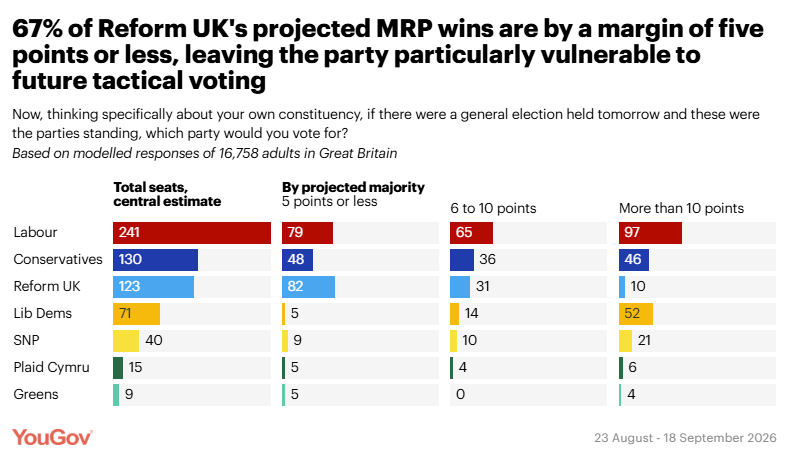
Fourth, a lot of seats are very close in these figures. As an example, look at this analysis from YouGov:
 |
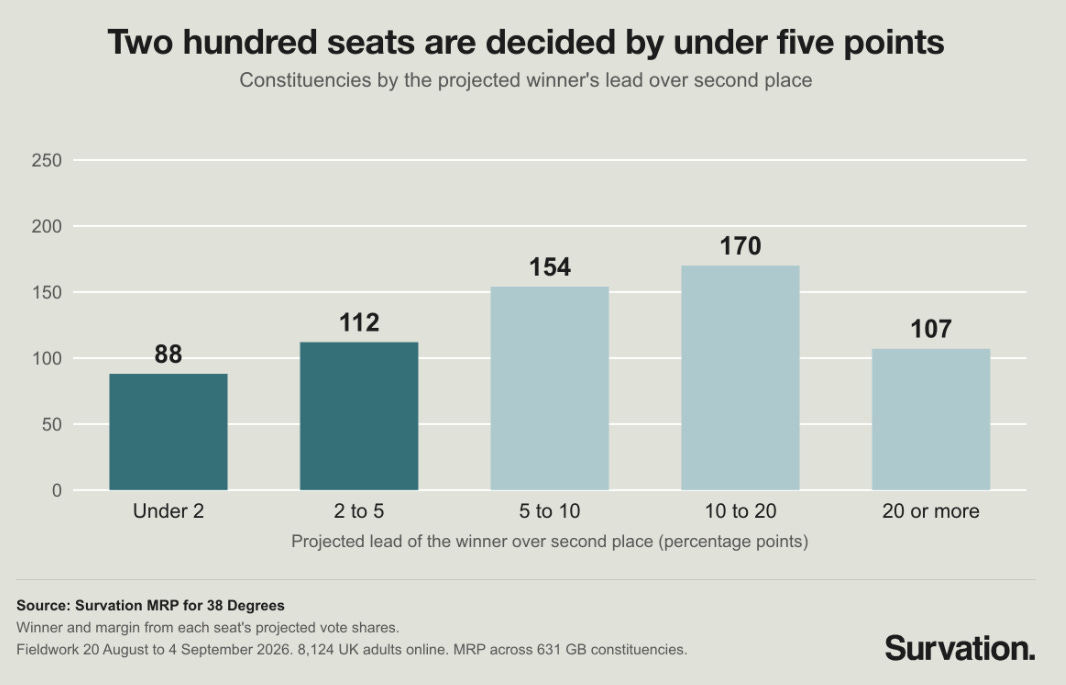
Survation has a similar picture:
 |
Or as More in Common put it:
Of the 631 seats contested by the parties, 302 (48 per cent) would be won by a margin of fewer than five points, 137 by fewer than two points, and 82 by less than a single point.
This cuts both ways regarding the utility of MRPs. Having so many seats be so close on the one hand makes life much harder for pollsters. On the other, it helps show the value of MRPs above simply having national voting intention polls.
People will of course pore over the details of individual seats, giving them more attention and reading into the figures greater precision than is warranted. Overall, however, the picture across them is sufficiently similar to give some reassurance that they are telling us a useful story.
And also, bearing in mind the political significance of the range in Conservative and Reform numbers, you really shouldn’t pay attention to just one MRP on its own.
Elsewhere from me…

If you spot a factual error…
Borrowing an idea from Stuart Ritchie and others, if you spot a factual error in an edition of this newsletter, I will give you a free 12-month subscription to the paid-for version (or an extra 12 months on your existing one). Factual errors qualify, but grammatical errors or disagreements over interpretation do not, and my decision is final. Messages about both of those are always welcome, though.
Voting intention and leadership ratings
Here are the latest voting intention polls from different pollsters. (The fieldwork for most of the ‘new’ MRPs started sufficiently far back that they have not made it into this table.)
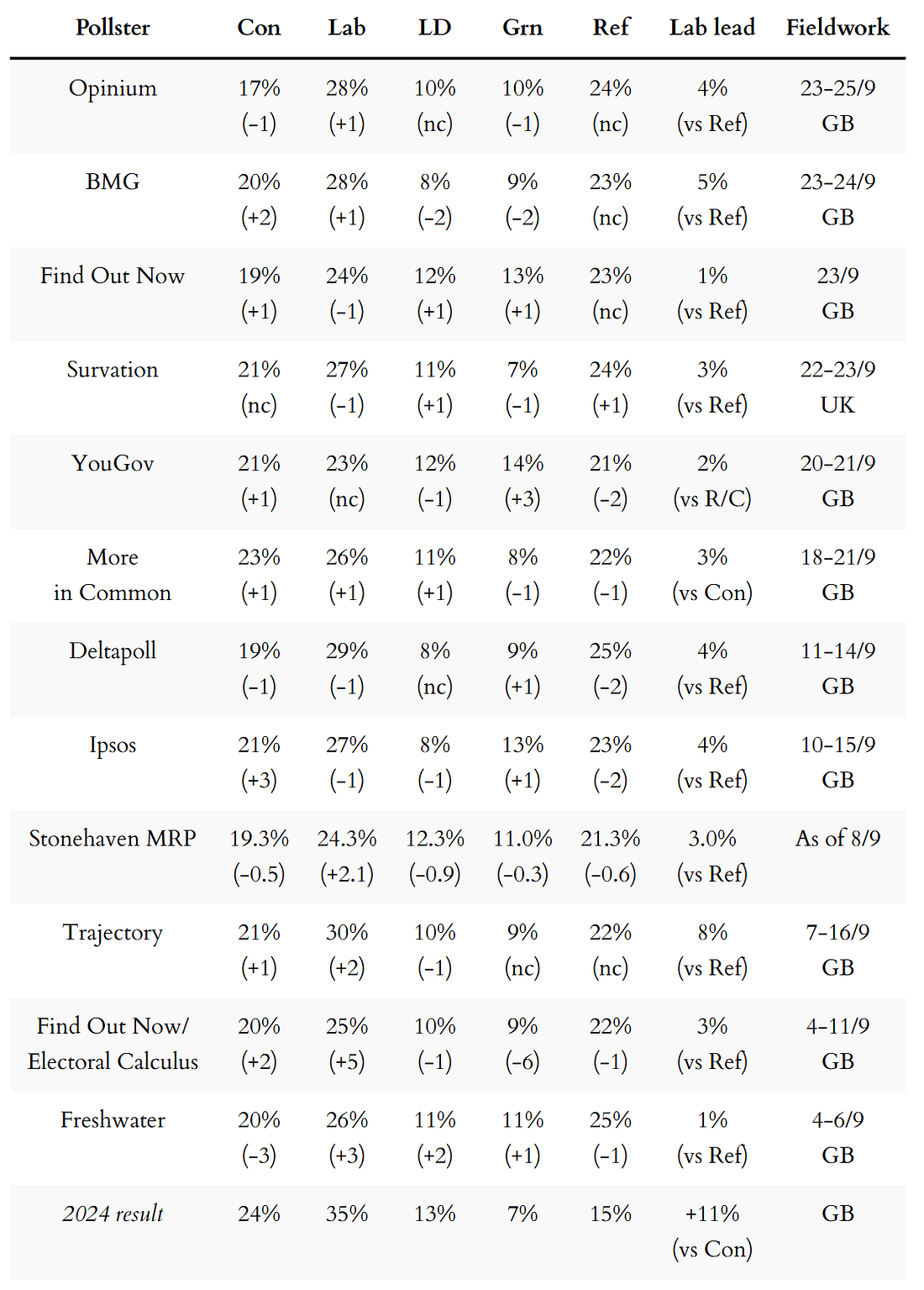 |
The table is also online here, along with explanations about what is included. It is updated regularly throughout the week as new polls are released.
Next are the seat projections from MRPs, also sorted by fieldwork dates, listing those which are based on dedicated fieldwork (rather than models based on averages of other polls).
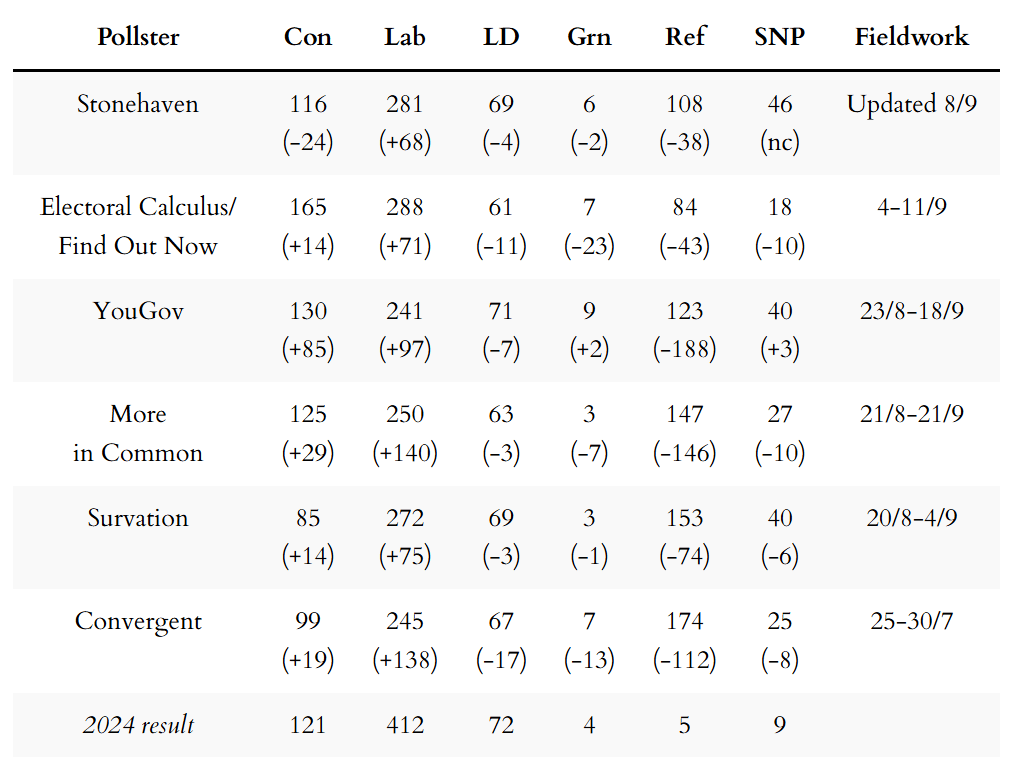 |
Finally, here is a summary of leadership ratings, with a graph from The Times:
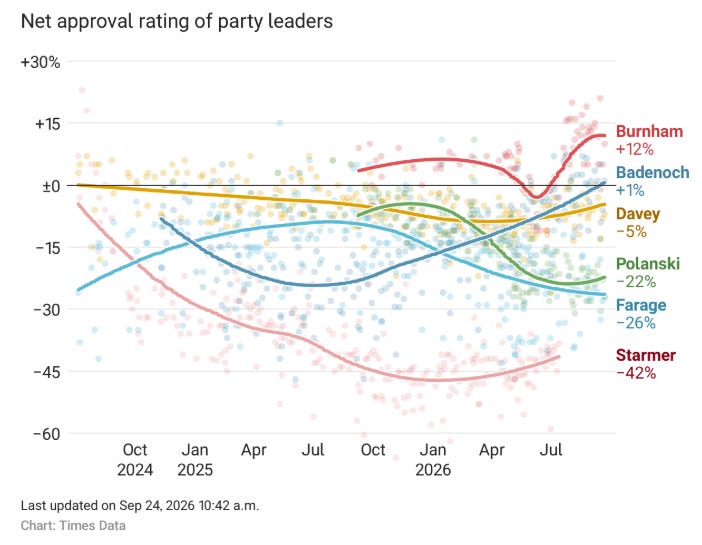 |
Detailed numbers from the latest polls are online here, and both that and the graph are updated regularly throughout the week as new data comes out.
For historical figures on both voting intention and leader approval stretching back to the 1930s, including Parliamentary by-election polls, see PollBase.
Catch up on the previous two editions
 |
|
 |
|
My privacy policy and other legal information are available here. Links to purchase books or other items are usually affiliate links which pay a commission for each sale.
Quotes from social media messages are occasionally lightly edited for punctuation and clarity.
If you are subscribed to other email lists of mine, please note that unsubscribing from this one will not automatically remove you from the others. If you wish to be removed from all my lists, simply reply to this email to let me know.
How did people get news about the May elections?, and 9 other polling insights you shouldn’t miss
The following ten findings from the most recent polls and analyses are only for subscribers who pay for the full edition, but you can sign up for a free trial to read them straight away.
Polling by Savanta for Ofcom, carried out shortly after the May elections but only just published in full, shows that, when it comes to getting news about those elections, the most popular source of information picked by people was...

Continue reading this post for free in the Substack app
| ||||||||||

