|


Welcome to the 177th edition of The Week in Polls (TWIP), which this time majors on two updates to stories from previous editions. Both have seen important new data appear, which makes them worth revisiting.
Next comes a summary of the latest national voting intention polls, seat projections from MRPs and the most recent party leader ratings.
Subscribers who pay for the full edition can also read ten insights from the latest polling and analysis. These include:
How polling did in the Green Party leadership election.
A great piece from the BBC which uses polling in a way that the media rarely does.
What people think of farmers.
If you are not yet a paying subscriber, you can read all the answers by starting a free trial now:
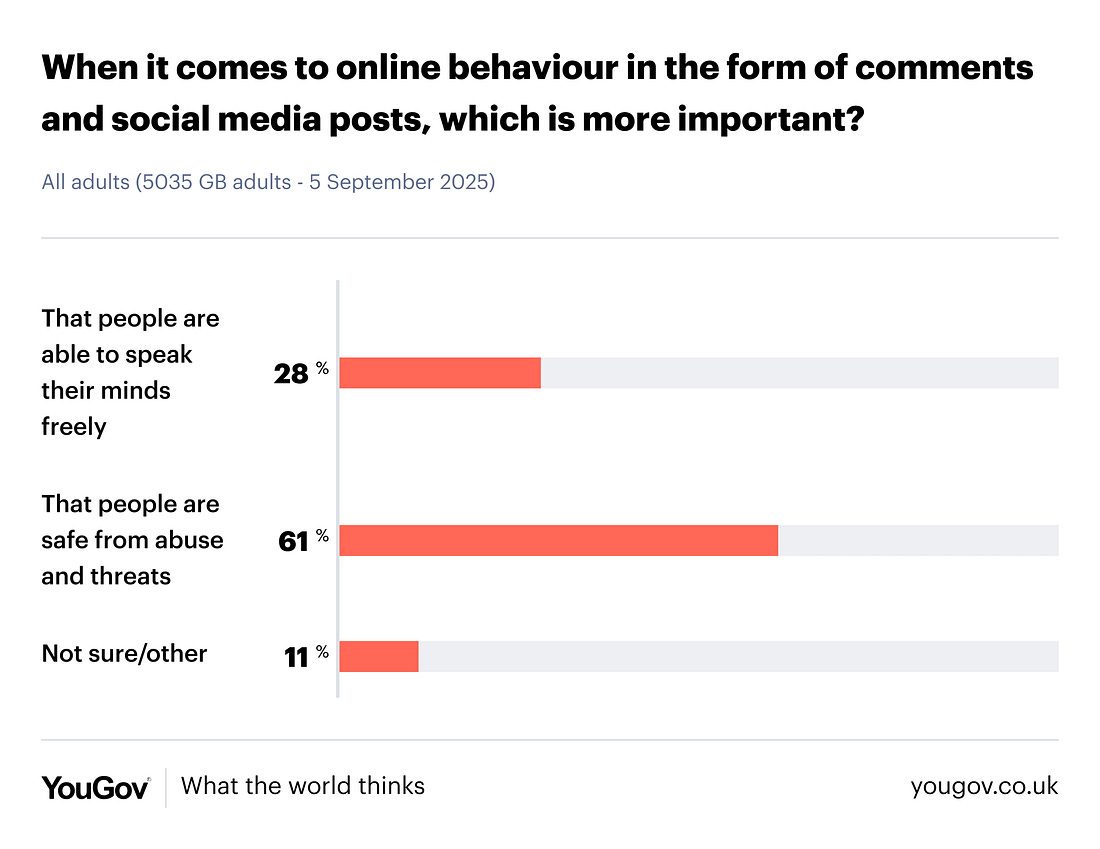
A very brief addition also to my previous post about polling around the Online Safety Act with this new polling from YouGov:
 |
And with that, on with the show.
Want to know more about political polling? Get my book - Polling UnPacked: the history, uses and abuses of political opinion polling.
What has happened to Labour’s 2024 vote?
Labour’s vote has gone down, obviously, but where has its support gone?
A few weeks ago I wrote:
[Pollsters] split into very different camps in what they tell us has happened to the 2024 Labour vote.
I calculated for each pollster where they showed Labour’s vote going, i.e. whether the story is about Labour losing votes to Reform and the Conservatives, or to the Lib Dems, Greens and nationalists:
Here is a league table of pollsters, showing the ratio each pollster finds between liberal/left switchers and populist/right switchers. If, say, a pollster has twice as many going to the former than the latter, then the ratio is 2. But if three times as many go to the latter than the former, the ratio is 0.3.
Here is the listing:
Find Out Now: 2.7
YouGov: 2.2
Find Out Now / Electoral Calculus: 1.6
Ipsos 1.2
Techne 1.2
Opinium 1.1
More in Common 0.9
BMG 0.9
Freshwater 0.7
Survation 0.5The variation here is striking. While Find Out Now has Labour losing almost three times as many voters to the liberal/left than to the populist/right, Survation has Labour losing twice as many to the populist/right as to the liberal/left.
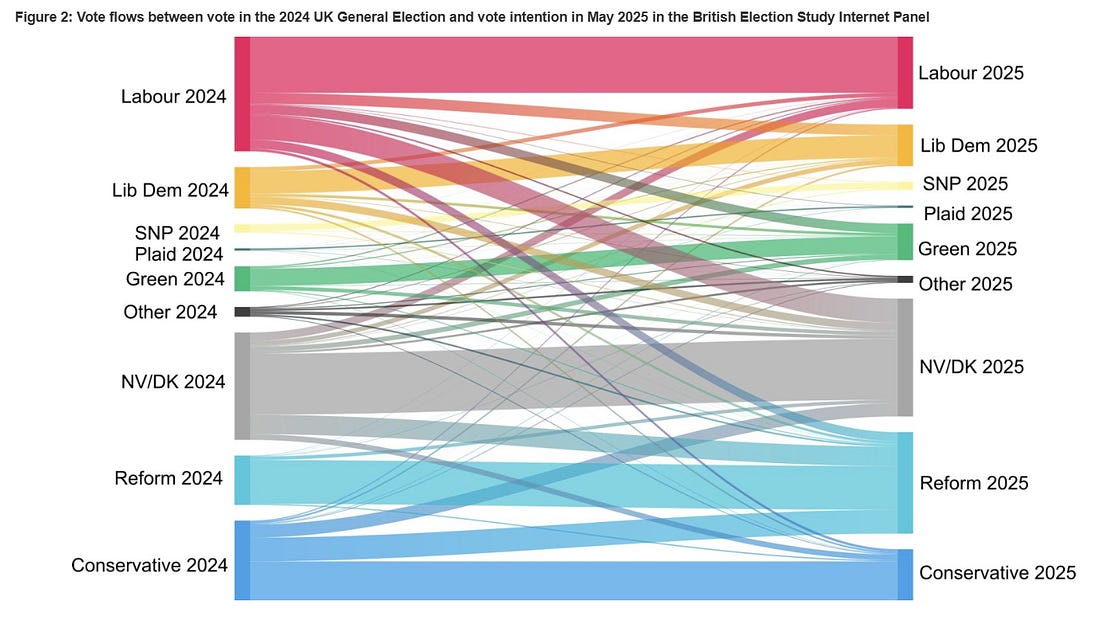
We now have some new, high-quality data courtesy of the British Election Study (BES). As the fieldwork is conducted by YouGov, so it is not a surprise that the BES data accords with YouGov’s own findings:
Labour’s biggest losses have been to indecision. Over 1 in 5 of 2024 Labour voters now say that they either would not vote or that they don’t know which party they would vote for. This is noteworthy because many headline polls only show vote intentions for respondents who pick between the parties.
The Conservatives lost a similar — albeit slightly lower — proportion of their voters to indecision in 2015, 2017, 2019, and in two elections they were able to convince the bulk to return (if we include non-voters, 65% returned in 2017, 70% in 2019, but only 31% in 2024). Therefore, undecided voters present both a risk and an opportunity for Labour — they might lose them for good, or they could win them back.
Labour have lost a further 27% of their support to rival political parties, with other left-liberal parties being the main beneficiaries (9% to the Liberal Democrats, 8% to the Greens, and smaller amounts elsewhere).
Labour have lost some support to Reform UK (8% of their 2024 electoral coalition), but the growth in support for Nigel Farage’s party has come mainly from other sources: 42% of Reform’s new supporters come from the Conservatives and 33% were non-voters in 2024, compared to only 16% who voted for Labour.
Or in graphical form:
 |
As the BES piece adds:
These patterns reflect the broader realignment in British politics, where – with some caveats for Scottish trends – voters tend to see parties as belonging to one of two major blocs: a left-liberal bloc (Labour, Liberal Democrats, Greens, and nationalists) and a right-conservative bloc (Conservatives and Reform). In both the 2024 election and the year since, those voters who have changed parties have mostly switched to a party within a particular bloc rather than between them.
Can Large Language Models/AI replace polling?
Over the summer I wrote:
According to The Spectator, Labour’s Morgan McSweeney is “experimenting with 'synthetic voters' – essentially fake focus groups of AI voters who can tell ministers more quickly and cheaply what the public thinks of policies”. Hmmm… though this is a good time to remind readers that using AI bots to quiz real people is a promising approach for conducting research.
We can now replace my “Hmmm” with some new evidence.
For although McSweeney is not alone in his interest in the idea (hello Ipsos!), the last few days brought us some evidence on how such approaches work.
The research is the brainchild of G. Elliott Morris:
Over the last two months, I have been working with the (human) polling company Verasight on a set of whitepapers assessing the accuracy of these LLM-generated synthetic samples. In our new and first white paper, I benchmarked multiple large language models against a high-quality, representative survey of 1,500 U.S. adults.
The results? Not good for synthetic fans:
We find that the AIs cannot successfully replicate real-world data. Across models, the LLMs missed real population proportions for Trump approval and the generic ballot by between 4 and 23 percentage points. Even the best model we tested overstated disapproval of Trump, and almost never produced “don’t know” responses despite ~3% of humans choosing it.
It gets worse:
When we tested the ability of a set of LLM “digital twins” to replicate population proportions on questions about topics the AI hadn't already been trained on — issues that emerged after the model's knowledge cutoff — the synthetic polling completely fell apart. On a question about local zoning reform, the AI not only got the percentages wrong but actually flipped which position had majority support.
These findings mirror previous academic research which found that:
Sampling by ChatGPT is not reliable for statistical inference: there is less variation in responses than in the real surveys, and regression coefficients often differ significantly … Our findings raise serious concerns about the quality, reliability, and reproducibility of synthetic survey data generated by LLMs.
Some of the problems he found are perhaps fixable. For example, this test found that the AI model repeatedly put down too few people as uncertain on an issue. That is an important error, but is perhaps also the sort of systematic error that future versions of AI models can fix.
Even if improvements can be made, this test is another strong pointer towards synthetic polling data not being fit to use at the moment for political polling.
You can read more in his full Substack post:

If you spot a factual error…
Borrowing an idea from Stuart Ritchie and others, if you spot a factual error in an edition of this newsletter, I will give you 12 months free subscription to the paid-for version of this newsletter (or an extra 12 months on your existing one). Factual rather than grammatical errors, and factual errors rather than disagreements over interpretation. Though messages about both of those are always very welcome.
Voting intentions and leadership ratings
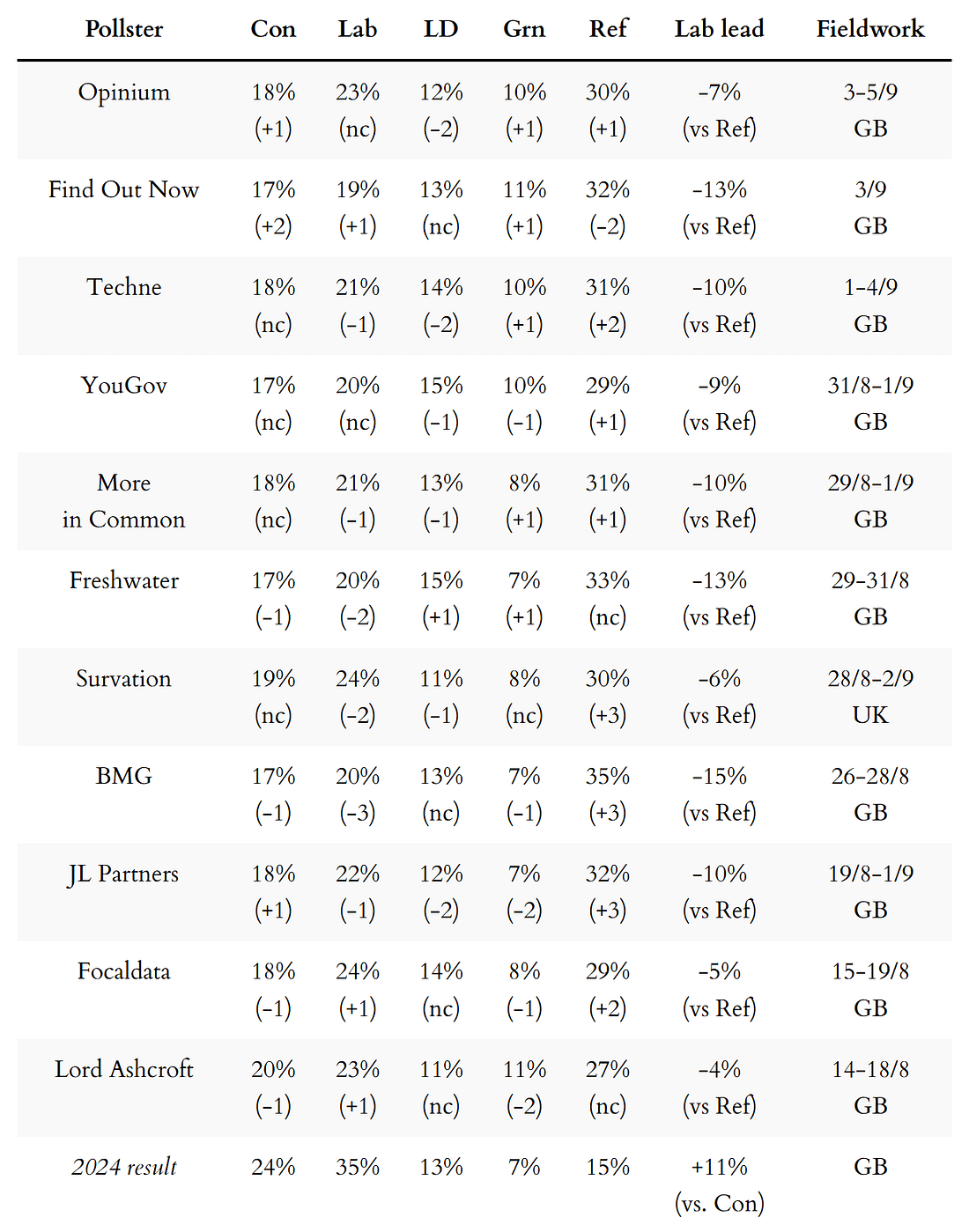
Here are the latest national voting intention figures from each of the pollsters currently active.
Last week I highlighted the two leads for Reform deep into double figures but cautioned they came from only two polls. Now we have more polls in and … the picture is back to where it was before those two polls.
 |
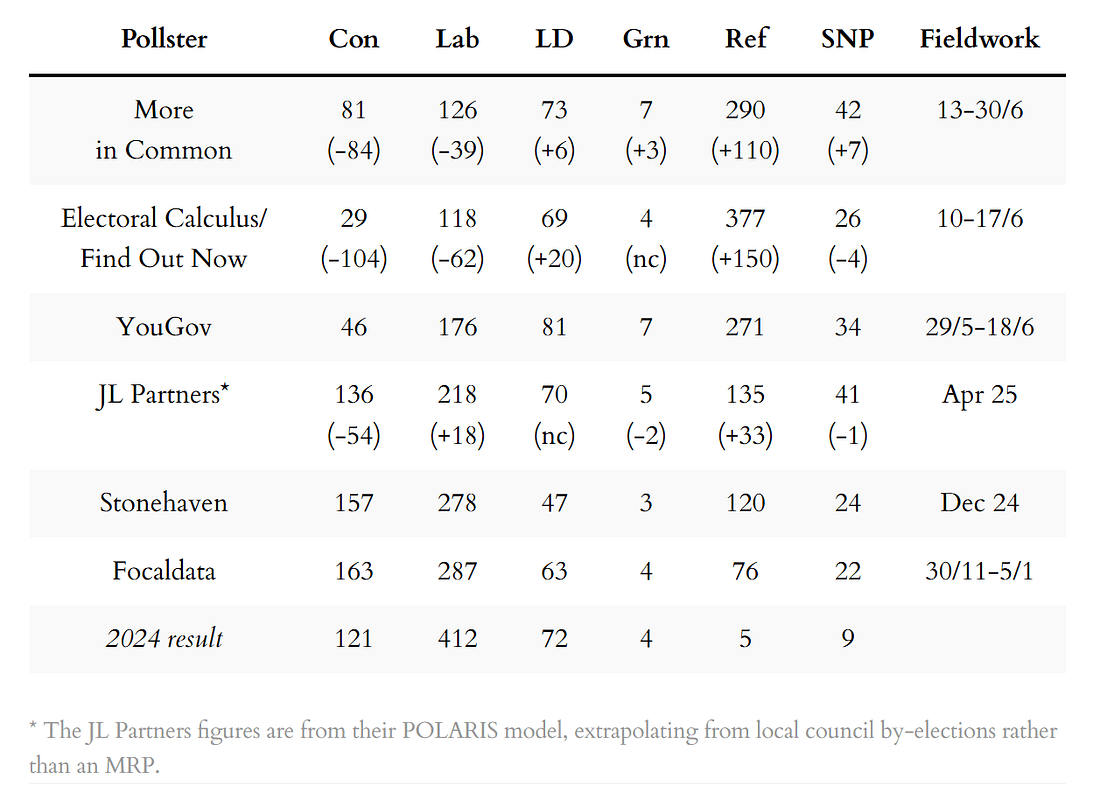
Next, the latest seat projections from MRP models and similar, also sorted by fieldwork dates. As these are infrequent, note how old the ‘latest’ data is.
 |
Finally, a summary of the latest leadership ratings, sorted by pollster name:
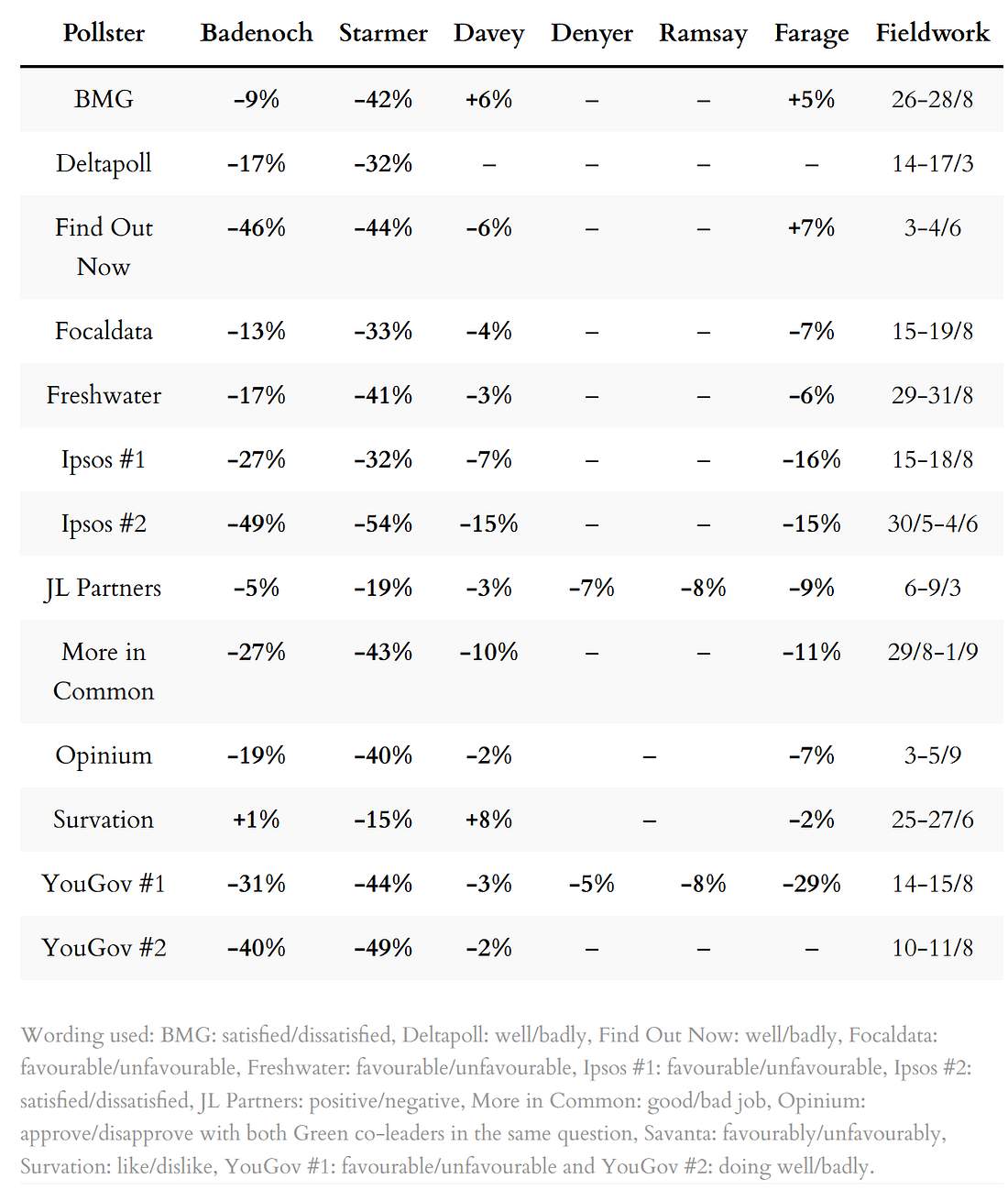 |
For more details, and updates during the week as each new poll comes out, see my regularly updated tables here and follow The Week in Polls on Bluesky.
For the historic figures, including Parliamentary by-election polls, see PollBase.
Catch up: the previous two editions
 |
|
 |
|
My privacy policy and other legal information are available here. Links to purchase books online are usually affiliate links which pay a commission for each sale. For content from YouGov the copyright information is: “YouGov Plc, 2018, © All rights reserved”.¹
Quotes from social media messages are occasionally lightly edited for punctuation and clarity.
If you are subscribed to other email lists of mine, please note that unsubscribing from this one won’t automatically remove you from the others. If you wish to be removed from all my lists, simply reply to this email to let me know.
Are young women more left wing than men?, and other polling news
The following 10 findings from the most recent polls and analysis are only for subscribers who pay for the full edition, but you can sign up for a free trial to read them straight away.
The BBC has a good new summary of the evidence around the apparent ...

Continue reading this post for free in the Substack app
| ||||||||||

