|


Welcome to the 186th edition of The Week in Polls (TWIP), which takes a look at a common - and superficially reasonable - critique of polling, namely people saying they don’t know anyone who has ever been polled.
That is followed by a summary of the latest national voting intention polls, seat projections from MRPs and the most recent party leader ratings.
Subscribers who pay for the full edition can then also read ten insights from the latest polling and analysis. These include:
Which party is best placed to beat Reform?
Which party leader do voters give the best ratings to on trust? and
What MPs think of fiscal rules.
If you are not yet a paying subscriber, you can read all ten of those ten insights by starting a free trial now:
For more polling news as it comes through the week, you can also follow The Week in Polls on Bluesky.
This week my eyebrows have been gently raised by those rushing to show that the high-profile election win by a man in the USA demonstrates their views were right all along, while neglecting to mention the two high-profile election wins by women.¹ But there’s been more than enough commentary of that sort, and there has also been some rather better commentary too, so let’s get on with the show.
How come I don’t know anyone who has been polled?
Variations on “I’ve never been polled and I don’t know anyone who has been” are common amongst people sceptical about opinion polls. Can the polls really be trusted if you don’t know anyone who has been polled?
Yes they can, and here’s why.
The most important reason is that polls do not need to encompass very many people in order to be accurate. A national poll typically needs only around 1,000 participants (see my piece here on why 1,000 samples are sufficient).
In the UK with an adult population of nearly 70 million, that means random chance would give you approximately a 1 in 70,000 chance of being included in any one poll. (For a similar calculation from the US, see the Pew Research Center.)
Of course, lots of polls take place. So let’s extend that.
There are currently 39 pollsters who are members of the industry self-regulatory body for polling. But there are other pollsters, so let’s call that 50 polling firms. Let’s also assume, generously, that each does a poll a week. That gives in round numbers 2,500 polls a year.
What’s your chance of never being polled in a year then, assuming those polls pick adults at random? It’s in round numbers 19 chances in 20.
That’s pretty low.
But the real chances are lower still because polls aren’t fully random.
Most polls these days are done through online panels, which means you have to have opted in at some point to be willing to take part in online polls.² A smaller number of polls are via the phone, which means you either need to have a landline number that you are willing to answer to an unknown number (as these can be called at random) or you must have opted to provide your mobile phone number at some point. An even smaller proportion of polling is done face-to-face, but these surveys are slow and expensive, and so very rare.
So that’s why it’s not a surprise if you haven’t been polled.
Nor is it much of a surprise if people close to you haven’t been either.
(Though in addition, how sure are you really that you don’t know someone who has been polled – have you asked everyone?)
This is an update to a piece I wrote a few years back. The biggest change in the interim is the large increase in the number of British Polling Council members. Chapeau, BPC.
Elsewhere from me…

If you spot a factual error…
Borrowing an idea from Stuart Ritchie and others, if you spot a factual error in an edition of this newsletter, I will give you a 12-month free subscription to the paid-for version of this newsletter (or an extra 12 months on your existing one). Factual rather than grammatical errors, and factual errors rather than disagreements over interpretation. Though messages about both of those are always very welcome.
Voting intentions and leadership ratings
Here are the latest national voting intention figures, and once again the latest polls both show a similar big picture yet also have plenty of variation between them. There is an 8 point spread, for example, between the lowest and highest Labour share in the last week and 8 points too for the Greens. With the parties in second to fifth place closely bunched together, those sort of variations are starting to matter.
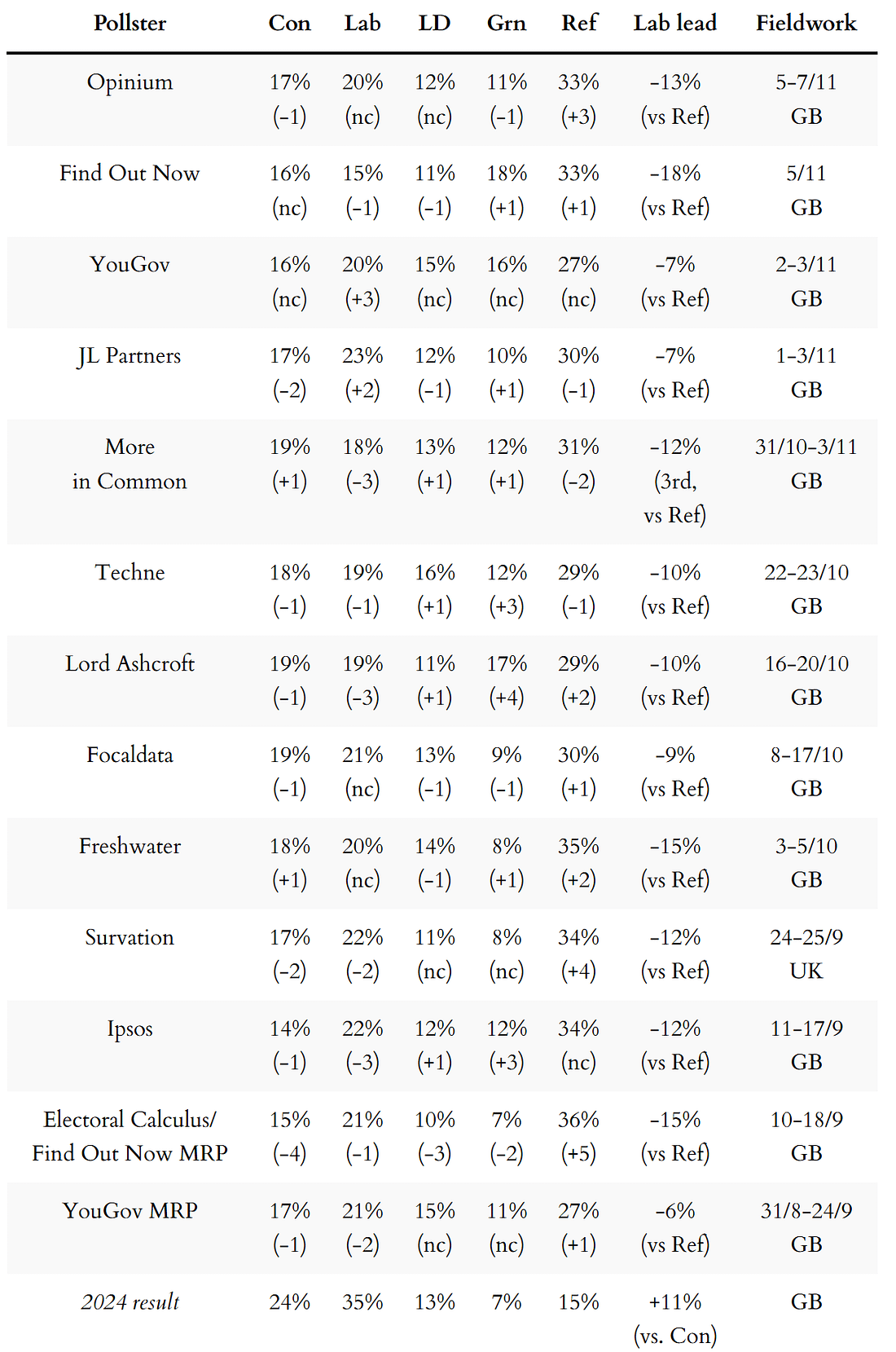 |
The table is also online here and is updated regularly through the week with new polls.
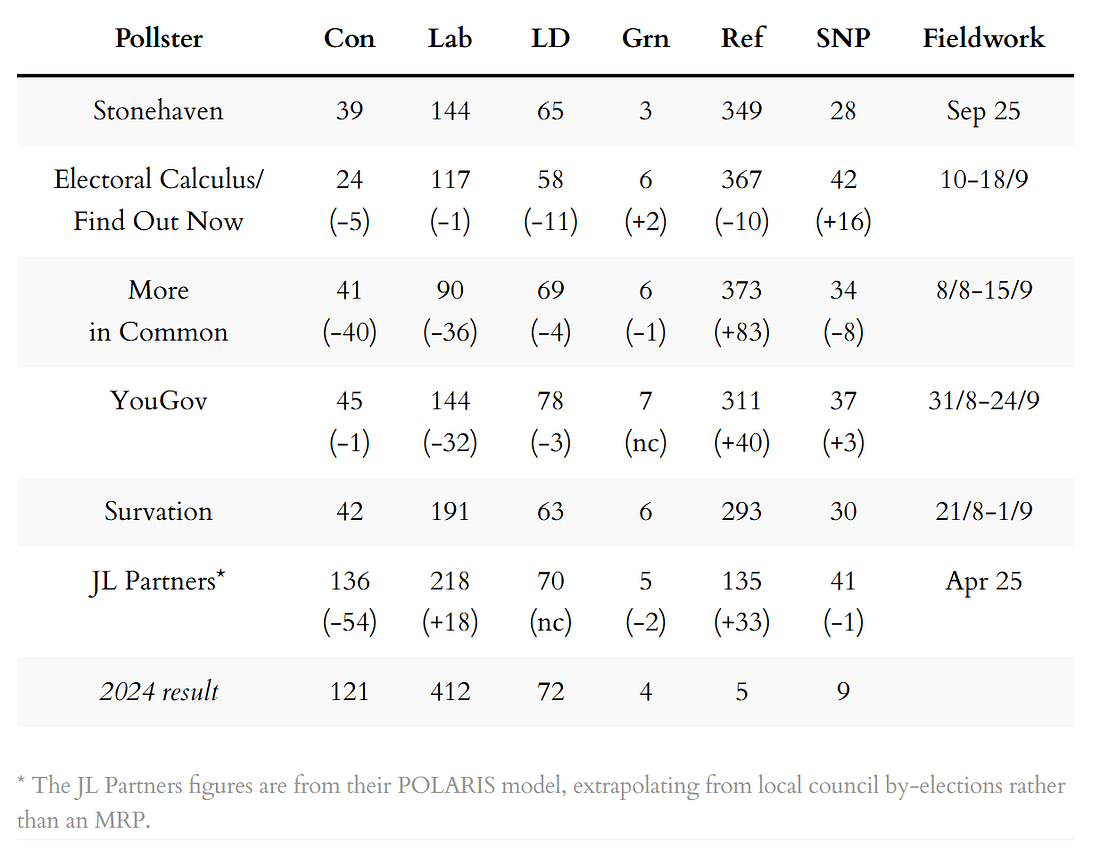
Next, the latest seat projections from MRP models and similar, also sorted by fieldwork dates. As these are infrequent, note how old the ‘latest’ data is.
 |
Finally, a summary of the latest leadership ratings, sorted by pollster name:
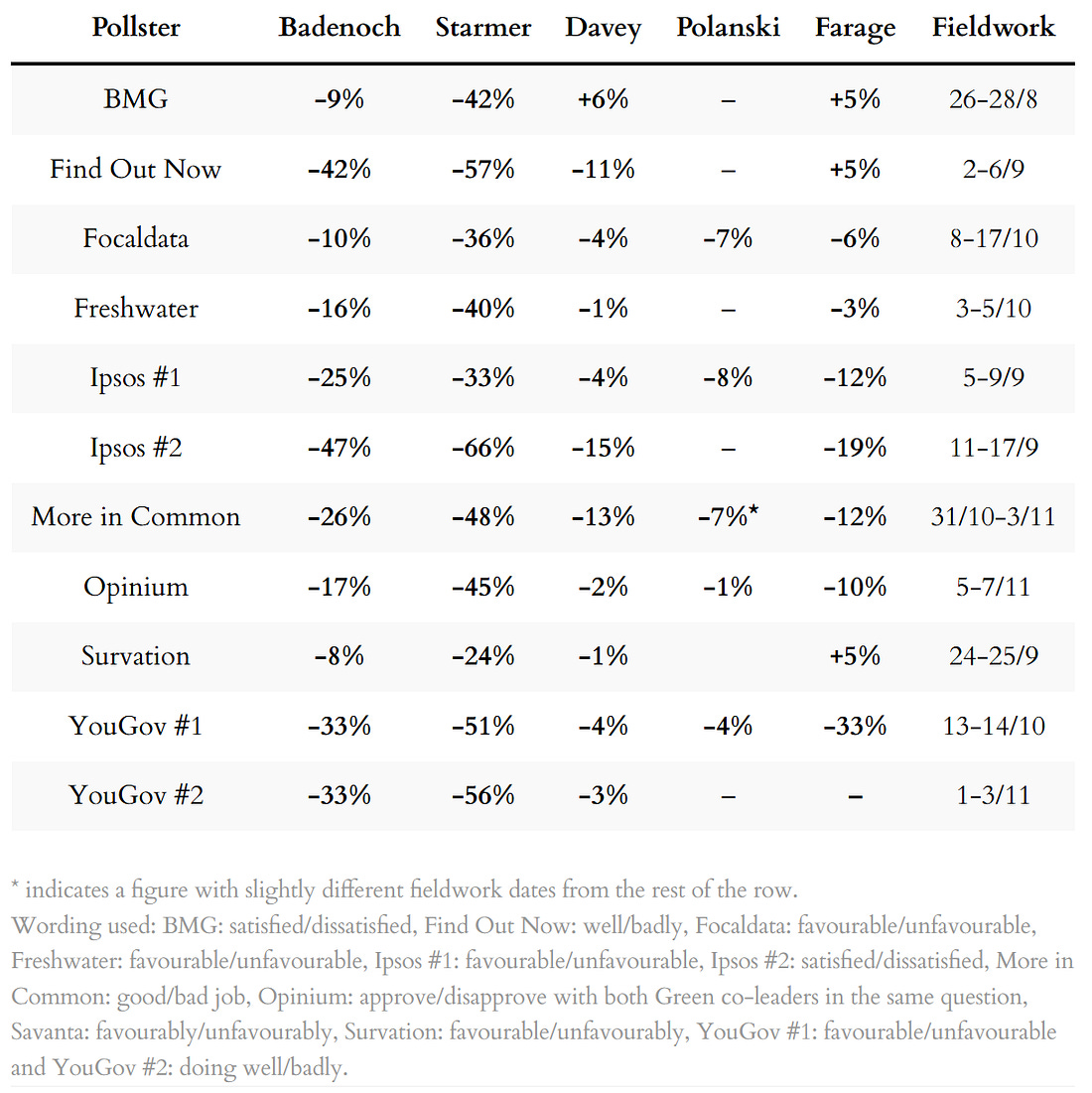 |
The table is also online here with additional details and is updated regularly through the week as new data comes out.
For the historic figures for both voting intention and leader approval, including Parliamentary by-election polls, see PollBase.
Catch up on the previous two editions
 |
|
 |
|
My privacy policy and other legal information are available here. Links to purchase books online are usually affiliate links which pay a commission for each sale.
Quotes from social media messages are occasionally edited lightly for punctuation and clarity.
If you are subscribed to other email lists of mine, please note that unsubscribing from this one won’t automatically remove you from the others. If you wish to be removed from all my lists, simply reply to this email to let me know.
Which party hypothetically does best at beating Reform?, and other polling news
The following 10 findings from the most recent polls and analysis are only for subscribers who pay for the full edition, but you can sign up for a free trial to read them straight away.
YouGov has been asking people how they would vote if the contest in their constituency was a two-horse race between Reform and various other parties. Such questions are a little artificial, as much more goes into voting choice in practice, but also illuminates the potential scope for tactical voting and who might be best at harnessing it. So with that caveat in mind, the results show...

Continue reading this post for free in the Substack app
| ||||||||||

