Happy New Year to all investors, PE partners, operators, executives, M&A advisors, industry professionals, and even students following the newsletter (among the 31,000 subscribers). Here's to a healthy and prosperous 2026 ahead! |
2023 was dubbed "The Year of Efficiency" after Zuckerberg took a hit on his Metaverse project, generating an operating loss of $13.7 billion in FY 2022, rising to $16.1 billion in 2023. |
What followed reshaped boardroom priorities across tech, private equity, and the mid-market. |
Efficiency was not a buzzword, unlike other hypes over the previous years. It was a forced correction, backed by the leading FAANG leaders, investor support, and the public - thanks to the stock market drop of 2022. |
Headcount rationalization, portfolio pruning, vendor consolidation, and margin discipline became non-negotiable. Capital was no longer cheap. Growth narratives were replaced by operating models. |
That reset set the stage for what followed. |
2024: From cost control to building capabilities |
If 2023 was about stopping the bleeding, 2024 was about rebuilding muscle. |
For PE-backed and mid-market firms, 2024 marked the transition from austerity to selective reinvestment. The focus shifted toward: |
Rebuilding operating cadence after layoffs Institutionalizing metrics beyond revenue growth Deploying AI and automation inside finance, ops, and GTM Professionalizing leadership layers ahead of exits or add-ons |
This was the year when AI moved from experimentation to adoption. Not moonshots. Not innovation labs. Practical deployment inside pricing, forecasting, customer support, and content engines. |
The best operators treated 2024 as a capability year. The rest treated it as a tooling year. That distinction matters going into 2026. |
But let's get through 2025 before the current predictions. |
2025: AI across internal teams |
By 2025, the new era of AI had advanced sufficiently: |
ChatGPT turned two by end of 2024, and OpenAI was receiving billions and billions in additional support Google's Gemini was getting integrated across the full suite Salesforce deployed AI everywhere - with Agentforce being the new big thing Anthropic made Claude the foundational model for engineering - and other niche industries |
Gamma became the go-to presentation layer. |
ElevenLabs made voice adoption commodity. |
And the biggest one of all: |
VIBE CODING got mass adoption across product teams, designers, marketers, and different executive functions (including account managers and CX leaders). |
Boards stopped asking "Are we using AI?" and started asking "Where is it changing EBITDA?" |
This is where productivity optimization accelerated while AI was thoroughly investigated under the hood. |
AI budgets came under scrutiny Pilots were killed if they did not touch margins Middle management roles were redefined or removed Smaller teams were expected to outperform larger 2022 orgs |
For PE, this became a diligence issue. AI and automation maturity quietly entered value creation plans, not as upside narratives, but as downside protection. |
Mid-market CEOs felt the squeeze most. Same expectations. Fewer resources. Shorter timelines. |
➡️ 70% of my own time was spent on PE execution across several of these areas - with contracts upsized and several new deals for incredible businesses. The heat was on - and the turbulence wasn't always pleasant, but the purpose was clear. |
2026 forecast: the year of value capture and 10x operators |
I asked AI to assess the previous years of efficiency, the Great Resignation, the Quet Quitting, and other trends over the 2020s. |
That's where it came up with the 2026 one: |
🏆️ "Year of Value, Agents and Organizational Reckoning" |
Looking ahead, 2026 will bridge the pieces together: with more confidence in automation and LLM support, with redefined roles, T-shaped experts, and my favorite role: The AI Operator (which I believe is the next Customer Support or mid-level manager role handling agents). |
For private equity and mid-market operators, three shifts are becoming unavoidable. |
1. From tools to systems |
2026 is the year when disconnected tools become a liability. We saw enough of that with disjointed SaaS apps and a hundred different licenses in 2021-2022 not speaking to one another. |
Firms will be judged on how well existing systems talk to each other: |
Forecasting tied directly to sales pipelines Pricing linked to real-time demand signals Marketing integrated with revenue accountability AI agents embedded across workflows, not bolted on |
PE operating partners will increasingly push for standardized operating systems across portfolios. Not platforms. Systems. |
We spend a good chunk of time on that with our RevOps plans at DevriX, through a proprietary data source analyzing public and private mid-market companies, and their revops maturity. |
2. The rise of the "operator-grade" organization |
Lean teams are here to stay, but resilience and tough skin are paramount today. All of the corporate "lean back" attitude of the 2010s is getting evaporated fast. |
Winning companies in 2026 will be built around: |
Fewer layers, higher judgment density Clear ownership of outcomes, not functions AI as a first-class team member, not a productivity hack Managers who understand systems, not just people |
This favors seasoned operators over visionary generalists. Execution fluency becomes a differentiator at both CEO and functional leader levels. |
3. Valuations will follow proof, not hype |
We live in an AI bubble today. And bubbles are not all bad - they fail when valuations don't pan out and usability is fabricated. |
In 2026, buyers and investors will increasingly reward: |
Predictable cash flow under volatility Demonstrated operating leverage post-AI Evidence of scalable decision-making Clean data, clean reporting, clean narratives |
The systems and models that facilitate that at scale - and contribute at scale toward GMV and revenue growth - will maintain strong valuations and turn into the new FAANG in the coming 2 to 3 years. |
What does this mean for the mid-market world? |
The Growth Shuttle thesis entering 2026 is simple: |
Growth is no longer about headcount and product MOAT is non-existent today. |
PE-backed and mid-market leaders who win will incorporate the right mechanisms to drive efficiency, growth, consistency, and data-driven decision-making. |
Taking a couple of extra days before Q1 officially starts, with three new contracts kicking off on January 5th. |
If your revenue lifecycle plan for 2026 isn't ready yet, the time is now. |
Mario |
|
|
|
👨🏭 LinkedIn delivering a month-old content - I consistently get served content in my feed that's weeks old - if you're seeing the same, drop in and let's investigate. |
💼 Hiring in Sofia - our DevriX team is scaling in our HQ in Sofia. If you're based in Sofia or have peers you can recommend, please touch base here. |
|
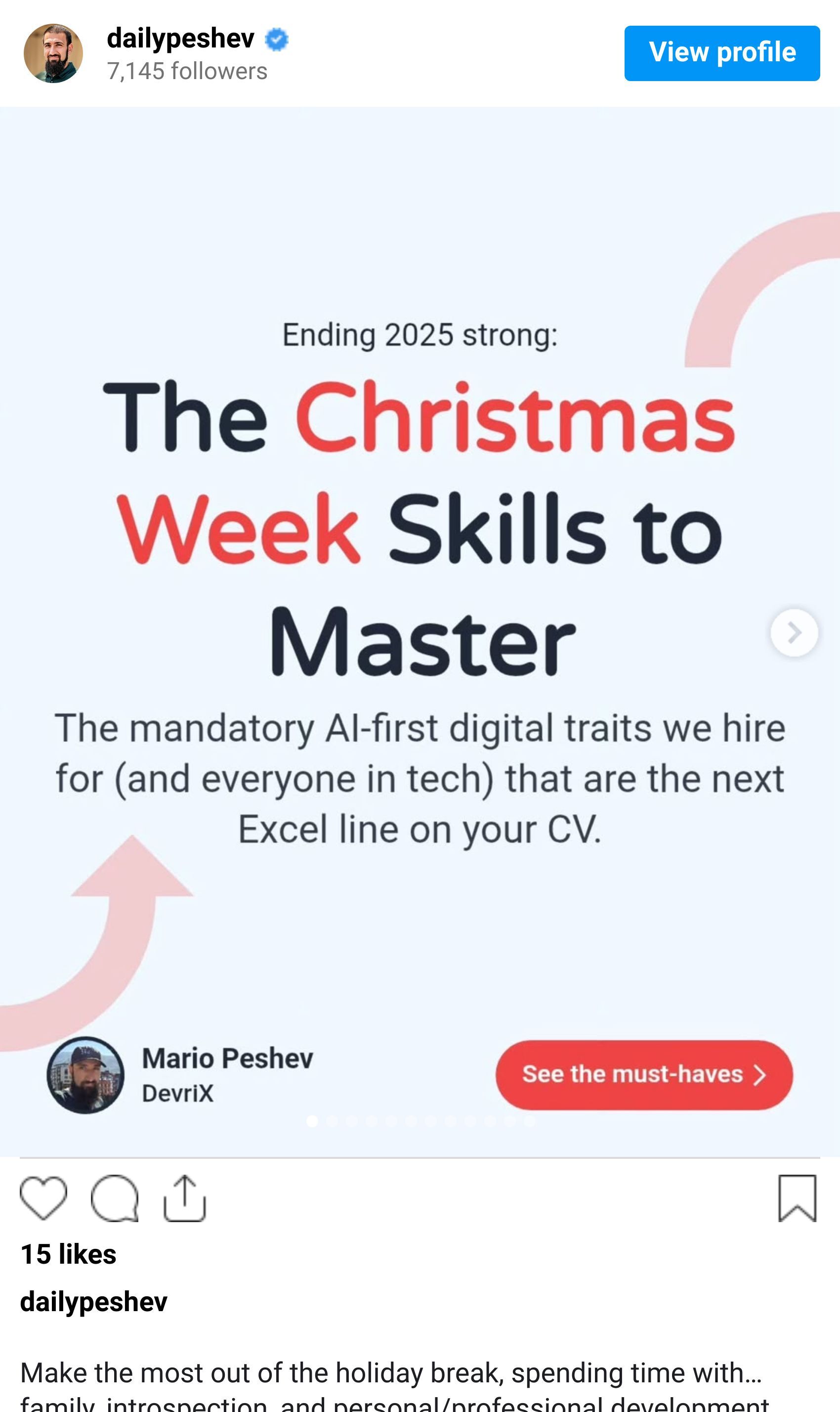
A deck with core skills I recommend studying up on in 2026 ^ |
Vote for newsletter format of 2026 (1 min) |
|
|
I'm keeping this edition simplified (no external articles and M&A offers) - what do you want to see as format in the new year? |
Should the newlsetter format stay the same in 2026?
The 2025 newsletter format followed this structure: - My intro - My take (other posts on social/podcasts/interviews) - Recommended books - Our B2B ecosystem (other sites) - Industry news - Investment opportunities (Flippa) Should we trim, keep, or redo?
|
|
|
|
A single click to vote for the format for the new year 👆️ |
For reference, the newsletter has been going through stages: |
|
And earlier versions in the past 5 years. |
I'll be revamping the "Working with me" section as well based on the votes below. |
Remember - when product MOAT is irrelevant, data and relationships mean everything. I've sent 400+ New Year's Day DMs to industry peers over the past 24 years alone. How about you? |
Mario |