|
 |
Dear Reader - our last two articles look at potential policies for a world with less jobs (decent ones anyway). We would love to know your views, and experience with any of these policies.
On the 10th September we have our 3rd Work 3 Webinar which we are excited about, where we cover “How to Use AI Agents - lessons from the frontline”
This is for Work 3 Community members - but we will share the registration link to the 1st 10 regular subscribers who hit reply to this email!
Andy and Matteo
A New Social Contract for Work - The Work 3 Manifesto
From flexicurity to lifelong learning – global policies and a blueprint for the future of work (Part 2)
|

| |||||||||||||||


 |
This is the 2nd article in our series on Future of Work public policies.
It’s worth reading the 1st article, if you haven’t already
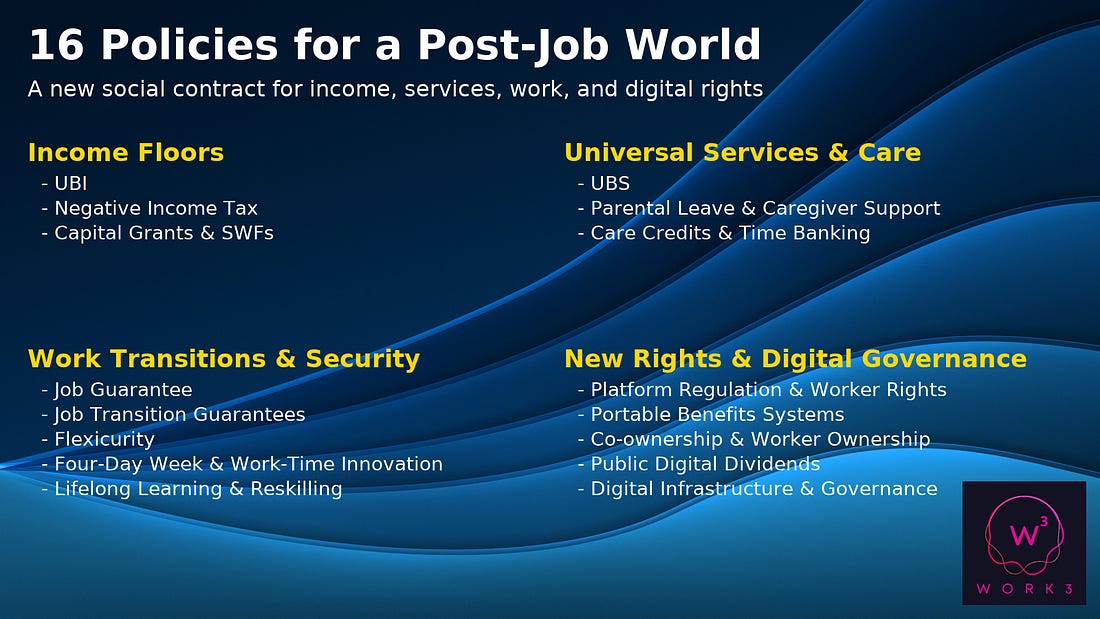
“Work 3 - Policies for a Post-Job World”
We explored Income Floors and Universal Services. We traced the long arc from the industrial-age “JOB” to today’s fragmented work reality, and examined policies designed to strengthen income security and social resilience in a post-job economy.
This week we complete the picture with Work Transitions, New Rights, and Digital Governance.
Then put them all through the Work 3 Policy Readiness Index.
We’ll close with the first draft of the Work 3 Manifesto, a bold but open framework for reimagining labour, value, and security in the decades ahead.
A New Social Contract for Work: 16 Policies You Should Know (Continued from Part 1)
Work Transitions & Security: Adapting to Change
7 - Job Guarantee
The state acts as employer of last resort, offering decent, socially useful jobs to anyone who wants one.
Example: India’s National Rural Employment Guarantee Act employs millions in public works; Austria’s 2020–23 Marienthal pilot cut long-term unemployment from 26% to near zero.
8 - Job Transition Guarantees
Temporary commitments that support workers when industries decline or automation displaces jobs. These schemes guarantee short-term employment, combined with retraining and career guidance, until workers can re-enter the labour market.
Example: The EU Globalisation Adjustment Fund has financed retraining and re-employment support for tens of thousands of workers affected by plant closures, from car manufacturers in Belgium to textile mills in Lithuania. In South Korea, targeted programmes help older shipbuilding and manufacturing workers retrain into service and care roles.
9 - Flexicurity
A long-term labour market model that combines flexible hiring and firing rules with strong safety nets and active labour market policies. Often described as the “gold standard” for balancing adaptability and security.
Example: Denmark’s model offers employers flexibility while guaranteeing workers generous unemployment benefits and robust retraining pathways. The Netherlands applies similar principles, with active labour matching and protections for temporary workers.
10 - Four-Day Week & Work-Time Innovation
Shorter or restructured working time to boost productivity, wellbeing, and sustainability.
Example: Iceland’s trial of reduced hours (35–36 per week) with no pay cut showed equal or higher productivity. Belgium’s law allows workers to compress 40 hours into 4 days.
11 - Lifelong Learning & Reskilling
Continuous training opportunities so workers can adapt to new skills and technologies.
Example: Singapore’s SkillsFuture credits give every adult SGD 500–1,000 for training; the EU has a 2030 target for 60% of adults in training each year.
New Rights, Ownership & Digital Governance
12 - Platform Regulation & Worker Rights
Ensures gig workers receive fair pay, benefits, and protections.
Example: Spain’s 2021 “Rider Law” reclassified food delivery couriers as employees; the EU is debating a Platform Work Directive.
13 - Portable Benefits Systems
Benefits (pensions, healthcare, training) tied to individuals rather than employers, following them across jobs and contracts.
Example: New York and California have piloted gig-worker benefit funds where platforms contribute to portable accounts.
14 - Co-ownership & Worker Ownership Models
Gives workers ownership stakes in firms or co-ops, aligning incentives and sharing wealth.
Example: Spain’s Mondragon Corporation is a federation of cooperatives employing 80,000 workers; the UK’s John Lewis Partnership is wholly employee-owned.
15 - Public Digital Dividends
Treats data as a collective asset, redistributing value back to citizens.
Example: California floated a “data dividend” in 2019; the EU is piloting “common data spaces” to share data value across sectors.
16 - Digital Infrastructure & Governance
Ensures universal internet access, digital literacy, cybersecurity, and democratic oversight of platforms.
Example: Estonia’s e-governance model lets citizens access nearly all state services online; South Korea’s broadband rollout provides near-universal high-speed access.
Case Study - Austria – Marienthal Job Guarantee Pilot (2020–2023)
In the town of Gramatneusiedl, every long-term unemployed resident was offered a publicly funded, fairly paid job suited to their skills and interests.
Outcome: Unemployment fell from 26% to near zero. Participants reported better mental and physical health, stronger social connections, and greater optimism.
Evidence: Tasks were substantive - municipal upkeep, ecological projects, and community services - with no sign of “make-work” roles.
Study: Conducted by the Bruno Rossmann Institute in partnership with the University of Oxford.
Verdict: Well-managed, locally tailored job guarantees can eliminate unemployment and improve wellbeing - if properly designed and funded.
These 16 policies sketch out a new social contract for the future of work.
Some are radical (UBI, Job Guarantee), others incremental (portable benefits, reskilling). It doesn’t include every policy - for example we believe tax cuts for solopreneurs would be useful to stimulate growth.
Some have been tried in pilots, others less just proposals and ideas.
Together, they aim to replace the vanishing promise of job-based security with new forms of resilience.
‘The New Social Contract for Work’ was the 7th trend in our exclusive report ‘Nine Global Mega Trends Shaping the Future of Work’
As a Work 3 Community member, you’ll get:
✅ A 30-page deep-dive PDF report, with 60 further resources to explore, PLUS a Q&A Worksheet to apply the ideas in your context
✅ Access to our monthly live webinars - the next one is on 21st August - “The End of the Corporate Silo”
✅ a PDF of this two-part article series (on request) with additional references and resources
Join the Work 3 Community today and get instant access — plus support our research, events, and future products.
Not ready for Work 3 Community membership yet? Subscribe free to get the latest Work 3 articles straight to your inbox.
Work 3 Policy Readiness Index
Here's our take on the “Work 3 Policy Readiness Index” over the next 10-20 years.
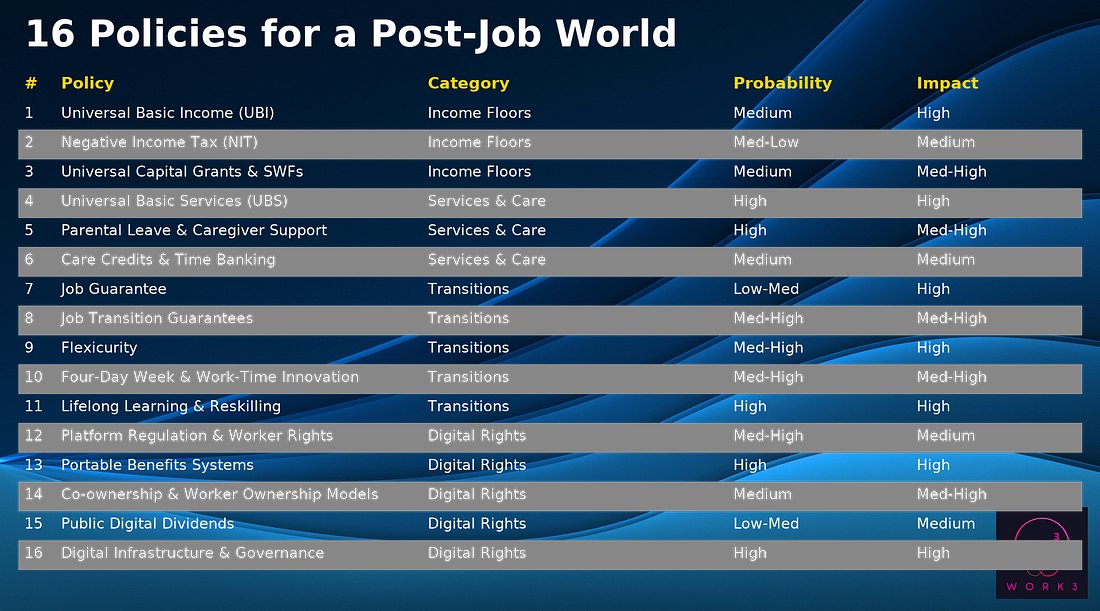 |
Work 3’s take?
The most viable near-term policies extend existing welfare logic - shorter hours, more services.
The most radical ones challenge the idea that income and status must flow from employment at all.
A Manifesto for a New Social Contract of Work
The structure of work has changed:
Reflect the unbundling of work — solopreneurs, gig platforms, AI agents.
Digital infrastructure is ignored — yet this is the new terrain of exploitation and empowerment.
Work ≠ Job — unpaid care, emotional labour, and invisible contributions rarely feature.
If we were building a post-work, policy Manifesto, we would discuss these policies and ideas with political parties.
Move beyond “Labour” and “Left” as identity politics
Build a brand around agency, dignity, digital sovereignty and financial security
Position yourself as the infrastructure party - not just physical but cognitive, digital, and emotional
Instead of just fighting for jobs, we should fight for the right to meaningful, self-determined work in all its modern forms and financial security.
Here are the principles that guide the next social contract:
1. From Wages to Security through Universal Services
The 20th century promised security through a job and a wage. In a fragmented, post-job economy, security must come from universal services and portable benefits — healthcare, housing, pensions, and training that follow people across contracts, platforms, and borders.
2. Agency, Not Just Employment
If AI and automation reshape industries faster than jobs can be created, then the goal isn’t simply “full employment.” The goal is full empowerment — enabling people to navigate transitions through lifelong learning, flexicurity, and support during job losses.
3. Digital Infrastructure as the New Welfare State
Just as roads and electricity powered industrial societies, universal broadband, data rights, and secure digital platforms are the backbone of the Work 3 era. We need public investment in digital infrastructure and governance that protects workers from algorithmic control and redistributes digital value.
4. Recognition and Reward for Invisible Work
Caregiving, volunteering, and community-building have always underpinned economies but rarely been valued. A new contract must recognise and compensate invisible labour through care credits, pensions, and social protections.
5. Shared Ownership of Wealth Creation
If jobs no longer guarantee rising wages, then ownership must be broadened. Cooperative platforms, sovereign wealth funds, and worker equity models give people a direct stake in the wealth they help create.
6. Ecological and Human Sustainability as Core Outcomes
The future of work must serve both people and planet. A livable income floor, shorter working hours, and sustainable industries should be measured not only by GDP, but by wellbeing, equality, and environmental resilience.
Rethinking Labour, Rethinking Power
Let’s not kid ourselves: labour is still losing.
Capital owns the platforms, the data, and the AI.
Workers - whether gigging or coding - rent access to digital landlords.
And while unions have negotiated protections for platform workers (notably in Spain, Belgium, and the UK), they are swimming against a global tide of casualisation and algorithmic control.
That’s why clinging to the job as the locus of power misses the point.
We need new forms of worker alliances, new protections for non-standard labour, and new ideas of value creation.
The scoreline so far?
Capital 1 – Labour 0
It’s time to change the game—not just play it better.
What do you think about these policies?
How are they being discussed in your country?
How might they impact your industry and company?
Please add your comments!
The Politics of Work Need a Reboot
As AI agents automate tasks, climate shocks demand new kinds of labour, and people stitch together lives across contracts, geographies, and platforms - the future of work will not be secured by defending yesterday’s institutions.
If we want a politics that’s fit for purpose, it has to:
Let go of inherited narratives from the industrial age.
Recognise that "work ≠ job".
Embrace decentralised, flexible, and digital-first models of value and care.
And for this to happen we need to get comfortable talking politics in a constructive and respectful way.
If dinner-table politics feels stuck, maybe it’s because we’re still arguing about jobs, not work. It’s time for a new conversation.
Work is not going away, in fact our most important work is ahead of us – building fairer and more prosperous societies.
Your future of work political correspondent,
You're currently a free subscriber to Work3 - The Future of Work. For the full experience, upgrade your subscription.
| ||||||||||

