|
 |
Dear Reader, I am speaking at a CRF event next week in Lisbon so looking forward to walking to work for once. If you are there say olá!
Our next Work 3 webinar is on the 16th October “The Impact of AI on Work” so make sure you join the Work 3 Community to get the invitation.
Andy and Matteo
Dystopia or Design? Imagining Work Futures Through Science Fiction
Technology might set the stage, but it’s our collective hopes, fears, and choices that decide the ending
|

| |||||||||||||||


 |
Your only chance of escape is to sell yourself.
15 Million Merits - Black Mirror (2011)
Modern work can be bleak, and our culture has depicted this in memorable ways.
From people cycling endlessly on exercise bikes, earning ‘merits’ to pay for trivial comforts in a closed digital economy, to 1920s images of workers marching in uniform lines into the underground machine.
In this article I tackle the question of whether can we learn anything about building a better future from Science Fiction.
I want to start with two bold claims before we start on the popcorn🍿.
First: there is no single ‘future of work’. There is nothing fixed or inevitable - the term is as nebulous as the ‘future of weather’. So we might as well get creative and build something better.
Second: how we feel about work shapes the future far more than we think. Right now, we’re living in an era of exuberant techno-optimism, driven by powerful stakeholders selling their AI visions of tomorrow. Our emotions are what truly determine which work futures become reality. So here’s my challenge: grab your own future.
And if you are feeling creative, at the end of the article, there are opportunities to submit your research ideas in the Future of Work Prize, and another with Stanford and DeepMind.
Sci-Fi as a Cultural Mirror
 |
Our collective imagination about work has been shaped by science fiction for more than a century.
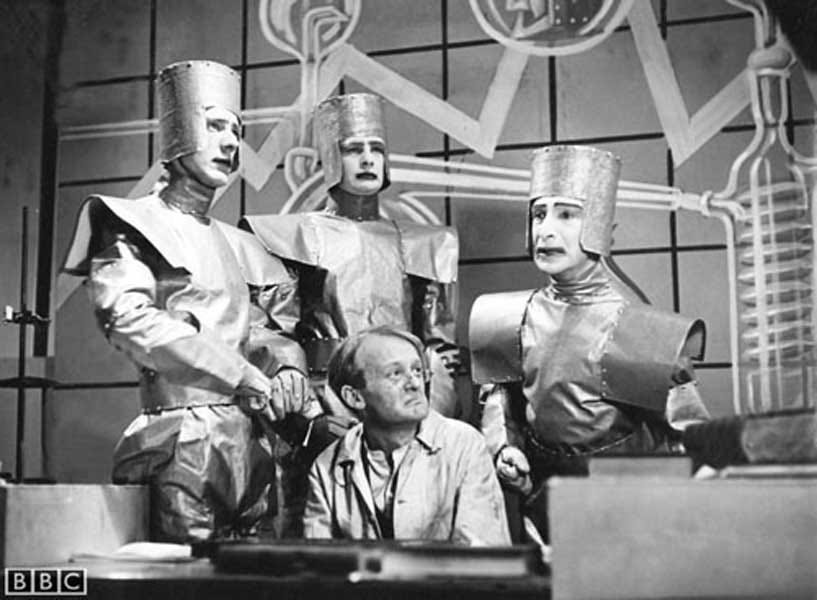
The word robot originates from the Czech word robota — meaning forced labour or drudgery. Introduced in Karel Čapek’s 1921 play R.U.R. The first robot story, from its very birth, was linked to fear about work being dehumanised. That resonance has never left us.
Over time, cinema has given us a catalogue of work dystopias:
Metropolis (1927) - a visually stunning tale of a divided society: ruling elites above ground, workers as cogs in machines below.
Modern Times (1936) - Charlie Chaplin’s satire of workers trapped by conveyor belts and relentless industrial speed.
Brazil (1985) — Terry Gilliam’s masterpiece of absurd bureaucracy, where work is a paranoid nightmare of forms, files, and malfunctioning machines.
These films were not predictions. They were warnings, emotional x-rays of their time.
 |
Fast forward to today, and we find new classics:
The Circle (2013, novel by Dave Eggers, and also a disappointing movie) - a Silicon Valley dystopia of surveillance and transparency.
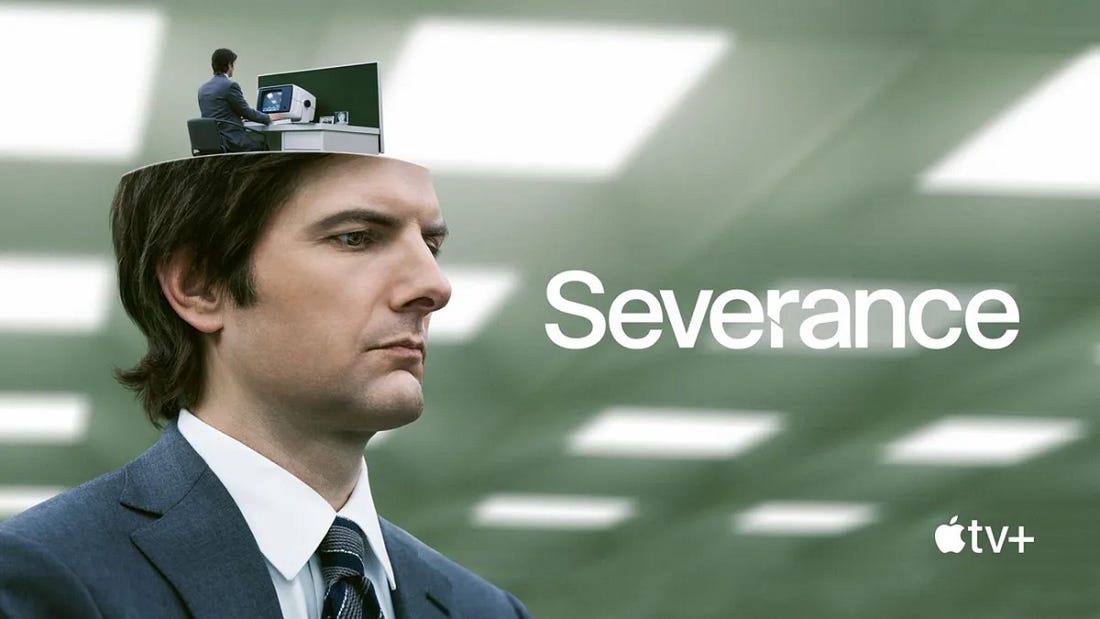
Severance (2022, Apple TV) — a chilling workplace where employees surgically separate their work and personal memories, raising questions of control, identity, and meaning.
Black Mirror (2011–2024) — with episodes like Fifteen Million Merits or Nosedive, dramatising our fears of algorithmic control, social ranking, and the commodification of our attention.
Each reflects back the anxieties of its moment.
Not predictions - but provocations.
Why Sci-Fi Matters for Work Futures
 |
This brings us to the research.
Last year, Max Bogaert won the Future of Work Research Prize for a project that digs into these very questions. His thesis: dystopian science fiction films are cultural artefacts that help us understand how people imagine the future of work. By analysing these stories, we uncover not just technological possibilities, but emotional currents: hope, resistance, fear.
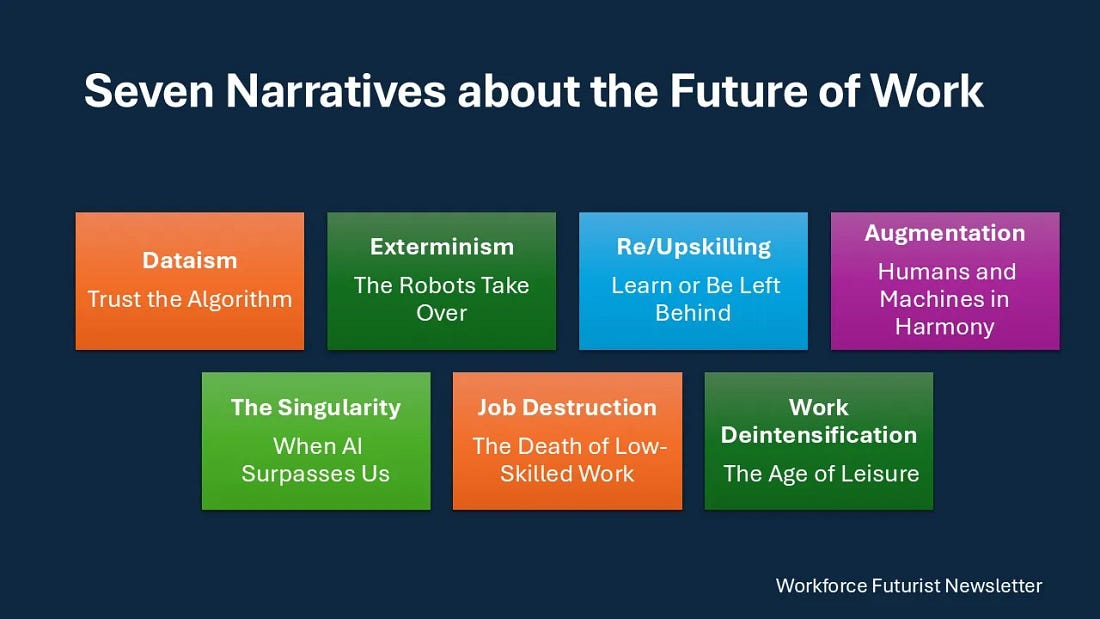
Last year I wrote about some research from some of Max’s colleagues which highlighted seven dominant narratives shaping the future of work.
Dataism: Algorithms dominate decision-making, sidelining human intuition.
Exterminism: Robots and AI lead to catastrophic job losses.
Re/Upskilling: Lifelong learning is necessary to remain employable.
Augmentation: Humans and machines collaborate in harmony.
The Singularity: AI surpasses human intelligence, reshaping society.
Job Destruction: Automation erodes low-skilled jobs, deepening inequality.
Work Deintensification: Technology ushers in shorter workweeks and UBI.
We tell ourselves stories about work — from “tech will save us” to “AI will take all our jobs.” These narratives matter because they shape policies, investments, and individual choices.
Sci-fi doesn’t just entertain us, it trains us. It builds affective infrastructures — the feelings, hopes, and fears we collectively carry into our conversations about work. And those feelings influence how organisations respond.
From Dystopia to Design
The real power of sci-fi is not prediction, but design.
This is why I often use scenarios and cultural references in workforce strategy. They are rehearsal spaces where leaders can road-test the future before it arrives.
They show us what a world might feel like, and they give us the emotional distance to ask: is this the future we want?
The question here is not
“What will happen?” but rather:
“What kind of future do we want to create?”
In an age when AI and automation dominate headlines, it’s a reminder that the future of work is not written in code. It is written in culture.
An Invitation: The Future of Work Research Prize
Which is why initiatives like the Future of Work Research Prize organised by The Center for Leadership in the Future of Work in Zurich are so important.
This year, the Prize is open again. Find out more here. (Entries close on 19th October)
If you’re researching work, culture, and futures - or if you know someone who is - this is a chance to contribute to a growing body of knowledge that will shape how we navigate the years ahead.
And on the subject of competitions, Stanford HAI and Google DeepMind also invite researchers to submit their research on how AI can improve and reimagine organisations. Find out more → AI for Organizations Grand Challenge.
Claim Your Own Prize
The future of work isn’t out there waiting to be discovered. It is something we are writing together - every day, with every choice, in every story we tell.
For individuals - understand which particular future of work narrative you are reading/listening to and challenge yourself to find an alternative viewpoint.
For employers - road test your current workforce strategy against a range of different potential scenarios in your industry (but not the one from Severance). What is the expected emotional impact of these changes?
For policy-makers - we highlighted 16 policies that move us towards a new social contract for work - what is the likely emotional response from citizens to these ideas?
So here’s my question to you: which books, films, or shows shaped how you think about work?
Was it Metropolis or Modern Times? Severance or Black Mirror?
Or perhaps a novel, game, or story that made you stop and think differently?
It’s your future to make. Don’t just consume the script.
Write the next chapter of your own work story.
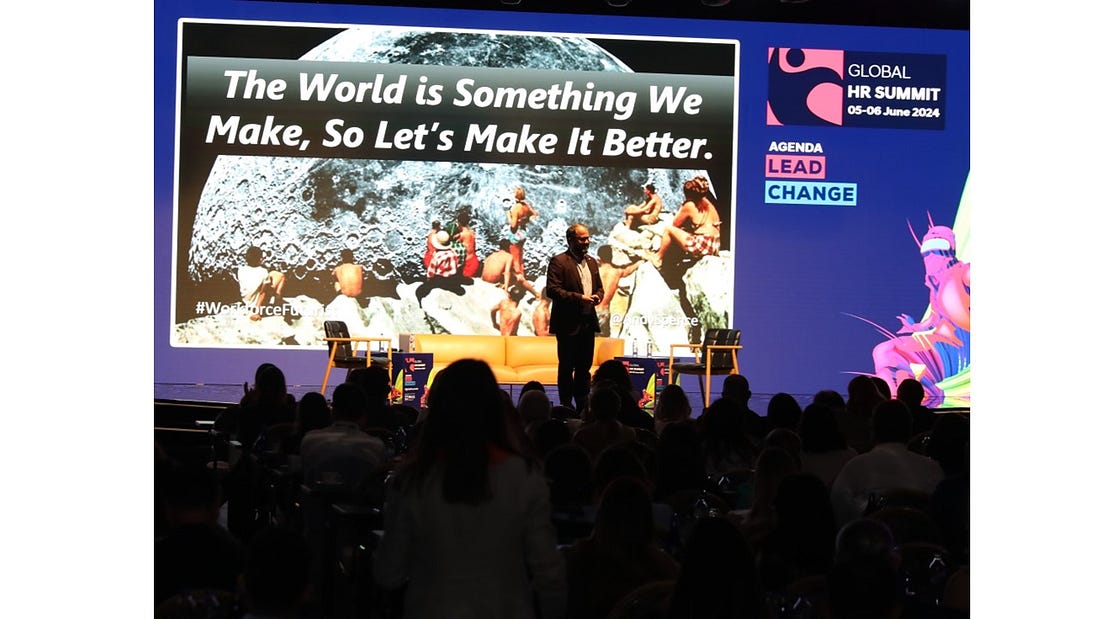 |
Writing my own script,
You're currently a free subscriber to Work3 - The Future of Work. For the full experience, upgrade your subscription.
| ||||||||||

