|
 |
Dear Reader, Spring 🌼 is in the air in the northern hemisphere, thankfully. We have not been publishing every week as usual because we've spent the last few weeks honestly assessing where we are. Thirty thousand of you read Work 3 Newsletter every week, which is both humbling and exciting. We are close to announcing a new programme of insights, essays, reports, products and opportunities to contribute. Watch this space!
White-collar workers are adopting ‘workplace polyamory’, according to Sam Kahn in The New Statesmen. This is not quite as sexy as it sounds, but the idea that an individual has multiple revenue streams, like the businesses they work for.
Surely this is more empowering, and sensible, than thanking one employer for a paycheck every month.
Andy and Matteo



 |
TL;DR - We’ve built an economy where ownership drives wealth - but a political system still optimised around work. Policy needs to shift from supporting earners to enabling ownership, especially for younger generations.
In the last century, the JOB provided most people in industrialised countries with food and housing for their families.
Our societies were funded from taxes from companies and workers earnings.
Our politics galvanised around workers’ interests, and owners’ interests.
Today this model is broken.
Most of the poor in the UK and US actually have jobs.
Getting on the housing ladder has become nearly impossible for thirtysomethings.
Financial security has become disconnected from employment.
Millennials are the first generation to earn less than the preceding one.
We have built an economy where ownership drives wealth - but a political system still optimised around work.
This essay - in two parts, argues that we need to reframe public policy, and work, through a different lens, that between the young (the earners) and the old (the owners).
Work Don’t Work
Gen Z look at mid-life millennials and think, ‘you’ve made work your life for twenty years and you still can’t afford a house.’ Eliza Filby
Work provides many meaningful benefits from a sense of purpose to social cohesion and importantly financial security for our families. Well-paid work is critical for ensuring people can afford the essentials and have a good standard of living. However, almost 7 in 10 working-age adults in poverty are in a household where at least one adult is in work. (Joseph Rowntree Foundation). Over 40% of Americans below the poverty line live in households with at least one worker.
Even people who are in employment often cannot rely on work to lift them out of poverty.
And looking more globally, around six in ten workers don’t even have a formal job.
That is two billion people.
The idea that employment alone provides financial security is becoming harder to sustain.
For some, work doesn’t work anymore, for many, it never did in the first place.
Your Generation
The connection between work and financial security is fractured, and is a factor between some of the visceral divisions in our societies. One that is overlooked is the divide between generations.
The older have always been richer than the youngers for the obvious reason that they have been on the planet longer to acquire wealth and assets.
There are societal fairness adjustments between generations such as inheritance, but I would argue that the contract in our society between the older and younger has crumbled. Increasingly there are much more favourable policies for elders than youngers and this is playing out in the world of work.
Older generations benefitted from cheap housing, final-salary pensions, and free University education.
Younger generations face unaffordable property, defined contribution pensions and student debt.
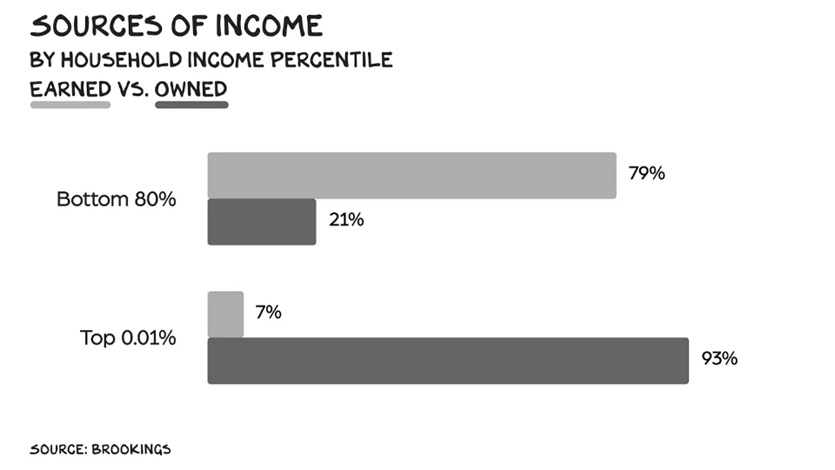
As Scott Galloway puts it,
“Over the past several decades, America has waged a covert war against the young. One front in this war is our income tax system, which favors Owners over Earners. Young people are almost all Earners, while Owners are typically older, and the tax code is a wealth-transfer vehicle for Owners to garner a greater share of our common wealth.”
 |
This divide between older and younger is not just found in the US.
Intergenerational wealth inequality has deepened significantly since the financial crisis; between 2006-08 and 2018-20, median wealth for Britons in their 60s rose by 55% in real terms, while wealth for those in their 30s fell by 34%.
An EU report on the “Intergenerational Contract”, noted that,
There is a widening “opportunity gap” between generations. Younger people face worse access to housing, stable jobs, and wealth accumulation. Older generations hold more assets, security, and political influence. Policy decisions today prioritise current voters over future citizens.
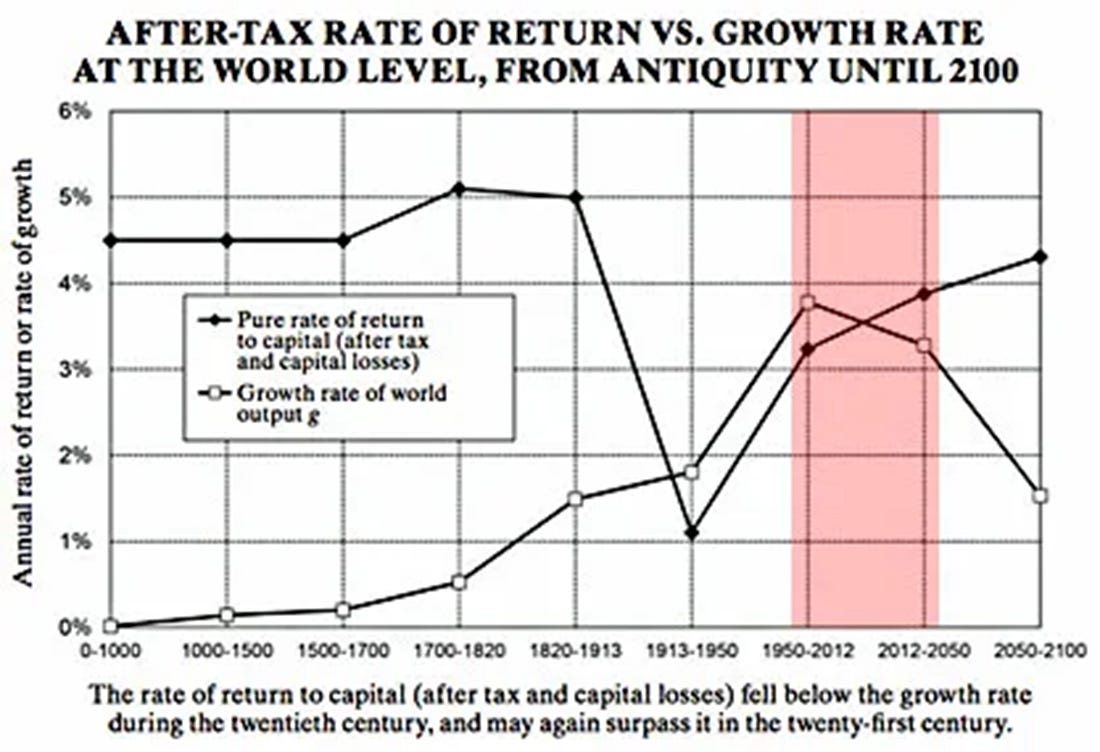
r > g, capital > labour, owners > earners
 |
The idea that society divides between those who work and those who own is not new.
It’s always been better to own the factory, than to work in it.
Economists from Ricardo to Marx framed it as labour versus capital.
The 20th century temporarily softened that divide, as rising wages, home ownership and pensions created a broad middle class. But the underlying tension never disappeared.
As Tomas Piketty showed, when returns on capital outpace growth, wealth concentrates.
Owners of capital see their incomes grow faster than ordinary laborers.
r >g OR returns on capital exceed economic growth
My translation of this would be
If you own assets → you compound wealth
If you earn income → you fall behind
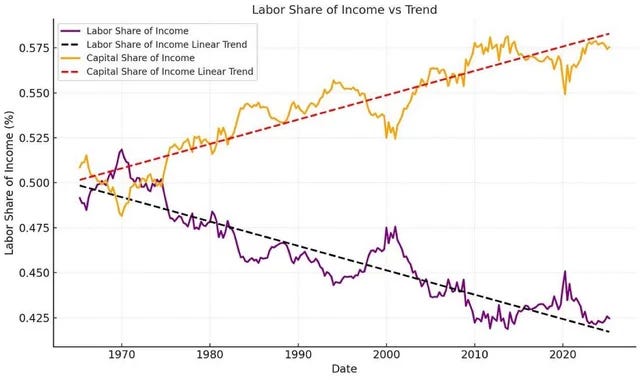
You can see the trend in the main graph, as a source of income, the trend is clear
Capital > Labour
The divide here is between earners versus owners,
Which tends to be younger generations vs older.
The Silver Voting Wave
 |
We have an economic situation, and policies, that suits owners more than earners, the old more than the young, and vested interests mean that people will vote with their feet.
In the UK for example this tension plays out on protecting national expenditure on state pensions and health services, offering tax shelters for investments, which directly benefit the older, versus spending on education and welfare for younger working-age adults.
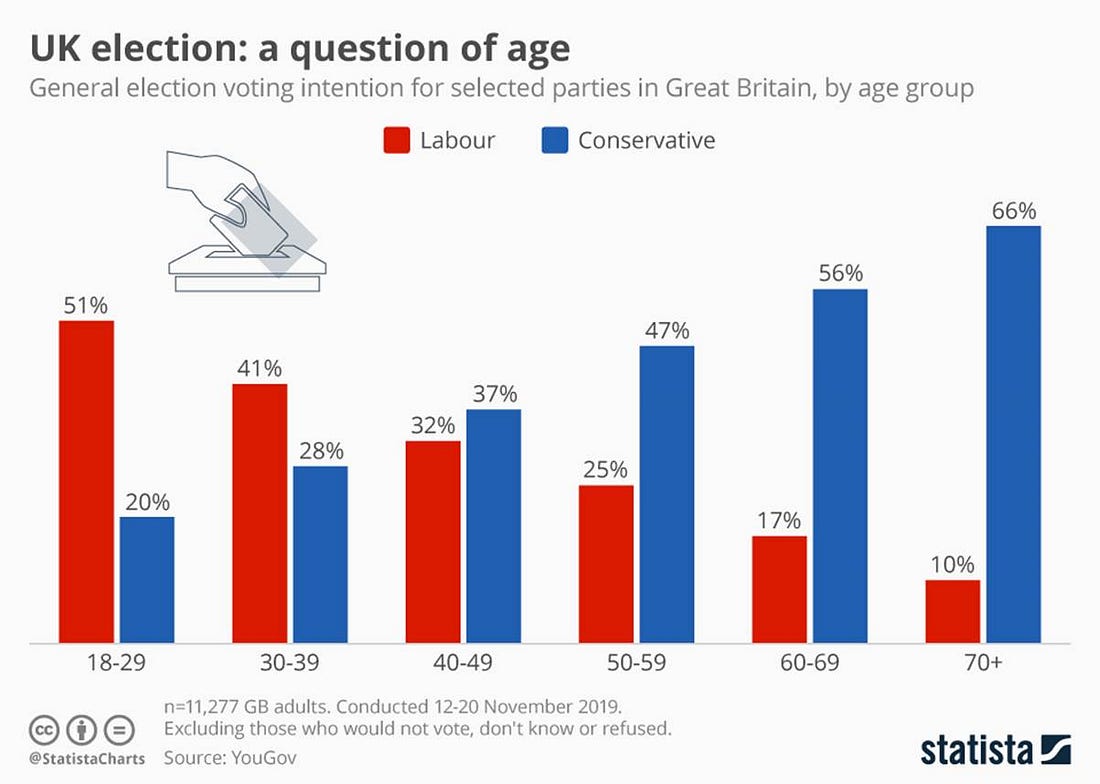
Historically, people might have voted by long-standing political class voting patterns but in 2026, whether you are an owner or an earner can mostly be predicted by your age.
In recent elections across the UK and US, age has become one of the strongest predictors of voting behaviour - arguably stronger than occupational class. In the 2019 UK general election, the crossover point was striking: voters under 39 favoured Labour, those above favoured the Conservatives. This wasn’t simply reducible to class.
A rigorous study of Swiss referendums across four decades provides unusually clean causal evidence. As voters of the same cohort age, they become less politically liberal and less supportive of policies that protect the environment, support young workers and families, or redistribute wealth.
Explicitly age-based political parties exist, from the Grey Panthers in Germany to 50PLUS in the Netherlands, and Gil Pensioners Party in Israel, but they remain marginal. Age is not a political identity in the way class once was. Yet modern politics increasingly behaves as if it is.
This provides hard evidence for the “gerontocracy” concern: that in ageing democracies, older voters structurally block policies that the young would prefer.
The Bank of Mum and Dad
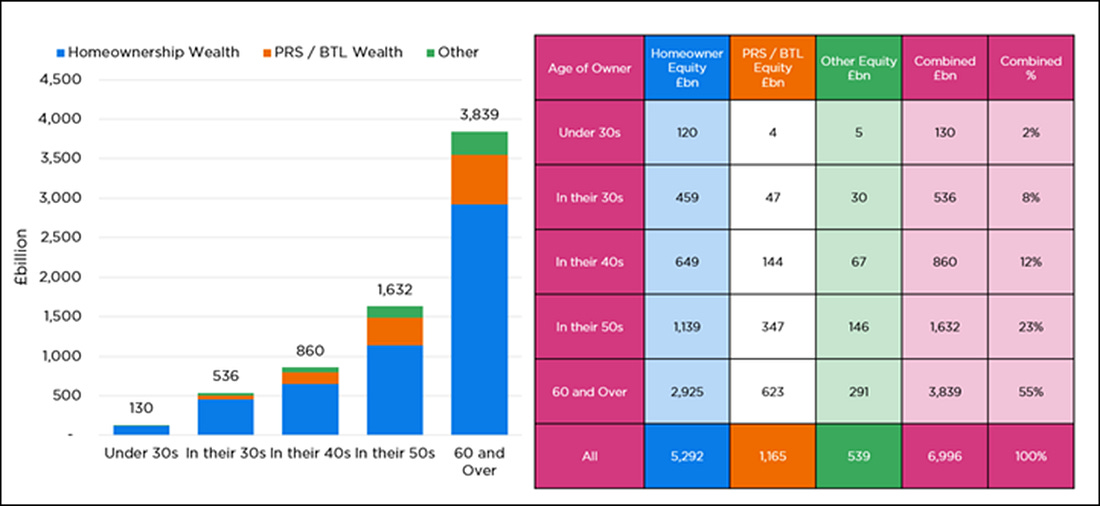 |
As baby boomers hold an increasing share of wealth, younger generations are finding it harder to build financial security, often relying on family support for major milestones like homeownership.
Under 30s hold just 2% of UK property equity, the over 60s now own 55%. (Savills).
More younger adults live at home with their parents until later than in previous cohorts, and it has been estimated that a worker renting in London saving their disposable income would take 30 years to save a typical deposit for a house. (ABC Finance)
An argument against ‘age vs class’ as a dominant political narrative would argue that if we looked more deeply at age effects we would see class underlying it. Over half of those with university-educated homeowning parents received transfers when buying for the first time, with receivers getting around £35,000 on average. This compares to 29% of those with renting parents receiving transfers, with an average transfer of £11,000. (IFS)
Read more on intergenerational politics, work and how we can build preferable futures for earners, owners and younger generations in Part 2 next week.
Learning, earning - and owning,
You're currently a free subscriber to Work3 - The Future of Work. For the full experience, upgrade your subscription.
| ||||||||||

