|
 |
Dear Reader, we had a great Work 3 Webinar last week, so thanks to all those who contributed.
Next one is on the 16th October - so make sure you join the Work 3 Community to get the invitation.
In case you missed it while you were on the beach, our two article series highlights 16 policies for a post-job World.
Andy and Matteo
From Tools to Systems: How Agentic AI Rewires the HR Work Stack
Agentic AI isn’t a faster tool—it’s a coordination engine that lowers the cost of organizing work across teams, tools, and talent.
|

| |||||||||||||||


 |
Welcome to this week’s edition!
Hiring has long been a complex systems problem. Most companies still rely on disconnected platforms, manual workarounds, and fragmented processes. The result is duplicated effort, hidden blind spots, and missed opportunities.
So why does Agentic AI offer a different path?
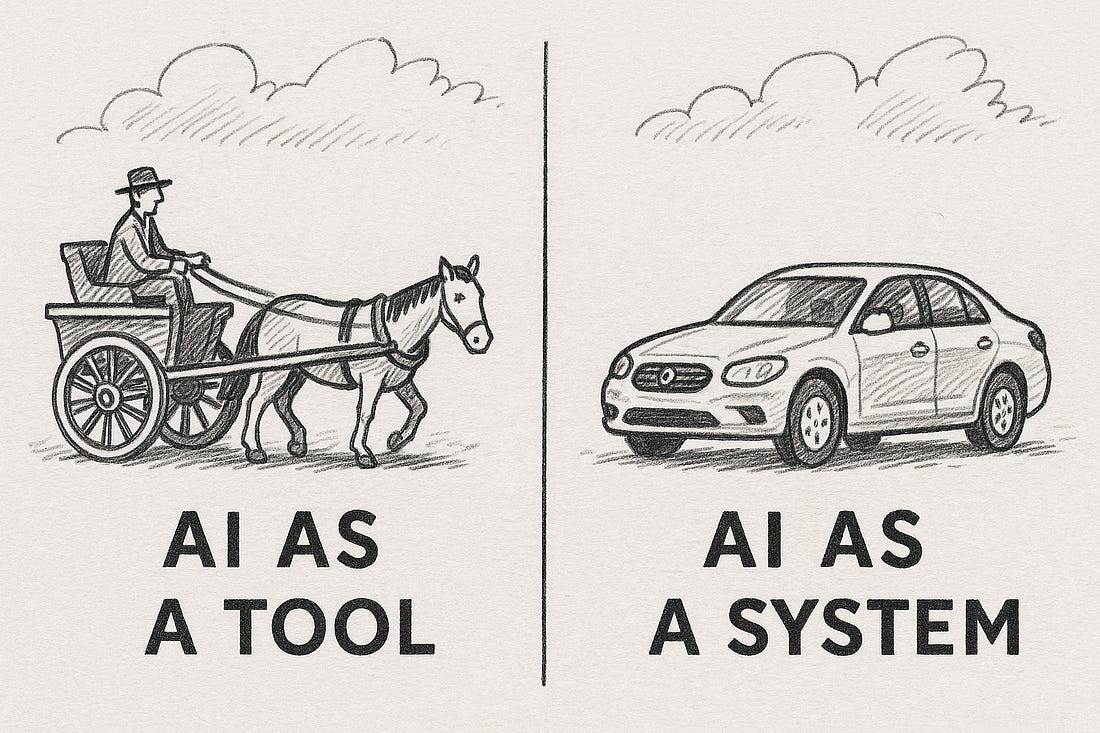
Most teams still talk about AI as a tool—a faster editor, a smarter search, a better bot. That frame is too small. Agentic AI is best understood as a system of coordination: it represents messy, fragmented work in a common model, guides decisions across actors, and executes actions across disconnected tools. The impact isn’t task speed; it’s system reliability and adaptability.
Agentic AI refers to systems being capable of setting their own goals, making independent decisions, and performing complex tasks with minimal human intervention. Deloitte predicts that by 2025, a quarter of all companies using Generative AI will be piloting agentic AI, and that number will double to 50% by 2027.
The early results from leading companies are already measurable. Bristol Myers Squibb cut its time-to-fill for critical roles by 21%. Coca-Cola Europacific Partners saw the number of employees with an active talent profile jump from 2% to 80%, transforming their internal talent visibility. And companies like Deutsche Telekom are now staffing critical projects in days instead of weeks.
But while the results are encouraging, a common illusion is emerging. In the rush to keep up, companies are plugging in AI tools in pieces—one for sourcing, another for screening, a third for scheduling. This is a classic digital transformation mistake: making small fixes when the foundation itself is cracked. This week, we’re looking at why this “point solution” approach is an illusion of progress, and why the real answer is a unified platform - and for this we partnered with Eightfold.ai - worktech platform that helped us go deep into how AI helps coordination and enables new work design.
The Promise of a Unified Platform
What’s missing isn’t more software. It’s a system of intelligence: a single system that sees an employee’s entire journey, connects their skills to what the business needs, and helps HR make faster, smarter decisions. Without it, even the most advanced AI becomes just another silo.
Under the hood, these platforms are powered by AI that’s learned from billions of real-world data points about careers and skills. It doesn’t just follow rules; it uses a dynamic understanding of skills as a universal translator for talent. It can sense what’s happening, use tools to talk to other systems, and remember past actions to get smarter over time.
Think of this as a coordination stack:
Unified representation — turn tacit, scattered knowledge (emails, meetings, resumes, tickets) into a shared, queryable model.
Unified decision-making — apply policies, priorities, and trade-offs consistently across functions (hiring, mobility, learning).
Unified execution — agentic workflows act across ATS/HRIS/LMS/CRM to move the process, not just report on it.
Governance — transparency, auditability, and guardrails so coordination doesn’t become a black box.
This enables capabilities like:
Unlock Hidden Coordination: Past profiles become live because the system maintains them and routes candidates to reqs and gigs without hand-offs.
Common Representation: Shared skills representation lets different teams “speak the same language.” The US Department of Defense, for instance, uses this to translate military experience into civilian skills, surfacing talent that would otherwise be invisible.
Coordinated On-Ramps: As entry-level roles change, platforms can sequence projects, mentors, and learning opportunities in the right order, creating structured career on-ramps (death of the entry-level job).
-
Coordinated Mobility: The Career Hub isn’t just a portal; it’s a traffic controller balancing employee goals and business demand in real time. Eightfold’s Career Hub is one example of this in practice.
The Integration Illusion: The Problem with Point Solutions
Automating a broken step simply scales the failure. The real bottleneck isn’t productivity inside each silo; it’s coordination across silos. Point tools optimize parts; agentic systems optimize the interactions: what gets represented, who decides, and how execution is sequenced when things change.
By adopting separate AI tools, organizations fall into familiar traps:
Creating New Silos: A sourcing tool that doesn’t connect with the mobility platform creates a blind spot—spending externally for talent you already have internally.
A Fractured Employee Experience: Multiple logins, redundant workflows, and disconnected data create friction, undermining engagement and retention. This mirrors challenges in the decentralized workforce.
Productivity vs. Performance: Faster recruiting doesn’t guarantee stronger outcomes. We explored this distinction in what new AI operating systems mean.
The AI Mirror: The first impact of AI is as a mirror: it makes system dysfunction visible. A point solution shows one part of the mess; a unified platform exposes the system as a whole, forcing hard questions (AI and the Corporate Pyramid).
Incomplete Intelligence: An AI is only as effective as the data it can access. Point solutions keep intelligence fragmented.
The Black Box Dilemma: Decisions without transparency erode trust. Explainability and governance must be built in from the start.
Coordination Tax: As headcount and tools grow, alignment costs grow faster. Agentic AI lowers this tax by keeping representation, decision, and execution in sync.
Coordination > Automation
Automation speeds up parts. Coordination scales the whole.
Automation is about efficiency within one step: sourcing faster, scheduling quicker, parsing resumes more accurately. Useful, but local.
Coordination is about how all those steps connect. It ensures the candidate sourced is visible to internal mobility, the interview schedule updates across calendars, and the offer flows into payroll without retyping data. It turns parallel processes into a connected flow.
Representation: Without unified representation, every team optimizes to a different truth.
Decision-making: Without shared decision rules, local choices collide—like managers competing for the same candidate.
Execution: Without unified execution, handoffs stall, exceptions multiply, and accountability blurs.
Kamal Ahluwalia, President of Eightfold, explained it this way: “Automation is like a line cook following a recipe. Agentic AI is like a chef: it tastes, adapts, and improvises based on the audience. That shift — from recipes to chefs — is what makes the system resilient.”
Automation makes silos faster. Coordination makes systems adaptive.
From HR Officer to HR Orchestrators
This new reality doesn’t just tweak HR; it rewrites the job description. Research from Deloitte shows that 6 in 10 workers already see AI as a coworker. The framing is shifting from “AI as a tool” to “AI as a teammate.”
As AI teammates handle more execution, the highest human value shifts to orchestration. This marks the evolution from traditional HR to systemic HR. The future HR leader is an architect of the work operating system, designing flows of talent, skills, and information.
Chano Fernandez, Co-CEO of Eightfold, has put it simply: “HR has to lead this transformation.”
This new role is critical because AI flattens and adapts org structures: less static hierarchy, more fluid deployment of people to work based on skills and needs. Coordination becomes the leadership job (inside the Prove AI Can’t First company).
What Orchestration Actually Means
Orchestration = Managing the Coordination Stack:
Set the representation standard (skills, roles, policies).
Define decision rights (what agents decide; what escalates).
Shape execution flows (handoffs across HRIS/ATS/LMS/finance).
Own governance (explainability, audit trails, ethics).
Practical Steps for Orchestrators
Redesign Interactions: Map the handoffs (where coordination fails), not just the steps.
Joint Control of the Coordination Stack: HR defines representation and policies; IT operationalizes agents, guardrails, and audit.
Market of Work Inside the Firm: Internal gigs are a coordination mechanism—agents continuously match supply and demand.
Measure System Outcomes: Fewer “time-to-X”; more flow reliability, mobility rate, and “decision latency.”
Coordination KPIs: % of reqs filled via internal mobility; % of actions executed agentically with human-in-the-loop; explainability coverage.
Final Thoughts: Building the New Work Operating System
The vision is not tool adoption; it’s a reliable, explainable coordination system for work.
First, there’s the societal cost of efficiency. The “death of the entry-level job” is real (read more here), and we need deliberate on-ramps for young talent.
Second, productivity gains inside silos don’t equal performance; coordination gains do. The key question is not whether AI makes recruiting faster, but whether it helps build a more resilient and capable organization.
Third, as work decentralizes across full-time employees, contractors, and agents, a unified coordination layer preserves culture and experience (the decentralized workforce).
The biggest return doesn’t come from shaving 10% off time-to-hire. It comes from lowering the coordination tax so skills, talent, and work can flow as one system. Right now, many organizations are building “horseless carriages” — bolting AI onto processes designed for another era. The opportunity isn’t to speed up the carriage; it’s to design the automobile.
In your next meeting, ask: Are we buying faster tools—or designing the coordination system that makes our organization adaptive?
Make sure to check out our partner Eightfold and their upcoming events 👇
See you next week!
Matteo
You're currently a free subscriber to Work3 - The Future of Work. For the full experience, upgrade your subscription.
| ||||||||||

