|
 |
Happy New Year!
Thanks for reading Work 3 in 2025
Hope you had time to read 6 Big Themes for Work in 2025.
Thanks to David Green for mentioning the article in his excellent compendium “The best HR & People Analytics articles of December 2025”
Stay tuned with Work 3 in 2026 - we have planned lots of interesting articles, reports, webinars, and collaborations.
Onwards and upwards…
Andy and Matteo
How to Stay Standing When Work Shifts
Stronger foundations for navigating jobs, tools, and markets in 2026
|

| |||||||||||||||


 |
I want to write a letter full of optimism for 2026. However, my honest feeling is that this year will be hard for a lot of people.
Today I explore what shifting jobs, fragile tools, and volatile markets might mean for work this year.
In the week before Christmas I met with Matteo in Rome to plan the Work 3 themes we will focus on in 2026 which we are very excited about.
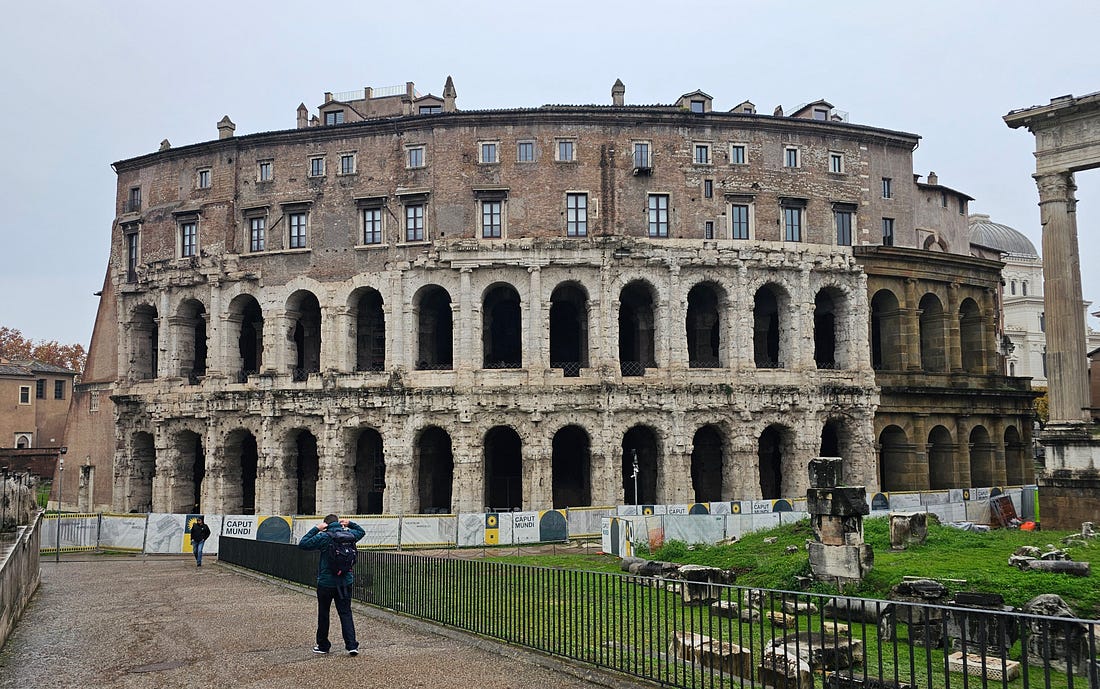
With some inspiration from the Eternal City, todays article is about building resilience.
Jobs Change Shape but Salaries Are Still Worth Their Salt
At recent festive gatherings I have met people making a living in diverse industries and there seems to be anxiety about job security, much attributed to the rise of AI. For example, the movie special effects conference delegates downbeat after another round of job-losses.
What does the actual job data tell us?
US unemployment is at its highest level since September 2021, but not historically high at about 4.6%.
The LinkedIn Workforce Report shows that over the past two years, hiring rates across major economies have fallen sharply.
We are not seeing mass job losses, but job slowing and job thinning. There is a lot of variation across skills, industries and geographies.
That’s not job destruction. It’s job deconstruction.
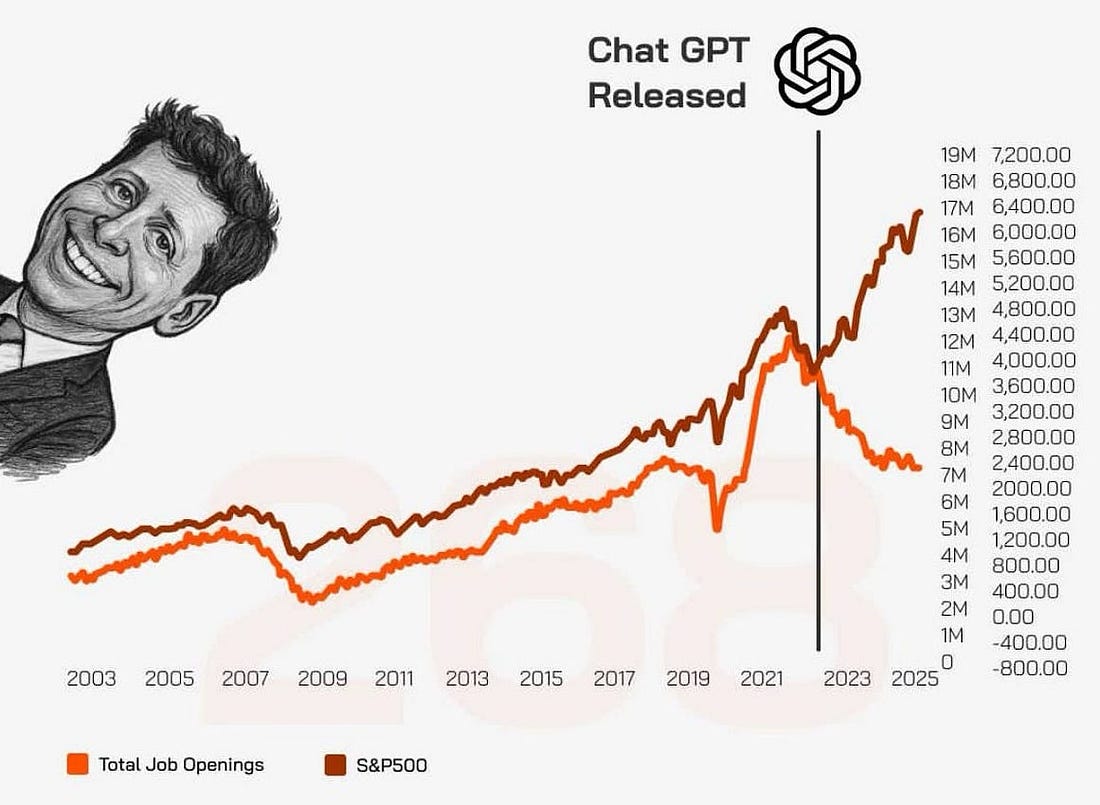 |
This graph looks like a simple story: markets rising while job openings fall.
The data is correct — but correlation isn’t causation.
Markets move on expectations; jobs move on budgets and time.
As Derek Thompson explains, for the last few decades, job openings have mostly tracked the rise and fall of the stock market. Nothing like the current divergence between equity returns and job openings has ever occurred in the history of the Job Openings and Labor Turnover Survey (JOLTS).
In fact the reduction in hiring can be better explained by interest rate hikes than AI. Higher rates are meant to lead to less investment, less spending, and less economic activity, which altogether can have the effect of reducing hiring.
The Roman roots of the word salary come from salarium — a payment linked to salt, once a valuable commodity.
Jobs won’t vanish all at once; they might crumble, get patched, get rebuilt, and work will continue with different arrangements, contracts, and, payment terms.
I have envisaged what a world with less formal jobs might look like. However, in an uncertain environment, a regular salary is still worth its salt.
As jobs become less predictable, people are compensating by embedding AI tools directly into how they work and think.
Don’t Build Your Thinking on Sinking Sand
AI tools are no longer just productivity aids. For many people, systems like ChatGPT, Copilot, Claude, Gemini and others have become part of how they think: drafting ideas, learning new topics, practising languages, preparing difficult conversations, organising knowledge, and making sense of complexity.
The scale of adoption is striking. I think it is reasonable to estimate that around a billion people use LLMs each week.
At the same time, the economics behind these tools are still being worked out.
OpenAI, for example, is widely reported to be valued at $500 billion USD, with revenue roughly $12 – $13 billion in 2025. Despite its popular tools it remains unprofitable, with losses likely in the $7 – $9 billion range as it invests heavily in compute, research and growth.
Similar patterns exist across the AI sector: extraordinary capital investment, rapid user growth — and a long road to durable profitability.
None of this means the tools are going away. But it does mean that the way we access and pay for them are likely to change.
Some plausible futures include:
Repricing: free or low-cost tiers becoming more limited as providers push toward sustainability
Consolidation: tools merging, being shut down, or absorbed into larger platforms
Enterprise capture: the best features moving behind corporate paywalls
Model churn: frequent shifts between models, behaviours, and interfaces as competition accelerates
Many people are now building prompt libraries, personal knowledge bases, workflows, and even emotional habits inside specific AI tools. If a product changes, reprices, or disappears, that work — and the thinking embedded in it — can be hard to retrieve.
What individuals can do now?
Keep your thinking portable. Store core ideas, notes, and frameworks outside any single AI platform.
Build a small portfolio of tools, not a dependency on one.
Treat prompts as patterns, capture reusable structures and reasoning approaches, not just verbatim text.
Use AI to amplify thinking, not replace it - If a tool vanished tomorrow, could you still explain your reasoning?
The winners in the next phase won’t be the people with the most AI subscriptions.
They’ll be the people with robust knowledge systems, adaptable workflows, and the ability to think clearly when the tools change.
Use AI deeply. Just don’t build your precious knowledge base on sinking sand.
Tools change. Platforms come and go. What matters is understanding the economic cycle underneath them — because that cycle has always shaped work more than any single technology.
When Markets Catch a Cold, Work Gets The Flu
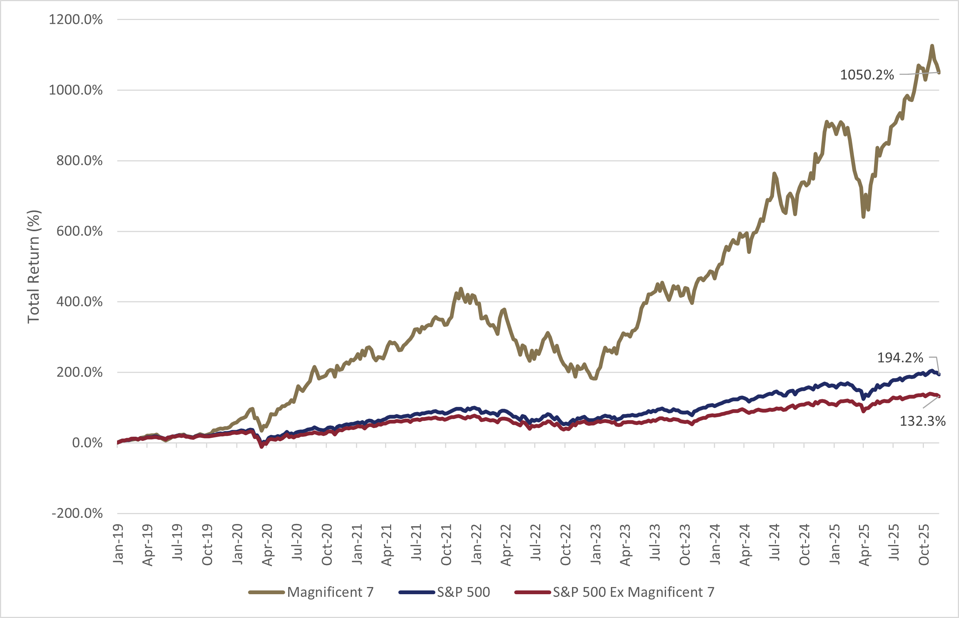 |
AI has been a powerful tailwind for financial markets. Nowhere is that more visible than the Magnificent Seven. No this is not Rome’s seven hills, but what investors call the seven US technology companies that now dominate the skyline of global markets:-
Apple, Microsoft, Alphabet (Google), Amazon, Nvidia, Meta Platforms,
Tesla
Together, these firms account for around one-third of the entire S&P 500, and well over half of the Nasdaq 100. From 2019 to 2025, the Magnificent Seven delivered a combined total return of over 1000%, compared with around 180–200% for the S&P 500 over the same period.
These companies make genuinely useful products, platforms, and infrastructure. Markets don’t price what companies did last year — they price what investors believe they will deliver in the next few years.
For example, Nvidia has recently carried a market valuation of around $4.6 trillion - more than the entire annual GDP of Germany. In its most recent financial year, Nvidia reported roughly $73 billion in net profit. At that pace, it would take around 60 years of profits at today’s level to match its current valuation. To put it another way, the market is assuming hundreds of billions of dollars in cumulative profits over the next decade.
The valuations might be realistic, but rely on near-perfect execution in an industry that will be impacted by competition, disruption, consumer demand, wars, sovereign debt crisis, recessions, and geo-political chess moves.
For now, I think we can safely say there is a chance that there will be a significant re-rating.
For history buffs, or those who still remember the sting, in the Dot Com crash in 2000/2, the Nasdaq fell 78% peak to trough, In the Global Financial Crisis of 2008/9 – the S&P fell 57%.
So you might be reading this, saying, well I don’t own any of the Magnificent 7 Stocks, so what’s the problem?
The problem for the rest of the economy is contagion. Typically when there is a market crash, all sectors sink. It will not discriminate between good and bad companies in the short term.
So what might be the impact on work and jobs?
History suggests that when the stock markets crash, work follows but on a delay.
After the dot-com crash, markets fell quickly, but hiring froze for years. During the Global Financial Crisis, unemployment continued rising well after share prices had bottomed out. And in 2020, while markets rebounded rapidly, more than 22 million US jobs were lost, with many workers taking years to regain stability.
One lesson is consistent: US market cycles shape hiring, investment, and job security far more than the latest AI product launch or marketing campaign. Macro-economics, markets, geo-politics move the labour market over the years. You can read more about the Nine Global Mega Trends Really Shaping The Future of Work here, and download our 30 page PDF.
When markets tighten, organisations pause, investments stall, projects stop, hiring freezes.
The real question isn’t what the market does next — but how can we prepare?
Strong Foundations for Uncertain Times
Just maybe….the markets are calm, the $50 trillion debt is ignored, the labour market generates wealth and security, we enjoy abundant innovation with little extra cost.
But, as 2026 emerges, this is a moment to think about the risks mentioned today calmly.
Resilience isn’t about predicting the future. It’s about staying regulated, connected and adaptable as life unfolds.
Here are some thoughts on building up your resilience :-
Stabilise your habits, processes, networks and health.
Reinforce your existing habits and processes to stay mentally and physically healthy. Focus energy on what you can control - your skills, and your habits. Rather than things you can’t control e.g. the job market or stock prices. Nurture your existing support network.
Create more options for your income, your ideas, and your learning.
Identify and reduce single-point failures – one employer, one skill, one revenue stream. If your work network is mostly people who work for your current employer. Cast the net more widely on ideas and people you can learn from. Keep Learning – people, agents, workflows – not just courses. Think about second and third income streams, more freelance work – from fractional execs, to design, coding, writing and task outsourcing. Start to experiment – it takes courage, but small experiments might lead to big reinventions later.
In 2026 Rome still stands, as it has done for over 2000 years. Families still enjoy the Christmas Market at Piazza Navona. There is resilience built into the system.
Rome has had its weak spots and cracks, but that is how the light comes in.
And the world of work will move forward in a similar way, unevenly, imperfectly, and very much in public.
Wishing you a steady year ahead.
 |
You're currently a free subscriber to Work3 - The Future of Work. For the full experience, upgrade your subscription.
| ||||||||||

