|
 |
Learning In the age of AI: Networks, Not Notebooks
In the age of AI, relationships still matter: how to tap your network for career growth
|

| |||||||||||||||


 |
I’ve been getting a lot of feedback from the last article – the idea that “AI feels like a second job” seems to have hit a real nerve. In summary, we saw that the culprit isn’t just the technology itself: it’s the cognitive overload, emotional pressures from media, and unrealistic pace of modern work. Today, we are focusing on the solution to this problem: people are overwhelmed because mostly, they’re trying to learn it alone. Just like we explored in There is No (A)I in Team, it is not only work that gets done better together. Learning follows the same logic.
How do we really learn?
It’s ironic: everything today pushes us to learn alone: personalised career advice, self-paced courses, AI tools, even corporate training that still works like a one-way broadcast.
We’ve never had more tools for self-learning, yet we’ve never shared less amongst each other.
This is why, when reading through LinkedIn’s latest research it revealed something simple, but fundamental – when it comes to real decisions, people still turn to people:
75% believe trusted human insight is irreplaceable
40% trust their network before AI tools
62% say colleagues and peers help them decide faster
Almost half rely on someone in their network for AI advice
Trust is a big component here, which we should dedicate a separate deep dive on (even humans are fallacious, but trusting a machine is always going to be different). The rest of the stats focus on the relationship element, and this makes sense when you look at how humans actually learn. We don’t learn complex, ambiguous skills alone. We learn through our networks, often in ways we barely notice. There’s an entire body of research that explains why:
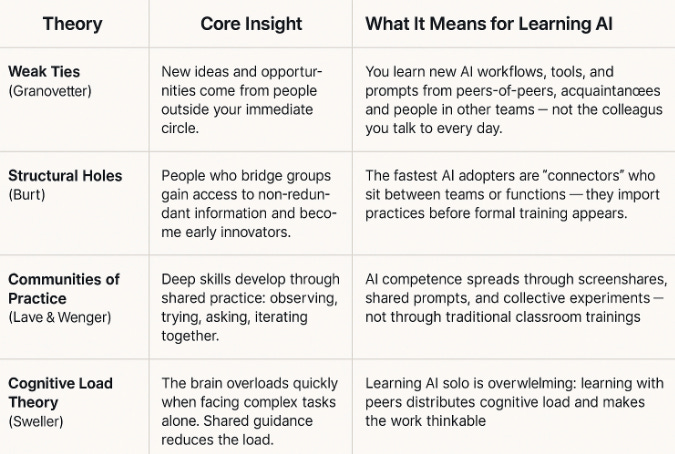
Weak ties – Our loose connections: the acquaintances, former colleagues, peers in other teams, are where new information actually comes from. They expose us to different tools, different prompts, and different ways of thinking that our closest colleagues don’t. For example, in AI learning, weak ties are often the first place a new workflow appears, maybe even coming from a completely different use case.
Structural holes – People who sit between groups (generalists, people with diverse responsibilities), rather than inside them, access non-redundant knowledge. These “bridges” spot patterns early and become the first movers in capability shifts. In AI, they spread new practices long before formal training even exists.
Communities of practice – Designers sharing Figma tricks, GitHub contributors troubleshooting together, analysts swapping workflows. These “digital guilds” are where deep skills actually form: through participation, observation, trial, error, and shared context.
Cognitive load – Learning complex skills alone overwhelms our working memory. Ambiguity, problem decomposition, and debugging create too much cognitive load for individuals to carry on their own. Shared strategies and examples distribute the load and make the work thinkable again.
Social learning – We learn best by observing others. Demonstrations beat instructions; modeling beats documentation. A colleague showing “here’s how I do it” can collapse hours of self-study into minutes and with positive emotions experienced.
 |
What am I trying to learn and why?
 |
That is all well and good. But we need structure in this chaos. If we don’t have a goal, a method, and a simple way to check whether we are making progress, any learning journey will stay messy and stressful. Right now, most people are not learning any topic with intention, they are mostly reacting. Our “goal” is to consume enough AI content to feel slightly less terrified about being left behind by scrolling, saving tutorials, opening ten tabs, watching a few minutes of a course, and then hoping it will all add up to something useful.
This is why grounding in a clear goal matters: many people understand the idea of setting a clear goal, but they rarely translate it into something written down, shared, and revisited. Even better is when a goal is shared – it changes not only the practical, but also the emotional context.
Inside a company, this should be mandatory. However, in this specific moment in time, where all Learning & Development teams haven’t caught up, or priority is given to earnings calls to talk about “efficiency”, goals are ideas of outcomes, much tied to the hype versus the real, practical possibilities.
The core here is to sit down and actually do the exercise, focusing on an intentional reflection of what we are trying to learn and why.
For example: Is it really worthwhile to focus on making that specific task more efficient, or should we focus on building a new capability altogether? This plays back the idea by Sangeet Choudhary, which we covered in From Tools to Systems that AI isn’t just another tool in the stack. It’s a coordination system that can reorganise how work happens, which means the real opportunity often lies beyond efficiency tweaks and toward entirely new ways of operating.
Then, using any one of the most common frameworks (SMART, OKR etc.) can be useful to further structure and put down on paper, or in any other system, what is trying to be achieved.
If this doesn’t come top-down, teams can fill in by creating them themselves and then sharing it with their managers and other teams too. Plus, they can use AI to capture and organise the effort, but keep the learning human, shared and visible.
How do I protect the thinking time this requires?
 |
I’ve talked a lot about cognitive overload because it is one of the silent forces shaping how we learn today. We are operating in an environment with more inputs, interruptions and micro-demands than at any point in history. This is where Cal Newport’s (author of seminal Deep Work, and more recently Slow Productivity) work is so useful. In a recent interview, he put it very clearly:
“Digital technology has made it effortless for people to ask us to do things and nearly impossible for us to stay focused long enough to finish them. Email, Slack, texts, notifications. There is no friction, so the requests multiply. We say yes to more, and yet we get less done.”
AI layers even more pressure onto that system. The expectation to “keep up,” to learn quickly, to not fall behind peers, becomes another cognitive tax. LinkedIn’s research reflects this clearly, with 41 percent of professionals saying the pace of AI-driven change is affecting their wellbeing. This helps explain why even small shifts in tools or workflows can feel heavier than they look on paper. This is why teams need shared routines that protect attention rather than fragment it. Not just new tools, but new habits, new rhythms and new social structures that make learning feel lighter rather than heavier.
Most of us now have some kind of task manager, but what we call a “to-do list” is often a wish-list. These are things we hope to complete, with little sense of how long they really take. We are surprisingly bad at estimating time, especially for cognitively demanding work like learning AI. This is why a technique like time-boxing helps. It replaces vague plans like “learn this tool” with a defined block of focused attention: instead of planning to watch a tutorial when you have time, you schedule it like a meeting with yourself. It makes learning manageable, reduces anxiety and shows you what can realistically fit into your week. It took me a long time to do this, but now every evening, I get on Sunsama (you can use Akiflow, Todoist, or also analog versions to do this) and have this ritual, which makes me remove any anxiety at the day’s beginning. I also review at the end of the week how much time I really spent on what, aiming to improve my projections and have more clarity on what I actually did.
However, time is not the constraint. Unprotected time is.
This means that to protect the thinking time that learning AI requires, we need to invest a specific time to it. Individually, yes, but also collectively. And here I need to be honest: my biggest failing as a team lead this year has been underestimating how hard this is in a high-speed environment. In agency and consulting work, everyone is pulled in different directions, constantly interrupted, context-switching across clients, tasks and emergencies. Time is scarce, mental load is high, and learning together often slips to the bottom of the list.
My goal for 2026 is to push for something closer to what Google popularised in its early years: dedicated time for exploration and innovation. Not as a perk, but as a requirement. In a year where many businesses will be disrupted, it should be non-negotiable that everyone — from CEO to intern — has at least a few protected hours each week to think, explore and test. But unlike the old “20 percent time,” this shouldn’t be scattered experimentation. It should be intentional, structured and cognitively focused.
How do we keep others from drowning in noise?
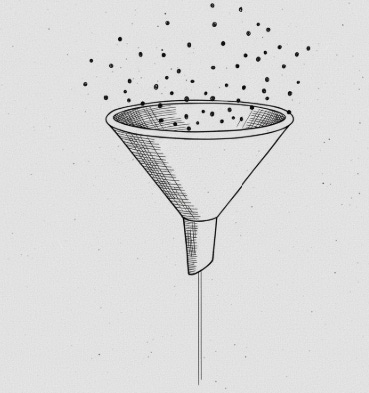 |
We said AI media still feels like drinking from a firehose. There is more information than anyone can track, and the volume creates the illusion that you must constantly consume just to stay relevant. LinkedIn has seen an 82 percent rise in posts from professionals talking about overwhelm and navigating change, which signals a collective struggle to interpret what matters and what does not. The way out is not to consume more. It is to share the load by creating a collective information flow with the people you work or learn with. A shared learning infrastructure turns noise into signal, and fear of missing out into a calm, curated stream we manage together.
My preferred solution for this is a shared aggregator like Feedly. A small group decides which sources to follow, which topics matter, and which articles or updates are worth keeping or removing. Instead of ten people scanning the same feeds, you split the work, tag what matters and annotate insights for one another. It creates a lightweight editorial layer: different people highlight different things, which immediately broadens perspectives and reduces blind spots.
This also solves a common problem inside teams: most people already share articles in Slack, Teams or Discord, but those links quickly disappear into a stream of conversation. It’s unstructured, hard to revisit, and almost impossible to learn from over time. A shared aggregator keeps the signal separate from the chat, so the knowledge becomes something the whole team can return to, not something lost by lunchtime.
This idea can be extended beyond media too. Shared prompt libraries, for example, give everyone visibility into how others are working, what outputs look like and where improvements can be made. When someone refines a prompt, the whole group benefits. When a prompt fails, that learning is captured too, instead of disappearing into private notes. A shared library becomes a living documentation of the team’s capability, not the output of one person.
The goal of this infrastructure is to make learning visible. When people can see what others are reading, trying, building or struggling with, the cognitive load drops. You no longer have to chase every update yourself because you know someone else will surface what matters. You no longer wonder if you are behind, you are using the collective memory.
How do we turn inputs into actual understanding?
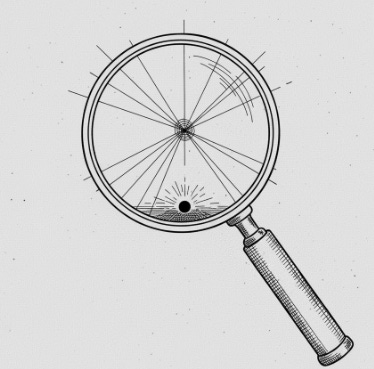 |
Learning together is not just about exposure, it is about making sense of what we see. AI tools, news, workflows and prompts only become useful when groups challenge them, critique them, and try them in real contexts. This is the part many teams skip: they assume they’ve understood it and move on. Real comprehension requires friction: it requires testing, questioning, comparing, refining.
These everyday exchanges are where the real progress happens. When someone experiments with a workflow and writes a few lines about what worked and what did not, and the rest of the team does not need to repeat the same detour. Someone else looks at a hyped up announcement and grounds it in reality, which keeps the group from chasing every new distraction. Another colleague shows how a small prompt change improved the output, and everyone’s bar rises a little.
Some ways we can build a few simple practices around it:
“Show me the output” moments, quick and informal reviews where someone shows a result and explains what they tried
Micro-demos, short walkthroughs recorded on Loom or presented live
Critique circles, small groups looking at prompts or workflows together and refining them
Application sprints, where everyone tackles the same problem for an hour, compares approaches and adjusts
Used sparingly, these routines help teams turn scattered moments into shared understanding.
Where does learning expand beyond the walls?
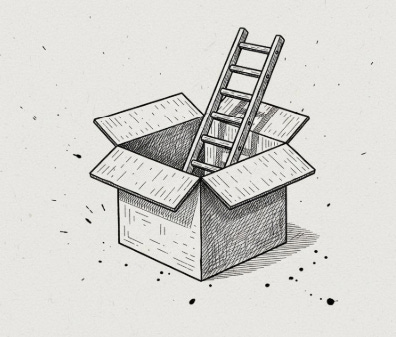 |
If internal networks (existing teams) help you learn faster, external networks (peers, second order connections, influencers) make you learn wider.
They expose you to different tools, different use cases and different ways of thinking that rarely surface inside a single company. In a moment where AI is evolving weekly, this outside-in perspective is necessary because it stimulates new ideas and connections from other use cases, industries and roles.
To do this, there are two main ways:
Learning Group – One very simple way to tap your network is to build a small group of three to five people you regularly exchange insights with. They can come from different industries or roles, the point is variety. These people act as your sense-makers, helping filter noise, highlight what matters and give you the confidence that you are not learning in isolation. This does not need to be formal, it could be living inside a WhatsApp group voice note, a shared Notion page or a monthly coffee.
Communities as Living R&D Labs – External communities are a great place where experimentation happens. Online communities, meetups and online cohorts move far faster than formal company training. Don’t just lurk. Contribute early. Share a prompt that worked, a workflow you tried or a failure that taught you something. These small exchanges unlock serendipity, and in the AI world, serendipity compounds quickly.
How do we turn private effort into shared capability?
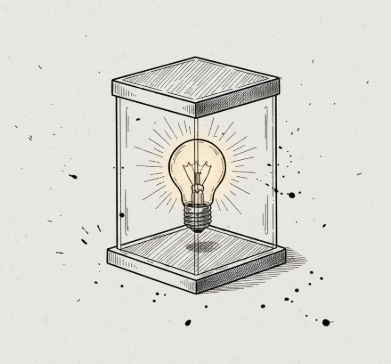 |
Learning accelerates when it becomes visible. Inside organisations, the teams that move fastest are the ones who make their experiments easy to find and easy to reuse.
Atlassian teams log prompt attempts and failures in shared AI boards, so knowledge spreads instead of living in someone’s notebook.
Duolingo holds weekly prompt reviews where people bring both the wins and the messy drafts, which helps everyone build a shared sense of what “good” looks like.
Shopify keeps an internal prompt library tied to their assistant, so improvements don’t disappear into private chats.
GitLab documents every test openly, which lets one team’s small discovery ripple across the company without extra meetings.
Airbnb brings designers, engineers and analysts into the same loops to review prompts and model outputs together.
Salesforce, HubSpot and Microsoft all run versions of these practices too.
The pattern is simple: when experiments are visible, learning compounds.
This idea also extends outside the company. A lot of people are already “learning in public” on social media, sharing workflows, prompts or small lessons. Done well, this helps others see what is actually happening on the ground and creates new connections around real experience rather than theory. The challenge is staying honest - it’s easy to drift toward hype or over-polished success stories, which doesn’t help anyone. Sometimes I wish we would treat posts the same way teams treat internal reviews: ask a colleague or trusted peer to read it first. “Does this feel grounded? Is it clear? Is anything exaggerated?”.
This is also where relationship capital becomes career capital: when people see your thinking, not just your output, your network becomes a real asset in shaping opportunities. And there’s a career effect too: LinkedIn often sees that the people who share their thinking, not just their finished work, build stronger relationship capital over time. Others begin to trust their judgment and involve them in better opportunities.
Final Thoughts
The story of AI has been told as a story about tools. What the last year revealed is that it is really a story about people. We need to start treating learning as a collective practice, not a personal sprint where ideas circulate, where experiments are visible, and where uncertainty is something you work through together.
If the pace of knowledge will keep rising, the only sustainable response is a stronger network of interpretation around each person. This is how we can develop expertise instead of scattered experiments, how teams can stay aligned and how work can become less reactive and more intentional. AI may reshape tasks and processes, but it is networks that will shape understanding, and understanding is what turns possibility into something we can use.
Our networks must become the place where knowledge stabilises, integrates and becomes usable - to do that, we need each other.
You're currently a free subscriber to Work3 - The Future of Work. For the full experience, upgrade your subscription.
| ||||||||||

