|
 |
Dear Readers,
In case you missed it, here was our article on New Years Day highlighting a couple of risks that we think have been under-estimated this year.
Stay tuned with Work 3 in 2026 - we have planned lots of interesting articles, reports, webinars, and collaborations.
Also, let us know what you would like to read more of from Work 3 this year.
Andy and Matteo



 |
For most people, work isn’t designed - it’s just assigned.
How do we design work?
As new tools and intelligent systems reshape how work gets done, design matters more. Any successful organisation needs the capabilities, systems, and culture to design work.
Empowering successful teams should be the remit of HR.
It is envisioned that a successful HR function in 2030 will be smaller, less process-orientated and architects of a healthy work ecosystem.
As Amber Grewal recently wrote in her Eightfold essay ‘A New Recipe for HR Transformation,’ the ingredients for success have changed. The familiar layers of HR - people, process, and policy - are being reimagined around data, intelligence, and experience.
So how should we approach People Management?
Like motherhood, everyone has an opinion about HR - even when they have never done it. This article will be of interest to those working in HR, and also to those whose working lives are impacted by it.
Old Recipes, New Ingredients
 |
A confession. I have designed, built, improved, tweaked, and dismantled more HR Operating Models than there are pastéis de nata in a Lisbon pastelaria.
There have been many flavours - from force-fitting HR generalists into business partner roles, installing self-service systems that nobody really used, and migrating HR into shiny shared-service centres from Glasgow to Mumbai - each iteration chasing efficiency, not always effectiveness.
Some went down a treat, others went a bit stale.
I have worked with many great teams and seen careers flourish, but have also seen untapped potential, and survived some toxic workplaces.
These experiences shaped a simple goal for me - to make work better, much better.
I believe HR has a big role to play in this, and here are some learnings I have shared recently at events in the Netherlands, London and Lisbon.
The first rule of HR Transformation is - Don’t mention HR Transformation
 |
Nobody actually wants to be transformed.
After many organisational changes, most things will stay the same anyway. Use inclusive language, involve employees in this change from the beginning - they are closer to the action and often know what will actually work.
Beware Borrowed Cookbooks
The standard HR operating model was developed around the turn of the century and influenced from external factors happening at the time. This included the move to Account Managers in support functions, e.g. IT, Finance. ERP Systems. Shared Service Centres.
IT and Finance went first, and HR copied this model.
But if you bake with the wrong ingredients you will get mixed results.
Primarily because the implementations did not use organisational design techniques, from first principles and incorporating the business context.
Secondly, many were trying to fit a square peg into a round hole. A model that works in an IT company might not work in a factory.
Haier - an 80,000-employee manufacturer - runs more than 4,000 self-managed micro-enterprises instead of a traditional hierarchy. Disco Corp in Japan lets employees choose their daily tasks via an internal currency system. Each structure fits its unique context, not an imported template.
I no longer show my slide, “here is the answer, now what is the question?” with respect to the implementation of rigid HR Operating Models - it ruffled certain academic feathers apparently.
Sometimes, we designed HR models that had no Business Partners, because they were not needed, with others we hired BPs from outside of HR to be commercial account managers. It depends on the business context and industry.
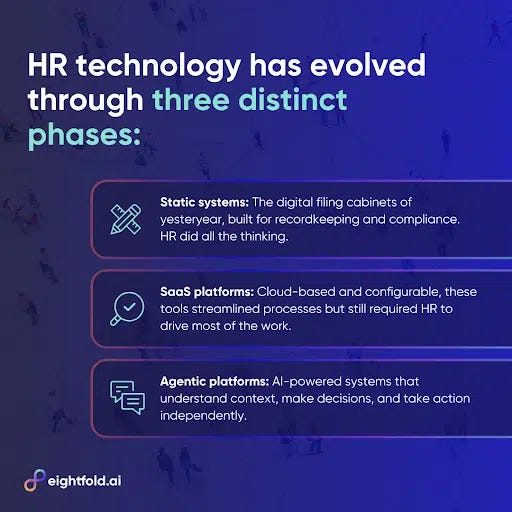
The external factors that once influenced the shape of HR in the last century, have now changed substantially, from SaaS to AI, and a workforce increasingly outside the payroll.
It’s time to throw out the old HR cookbook and rebuild the people function.
Evidence Over Technology
Why do we continue to use certain twentieth-century management practices?
One reason is that we continue to use the software licenses we inherited.
If there was a business case, we don’t know whether the process worked, because we didn’t measure the results.
Use evidence-based design to solve organisational problems - and avoid the worst mistakes.
Examples of designing work using relevant organisational evidence, include Amdocs, where the talent team used Eightfold’s platform to mine a database of some 2 million candidates and saw a 20 % reduction in time-to-hire for specific skills. At Symetra internal mobility jumped from 38% to 48% once adjacent skills were surfaced.
Use the best available evidence to make decisions, this includes academic meta-studies (if you are lucky), asking those who have done it before (if they will speak to you), and your own stakeholders (much easier).
For more resources on evidence-based management use this excellent resource → CEBMa
Start with Better Questions
From the start of your journey – obsess about asking the right questions.
I sometimes hear from CHROs, “fascinating how India and Africa will change work this century, but my CEO wants to know, when are we implementing AI and can we cut 20% off the payroll in the next 3 years?”
So a hint,
“how do we implement AI?”
is the wrong question.
Instead ask about which capabilities your organisation needs to succeed, and how to create a system that will adapt successfully to changes.
GitLab’s all-remote model starts with a sharper question: “How can work flow without meetings?” The answer led to a design built on transparency and trust, not geography — proving that capability, not proximity, is the true foundation of performance.
So what’s a modern HR Leader to do in 2025?
Look to the Future using Scenarios
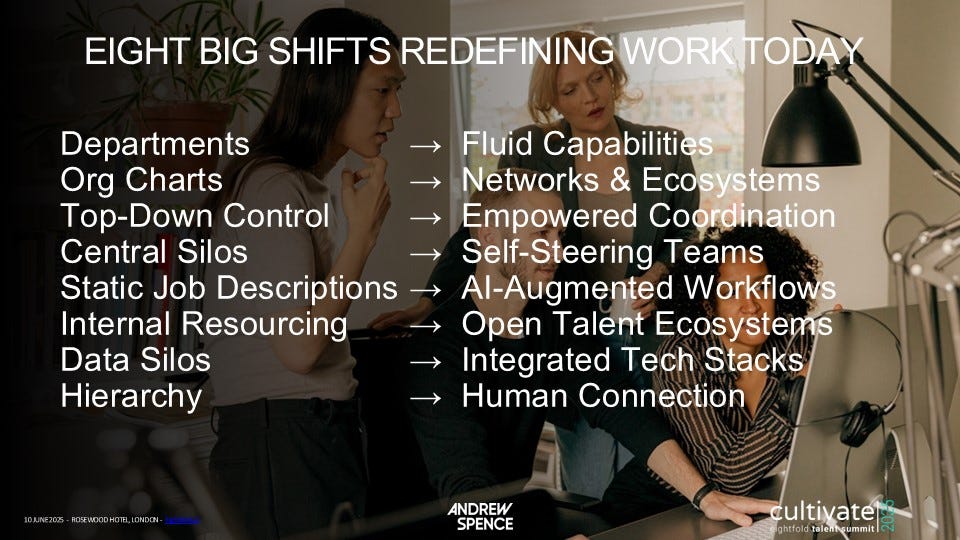
The next decade isn’t about digital transformation - it’s about organisational redesign, as industries restructure.
Teams will increasingly manage themselves, powered by smart tools and intelligent systems. Firms will get smaller, more fluid, mixing employees, contractors, and digital agents. HR’s role won’t vanish; it will orchestrate agility, culture, and capability across these ecosystems.
Read our article, “The Global Mega Trends Shaping the Future of Work”, download PDF for your team to read, and pick out some scenarios to test against your workforce strategy.
Focus on What Matters
Every HR leader is being sold the latest platform, dashboard, or productivity hack.
But the best-performing teams keep their eyes on purpose and capability, not shiny tools.
Start with organisational goals, design for how value is created, and help teams build the skills to deliver it.
Evaluate new technology — but only after you’ve answered: what problem are we solving?
Amber describes this shift as ‘deconstructing and rebundling’ HR capabilities — a recipe where technology, data, and design come together to elevate the employee experience.
Get stuck into conversations about the future of the organisations – the workforce strategy will quickly follow.
Think Work, Not Jobs
Work is being unbundled and reassembled in new ways.
Talent is no longer bound by geography, and tasks are no longer trapped inside jobs.
Intelligence is shared between humans and AI co-pilots; teams are networked rather than hierarchical.
In healthcare, AI-enabled assistants like Woebot and Wysa are used to collaborate with clinicians, augmenting emotional-support roles. The lesson: design workflows where human empathy and machine intelligence complement rather than compete.
Security, too, is shifting — from employment to skills and reputation.
HR’s mission now: engineer how work gets done - not just enforce process.
Trust Over Technology
Trust remains the true currency of change — for employees, customers, and leaders alike.
AI without trust is just automation.
Keep people first, stay curious, and remember: technology amplifies what already exists - it doesn’t fix what’s broken.
Empowering Teams to Design Work - From Recipes to Actions
Some HR operating models are on their eighth recipe iteration; others are still half-baked.
Any successful organisation needs the systems and culture that enables the process of designing work to respond well to the industrial context they are in.
Some suggested actions for Work Designers :-
Start small, design boldly. Choose one workflow or team and redesign how work gets done using evidence and data - not hierarchy.
Map capabilities, not jobs. Use talent intelligence tools to understand which skills drive performance and where the gaps lie.
Build feedback loops. Treat every HR process as a prototype - test, learn, and refine.
Empower teams. Train managers to co-design roles and workflows with their people, not for them.
Measure what matters. Track capability growth, trust, and adaptability - not just headcount or time-to-hire.
Don’t just add AI to an old recipe and expect a better flavour.
The Cherry on Top
HR can play a key role to create systems that enable teams to design and manage work better, much better.
Those who get this will power ahead.
Challenge the 20th-century modes of management and reinvent them for your teams, your organisations and your industries.
Embrace the role of the work designer. Leaders must shape systems that flex as fast as the world changes.
Work design isn’t a project - it’s a craft.
HR’s next act isn’t about rolling out another transformation project. It’s about designing the systems that let people and technology work brilliantly together.
Your cinnamon-dusted futurist,
Invite your friends and earn rewards
| ||||||||||

