|
 |
Seven Ways Technology is Making Us More Human, Not Less
From AI SuperWorkers to Digital Soulmates—How Technology is Reshaping What It Means to Be Human
|

| |||||||||||||||


 |
We shape our tools and thereafter our tools shape us. Marshall McLuhan
Technology feels like it’s reshaping the world in ways we can’t control.
The TechBros are swinging chainsaws—cutting jobs, flooding social media with AI-generated noise. Apple’s market cap is now larger than the GDP of all but seven countries.
In response, a tech resistance is emerging:
Governments are banning social media for kids. (Australia now restricts social media access for under-16s.)
People are ditching WhatsApp for privacy-friendly alternatives like Signal and Telegram.
The dumbphone movement is growing, as users swap their iPhones for old-school Nokias to escape digital addiction.
These resistance movements come from a real concern—that technology is making us less human, not more.
And yet, I don’t think the answer is to opt out entirely.
Technology is neither good nor bad; nor is it neutral. Melvin Kranzberg
There have been five technology-led revolutions in that last 250 years, according to Carlota Perez. Before the Digital Age, we had the Age of Oil.
But Technology isn’t like Oil—it’s more powerful than that.
Oil powered industries; technology rewires decision-making, behavior, and even identity.
It can be used to exploit us, or to empower us.
We have a choice.
If we shape technology with intention, we can use it to solve human problems, build deeper connections, and expand what’s possible.
Here are seven ways technology is making us more human—not less.
1️⃣ AI is Helping Us Understand Ourselves Like Never Before
For centuries, we’ve guessed at how we think, feel, and behave. Now, AI is revealing patterns in human psychology, decision-making, and well-being that we never could have seen before. We now have a treasure trove of data revealing how we truly behave-often contradicting what we report in surveys.
AI-powered brain research is unlocking how memory, emotions, and burnout work.
Wearables track focus, stress, and energy levels, helping people optimize their performance.
AI can detect mental health struggles before we even realize we’re struggling.
🔹 Example: Woebot - an AI-driven mental health chatbot with strong clinical backing.
💡 The Future: Expect AI-driven personalized coaching tools that help us understand and improve our own behavior.
⚠️ Insights from this data should be regarded as a public good and not owned by companies or locked inside impenetrable academic firewalls.
2️⃣ AI and Platforms Are Shifting Us From Employees to Career Owners
Technology has unbundled work—we’re no longer limited to a single employer or job. AI and platforms are giving individuals more control than ever over when, where, and how they work.
Freelancers use AI to find global clients.
Substack, YouTube, and Patreon let creators monetize their audiences directly.
AI copilots (ChatGPT, GitHub Copilot) supercharge productivity, making workers 10x faster.
🔹 Example: Braintrust - a decentralized talent network connecting freelancers with top companies, allowing them to keep 100% of their earnings.
💡 The Future: AI won’t necessarily replace workers—it will amplify those who know how to use it.
⚠️The platforms aren’t perfect – there are too many transaction taxes, friction, and digital fiefdoms to work around – but they are better than the alternative. (I’ve explored these challenges in more detail in my paper on user-owned platforms using decentralised technology)
3️⃣ AI is Helping Us Find the Right People—For Work, Love, and Life
We underestimate how much AI is already shaping human relationships. It’s not just automating tasks—it’s connecting us with people who share our interests, skills, and values.
AI-powered job-matching helps professionals find meaningful careers.
Dating apps use AI to predict compatibility more effectively than humans.
Freelance platforms match people with ideal clients and collaborators.
🔹 Example: Lunchclub - facilitates professional networking by connecting individuals with similar interests for virtual or in-person meetings.
💡 The Future: AI-powered ‘life assistants’ will curate the best people for us to meet, collaborate with, and learn from.
4️⃣ Some People Will Thrive in Digital Worlds More Than in the Physical One
The Loneliness Epidemic might not be real, but more people prefer to be physically alone more of the time and technology is offering alternative ways to connect.
VR therapy is helping people with social anxiety interact in safe environments.
Virtual workspaces (e.g., Gather.town) are replacing traditional office dynamics.
AI-generated worlds (Metaverse, spatial computing) are allowing people to design their ideal work and social spaces.
🔹 Example: Virbela—a virtual workplace that helps remote teams collaborate in immersive environments.
💡 The Future: More people will feel at home in digital spaces—not as an escape, but as a better fit for their personality and work style.
5️⃣ AI is Accelerating Breakthroughs in Health, Climate, and Science
Technology isn’t just about jobs and entertainment—it’s also solving humanity’s biggest challenges. During my keynote in Istanbul last year on Sustainability, I argued that;
“while humans have caused many of the sustainability problems we face, we must also be the ones to solve the same problems.”
This will come from diverse teams working creatively. By improving how we work, we significantly increase our chances of addressing these complex challenges.
AI-powered drug discovery is cutting research time from decades to months.
AI climate models predict extreme weather and optimize renewable energy.
AI simulations are helping scientists understand complex biological systems, including aging.
🔹 Example: AlphaFold—AI that solved a 50-year-old biology challenge, predicting protein structures with unprecedented accuracy.
💡 The Future: AI won’t just make businesses more efficient—it will help solve existential human challenges.
6️⃣ We Now Have Unlimited, Free Access to Knowledge and Entertainment
In 1994, accessing knowledge meant buying books, CDs, and VHS tapes. Today, we have:
Millions of free courses and lectures on YouTube.
Unlimited music, movies, and podcasts at our fingertips.
ChatGPT and AI tools that act as instant tutors for any subject.
🔹 Example: Khan Academy AI—AI tutors providing personalized education for students.
💡 The Future: AI-driven learning will make elite education available to anyone, anywhere, for free.
7️⃣ AI is Forcing Us to Ask: What Does It Mean to Be Human?
For the first time, we’re competing with machines that can write, design, and even simulate human emotions.
Generative AI is blurring the lines between real and artificial creativity.
AI-generated art is forcing new debates about originality and authorship.
AI ethics is now one of the biggest conversations in society—who decides what AI should or shouldn’t do?
🔹 Example: Anthropic Claude AI—one of the leading AI companies developing ethical safeguards for AI alignment.
💡 The Future: As AI advances, humans will need to double down on what makes us unique—curiosity, relationships, and creativity.
Shape Your Own Future - Or Let AI Shape It For You
The best way to predict the future is to create it. Peter Drucker
We can either let AI happen to us—or use AI to shape the future we want.
🚀 AI is not the enemy. Passivity is.
Sure, we can opt-out of unpalatable apps – an illusory protest vote that protects our conscience but changes little.
But, if we sit back and let big tech dictate how technology evolves, we lose.
Another approach, is to try to experiment, build, and adapt - to gain rather than lose.
Here’s what you can do today:
✅ Use AI as a partner, not a replacement. Try ChatGPT, AI design tools, or automation software.
✅ Find your niche. The best careers of the future will belong to those who understand how to work with AI—not against it.
✅ Think bigger. AI isn’t just about productivity. It’s about freedom, new possibilities, and creating the life you actually want.
Technology isn’t the problem.
The real danger is thinking we have no control.
The future belongs to those who engage, experiment, and build.
Will you be one of them?
A Day in the Life of a (Learning) Professional in 2035
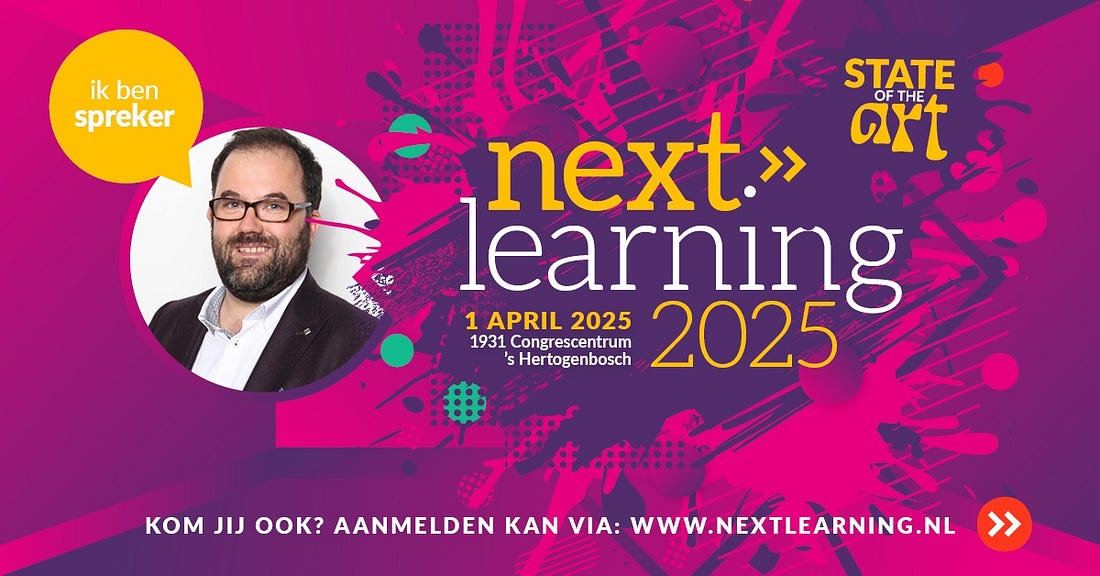 |
I will be in Den Bosch, Netherlands delivering a keynote on April 1st at the Next Learning Event. Come and say hello if you plan to attend, and if you haven’t booked a ticket, we have a special offer for subscribers.
Optimistically,
Andy
Andy Spence is a Workforce Futurist, advisor, researcher, global keynote speaker, and agitator for a preferable future of work. He learnt to programme neural networks and philosophise about AI in his Masters in 1995. Although there was not much demand for these skills then, he worked for the big consultancies until he had saved enough to buy a round-the-world ticket in 2003. He started his own consultancy in 2006, and worked on over 40 digital transformation programmes. He now lives in Lisbon, learns Portuguese very slowly and tries to avoid the daily temptation of pastéis de nata.
Ciao! 👋 I’m Matteo, thanks for reading!
My mission is to decode the future of work by analyzing news, trends, tools and companies looking to disrupt this space. I do this by publishing practical guides and interviews.
Please like and subscribe below to receive weekly updates in your inbox if you liked this post!
| ||||||||||