|
 |
Dear Reader, we hope our friends in the US enjoyed thanksgiving. We have been looking back at 2025 and hope to have an interesting discussion next Thursday for our 5th Work 3 Webinar on expected work themes for 2026. Its more of an open discussion with some of the sharpest minds on the future of work. All welcome - hope you can join us!
Andy and Matteo
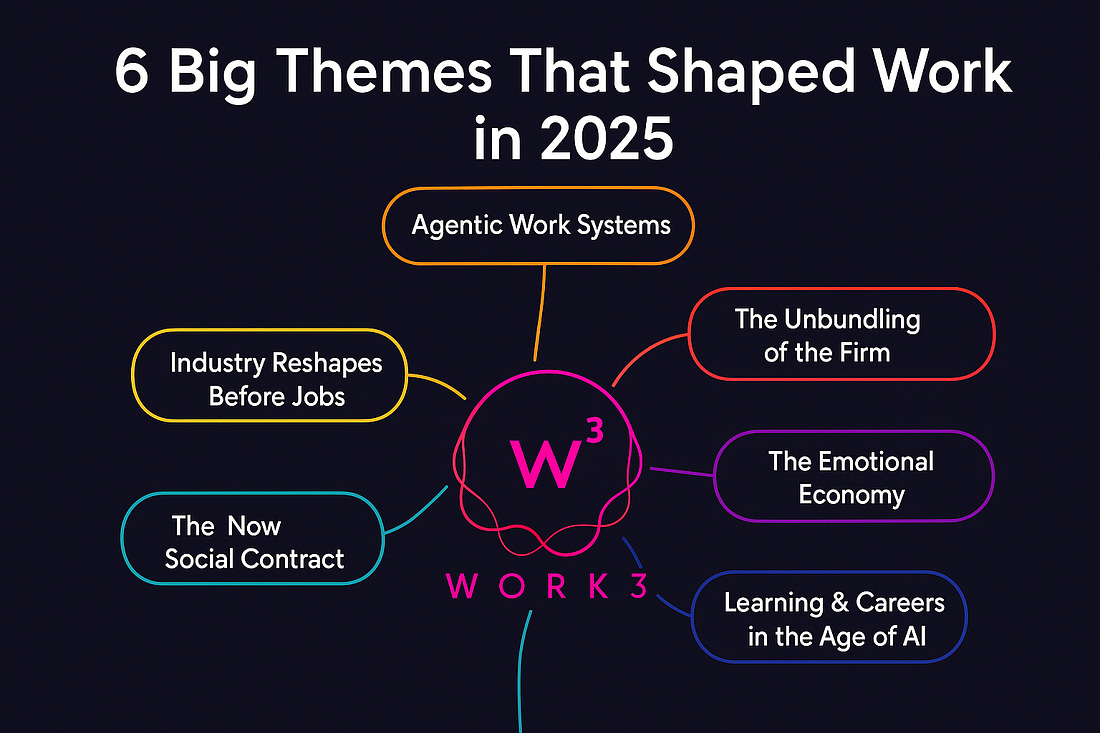
Six Big Themes That Shaped Work in 2025 - And What They Tell Us About 2026
A year of programmable work, organisations unbunding, emotional economies, networked learning and industries reshaping faster than jobs
|

| |||||||||||||||


 |
2025 was an important year for Work 3 with a merger, new partnerships and collaborations, research reports, and a packed run of webinars. And in between all that, we still managed to publish over 40 articles exploring how work, technology, and society are changing.
It is annual prediction season. We are all shaped by news agendas, marketing plans, headline theatre, and frankly noise.
It says nothing to me about my life.
Predicting how the future plays out is slower and more personal. Our early attitudes, our social networks, and how complex global systems land where we live.
These forces tend to ignore calendar years and neat predictions.
But there is no need to Panic.
We stepped back recently and analysed every Work 3 article published in 2025 — with some help from our Work 3 AI Agent team (who, frankly, are looking forward to a few days off at Christmas). Six themes emerged with surprising clarity.
These themes reveal not just where work is today, but where it might be heading — and what we’ll be watching closely together in 2026.
To explore this with the Work 3 community, we’re hosting an open Webinar (free for all readers) next Thursday 7th December - 5 pm GMT (UK) / 12 pm EST (US)
We’ll share the themes, debate what’s coming next, and highlight the signals we’re tracking for 2026, but more importantly we want your contribution!
The Six Themes That Shaped Work in 2025
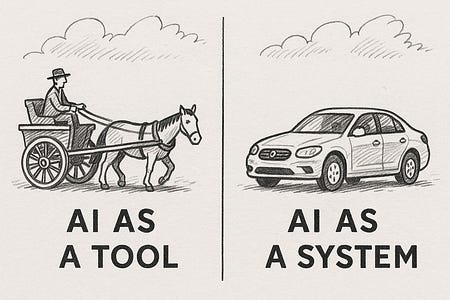
1 - Agentic Work Systems - The New Operating System for Work
We explored how agentic AI will impact how we design work.
 |
Recommended Work 3 Articles
When Work Becomes Programmable - currently AI Agents are like bright interns without process memory, this article describes an early view of Anthropic’s Agent Skills which might change this. Plus some suggestions on how to get started yourself.
From Tools to Systems: How Agentic AI Rewires the HR Work Stack - The infrastructure of work is broken - inadequate with a global workforce governed by thousands of different work contracts. One way to see the impact of Agentic AI on work is the addition of a coordination layer that lowers the cost of organizing work across teams, tools, and talent.
Inside the “Prove AI Can’t First” Company - exploring the impact of leaders like Shopify’s CEO Tobi Lütke voicing this “AI-first” philosophy, issuing directives that managers must first prove why AI cannot accomplish a task before requesting more human headcount. Plus the emergence of the “SuperWorker”.
What New AI Operating Systems Mean for Work - first our computers, then our firms. Taking a longer-term view on the implications for the Future of Work.
Signals
In several companies we analysed, ‘Agent Skills’ are now part of onboarding — meaning new employees learn how to delegate to machines before they learn the org chart.
Key Insight
Work is becoming programmable. Productivity shifts from individual effort → orchestrated workflows between humans, AI agents, and integrated systems. This is already yielding some radical experiments and a new generation of leaders.
Question
What happens when every employee, and every team, has an effective AI Agent acting alongside them?
2 - The Unbundling of the Firm - From Hierarchies to Networks
From Agentic AI changing how work is done today, we also explore the longer-term impacts on the firm.
 |
Recommended Work 3 Articles
Last Stand of the Corporate Peacock 🦚 - After ‘Peak Office’ why Return-to-Office mandates are more about strutting than strategy. Our most popular article started with my intent to share this photo of a bird - take inspiration where you may find it!
The End of the Corporate Silo - there was some excitement in the LinkedIn HR community about Moderna merging its HR and IT Departments. At Work 3, we took it a few steps further and asked why not get rid of traditional 20th century corporate silos?
The Decentralised Workforce - The rise of freelancers, creators, and one-person empires - how digital platforms are reshaping work and wealth creation.
AI & the Corporate Pyramid - what will be the impact on Middle Managers in the next few years? We looked at the evidence and the emergence of new paradigms.
Eight Big Shifts Redefining Work Today - from corporate silos, org charts and job descriptions TO talent ecosystems, integrated tech stacks and more human connection.
Signals
In the biggest workforce in the World, China, 200 million depend on some kind of flexible work. That’s 40% of the urban labour force. (Source - The Economist)
A global pharma firm quietly moved 40% of its operations into cross-functional “workflows” instead of business units - and productivity jumped without hiring.
75% of Generation Z have no plans to go full-time in their whole lives. (Source – Dazed magazine survey)
The size of the gig economy is estimated at $556.7 billion in 2024 and is projected to more than triple to $1,847 billion by 2032 (Source - WEF).
Key Insight
The traditional firm is breaking apart.
Work is shifting from rigid, top-down structures → fluid, cross-functional networks driven by platforms, AI, and team-based coordination.
Question
If you were designing your organisation from scratch today -
would you rebuild HR, Finance, IT, and Marketing as they are?
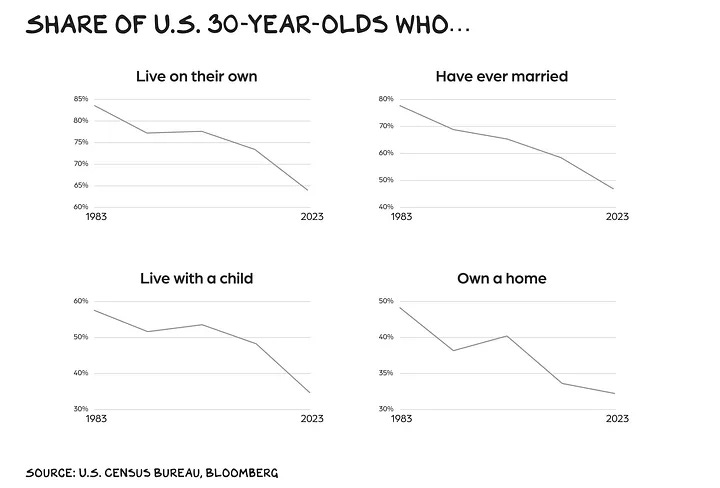
3 - The Emotional Economy - Human Connection in a Technological Age
From Agents to Orgs, we get back to what is really happening us soft and cuddly humans…
 |
Recommended Work 3 Articles
The Emotional Economy: When AI Becomes a Friend - from friendship apps to therapy bots - how tech is answering our need for connection.
The AI Mirror: What Using AI Reveals About Your Leadership - Forget coding. The most valuable skill in the age of AI is management - and if you can’t lead people, you won’t be able to lead technology.
The Loneliness Epidemic - Five Ways Employers Can Improve Belonging - we look at some of the sociological evidence for this, the important difference between being alone and being lonely and some tips for employers to reduce loneliness at work.
Seven Ways Technology Makes Us More Human - from AI SuperWorkers to Digital Soulmates.
Signals
The U.S. Surgeon General has equated loneliness to smoking 15 cigarettes a day in terms of health risks.
In the UK, about 6% of young adults say they meet friends, relatives, or colleagues less than once a month.
In China, the Maoxiang app allows users to create their own virtual characters to interact, virtual friends, with and has 2.2m monthly active users.
Key Insight
As AI scales, emotional value becomes a differentiator. Belonging, trust, and human connection matter more, not less, in digital work. As we accumulate vast amounts of personal data, we have the opportunity to learn more about people in the next 10 years than the last 100.
Question
How do we design emotionally intelligent workplaces in a world where AI is everywhere?
(This is a long article - you can read the full article online if you prefer)
4 - Networked Learning - Careers in the Age of AI
With all this change, how can we learn more effectively and manage our careers?
 |
Recommended Work 3 Articles
Learning in the Age of AI: Networks, Not Notebooks - In the age of AI, relationships still matter: how to tap your network for career growth. Stories of Learning Groups and Communities, digital guilds, social learning, micro-demos, critique circles, applications sprints, and shared prompt libraries.
Learning AI Feels Like a Second Job - anyone feel AI fatigue? Matteo explains why, and gives some ideas on how to learn AI without losing yourself.
Death of Entry Level Jobs - are we building a world without beginners? We look at the data, and give some ideas on how employers, graduates and governments can respond.
Signals
41% of professionals say the pace of AI-driven change is affecting their wellbeing. (LinkedIn research)
62% of professionals globally say they’re optimistic about AI improving their daily work life. (LinkedIn research)
Key Insight
Learning has shifted from courses → networks.
People now learn through peers, agents, workflows, and communities while entry-level jobs quietly disappear.
Question
What replaces the traditional career ladder in a world without beginners?
5 - The New Social Contract - Policy, Demographics & the Future of Work
We need to reframe how we think about work, so cast our nets globally for ideas and policies for a post-job world.
 |
Recommended Work 3 Articles
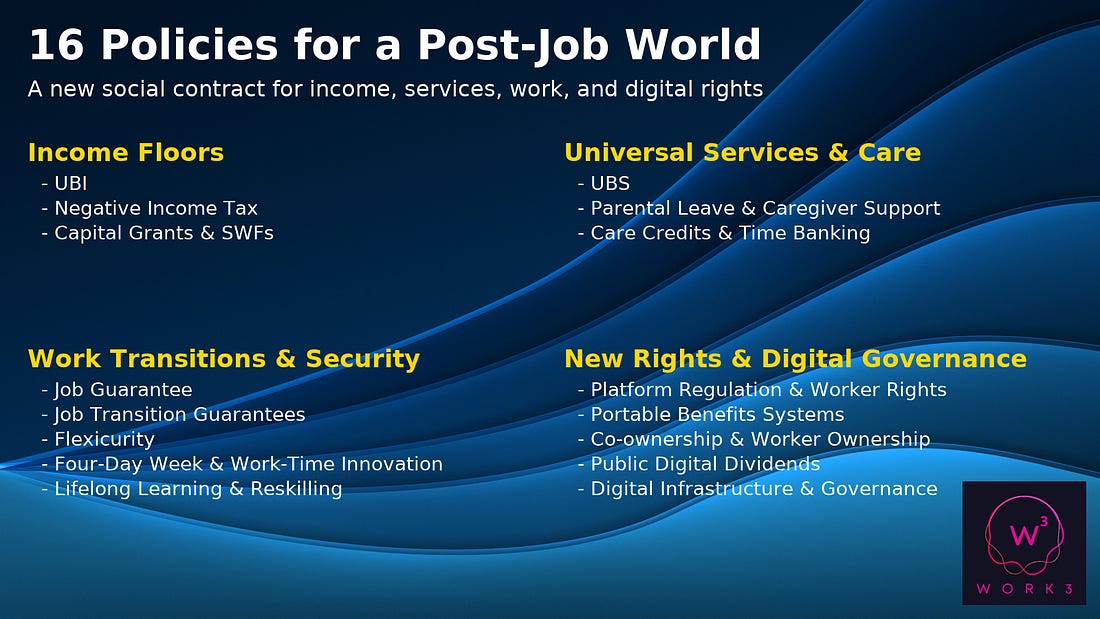
Work 3 Policies for a Post-Job World (Part 1–2) - 16 policies sketch out a new social contract for the future of work. Some are radical (UBI, Job Guarantee), others incremental (portable benefits, reskilling).
AI-geism - Can AI help or make ageism in tech worse?
Japanification of Work - Cuddly seals and exoskeletons: how Japan tackles an ageing workforce.
Africa’s Hustle Generation: Ambition, Innovation, Opportunity - with rising investment, some digital leapfrogging, digital platforms, and a young population, Africa is poised to lead a new era of global growth.
Signals
By 2030, more than half of the young people entering the global workforce will be African. Africa boasts the youngest population in the world, with a median age of just 19.2 years compared to Europe’s median age of 44.7 years.
Japan’s blend of robotic care, active ageing policies, and work re-design gives us a preview of what many Western nations might face by 2030.
Key Insight
Ageing populations, automation, and new forms of labour are pushing governments to rethink everything: pensions, safety nets, immigration, skills investment, and the very definition of work.
Question
How can government policy keep up with the pace of industrial and technological change?
6 - Industry Reshapes Before Jobs - The Hidden Transformation
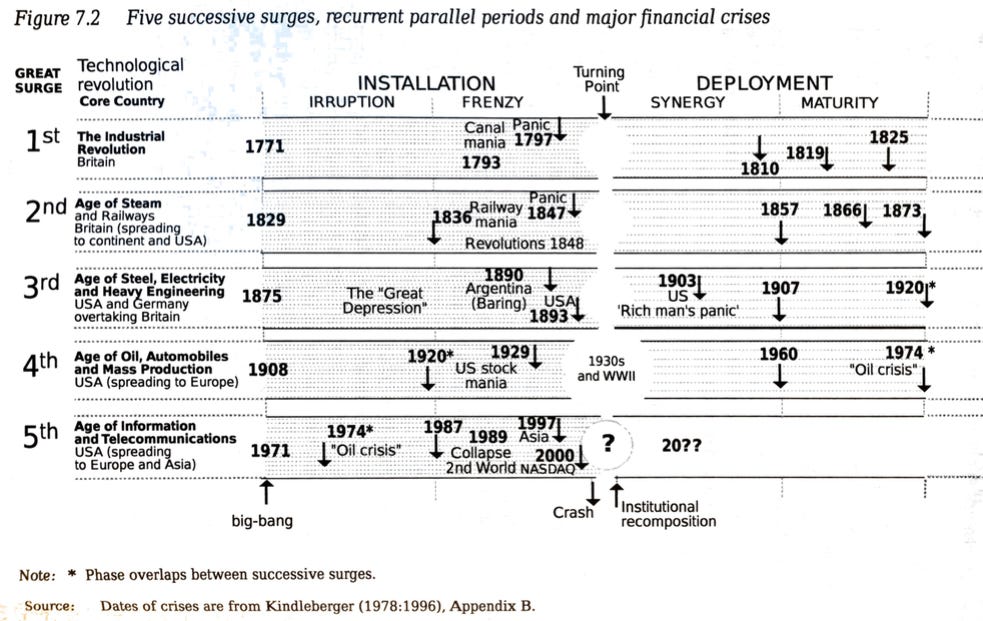
Many are looking at the impact of AI myopically - at our own function. But AI will transform industries then the organisations, then what it takes to run them.
 |
Recommended Work 3 Articles
The Impact of AI on Work (Isn’t About Jobs) - most debates start with the wrong question: the impact of AI on jobs. But our systems of work are broader than payroll - today around two billion people work without a formal job.
The Future of Jobs Report 2025 - summary of survey from 1000 global companies predicts 170 million jobs will be created by 2030 - but read with some scepticism.
-
Proof of Work Paradox - a new infrastructure for work-matching to boost the economy.
Signals
Some sectors are already eliminating entire layers of workflow, long before job titles officially change — e.g., procurement, compliance, and parts of customer success.
The WEF report predicts the creation of 170 million jobs by 2030, and displacement of 92 million current jobs.
Key Insight
The biggest disruption isn’t job loss — it’s the restructuring of industries, supply chains, and business models.
Jobs change after industries transform, not before.
Question
Which industries are next in line for AI-driven restructuring - and what early signals should we watch?
POLL🗳 - Which theme will impact work most in 2026?
I’ve set up a 10-second poll with our 6 big themes.
Click HERE to vote in the poll
We’ll share the results in a future post.
Join Us: Work 3 Live Discussion - What’s Coming in 2026?
We’ll dive into all six themes and explore the emerging patterns we’re tracking for next year:
Will AI Agents finally tip from experimentation → standard practice?
Is the corporate hierarchy entering its final decade?
Are we heading toward a multi-speed labour market?
What new work infrastructure will we need in 2026?
This is not a presentation, or a lecture, but a discussion.
Bring your questions, your examples, your challenges.
We’ll map the future of work together, as a community.
Thursday 7th December - 5 pm GMT (UK) / 12 pm EST (US)
CLOSING NOTE
Work 3 exists because of the questions you ask and the signals you share.
Tell us in the comments, which of these articles or themes resonated with you most this year? Which will dominate in 2026?
2025 showed us that work is changing faster than expected — and that our community has become a place where people come to make sense of it all.
Here’s to shaping the next chapter, together.
Join the Work 3 Community
Consider Joining the Work 3 Community for, you’ll get:
✅ A 30-page deep-dive PDF report, ‘Nine Global Mega Trends Shaping the Future of Work’ with 60 further resources to explore, PLUS a Q&A Worksheet to apply the ideas in your context
✅ A 15 minute call with Andy and Matteo
Join the Work 3 Community today and get instant access plus support our research, events, and future products.
Not ready for Work 3 Community membership yet? Subscribe free to get the latest Work 3 articles straight to your inbox.
You're currently a free subscriber to Work3 - The Future of Work. For the full experience, upgrade your subscription.
| ||||||||||

