|
 |
Dear Reader, did our 6 Big Themes for Work in 2025 resonate with you?
We are interested in what you are seeing and expecting for next year. You are all invited to our Work 3 Webinar on Thursday 4th December, 5pm GMT, 12pm EST. Less of a lecture, more of an open discussion with some of the sharpest minds on the future of work.
Register Here (its free this month)
All welcome - hope you can join us!
Andy and Matteo
Skilling Me Softly – How to Manage Your Career When Job Titles Become Meaningless
Skills, experimentation and tiny-gains
|

| |||||||||||||||


 |
In past tech revolutions, access to tools and information was limited — only a few could afford early computers. Today, AI arrived essentially for free and for everyone, even before we fully understood what to do with it. The result is a much narrower learning divide—but also a new kind of pressure, where even early adopters don’t feel ahead. LinkedIn data reflects this tension: 41% of professionals feel overwhelmed by how quickly they’re expected to ‘get AI’, and posts about AI overwhelm are up 82% year over year.
This is where our earlier work connects: in the first part of this series, AI feels like a second job, we explored what many professionals were quietly experiencing: anxiety, pressure, and the sense that AI has added a whole new layer of work. In Learning in the Age of AI we focused on the antidote that works in real life: learning together and building confidence with other people, because that is how we are truly wired to progress.
Today, we shift from the emotional and social side of adaptation to the structural one. We look at:
- How AI is reshaping careers: what current adoption looks like, what the data shows about the roles changing first
- What it means when job titles, the labels that defined work for decades, begin to lose relevance.
We’ve Been Here Before, But This Time Feels Different
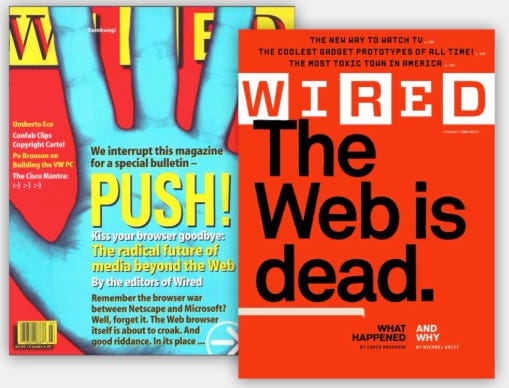 |
Each technological shift has arrived with predictions of disruption, job loss, and new forms of productivity: the ‘web’ has been dying since 1997, - and yet each time, the story unfolded slower and more unevenly than predicted. As Reinhart and Rogoff argue in the book This Time Is Different, we routinely believe that a moment is unprecedented, even when the underlying pattern repeats. The real story is not that something fundamentally different is happening, it’s about the familiar mismatch between expectations and actual readiness.
For this reason, I spoke with Catherine Fisher, Career Expert and VP of Communications at LinkedIn, to try and get some insights from her vantage point - right at the intersection of companies and employees. During our conversation, she captured this clearly and simply: “First of all, employees are still learning AI, but companies already expect them to be fluent. Then, the disruption is creeping in at the task level, while expectations rise at the role level. Workers can feel the shift before they fully understand it.”
This is the gap that makes this moment feel faster, more visible, and more personal than previous ones and that sets the stage for what we should really focus on: how people learn, experiment, and adapt in small steps, long before job titles start to shift (remember what we talked about extensively The Impact of AI on Industries: disruption starts at the industry level, then organizational level, before it goes to the individual level).
Skills before Jobs: What’s changing, and where value is moving
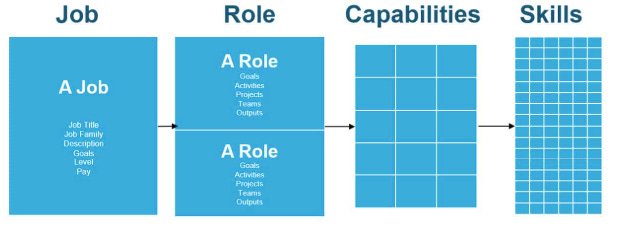 |
Just as scientists must study matter at the atomic level to understand real change, we need to examine work at the level of skills, not job titles. Job titles are lagging indicators - the work inside them shifts long before the label does. Skills show us where change is actually happening.
There is lots of data that predicts this shift: according to LinkedIn data, 85% of U.S. professionals could see at least 25% of their skills change as AI advances. Yet the fastest growing skills are not the ones you might expect, they are human. Of the 10 rising most quickly only one is technical (LLM Development and Application, possibly joined by Process Optimization, depending on how you classify it). That is the real story underneath the numbers: the skills rising fastest are not technical certifications or model-specific capabilities; they are the human skills that become more valuable as AI reshapes work (don’t forget, we are still looking at how to use it as a tool, but it will eventually change the whole of work design itself). Judgment, coordination, originality, and communication will become the scarce inputs, because they are the skills that hold teams together, move projects forward, and turn AI output into real outcomes while keeping it in check. They are also the skills that differentiate people in a market where everyone has access to the same tools.
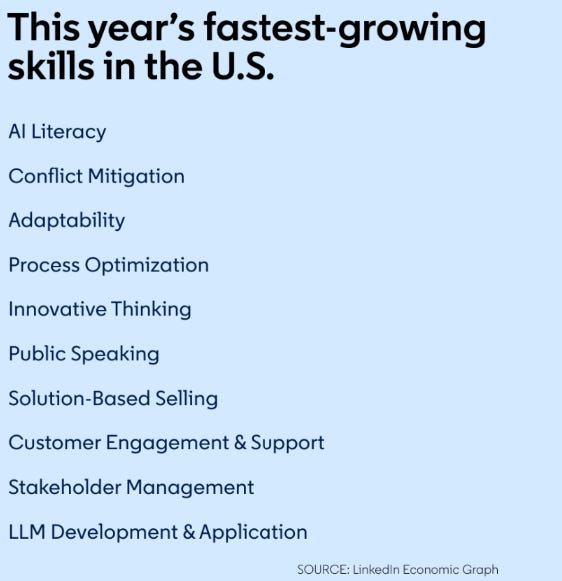 |
Conflict Mitigation - Already very valuable, but as AI speeds up decision making and shortens project cycles, misunderstandings can multiply faster. Teams collaborate across functions, AI agents, and shifting roles means that more decisions happen in ambiguous contexts. This will increase friction and people who can calm tensions, clarify expectations, and prevent escalation will become organizational stabilizers.
AI Literacy - On this, Catherine Fisher from Linkedin stressed how “It's one of the top skills that companies are looking for, and certifications help you show it, but what really matters are concrete examples of how you have used” - which ties in strongly with everything we talked about proof of work.
Adaptability - When tools evolve often and industries are more dynamic, adaptability becomes a core market survival skill. It is difficult to measure, and it lives as much in emotional regulation as in technical ability but at its heart, it’s about responding constructively to change, staying grounded, and focusing on the parts of the work that remain under your control.
Process Optimization - Once AI handles individual tasks, the real leverage comes from improving the system around them. Companies need people who can redesign workflows, spot inefficiencies, and integrate tools in ways that multiply output.
Innovative Thinking - AI inevitably makes MOATs incredibly hard to have for companies, and at the same time, for individuals themselves (always remember, that both inside the company and in the job market, you are a ‘product’ that needs to be evaluated by supply and demand). This means, that thinking outside of the box becomes essential. Anyone can now do basic (maybe not professional) design, edit, or prototype with minimal expertise and this pushes the value of originality far higher. With execution becoming cheap, fresh thinking and novel combinations of ideas become the scarce advantage.
Public Speaking - As AI automates “cheap” written communication, spoken communication becomes a differentiator. Teams and leaders rely on people who can explain ideas clearly, persuade groups, and make decisions in real time. An AI can generate a script or deck, but only a person can deliver it with conviction and move a room.
Solution Based Selling - Buyers now arrive informed, with AI powered comparisons and research already done. What they need is interpretation from professionals who can frame problems, translate complexity, and guide clients through options become trusted advisors. The role shifts from pitching features to helping customers make confident decisions in a very competitive world.
Customer Engagement and Support - If AI handles routine or repetitive questions, that leaves humans with the complicated, emotional, or high stakes cases. Empathy, clarity, and accountability become premium skills. Customers escalate beyond chatbots because they want someone who can truly understand the situation and resolve exceptions with judgment.
Stakeholder Management - AI powered work touches more teams than ever before, making alignment harder. Projects move faster, involve more roles, and create more dependencies. People who can maintain relationships, negotiate needs, and keep groups rowing in the same direction become essential. They are the coordination layer that makes complex work possible.
These skills are not something you acquire through courses alone: they emerge through experience, through practice, and through the kind of human interaction that shapes judgment. When I asked Catherine Fisher about this, she made the point in a way that stayed with me. “As people start using AI in their daily routines… it becomes second nature, but what rises in importance is our ability to interpret, explain, and guide - not just use the tools, but make sense of them for others.”
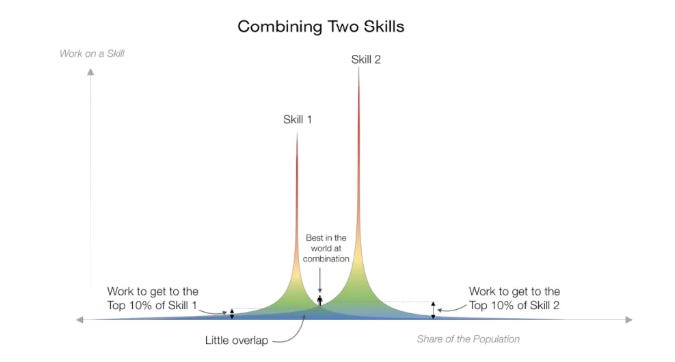
Once we understand which skills are rising in value, the next step is to look at how people combine them in ways that create new advantages in an AI driven career world. This is where Thomas Pueyo’s idea of skill stacking becomes particularly relevant: the notion that developing two or more distinct skills, and blending them, can create a kind of edge that is very hard to replicate. Every skill has diminishing returns, and there is a point where going from great to world class requires exponentially more effort, while adding a new complementary skill often produces far more leverage.
You can be in the top 10 percent of F1 engineers, for example, or the top 1 percent of people leaders who understand F1 engineering teams - and the second profile, while less obvious, is far rarer and often far more valuable. Many of the most impactful innovators operate this way. They don’t win by burrowing ever deeper into a single discipline, but by combining fields into a lens that allows them to see patterns, solve problems, and produce work that specialist paths alone could not have produced.
In an AI powered workplace, where the boundaries of roles are still being drawn, skill stacking becomes one of the most practical ways to shape the careers that are emerging, not the ones we are leaving behind.
 |
Right now, Experimentation means everything
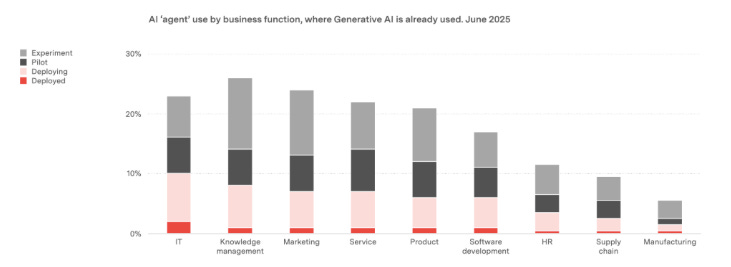 |
AI adoption rates are still very timid in business functions versus individual use. Most companies are in the experimentation and pilot phases, something LinkedIn’s data confirms:
- Two thirds of U.S. workers say they are still in “experimentation mode,” using AI only for simple tasks
- Almost half say they are not using AI anywhere near its full capability, and one third say they rarely or never use it at work.
This is important because it reframes the fear: the pace of change feels fast, but the real transformation will unfold over years, not months. Expectations have surged, but practical capability is only beginning to develop. Not to say this won’t be growing or accelerating, but my argument is that even though the pace of changes is (or feels) faster, it will take several years for AI to be massively adopted, functional, and have the scary outcomes that people are fearing. Side-note: right now, we have seen how most AI-pocalypse layoff announcements have come as a cover up for COVID hiring sprees, and general macro-economic weakness.
What does this means for careers? It means that people should not be worried about their job 5, 10 years from now. We have already been living (especially as Millennials, and GenZ) in an era of disillusionment and detachment from long-term and linear careers (wrote extensively about in Planning for Non-Linear Careers). AI is accelerating a shift that was already underway.
This is why the smartest thing we can focus on right now is not predicting where jobs will be in a decade, but building better habits of small, consistent learning.
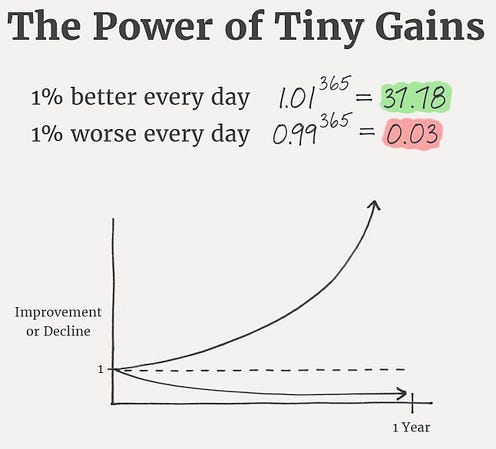
James Clear’s well known concept, “The Power of Tiny Gains” shows how 1% improvements compound into something transformational over a year, and the same logic applies to AI adoption. Tiny experiments lower the anxiety, build confidence, and turn ambiguity into action. The moment you try something, the fear starts to shrink. And as you practice in small steps, you also become more visible to your team and your company. You begin to close the gap between the expectations companies place on workers and the reality of how people are actually learning these tools today.
Catherine Fisher called this the “Life Curriculum”, emphasizing the importance about building a cadence where each week (or even each day) you try one new thing, refine it, and fold it into your practice. The only addition I would make is that companies must adapt their expectations too: instead of imagining instant transformation or treating AI as a magic switch, they should value and evaluate the frequency and consistency of these small experiments, because that is where capability compounds.
That brings us to Learning Velocity: not just the willingness to learn, but the pace at which someone can absorb something new, apply it, and move forward again. Unlike formal credentials, this is a muscle you build through repetition which happens through four steps:
Consume: Ingest high-quality information and examples.
Analyze: Reflect on what you’ve learned, test your assumptions.
Create: Apply it by build something, try a workflow, solve a problem.
Teach: Share it with someone else - teaching forces clarity and deepens expertise.
This loop turns scattered experimentation into something compounding. It creates visible evidence of learning - something you can point to in interviews, performance reviews, or even within your team. And it replaces the outdated idea of mastery with something far more realistic: adaptability, curiosity, and the ability to build new skills faster than the environment changes.
(This is a long post, if you prefer to read in the browser click here)
 |
I also think that people who experiment the most will be the ones who end up shaping the new roles. At this stage, even companies do not fully know what the next generation of jobs will look like. They are still figuring out the tools, the workflows, and the impact on teams. If roles are being rewritten task by task, then the people who test the tools, document what works, and share what they learn become the ones who define what the new role actually becomes. In a moment when the job market is fluid, the experimenters can become the architects. This can become a ‘mission’ for individuals or teams, something that also communicates ambition and eagerness to innovate and evolve inside of the company.
Last, but not least - experimentation also creates the conditions for career pivots. Across job functions like legal, engineering, accounting, and marketing, many are moving across fields that seem unrelated at first glance:
- Lawyers are moving into research and operations
- Engineers are moving into education and community roles
- Marketers are moving into project management and even real estate
- Accountants are shifting into education and operations
These shifts come from people understanding their strengths and goals, and then testing possibilities through small experiments, both in their jobs and in the work they explore also in ‘side quests’.
Rise of Side Quests, Solopreneurship, Portfolio Careers
 |
Everyone I know who builds something in their free time, or uses their spare time to explore a curiosity, ends up much further ahead in one or more of the skills we discussed earlier. Side projects become labs for experimentation because they sharpen communication, deepen expertise, stretch creativity, and build confidence in ways that formal training rarely does.
They learn faster and discover new strengths because they step outside the comfort of their job description and the limits a role quietly imposes. As people take more control of their learning and experimentation, something important happenes: they feel more control over their entire career:
LinkedIn’s Workforce Confidence data reveals that only 45% of Americans feel in control of their career, but that number jumps to 65% among the self employed.
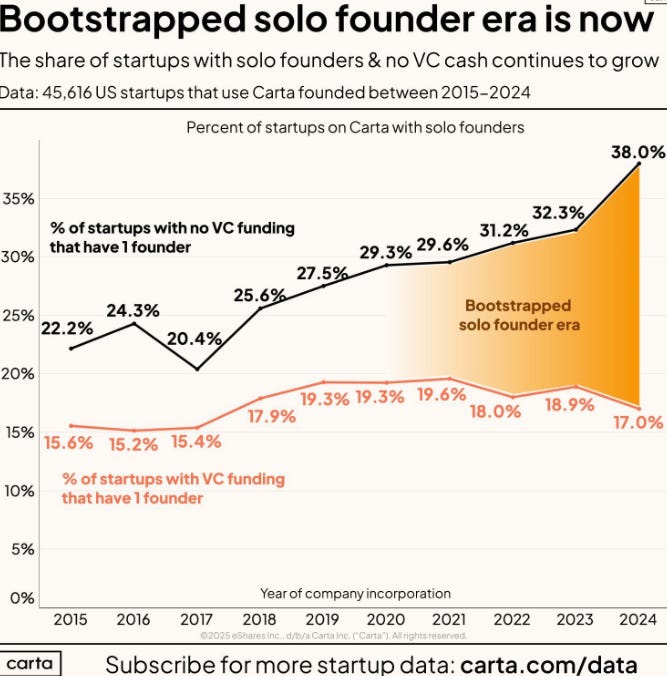
From side quests, the leap to solopreneurship seems much smaller. And with AI being such a powerful tool to prototype and experiment, we are seeing unprecedented growth in bootstrapped (no venture capital involved) startups being founded.
According to MBO Partners’ 2025 report, nearly 73 million Americans, about 38% of the U.S. workforce, now freelance in some form. At the same time, 78% of companies say they plan to rely on freelance or contract talent rather than hire full-time staff. Add to this shift the fact that more than 22% of U.S. employees now work partly remotely, and the stage is clearly set for a rise in portfolio careers. Flexibility is, or should, become the design principle of work.
The next step from here is already emerging: as AI lowers the cost of coordination and execution, work begins to break apart into smaller, more personalized units. Instead of every responsibility being absorbed into a single job description, more tasks are becoming project-based or bounty-like, where individuals contribute to specific problems rather than to abstract roles. Companies benefit from more precise access to talent, while individuals participate in work that matches their skills and availability more closely. Work can become something you assemble, not something you inherit.
The concept of portfolio careers fit where the reality that careers are becoming fluid, modular and shaped by a mix of income streams, side projects and learning loops. But beware: this is not about doing more work (that is the concept of Overemployment). Like we said in skill stakcing it is about combining multiple capabilities, each one opens the door to a different type of project or collaboration.
In this sense, AI does not push people into ever narrower specialisations. It pushes them into becoming adaptive generalists with spikes of depth (David Epstein has a great book on this called Range). It rewards people who can learn quickly, combine fields, translate between domains and move fluidly where the work requires them. As work fragments, the worker becomes the integrator and as the market tilts toward flexibility and optionality, portfolio careers become less a fringe choice and more the default operating system for how modern careers evolve.
Skilling me softly - What happens when Job Titles lose meaning
 |
I think the broader picture is starting to emerge.
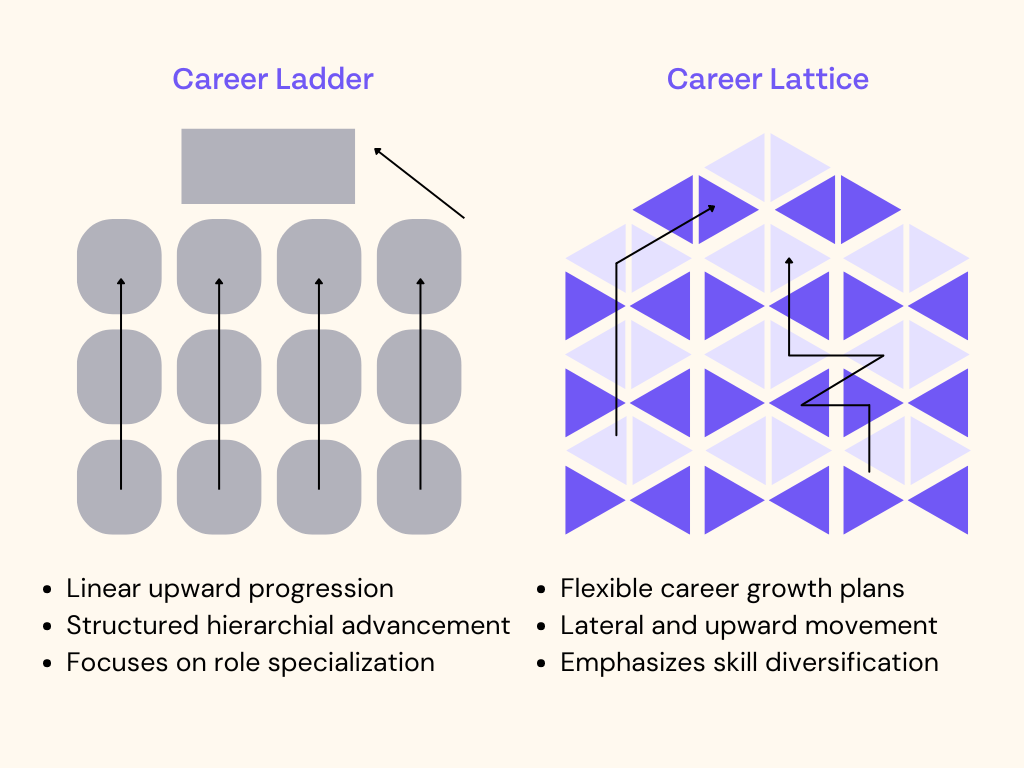
The Latin root of the word “career” means journey, yet for most of the twentieth century that journey followed a narrow, predictable path: roughly 45 years of linear progression, a dozen employers, and a clear endpoint. Today careers resemble a 3D lattice made of learning, earning, caring, moving, pausing and restarting. Some work is paid, some not. Some defines our identity, some simply carries us to the next chapter. Job titles lose meaning in this environment. What matters is the composition of skills and ability to demonstrate them in motion.
This is why Google DeepMind’s Demis Hassabis is right when he says that “learning how to learn” becomes the most essential skill for any professional. As tools evolve faster, meta skills become the real differentiators.
This is also why making predictions is a weak response to uncertainties. We need to think like investors, not a forecasters. We won't know which jobs will exist in ten years, but we can know how to compound skills, habits and visible work in ways that keep creating opportunity. We need to ignore advice built for the last generation.
For companies, this shift requires clarity at the foundational (and executive) level. Every organisation should be doing four things exceptionally well: mapping their skills, understanding how work actually flows through their networks, designing learning programs that build capability rather than credentials, and setting goals that help people see how their growth connects to the company’s mission. These are not “future of work” initiatives. They are simply the infrastructure of a redesigned modern workforce.
For individuals: build range, make your work visible, strengthen the human skills that are rising in value, experiment often enough that you learn faster than your environment changes. Invest in relationships because careers are built inside networks, not job descriptions. And above all, treat learning as a lifelong operating rhythm, not a course you take when everything feels stable again.
Whether or not we ever see the mythical “one person billion dollar business” is beside the point. What matters is that the job market we know today will age quickly, just as the pre-gig economy world looks unrecognisable in hindsight. And whatever comes next will be shaped not only by AI but also by geopolitics, macroeconomic cycles and climate realities that may prove even more disruptive.
In the meantime, we focus on what is in our control. Catherine Fisher said something in our conversation that I keep returning to: “It is not always about productivity. It is about how the work becomes better.” If we orient ourselves toward making the work better, the productivity and the outcomes tend to follow naturally.
That may be the simplest and most durable career strategy of all.
Invite your friends and earn rewards
| ||||||||||

