|
 |
Dear Readers, in case you missed it, here is our last article about how the fight for the future of work is more ownership, than employment.
Stay tuned with Work 3 in 2026 - we have planned lots of interesting articles, reports, webinars, and collaborations.
Also, let us know what you would like to read more of from Work 3 this year.
Andy and Matteo
The Future of Work Research Prize
Five research ideas shaping how we will work, lead, and collaborate next - Cast your vote!
|

| |||||||||||||||


 |
This week, we’ll be introducing each of the five finalist research teams for the Future of Work Global Research Prize.
These proposals come from leading universities across Europe and the US, and they all tackle questions that sit right at the heart of Work 3:
how work is changing as AI scales, identities fragment, power dynamics shift, and coordination becomes more complex.
We care deeply about closing the gap between academic insight and organisational reality. Too often, rigorous research arrives years after leaders need to make decisions. These projects feel different: ambitious, and grounded in real-world work.
A big thank you to Professor Jochen Menges, the University of Zurich, and the Adecco Group for highlighting and supporting this work.
At the end, I’d encourage you to cast your vote for the research you find most compelling.
🗓 Voting deadline: 30 January 2026
1 - Can a generative AI chatbot improve the wellbeing and performance of office workers over time?
This project tackles one of the most practical questions organisations are quietly asking: does everyday AI support actually help people?
To answer it, the team is running a large-scale field experiment inside a single firm with 40,000 employees across 96 countries, tracking real wellbeing and performance outcomes over 18 months. For example, one hypotheses being tested is does greater use bring larger impact?
Led by Dr William Fleming, with Jan-Emmanuel De Neve and Cherise Regier from Oxford’s Wellbeing Research Centre, this study stands out for its scale, duration, and realism.
From a Work 3 perspective, this matters because we are moving beyond AI pilots. If AI is becoming part of the daily work environment, we need evidence not just on productivity, but on human sustainability over time.
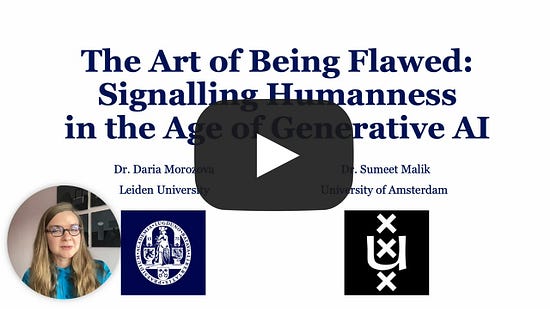
2 - In a world of “perfect” AI output, does imperfection become the new creative advantage?
As generative AI produces increasingly polished work on demand, this research asks a provocative question: will creativity be redefined not by perfection, but by deliberate imperfection?
Prof. Daria Morozova (Leiden University) and Dr Sumeet Malik (University of Amsterdam) explore how human creators may differentiate themselves by curating flaws, ambiguity, and idiosyncrasy — precisely the things AI tends to smooth out. With some examples from Daria’s own poems Vs LLM poets.
As tasks become automated, human value shifts from execution to judgment, taste, and intention. Understanding how imperfection functions as a signal of humanity may become central to future creative work.
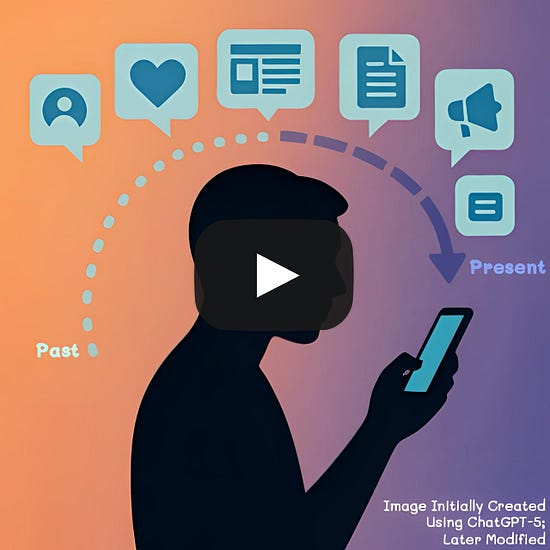
3 - What happens to your digital past when you’re looking for your next job?
In a labour market shaped by online traces, Jaylon Sherrell (Harvard Business School) examines how workers manage identity during job search.
People change. Opinions evolve. Yet digital footprints often persist for decades, resurfacing at precisely the moment of highest scrutiny: hiring.
This research speaks directly to Work 3 themes of identity, ownership, and control. Who owns your past self in a world of searchable histories? And how should organisations interpret digital traces that may no longer reflect who someone is today?
4 - Why is delegation riskier for women — and how can organisations change that?
Delegation is meant to reduce workload and enable leadership. But this research starts from an uncomfortable truth: delegation is not experienced neutrally.
Anisha Singh (LSE), with Laura Giurge (LSE) and Cydney H. Dupree (UCL School of Management), show that women managers face a “double gaze” when delegating — judged both by those above them and by those they lead. This pressure can intensify further when race is taken into account.
Based on 30 qualitative interviews and pilot experiments, the findings suggest that delegation can increase leadership strain for women rather than relieve it. The next phase, a large-scale experiment with 800 women managers, will test these dynamics even further.
From a Work 3 lens, this research will highlight how work design and power dynamics still shape outcomes.

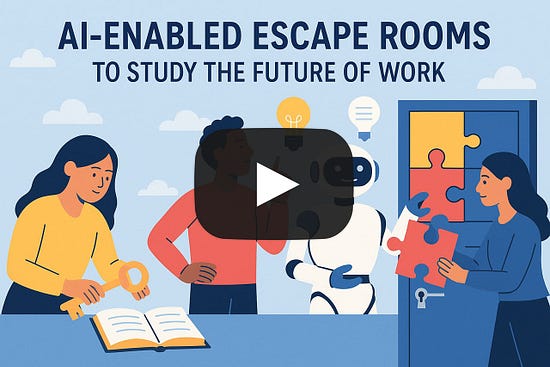
5 - How do humans and AI actually work together under pressure?
Studying human–AI collaboration in real time is hard. Professor Steven Zhou (Claremont McKenna College) takes a bold approach: AI-enabled escape rooms.
By placing human teams and intelligent agents into time-pressured problem-solving environments, the research captures leadership, coordination, and communication as they unfold using cameras, microphones, and wearable sensors.
The questions are very practical:
When does AI help teams perform better?
When does it get in the way?
What leadership behaviours enable effective human–AI collaboration?
What makes this especially compelling is the blend of experimental control and realistic pressure exactly the conditions future teams will face.
Vote for Your Favourite Research Idea Here!
We highlighted last years winner of the prize, from Max Bogaert et al, with our article
Dystopia or Design? Imagining Work Futures Through Science Fiction
His thesis: dystopian science fiction films are cultural artefacts that help us understand how people imagine the future of work.
These projects offer a glimpse of where Future of Work research is heading — and where leaders will soon need answers.
Joining the dots,
Andy
You're currently a free subscriber to Work3 - The Future of Work. For the full experience, upgrade your subscription.
| ||||||||||

