|
 |
Dear Reader, we have been busy mega-trending across the future of the worksphere - we do hope you enjoy this edition. Work 3 Community members will get access to the full PDF Mega Trend Report next week, so consider joining up if you haven’t already.
We think we have an interesting set of Work 3 Community Webinars lined-up for the rest of the year.
On Thursday 17th July 2pm BST, we have our 1st Work 3 Community Webinar!
"The future of CVs and Credentials" We have made this free for 25 valued Work 3 Subscribers. Make sure you register here!
Also, here is a video of Andy and Rishad Tobaccowala discussing some their views on the Rethinking Work Show (also available on Spotify and 🍏)
Andy and Matteo
The Global Mega Trends Shaping the Future of Work
From the Global Talent Reset, to the Unbundling of Work and the Rise of Self-Organised Teams (Work 3 Community Members can access the full PDF report)
|

| |||||||||||||||


 |
It is impossible to predict which skills will be needed in the future, yet the broad contours of change are becoming visible.
According to the World Economic Forum’s ‘Future of Jobs’ Report for 2030
92 million jobs will disappear, and 170 million new ones will be created.
While we take those figures with a healthy pinch of salt, the message is clear -
There will be winners and losers in this transition.
This article explores some of the global macro trends that we should not underestimate when rethinking the future of work.
👉For those that want to dig deeper you can access a full PDF report - find out more at the end of the article
Global Mega Trend 1 - The Global Talent Reset
From Build, Buy, and Borrow -> Bundle, Bots, and Barter
 |
For decades, workforce strategies were centered on three levers:
Build (train internally), Buy (hire externally), or Borrow (bring in temps or consultants).
But in an era of demographic shifts, digitisation, and disillusionment with traditional models, new levers are emerging:
Bundle – Combine internal teams, freelancers, AI, and partners into agile project units.
Barter – Exchange skills, access, or services in peer-to-peer ecosystems (e.g. DAOs, talent collectives).
Bot – Use AI agents to handle repeatable or cognitive tasks that once required human labour.
📡 Signals
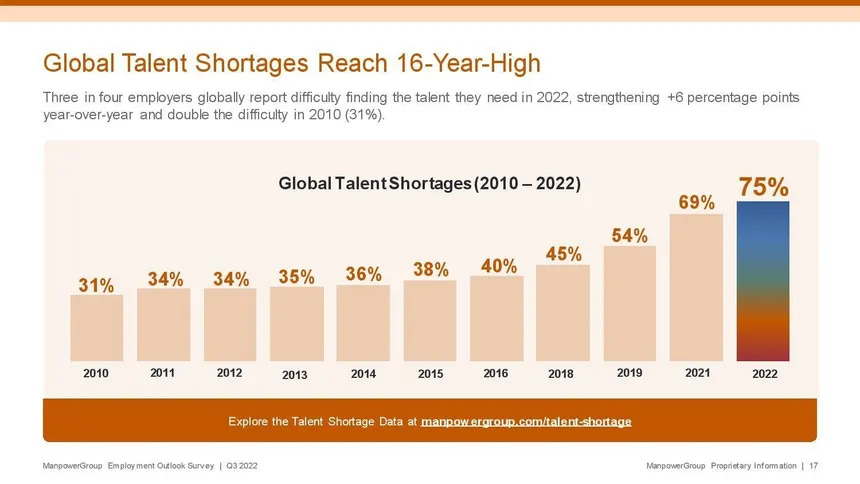
Globally, 77% of employers can’t find the talent they need - the highest level in 17 years. (ManpowerGroup, 2024)
Despite 736,000 unfilled jobs in the UK, nearly one million young people aged 16–24 are classified as NEET—not in education, employment, or training—highlighting a deep mismatch between opportunity and access. (ONS)
600 million Chinese workers joined the global labour force over the past four decades, holding down wages in Western economies and lifting millions out of poverty.
However China’s workforce shrunk by 40 million between 2010 and 2020. India now holds the crown as the most populous country in the World. By 2030, more than half of the young people entering the global workforce will be African. It remains to be seen if India and Africa can supply workers to the global economy as successfully as China has.
🔍 Analysis
What we’re seeing now is a global talent realignment - a collision of demographic shifts, digital expectations, and broken infrastructure.
We’ve moved from a world of abundant labour to one marked by:
Uneven access to opportunity across regions and social classes
Trust collapse - CVs and degrees fail to signal potential for reliable credentials
Ageing populations and shrinking workforces in high-income countries
Youth surges in lower-income nations without the tools or policy to connect them to opportunity
Mismatch between the skills employers want and the ones workers have
Outdated signals (CVs, degrees, office presence) failing to identify potential
Rising digital expectations from younger talent, met with legacy systems
Global supply and demand of skills has always driven how we work, our economic success and impacted society and politics.
We don’t have a global a labour shortage. We have a systems failure—of how we recognise, route, and reward talent globally.
👀 Things to Watch
How many organisations actually redesign work, vs just filling gaps with contractors and AI?
Will digital credentials replace CVs—and who controls the trust layer?
Can sourcing models move beyond borders and job titles?
Will countries liberalise or restrict talent migration in the face of local pressure?
Can employers scale age-inclusive work models and support midlife re-skilling?
Global Mega Trend 2 - The Unbundling of Work - From Jobs to Tasks, from Employees to Ecosystems
 |
📡 Signals
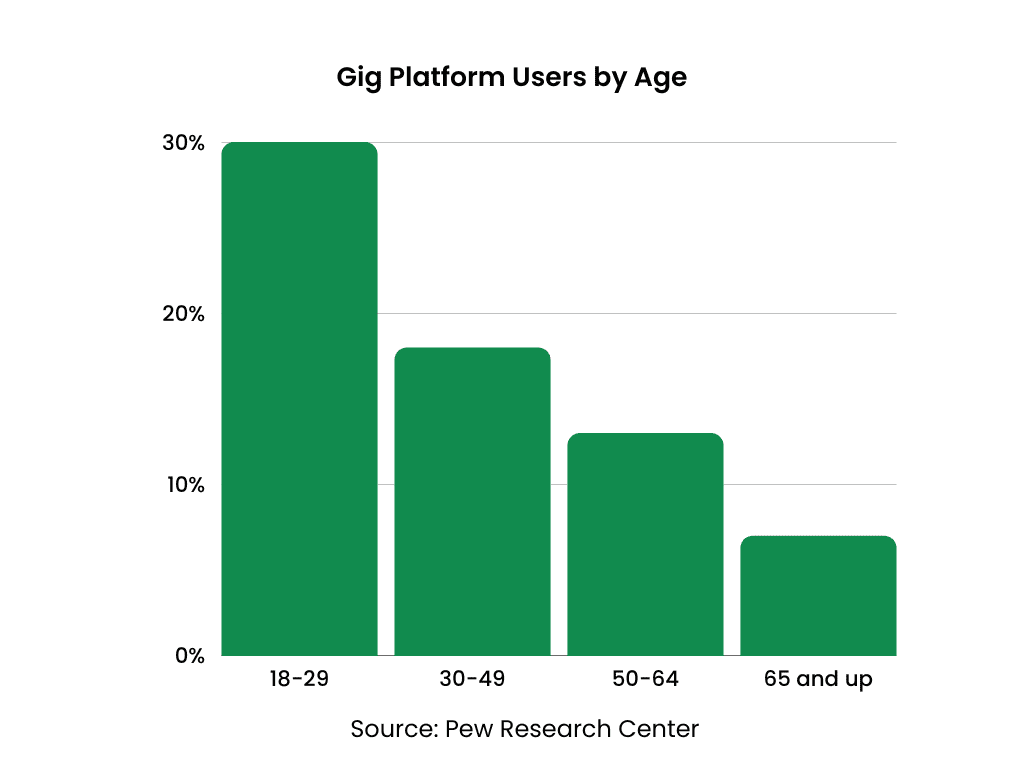
In the US, 1 in 7 working-age adults have earned income via a digital platform.
(Pew Research Center, 2024)
Work is fragmenting. What used to be wrapped inside a full-time role—tasks, skills, communication, benefits—is now being redistributed across platforms, contracts, tools, and even AI agents.
The size of the gig economy is estimated at $556.7 billion in 2024 and is projected to more than triple to $1,847 billion by 2032 (Source - WEF).
14.5% of EU workers are self-employed, and 48% of workers globally are self-employed and work informally (Source – OECD)
From Fiverr to TaskRabbit, DAOs to Discord communities, Shopify to Substack—people are working, just not always in jobs. (read more on The Decentralised Workforce)
Buurtzorg nursing teams in the Netherlands working without middle managers, or a head-office.
A driver cooperative in New York where workers own their own ride-hailing platform.
🔍 Analysis
It was Technology that enabled us to centralise work into factories. Now it’s Technology that is allowing us to decentralise work - into networks, platforms, and fluid teams.
This isn’t just about gig work—it’s a structural unbundling.
Work is moving from jobs to tasks
Labour is being coordinated by algorithms, not line managers
Teams are forming around projects, not org charts
AI agents are beginning to orchestrate workflows themselves
Work is still being done—but not always by employees, not always in firms, and not always by humans.
👀 Things to Watch
AI-led work orchestration—will LLM agents become project managers?
Fractional and pop-up organisations—can we build fast, trusted teams across borders?
New governance models for distributed work—what replaces the HR function when no one reports to you?
Compensation innovation—tokens, equity, usage-based income streams
Global Mega Trend 3 - The Human–AI Partnership - Rewriting Roles in an Augmented Workplace
 |
📡 Signals
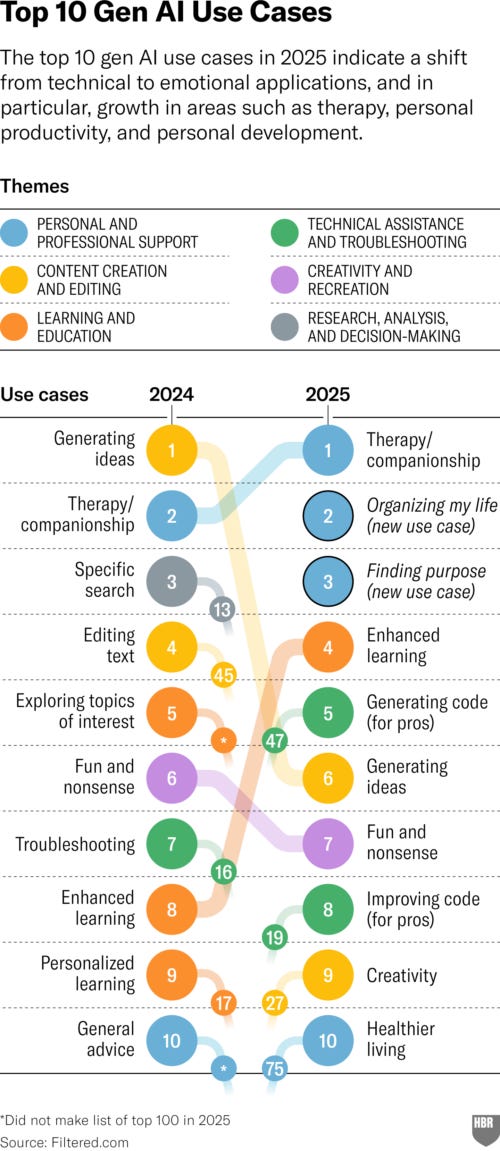
🧠 In 2025, the top use of large language models globally is not document generation - it’s therapy and companionship. (Source: Stanford HAI, 2025)
Replika – is an app that allows users to form romantic relationships with AI avatars.
In China, the Maoxiang app allows users to create their own virtual characters to interact with. It has 2.2m monthly active users, for comparison DeepSeek has about 14m.
HereAfter.ai creates an interactive avatar of a deceased person – trained on their personal data.
AI Therapists like Woebot, Youper – provide emotional health assistants.
Wysa is being used by national health services in the UK, it offers chat functions, breathing exercises and guided meditation, with escalation pathways to helplines.
🔍 Analysis
This isn’t AI vs Humans. It’s a reconfiguration of work, sometimes emotional work -powered by algorithms, guided by humans.
What’s really happening:
AI is scanning skills, behaviours, values—not just CVs
Digital talent agents now recommend jobs, feedback loops, and even learning pathways
Workers are starting to design their own agents—tuned to their goals, tone, and task types
In hiring, AI may not beat a human’s gut feeling, but it never forgets a data point—from interview tone to collaboration history
We’re moving toward AI as Co-Pilot, not competitor.
As work unbundles into modular tasks, AI agents don’t just support—they begin to orchestrate.
The most impactful workers in 2035? Not AI engineers—but “Super Operators”: those who adopt and adapt tools faster than the org around them.
The most forward-thinking HR teams? Not the ones managing headcount—but those orchestrating complementary intelligence.
👀 Things to Watch
Will every worker soon have a personalised AI agent for tasks, learning, and feedback?
How do we design ethical safeguards in hiring agents and internal LLM tools?
Can we build trustable skill maps that go beyond self-reported CVs?
What’s the role of empathy, curiosity, and humour—traits machines still lack—in this new partnership?
Global Mega Trend 4 - Digital Infrastructure Revolution - Code, Cloud, and Coordination Without Borders
 |
📡 Signals
💻 In 2025, over 80% of large employers report using AI-powered tools to manage hiring, learning, or productivity—but fewer than 20% say their underlying digital infrastructure is ready to scale them. (Source: Deloitte Human Capital Trends, 2025)
78% of candidates admit to lying on their CVs, which still hasn't evolved much since Da Vinci sent his to the Duke of Milan.
Meanwhile, tools like Eightfold’s AI agents are helping organisations match people to projects - not just by title, but by soft skills, learning patterns, and team dynamics.
Behind every AI upgrade and talent shift is a quieter story: infrastructure. It’s the foundation that determines whether work transformation actually scales.
Even as companies race to adopt generative AI, many are realising they don’t have the foundations:
Siloed HR systems
Outdated workflows
Talent data that lives in PDFs, not APIs
At the same time, a new stack is emerging—from skills wallets and agent platforms to trust layers and dynamic knowledge graphs.
🔍 Analysis
Work tech used to mean HR system-of-record, payroll and performance management. Now it means the infrastructure of how work is done, measured, shared, and redesigned.
For every new technology that emerges, we have got it wrong initially by asking the wrong questions.
“How do we implement AI in our organisation?” is nearly always the wrong question
What’s changed?
The software layer: AI-native tools (e.g. Sana, Glean) shift focus from forms to flows
The trust layer: Verifiable credentials, proof-of-skill, digital CV wallets
The orchestration layer: Agents coordinating meetings, tasks, even onboarding
The architecture: Work is no longer designed around departments—it’s built around systems, skills, and APIs
In Work 3, we’ve called this the quiet revolution behind the flashy demos:
In The Proof of Work Paradox - we asked how a new infrastructure for work-matching could boost the economy
Death of the CV argued that legacy formats are incompatible with a skills-based future
Our readers know: Work tech isn’t just about tooling. It’s about redesigning how people and organisations connect
As your organisation digitises, ask:
Are we adopting tools, or are we redesigning infrastructure?
Because real transformation isn’t cosmetic. It’s connective.
👀 Things to Watch
Will skills-based orgs become the default structure—not just a talent buzzword?
Which vendors will win the AI agent orchestration layer ? The old guard, or start-ups/scale-ups…
Will interoperability and open data standards finally arrive in HR tech?
How soon will we see fully composable work systems, built like Lego?
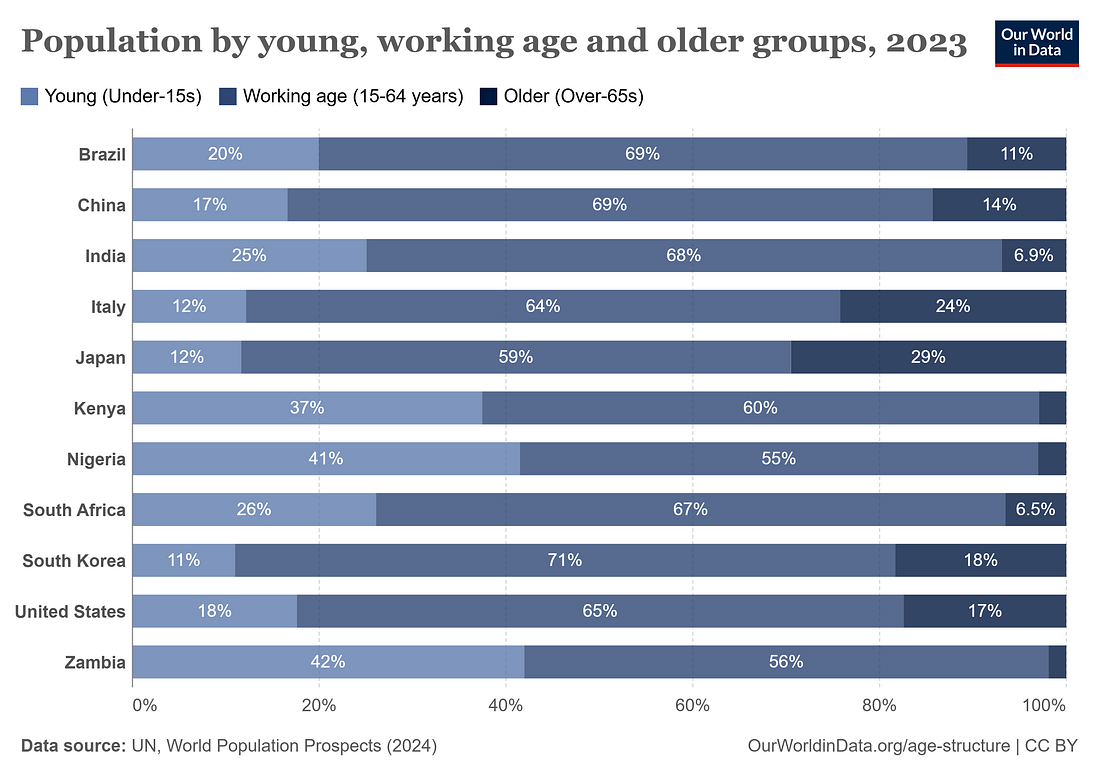
Global Mega Trend 5 - The Demographic Squeeze - Population Pressure Meets Productivity Gaps
 |
📡 Signals
👶 A child born today in a high-income country has a better-than-even chance of living to 100. (ONS, 2024)
Europe, Japan, and South Korea are already deep into population decline.
Fewer young entrants and more late-career professionals remaining on the job.
In contrast, over 70% of Africa’s population is under 30.
And yet, our work systems are still built around a 20th-century life model:
study for 20 years → work for 45 → retire at 67 → hope for 15 good years
That model is breaking down.
🔍 Analysis
We’ve already explored how demographic shifts are reshaping global talent flows.
But there’s another story here: time itself is being restructured.
People are living longer—but not always healthier
Fewer young workers are entering formal employment
Older workers are staying in the labour market, sometimes by choice, often by necessity
Work stretching over 60+ years, requiring career pivots, digital retooling, and identity reinvention
The challenge is twofold:
Productivity needs to increase to compensate for shrinking workforces
Work needs to stretch across longer, more varied lives
Singapore’s SkillsFuture is one model—offering mid-career citizens training credits and lifelong learning pathways. But most orgs haven’t caught up. They offer career ladders, not lattices. They assume retirement at 65, not reinvention at 70.
And while tech could extend capacity—via AI copilots, smart health systems, or remote roles—age bias, poor design, and lagging digital access still block older workers from participating fully.
👀 Things to Watch
Will pension systems bend—or break—as lifespans stretch?
Can organisations design age-inclusive AI tools and learning systems?
What models will support midlife career pivots at scale?
Can younger economies convert their youth bulges into workforce dividends—or will those aspirations be deferred?
📥 Want the Full Report ?
Our “Nine Global Mega Trends Shaping the Future of Work” PDF includes:
4 more Global Mega Trends
Additional Resources: links, videos, and research
-
New Sections
8 Big Shifts Redefining Work
Impact for HR, Employers, Policy-Makers
Q&A Worksheet for Workforce Futurists
👉 Paid Work 3 Community Members will receive this PDF automatically next week.
💬 Not a paid member? If cost is a barrier, hit reply, we’ll try to help.
Let us know what you think, which of these Mega Trends will shape work most in the next 10 years?
Your mega-trender,
Andy
Andy Spence is a workforce futurist and helps organisations redesign work. He speaks regularly on global stages from Singapore to Seville and Sarasota.
Invite your friends and earn rewards
| ||||||||||

