|
 |
Dear Readers – a special warm welcome to Workforce Futurist Newsletter subscribers!
This week we cheer for the last stand of the Corporate Peacock, as Work 3 Newsletter exclusively publishes weekly articles written by Andy Spence and Matteo Cellini.
Thanks for your continued support!
Andy and Matteo
The Last Stand of the Corporate Peacock🦚
After ‘Peak Office’ why Return-to-Office mandates are more about strutting than strategy
|

| |||||||||||||||


 |
Not being able to get together in person is a pure negative.
Reed Hastings – Netflix Co-founder
The corporate peacock is alive and well.
Feathers fluffed. Chest puffed. Strutting across near-empty floors in a grand display of status and control. Not because it makes work better — but because it once did.
As Workforce Futurist merges with Work3, it feels fitting to mark this moment with a short obituary of sorts — not for the office itself, but for the behaviours and status games that once dominated it. This is the final flutter of the Corporate Peacock: the leader who confuses presence with performance.
High-profile employers have made the klaxon call back to the office for workers, with company-wide mandates, including Amazon, Uber, Twitter, Starbucks, Meta, Google, Goldman Sachs.
They’re billed as productivity plays. But scratch the surface, and it’s more about sunk costs, status signals, and old habits that die hard.
We’re entering the last stand of the Corporate Peacock🦚 - and if you're still leading by fluffing your plumage, you might be out of step with the times.
🧪 What the Evidence Says About Return-to-Office Mandates
It’s a bold move to bring everyone back to the office because of productivity.
Of course working together in person and on-site is necessary for half the workforce who work in shops, drive trucks and perform operations in hospitals. For the other half of knowledge workers, marketers, designers, engineers, writers - some activities are surely better in person if possible.
But what is the evidence that working in the office is more productive?
📊 Productivity: – Hybrid work boosts productivity by 4–5% on average
(Nick Bloom, Stanford; WFH Research, 2023)
📊 No consistent productivity gain from full RTO across industries
(OECD Working Paper, 2023)
🔁 Attrition Risk: – RTO mandates increase turnover among high performers, women, and millennials (Gartner Research, 2023)
🧠 Perception Gap: – Managers fear lost productivity (‘productivity paranoia’)
– Employees say they’re getting more done remotely (Microsoft Work Trend Index, 2022–2023)
📚 Management Theatre: - A recent study of S&P 500 firms found that Return-to-Office mandates are often driven by managers seeking to reassert control or deflect blame for poor performance — with no evidence that these mandates improve firm value, and clear evidence they reduce employee satisfaction.
(Source: SSRN, "Return-to-Office Mandates" (2024))
💡 Recommendation: Use an Evidence-Based Management approach
tapping into organisational evidence (information they already have in-house), scientific evidence, practitioner evidence (not opinions but advice from people who have solved a similar problem) and stakeholder evidence, which can include employees
Dr Tatiana Andreeva in The Irish Times
So why do some leaders cling so tightly to RTO?
It has less to do with data, and more to do with ego and money.
🏢 Reason #1 - Sunk Costs and Saving Face
Let’s follow the money.
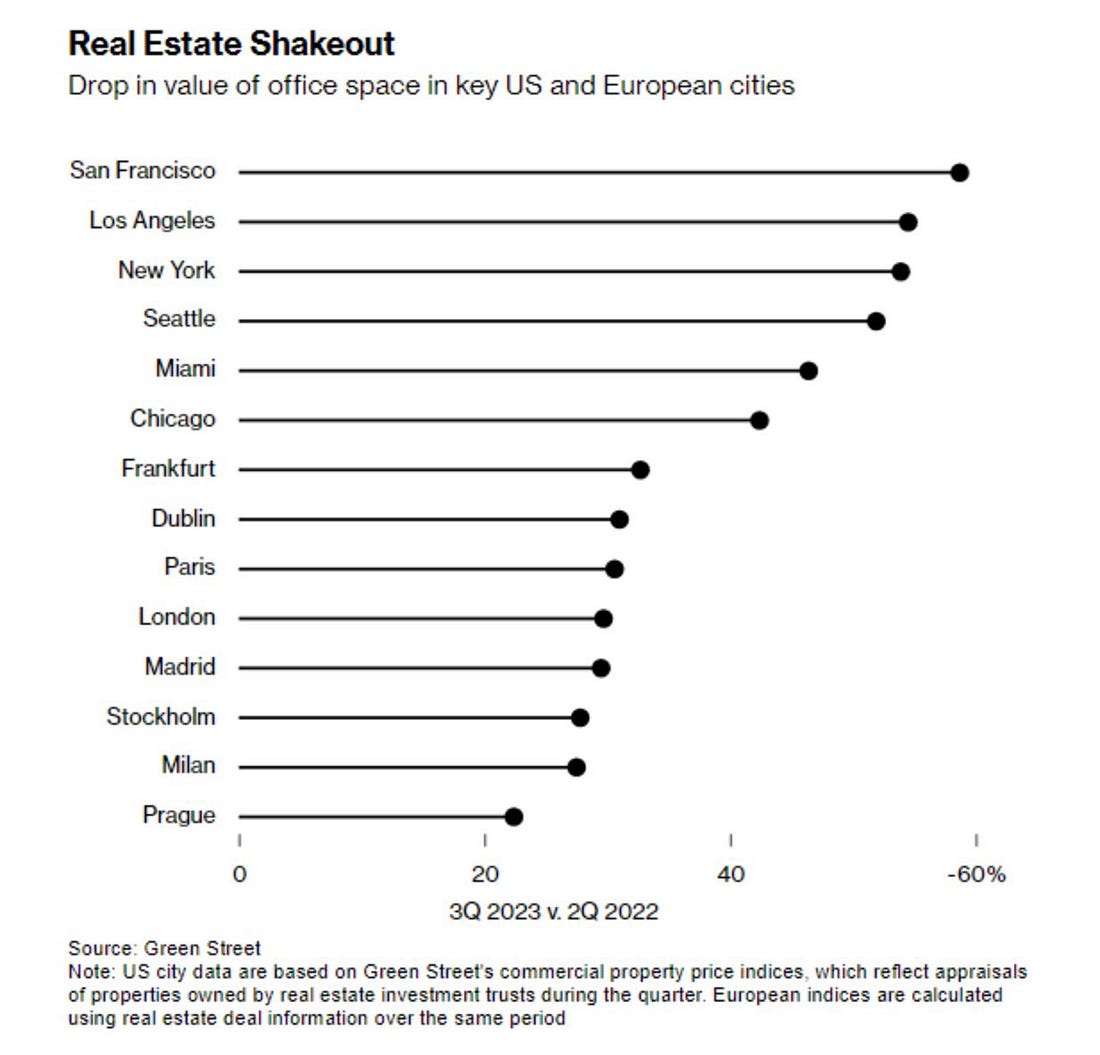 |
A staggering $1.5 trillion in U.S. commercial real estate debt comes due before the end of 2025. A third of long-term office leases will expire by 2026.
For some firms, RTO mandates are a form of financial theatre: signalling to shareholders, not supporting workers. It’s about sunk costs, not productivity.
A darker thought is, will this debt precipitate a commercial debt crisis?
A trillion dollar debt crisis can sink economies, and have a much bigger impact on the workforce than any RTO mandate.
🦚 Reason #2 — The Corporate Peacock
The second reason is behavioural — and frankly, it’s a bit more primal.
Corporate Peacocking — like male peacocks displaying vibrant plumage to attract mates, some managers showcase their status and contributions more effectively when working onsite. The office becomes their stage: holding court at all-hands meetings, buying post-work drinks, holding visible court. By bringing workers back, they can better signal their dominance in the corporate pecking order.
We’ve seen it play out: managers struggling with distributed teams, worried they’re losing grip. They default to what they know — control by proximity.
This mindset can still work — if you're working with people with no better options.
For some leaders, bringing workers back to the office is about reasserting dominance, not improving performance.
🏢 Mandates and Monuments
Hustlers and High-Rises
“It doesn’t work for people who want to hustle.“
Jamie Dimon on working from home – JPMorgan Chase CEO
 |
Jamie Dimon has spent about $3 billion on the new HQ at 270 Park Avenue in New York City. So it would be a bit embarrassing for him and shareholders if the office is empty. This is unlikely as the sparkling HQ has yoga studios, Irish pubs, a 19-restaurant food hall and desk-side sushi delivery.
Musky Mandates
“If you don’t show up, we will assume you have resigned.“
Elon Musk – Tesla, X, DOGE etc
 |
Space Ship HQs
Tim Cook, the Apple CEO framed the RTO plan as a way to “preserve the in-person collaboration essential to our culture.” and emphasised Apple’s belief in the “irreplaceable” benefits of being together in person.
 |
When you have spent billions creating the world’s most stunning offices, you want people in it.
But the argument for RTO mandates are more to save face than to improve workforce productivity.
🧬 The Habitat Has Changed
We have already passed Peak Office and hopefully Peak Peacock, too.
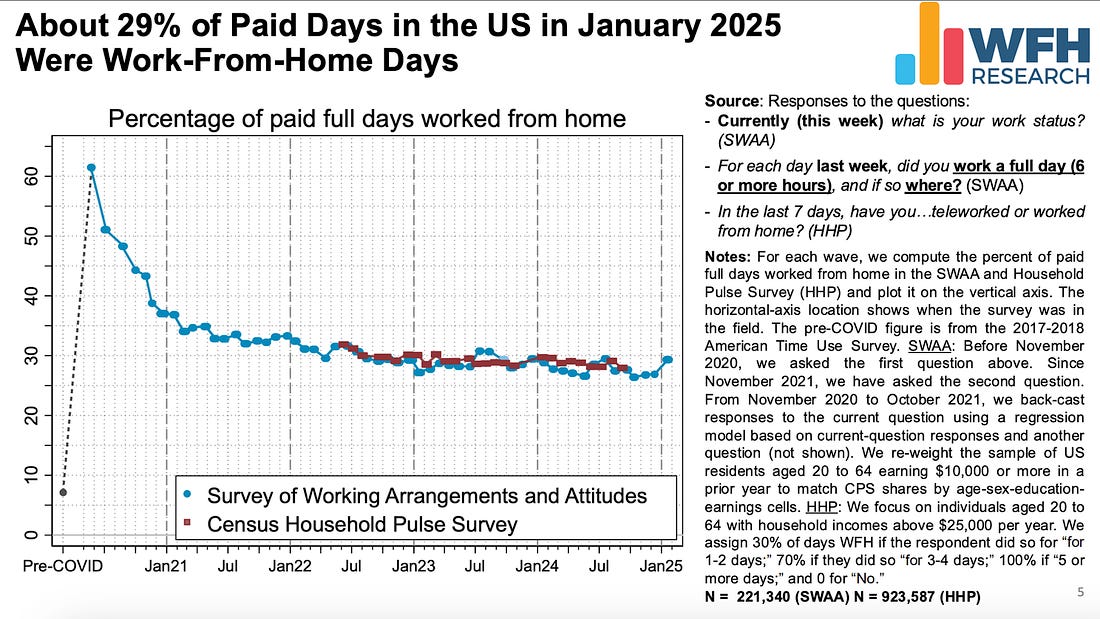 |
The structure of work has shifted:
Occupancy rates are still half pre-pandemic levels in many cities.
Workers overwhelmingly want more flexibility. About one third of workers say they want on-site jobs, a third want hybrid jobs and a third want fully-remote jobs (Source - LinkedIn Surveys).
Younger generations expect autonomy, not surveillance.
Digital status signalling (influence, visibility, network) increasingly outpaces in-person optics.
We’ll always need some face-to-face time. But the office is no longer the main stage. The smart performers have already moved on.
The future of work won’t be built on floorplans or fluffy feathers — but on trust, clarity and impact.
Various trends indicate the days of corporate peacocking will come to an end over the coming years.
City office leases will expire and convert to apartments.
Industries will adapt to emerging technology and geopolitics.
Self-organised teams will need less show-offs to demonstrate their value.
We will still look for ways to signal our status - but more in the digital realm than strutting our feathers in the office.
✅ What Smart Leaders Should Do Instead
Here’s how to lead without the fancy feathers - and in line with Work 3 principles:
The ‘Where of Work’ is just one component of designing work - The ‘Where of Work’ design has been prominent in recent years for obvious reasons. However, Work Designers will not want to ignore important other aspects including the Why, How, Who, When of Work.
Co-create your work model - Involve teams in designing where and when work happens. One-size-fits-all mandates are lazy leadership.
Focus on outcomes, not optics - Ditch presenteeism. Make performance visible through shared goals, not headcounts in open-plan spaces.
Use evidence, not ego - Pilot new approaches. Track what works. Share the results. Be curious, not certain.
Upgrade your management operating system - Leaders now need to enable, not oversee. Focus on coaching, clarity, and culture-building. Think like a product owner, not a project manager.
🦚The Final Flutter
Some work activities are better done in the workplace and others better done at home.
Both employees 𝘢𝘯𝘥 employers will benefit from allowing more flexibility around where and when work takes place. However, these need to be understood using evidence rather than simply imposing blanket company wide mandates.
The last corporate peacocks are still strutting louder and more desperate — while the rest of the workforce quietly moves forward.
The choice is yours: double down on plumage, or lead with purpose.
We’ve seen the future. It doesn’t wear a feathered suit.
Thanks for reading Work3 Newsletter reaching over 31,000 people who are also interesting in building a better future of work.
If you enjoyed this piece, feel free to share it, or subscribe if someone forwarded it to you.
And we are always interested in your thoughts, have we reached Peak Office and are the days of the Corporate Peacock numbered?
-----------------------------------------------------------------------------------------------------
Thanks for reading!
Our mission is to decode the future of work by analyzing news, trends, tools and companies looking to disrupt this space. Please like and subscribe below to receive weekly updates in your inbox if you liked this post!
| ||||||||||