|
 |
The Loneliness Epidemic - Five Ways Employers Can Improve Belonging
Building a more social future of work
|

| |||||||||||||||


 |
Loneliness isn’t just a personal struggle—it’s a workplace epidemic.
Despite our hyper-connected digital world, more workers than ever feel isolated, disconnected, and disengaged.
This isn’t just a human problem; it’s a business problem.
The U.S. Surgeon General has equated loneliness to smoking 15 cigarettes a day in terms of health risks. It erodes mental well-being, damages productivity, and even accelerates employee turnover.
Yet, while loneliness is widely discussed, the workplace’s role in shaping and mitigating it is often overlooked.
Does being alone cause loneliness?
Is the rise of remote work to blame?
Are younger workers now lonelier than previous generations?
And most critically, what can employers do to rebuild connection in an increasingly fragmented work landscape?
I Think We’re Alone Now?
More Americans are bowling than ever before, but they are not bowling in leagues. They are bowling alone.
Robert D. Putnam, Bowling Alone: The Collapse and Revival of American Community. 2000.
 |
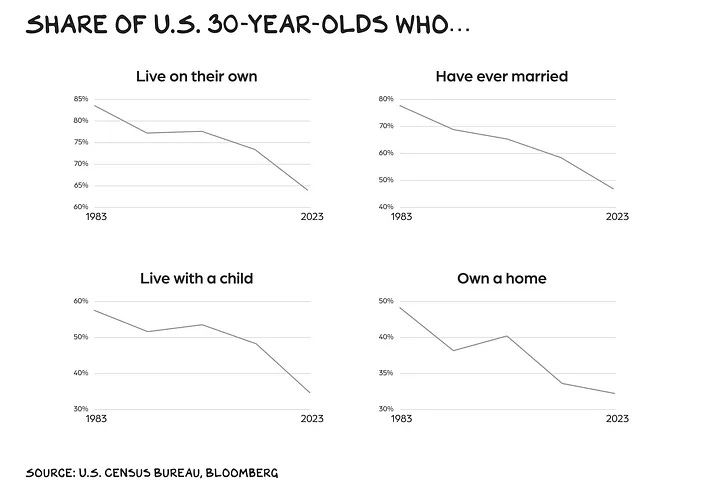
Putnam’s book outlined an erosion of social capital and community engagement towards the end of the last century. Fast forward 25 years and we can see more eating alone, drinking alone, sleeping alone, shopping alone, relaxing alone, even worshipping alone.
Self-imposed solitude might just be the most important social fact of the 21st Century in America according to Derek Thompson in his essay The Anti-Social Century.
 |
Loneliness is Rising—Especially for Younger Workers
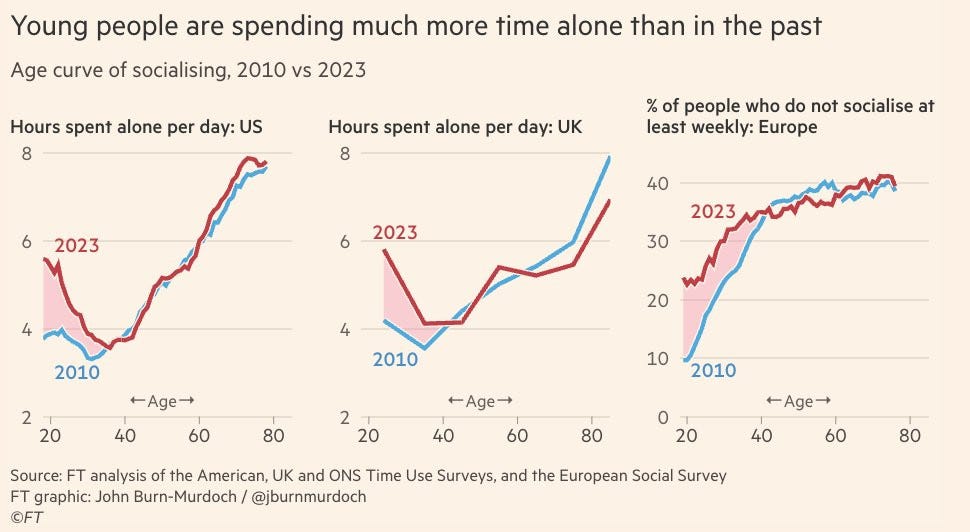
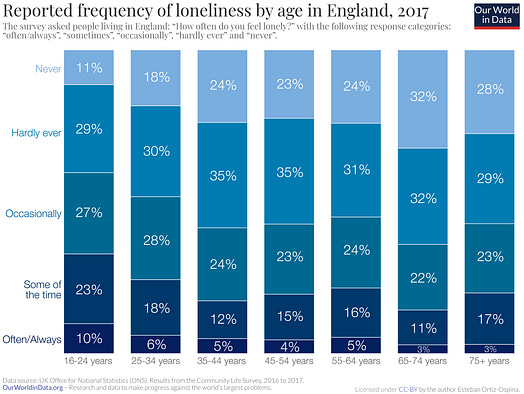
Young people are feeling it the most: In the UK, it was once the over-80s who reported the most loneliness, but by 2023, under-30s have become the most affected group. About 6% of young adults say they meet friends, relatives, or colleagues less than once a month.
Americans are spending more time alone than ever: The typical American now spends more time alone than at any point since 1965.
Declining social interaction: The number of adults who have dinner or drinks with friends on any given night has dropped by over 30% in the last two decades.
Romantic relationships are declining too: The number of under-35s not living with a partner has nearly doubled since 1980.
Loneliness Vs Aloneness
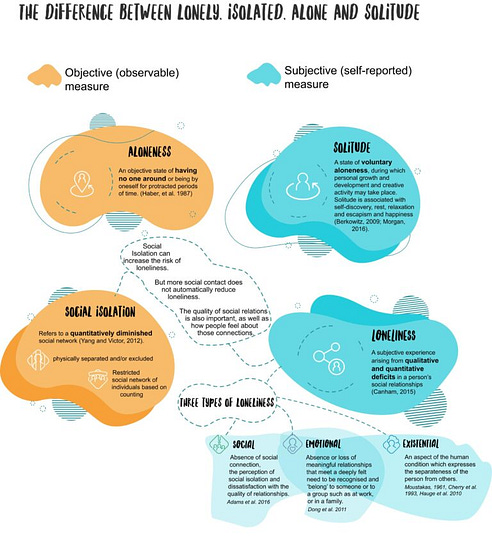 |
Loneliness is not the same as being alone.
There is not strong evidence that being alone necessarily leads to reported loneliness. In fact some researchers talk about self-imposed solitude as a healthy emotional response and a cue to getting off the sofa to meet people.
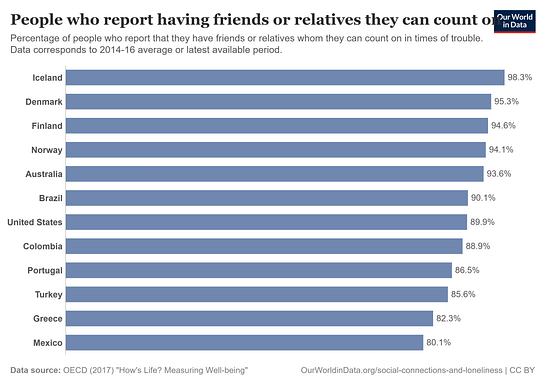
Loneliness is not a binary state, and feelings of loneliness are heavily shaped by cultural norms. This subjectivity presents a fundamental measurement challenge. There is no empirical support for the fact that loneliness is increasing, let alone spreading at epidemic rates.
 |
So as the social contract appears to crumble in the 21st Century, we will struggle to isolate the reasons why. The decline of social capital, as explored in Robert Putnam’s Bowling Alone, has reshaped our relationship with work. Once, jobs were not just a source of income but a foundation for community. Today, as more people work remotely or in short-term contract roles, opportunities for organic social interaction have shrunk.
Why Loneliness At Work Matters
One in five employees worldwide currently feels lonely at work, according to the 2024 State of the Global Workplace report by Gallup.
Loneliness is more than a personal inconvenience—it has measurable health and business costs. Studies from The Lancet and Holt-Lunstad et al. show that chronic loneliness increases the risk of early mortality by 26%, equivalent to the impact of obesity or excessive smoking. Socially isolated employees experience higher stress levels, poor sleep, and weakened immune responses.
For businesses, the impact is just as stark. Lonely employees report:
Lower job satisfaction and engagement.
Reduced productivity—lonely workers are 3.8x more likely to have unproductive workdays.
Higher turnover—disconnected employees are twice as likely to leave their jobs.
But before we send a whatsapp invite for team drinks tonight, it is worth considering some myths about loneliness - the first is that loneliness can be solved with in-person work.
Debunking the Remote Work Myth
It’s easy to blame remote work for rising workplace loneliness—but the truth is more complex. Research by Constance Noonan Hadley and Sarah L. Wright shows that loneliness is not about where you work, but the quality of workplace interactions.
People can feel lonely even in a crowded office. A survey from workforce analytics firm Worklytics found that coming into the office once a week provides just as much connection as coming in four or five times. Simply being physically present doesn’t solve the problem—what matters is how workplaces structure social interactions.
What Can Employers Do To Reduce Loneliness At Work?
A return-to-office mandate won’t automatically fix workplace loneliness—but employers can take steps to design work environments that foster meaningful human connection.
Here are five key strategies:
1️⃣ Measure and Diagnose the Problem
Loneliness should be tracked just like engagement and productivity.
Use pulse surveys and Organizational Network Analysis (ONA) to map social fragmentation.
Test interventions—does introducing shared lunches actually improve social bonds? Are remote workers experiencing more loneliness than in-office employees?
2️⃣ Redesign Workplaces for Connection
Physical offices should prioritise communal spaces—shared meals, informal gathering spots, and structured peer networking.
Bring back canteen culture and casual social hours to create micro-communities.
Social events should be low-pressure and inclusive—not just pub drinks or awkward icebreakers.
3️⃣ Use Technology Wisely
The internet has contributed to social fragmentation, but it can also be part of the solution.
AI-powered apps like Woebot Health offer mental health support, and workplace communities can rebuild some social capital..
Employers should invest in better-designed online spaces where employees build real connections, not just work threads.
4️⃣ Work Has Always Been Social
A quarter of all couples used to meet at work—but with fewer in-person interactions, younger workers may be missing out on these organic relationships.
As the romantic Scott Galloway argues, remote work is a disaster for young professionals trying to form social bonds.
While companies don’t have a matchmaking 😘 role, they can create environments where people feel comfortable socialising, collaborating, and forming friendships.
5️⃣ Train Managers to Lead with Empathy
Employees feel lonelier when they lack psychological safety—the ability to speak up, ask for help, or admit struggles.
Train managers in empathy and active listening—Ogilvy’s Mindful Manager program with Calm is one model for improving workplace well-being.
The Business Case for Belonging
The biggest competition for employers isn’t always a rival company—for an individual it’s the allure of digital entertainment, the creator economy, and alternative income streams and lifestyles.
Why work in an office when Twitch, Discord, Netflix and YouTube offer endless entertainment while enjoying mum’s cooking?
Winning employers will need to sell belonging, purpose, and community not just salaries. Those that succeed will attract the best talent and create workplaces that people actually want to be part of.
Final Thoughts: The Future of Work is Social
Work has never just been about productivity—it has been a central force in shaping human connection and community.
Employers have a once-in-a-generation opportunity to redesign work for belonging. Those that do will boost engagement, loyalty, and even reduce some loneliness.
How is your company tackling workplace loneliness? I’d love to hear what’s working—and what’s not.
Nurturing connections,
Andy Spence
Ciao! 👋 I’m Matteo, thanks for reading!
My mission is to decode the future of work by analyzing news, trends, tools and companies looking to disrupt this space. I do this by publishing practical guides and interviews.
Please like and subscribe below to receive weekly updates in your inbox if you liked this post!
| ||||||||||