|
 |
Interested in more than sneak peek on this and following articles? Consider subscribing to get full access and also participate in the community, webinars, and products we have.



 |
Is AI creating jobs or taking them?
Inconveniently, both.
So after our summer break, we’ve picked seven charts that cut through the easy predictions on the complex world of work.
Construction crews and electricians are building the data centres, and, AI-labelled roles are appearing in white-collar work. Meanwhile, customer service and admin jobs are shrinking. Young people are missing the first rung of the ladder, and those still in work are quietly paying out of their own pockets to keep up. All of it rests on a trillion-dollar bet that may not pay off.
Together, they raise a bigger question than how many jobs AI will create, or destroy:
who will own the value AI creates, and who pays if the bet goes wrong?
1 - Are we in an AI Jobs Boom?
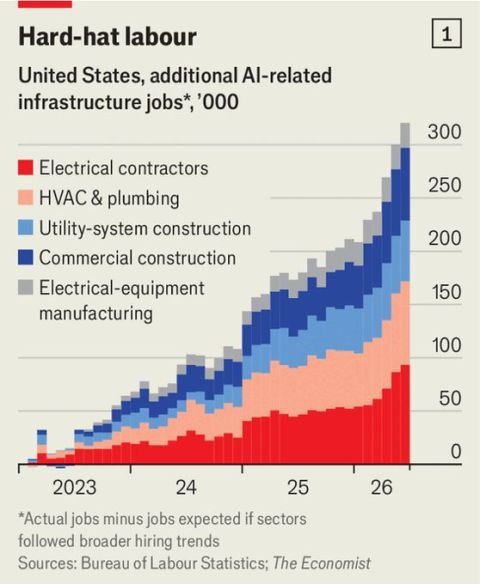 |
The Economist reports that not only has the jobs apocalypse been averted – we are in fact in an AI Jobs boom.
There are well reported layoffs attributed to AI in the media. These are often a convenient smoke-screen for deeper business issues and have created fear. Some professions are suffering: for example since 2023, there has been a 10-15% fall in jobs for customer service workers, and administrators.
However, it is not all doom and gloom.
It is estimated that AI has created about 1 million new jobs in America. The vast investment in data centres and power generation has increased demand for construction and infrastructure workers.
AI is also creating a new class of white-collar jobs. Gad Levanon, from Burning Glass Institute, analysed LinkedIn data and reckons 1% of professional jobs are now AI jobs. It is not clear whether this is people rebranding themselves ‘AI Consultant’, doing AI development, or simply using AI tools in their work, like everyone now.
Skills, geographies and industries will feel AI at different speeds.
Initially as broader digital transformation, then as industry reinvention.
Slow, slow, then fast.
Further Reading - the Economist article “The Jobs Apocalypse Is Postponed”
2 - Capital 1 Labour 0 - The Workers’ Share of Economic Output is Lowest on Record
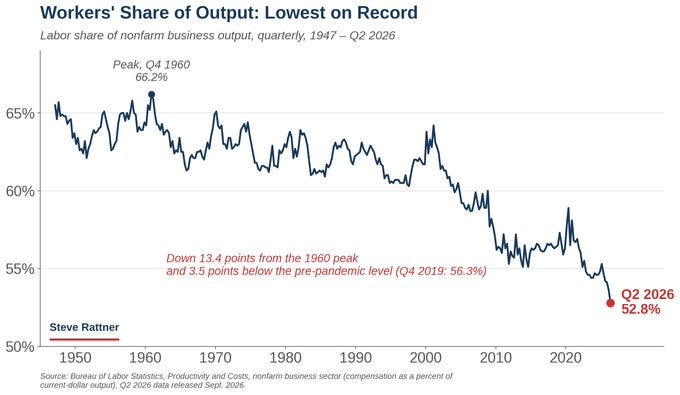 |
The workers’ share of US business output has hit its lowest point in the history of the series. That doesn’t mean jobs have vanished, wages can’t rise, or AI caused the decline. The trend started long before ChatGPT.
But it does challenge the comforting assumption that a growing economy will automatically deliver a growing share to the people doing the work. The job isn’t finished, but it may be carrying less of the load. So the question gets harder to avoid:
If the economy grows but workers' share keeps falling, how do we make work more equitable?
Further Reading - What comes after the Job? on why the job can no longer carry everything we attached to it, and the five functions we need to rebuild.
3 - Anthropic’s Scenarios for Our Economic Future
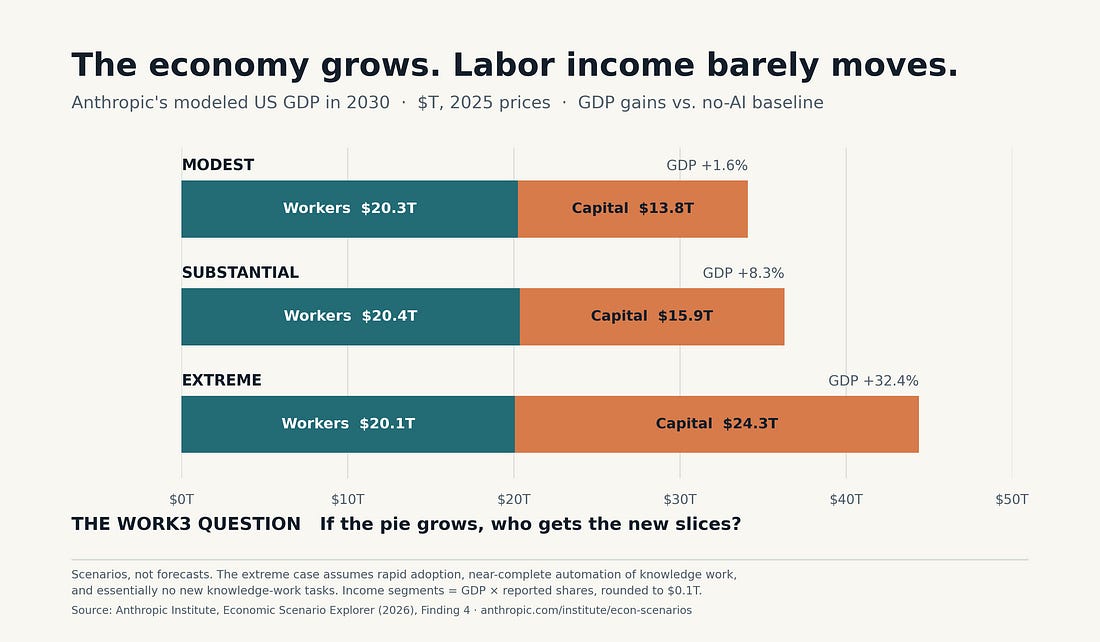 |
In their paper, “Scenarios for our Economic Future”, Anthropic sketch a world in which AI makes the US economy dramatically richer, yet the total income going to workers barely changes.
The analysis starts by treating work as a bundle of tasks rather than a job, using a nurse as the example. For work designers, that is usually the better starting point than skills, or indeed jobs. In this example, the nursing example is a theoretical exercise, and nobody has to deal with messy humans.
Think of a day in the life of a nurse
You can think of any job as a bundle of tasks that someone does. She does rounds to check on a sick patient. She draws blood. She triages incoming patients, charts patients’ vitals, and orders supplies for the ward. That’s just the start of the list. (from the Anthropic report)
They argue that AI can help the nurse do some of these better or faster: drafting discharge instructions, monitoring patients remotely, planning the shift's care schedule. Other tasks stay human - AI can't bathe a patient.
So the nurse’s job changes. But that is where the task analysis stops. It can show how one role shifts, yet it can’t tell us how the labour market itself will restructure. That depends on how tasks get rebundled into entirely new jobs, a decades-long reshuffle that is very hard to model.
Anthropic has developed scenarios for an AI catalysed economy. In the extreme case, the extra economic output flows largely to capital, and that requires rapid adoption and near-complete automation of knowledge work.
Even so, it builds on Chart 2’s question: if a bigger economy no longer means more income from work, people need a claim on the value created beyond their next pay cheque. And none of it is predetermined. The outcome will be shaped by public opinion, law and, as ever, events, dear boy, events. However, we are not passive recipients on this journey and it is important that we develop and share preferable scenarios for our societies.
 |
Further Reading - Scenarios for our Economic Future
4 - The Token Games - And the Impact on Work
 |
As mentioned in my warning post on New Year’s Day, the Magnificent Seven Tech firms make up between a third and a half of the US Stock Market. With a bold substantial trillion dollar investment in data centres.
But what if the ROI isn’t quite as expected?
Beyond the direct stock revaluations, the indirect impact of recessions in far away countries and capital squeezes in other markets. It has geo-political implications too.
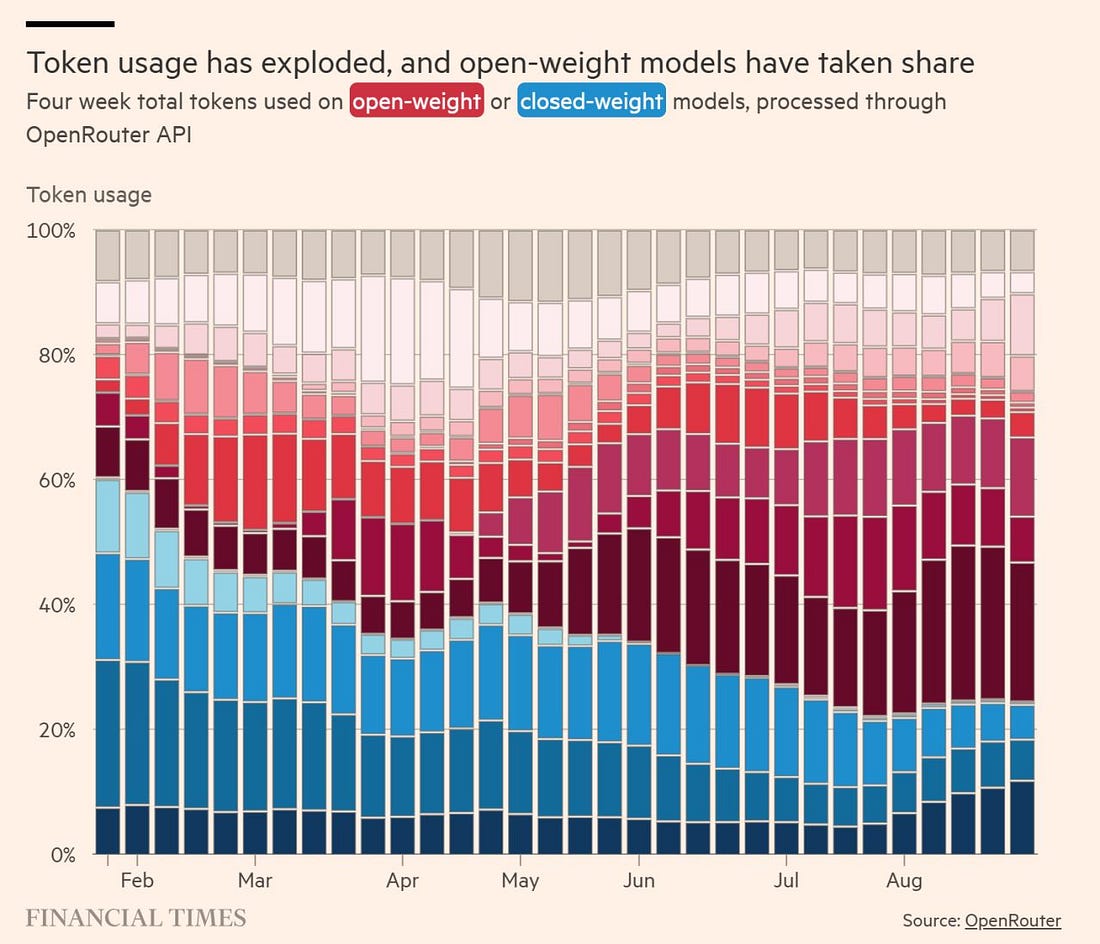
It seems firms such as DoorDash, Siemens and Airbnb are using a greater proportion of cheaper, Chinese open-weight AI models. ( Chart via Carl Benedikt Frey ) These are AI models whose trained parameters are published, so anyone can download, run and adapt them, typically at much lower cost than a closed, paid-for API.
If you remember the impact of DeepSeek’s launch on tech share prices, I wonder if China are waiting for a judicious time to pop (or threaten to) the US AI bubble.
So what does this mean for work? When Markets Catch a Cold, Work Gets the Flu.
Power flows to whoever controls the scarce resource. The Straits of Hormuz are a focal point for oil, but in this context it means AI tools with trillions of dollars of customer relationships built in. If the US economy stalls, the rest of us feel it. Watch this space.
That’s the big picture: a jobs boom, a possible bust, and no guarantee the gains reach the people doing the work. For Work3 futurist subscribers, the next three charts show who is picking up the bill: UK starter jobs have almost halved, workers are funding their own AI tools, and in Australia the jobs most exposed to AI are mostly held by women. Subscribe to read on, and join our ‘Brains Trust’ on 21 October: “If AI does the work, who owns the value?”...

Continue reading this post for free in the Substack app
| ||||||||||

