|
 |
Dear Reader - I hope you are reading this on the beach 🏖️ enjoying a well deserved break from work. Our next two articles look at potential policies for a world with less jobs (decent ones anyway). We would love to know your views, and experience with any of these policies.
Tomorrow (Thursday 21st August) we have our 2nd Work 3 Webinar which we are excited about, where we ask “Is it the End of the Corporate Silo?”
This is for Work 3 Community members - but we will share the registration link to the 1st 10 regular subscribers who hit reply to this email!
Andy and Matteo
Work 3 - Policies for a Post-Job World
From universal basic services to time banking - rethinking work and life for the 21st century (Part 1)
|

| |||||||||||||||


 |
Everyone has a view on the future of work.
But any opinion about how we’ll work tomorrow quickly drifts into bigger questions about how society itself should function.
Take the familiar line: “AI will eliminate knowledge work and middle managers.”
That sparks bigger questions:
How will people earn enough to cover living costs?
How will governments raise the taxes to fund public services?
Suddenly our quiet chat about AI and jobs is firmly in the domain of politics.
Politics is already a touchy dinner-table subject and a conversation that can turn icy in the boardroom.
What used to be political debate has corkscrewed into cheap entertainment, dominated by viral soundbites. The punchline?
We no longer vote for politicians - we vote for entertainers.
The competing forces in our society are blurrier than ever. Last century, the battles were Left vs Right, Workers vs Owners, Capital vs Labour.
Today, the fault lines also run between:
Those who can afford to feed, clothe and house their families, and those who cannot
Those who can work anywhere, and those who have to work somewhere
The young—who rely on publicly funded education—and the old—who rely on pensions and health services
Those who have access to leading-edge technology (including AI) and knowledge, and those who don’t
Society has changed, yet our political rhetoric hasn’t moved on from the industrial age. So let’s park the tribalism for a moment and ask:
Which policies could support a preferable future of work?
The 20th-century social contract was built on full-time jobs, state pensions and predictable careers. What replaces it when work becomes fragmented, AI-powered and borderless?
This week’s Work 3 article is in two parts and explores 16 policy proposals from around the world. We take a first step towards a Work 3 Manifesto - and some ideas may surprise you.
‘The New Social Contract for Work’ was the 7th trend in our exclusive report ‘Nine Global Mega Trends Shaping the Future of Work’
As a Work 3 Community member, you’ll get:
✅ A 30-page deep-dive PDF report, with 60 further resources to explore, PLUS a Q&A Worksheet to apply the ideas in your context
✅ Access to our monthly live webinars - the next one is on 21st August - “The End of the Corporate Silo”
✅ a PDF of this two-part article series (on request) with additional references and resources
Join the Work 3 Community today and get instant access — plus support our research, events, and future products.
A Brief History of The JOB
To understand today’s post-job challenges, it can be as informative to look back as to look forward.
Working from home isn’t new: in the 1600s, people in England made dresses and shoes at home.
Technological innovation—like the Spinning Jenny—brought us together in factories, and the modern job was born.
The job gave us the 12-hour day, the six-day week, the five-day week—and guess what’s coming next?
The four-day week.
We created new laws. Societies raised taxes and provided welfare, education and health services.
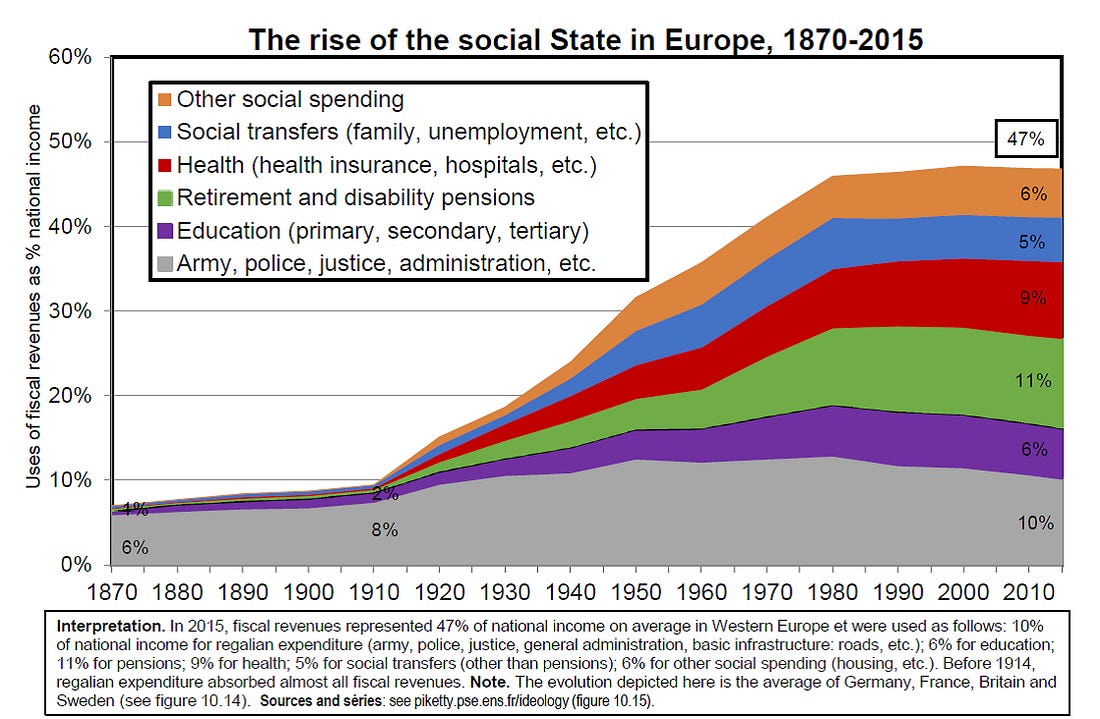 |
Public spending in Europe rose from around 10% of fiscal revenues to roughly 47% as the social state expanded.
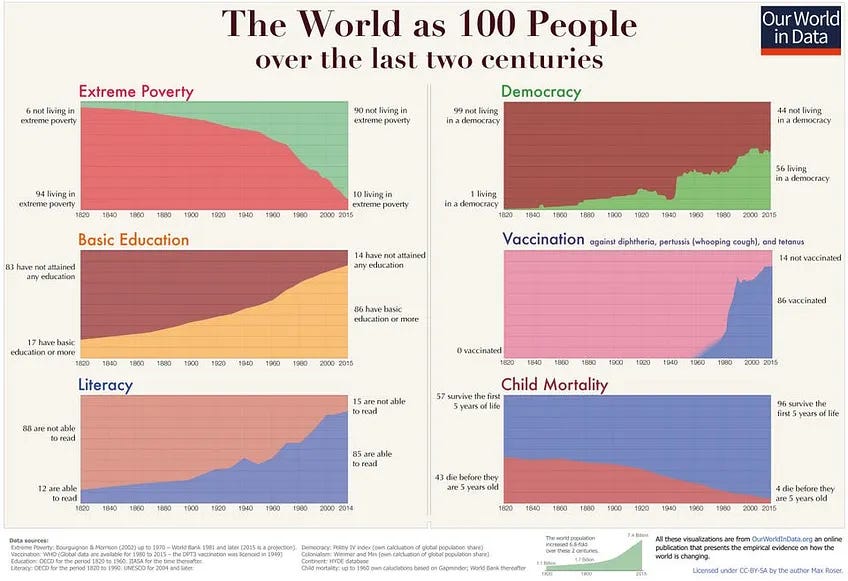 |
Many people benefited from the rise of the job.
For some, it gave meaning, structure and purpose.
For most, it put food on the table.
For two centuries, jobs - and the institutions we built around them - helped redistribute wealth and improve education.
Capital 1 — Labour 1.
The Walls Come Tumbling Down
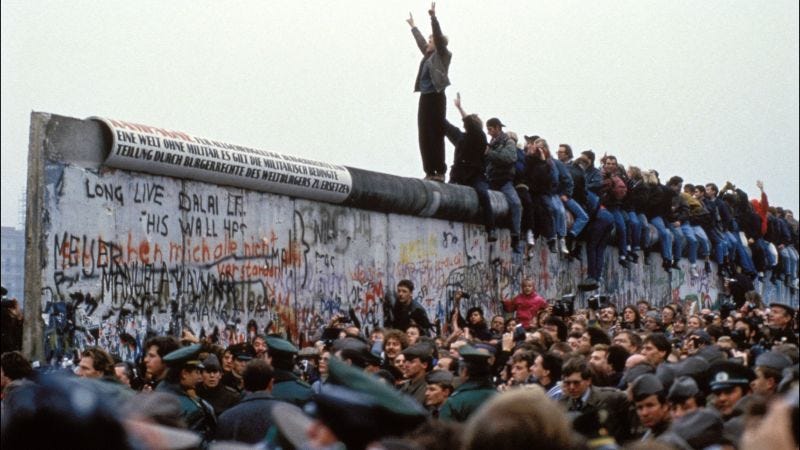 |
As the Berlin Wall crumbled in 1989, hundreds of millions of Chinese workers joined the global economy. It was the largest reduction in poverty in human history, but it also suppressed wages in many Western economies.
Fast-forward a few decades. The technologies that centralised and industrialised work in factories are now enabling us to decentralise some work into smaller teams.
There are 3.4 billion people in the global workforce. A world with fewer jobs might surprise you, but consider this: six in ten workers do not have a formal job—they work in the informal economy, with no contract and little protection.
Work has Changed - Politics Hasn’t
Work is being reshaped - slowly, then quickly- by global mega trends. The structure of work has fragmented:
Millions work as freelancers, gig workers, creators or part-time carers
AI agents and task platforms are unbundling what we used to call a “job”
Invisible labour—care, emotional support, community work—still goes unrecognised
Yet most political platforms still frame policy through the lens of jobs:
Job creation
Job guarantees
Job security
Job protectionism
Heritage political parties (e.g., Labour in the UK, Australia and New Zealand; the Workers’ Party in Brazil; the Arbeiderpartiet in Norway) are still defined by the job - and often funded in part by union subscriptions that derive from jobs.
If the job is no longer the dominant unit of economic participation, should it still dominate our political language? The world of work has transformed - but many left-leaning political brands remain stuck in the industrial age.
Why We Need a New Social Contract
Unemployment is historically low in many countries. Wages are rising in some sectors. There’s no immediate sign of the job apocalypse.
So why talk about a new social contract?
Because it’s not the number of jobs—it’s the quality.
Jobs no longer guarantee security, progression, meaning or predictable hours.
As AI, ageing, automation and climate change reshape work, last century’s institutions - from unions to political parties - still speak a language that’s increasingly out of step.
Some Work 3 assumptions:
There may be less work to do
Employment contracts will change
Wealth needs to be redistributed in different ways
Work doesn’t go away, but needs to be reframed, re-valued and re-organised
Financial security is increasingly disconnected from labour
If there is less work to do, and less jobs, the society goal shouldn’t be full employment - it should be greater financial security.
Below are examples of policies proposed by political parties around the world.
A New Social Contract for Work: 16 Policies You Should Know (Part 1)
Income Floors: Guaranteeing a Basic Standard of Living
1 - Universal Basic Income (UBI)
Unconditional, regular cash payments to all citizens, providing a baseline of security regardless of work status.
Example: Finland’s 2017–2018 trial showed reduced stress and higher wellbeing; Alaska’s oil-funded Permanent Fund Dividend is often cited as a real-world UBI-style model.
2 - Negative Income Tax (NIT)
Guarantees a minimum income by topping up low earnings via the tax system, phasing out as income rises.
Example: The US Earned Income Tax Credit works this way; 1970s pilots in New Jersey and Seattle reduced poverty, though showed mixed effects on work incentives.
3 - Universal Capital Grants & Sovereign Wealth Funds
Public assets managed for citizens, paying out lump-sum “baby bonds” or annual dividends.
Example: Norway’s Sovereign Wealth Fund (USD 1.4 trillion) supports pensions for future generations; Alaska’s dividend delivers ~$1,000–$2,000 a year to residents.
Universal Services & Care: Reducing Life Costs and Valuing Unpaid Work
4 - Universal Basic Services (UBS)
Free or low-cost essentials (healthcare, education, housing, transport, internet) provided as rights, cutting living costs.
Example: UK’s NHS is the archetype; Tallinn, Estonia offers free public transport to residents.
5 - Parental Leave & Caregiver Support
Paid leave, childcare, and eldercare services that enable people — especially women — to participate fully in the labour market.
Example: Sweden provides 480 days of shared paid parental leave; Canada rolled out a national childcare programme in 2021.
6 - Care Credits & Time Banking
Assigns value to unpaid care or volunteering by rewarding time with credits for future services or pension entitlements.
Example: Japan’s Fureai Kippu (“Caring Relationship Tickets”) allows people to earn credits by caring for elders, redeemable later in life.
These ideas aren’t new, and they vary in ambition and feasibility, but together they show how the politics of work could evolve beyond a narrow focus on “jobs” alone.
In the next part of this series, we’ll explore more policies that focus on work transitions and digital governance and ownership - including the four-day week, lifelong learning and data dividends. We’ll assess them using the Work 3 Policy Readiness Index, and share the first draft of the Work 3 Manifesto—our attempt to sketch a politics fit for a world where work is more fragmented, digital and decentralised.
Your future of work political correspondent,
To go deeper, The New Social Contract for Work was the 7th trend in our members-only PDF report Nine Global Mega Trends Shaping the Future of Work.
Be Part of Building the Future of Work
As a Work 3 Community member, you’ll get:
✅ A 30-page deep-dive report, with 60 further resources to explore, PLUS a Q&A Worksheet to apply the ideas in your context
✅ Access to our monthly live webinars - the next one is on 21st August - “The End of the Corporate Silo”
✅ a PDF of this 2 part article series (on request) with additional references and resources
Your membership funds more research, events, and experiments — and connects you with others building fairer, future-ready work.
Not ready for Work 3 Community Membership yet?
Subscribe free to get the latest Work 3 articles direct to your inbox.
You're currently a free subscriber to Work3 - The Future of Work. For the full experience, upgrade your subscription.
| ||||||||||

