|
 |
Dear Readers, in case you missed it, here was our article on New Years Day highlighting a couple of risks that we think have been under-estimated for 2026. What do you think?
Stay tuned with Work 3 in 2026 - we have planned lots of interesting articles, reports, webinars, and collaborations.
Also, let us know what you would like to read more of from Work 3 this year.
Andy and Matteo
You Are Training AI: Who Gets Paid for It?
Why the next fight about work isn’t employment, but ownership
|

| |||||||||||||||


 |
Welcome to this week’s edition!
This week, I want to address what I think is one of the biggest mistakes we keep making about AI and work:
We think the battle is about jobs.
It isn’t.
The battle, is going to be about ownership.
AI systems are trained through everyday work. We correct them, guide them, refine them, and teach them what “good” looks like. That knowledge doesn’t disappear when the task is done, it gets embedded into systems that scale.
Previous technologies (think of the industrial revolution) didn’t have this immediate and total absorption mechanism. Yet, 100 years on, we pay for time just like we did when people worked in factories.
That’s why today I want to deep dive into how we need to redesign ownership and compensation in the era of AI.
Where AI creates value - what people get wrong
 |
Right now, 99% of the debate is framed around jobs, productivity and efficiency, as if we’re still inside the industrial system where value is created by hours worked and outputs shipped.
The catch is that AI doesn’t just accelerate work (which we have already argued is not always a good outcome, when it scales the wrong workflows faster, or optimizes for the wrong outcomes "AI Productivity vs Performance”, "The Impact of AI on Work (Isn’t Jobs)"). It absorbs it and turns work into training data.
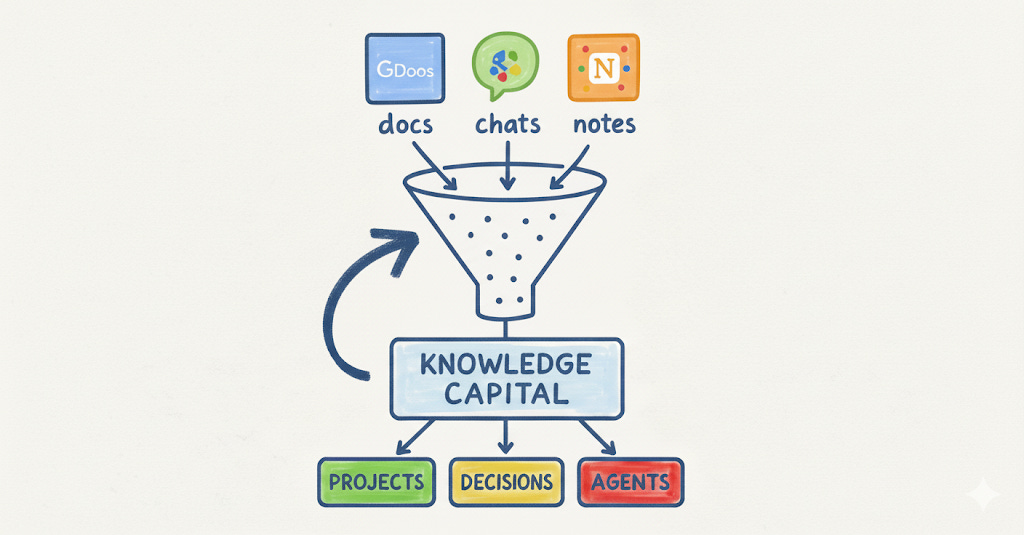 |
Most new and native AI systems (as we talked about in "The Enterprise Graph") are explicitly designed to rely on continuous human input, feedback, supervision, and correction to function at scale: every prompt, judgment call, document, and online meeting is not just “using AI.” It teaches a system how to behave, and it turns everyday work into training signal.
This is also why “agent skills” are becoming such an important concept. In our piece on Anthropic’s Agent Skills, we argued that a Skill is essentially a digital representation of procedural knowledge, a reusable module that captures how work is done so agents can execute it reliably. In other words, the work is not just performed. It gets packaged, versioned, and encoded into systems. Once work becomes programmable in this way, the ownership question becomes unavoidable, because what you are producing is no longer just output.
This dynamic is likely to intensify over the next decade.
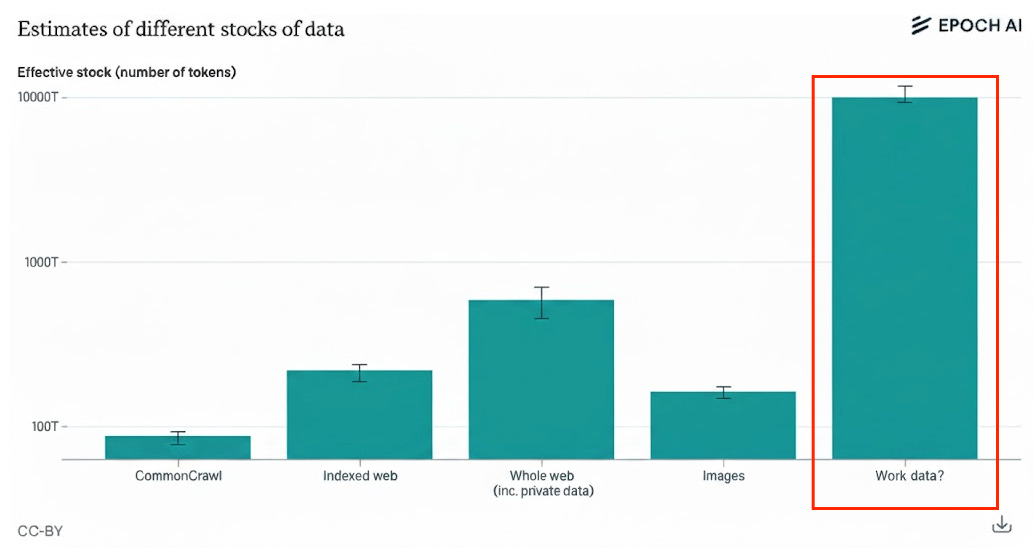
Research firm Epoch AI estimates that the effective stock of high-quality public human text is finite, and that frontier models could fully utilize it between 2026 and 2032. If public data becomes a bottleneck, the next training frontier will shift from “the open internet” to something else: proprietary workflows, human feedback loops, and enterprise context. Once that happens, the question is no longer whether AI uses human knowledge, but who owns the intelligence that gets captured. Researchers increasingly describe this as instructional labor, data labour, or human-in-the-loop work: work that produces durable economic value, but remains largely underwater in our compensation models.
Yet we continue to evaluate and compensate people as if their contribution disappears the moment they log off. That’s because knowledge work has not been redesigned for the AI era, it simply inherited the rules of industrial labour (time-based pay, task-based productivity, zero ownership of accumulated knowledge).
Those rules worked when work was ephemeral, but they break when work becomes cumulative, reusable, and scalable without the worker.
We’ve already lived through one great wave of value extraction: Social media trained us to give away personal data in exchange for free products. Search became one of the most profitable business models in history precisely because people accepted this trade-off: convenience now, monetization later. But AI at work is not the same thing. When a worker uses AI to be faster, more accurate, or more creative, the value does not accrue to the them individually, it compounds inside the company. The system learns from professional judgment, edge cases, and institutional context, all while the worker is paid as if nothing durable was created.
Data as labour
 |
The truth is that labour is becoming equivalent with data.
Across academia and industry, the same pattern is described in different ways, but it shows up in very specific roles inside real companies:
Data labor - At companies like Scale AI and Sama, this work appears under titles such as data annotator, labeling specialist, or AI trainer. These roles involve tagging images, classifying text, ranking outputs, and correcting model behavior. While often framed as low-skill or entry-level, this work requires sustained attention, contextual judgment, and consistency. It is also frequently outsourced to workforces in Africa, South Asia, and Southeast Asia, where wages are a fraction of those in Western markets.
Feedback labor - Large model developers like OpenAI and Anthropic rely on roles such as AI trainers, model evaluators, and alignment reviewers. These workers compare outputs, flag failures, enforce tone and safety norms, and teach models what “good” looks like. Despite shaping how systems behave at scale, this labor is typically contractual, anonymized, and disconnected from any long-term ownership or upside in the systems being trained.
Human-in-the-loop work - In enterprise automation platforms like UiPath and Palantir, humans are embedded as process supervisors, operations analysts, or exception handlers. Their job is to intervene when automation breaks, resolve edge cases, and gradually encode those decisions back into the system. This is often presented as oversight or QA, but in practice it is incremental system design, where human judgment is steadily converted into machine behavior.
Invisible labor - A significant share of moderation, safety review, and model supervision is handled by large outsourcing firms such as Accenture and Cognizant. Job titles here include content moderator, trust and safety analyst, and AI operations associate.
In all cases, people are performing instructional work that improves systems over time. The output is not a task completed, but intelligence accumulated.
And while this is increasingly becoming a recognizable category of work, it is still compensated as if nothing enduring is being created (though one could argue that at least it is compensated, if you think about how most LLMs have been trained on stolen copyrighted data).
Another way to see this shift is through the industry’s upcoming obsession. The emerging reality is that models are becoming commoditized, and context is the moat. Prompt engineering is giving way to context engineering, the discipline of curating and maintaining the right information at inference time. In enterprise settings, the limiting factor is often not the model, but operational context, the live signals, workflows, and metadata that tell systems what is actually happening. This is where the ownership question becomes unavoidable. Context is increasingly the moat, and most of that context is generated by work.
As we expand usage of this technology, we increasingly start to capture any type of work and intellectual output as part of what we called the Enterprise Graph: basically a digitalized version of every interaction, thought, and output of knowledge work with its history, connections, evaluations and so on.
This means salary, which was built for work that ends, is not sufficient anymore.
And this won't be a question about fairness, but about work design.
Intellectual Equity: a better mental model
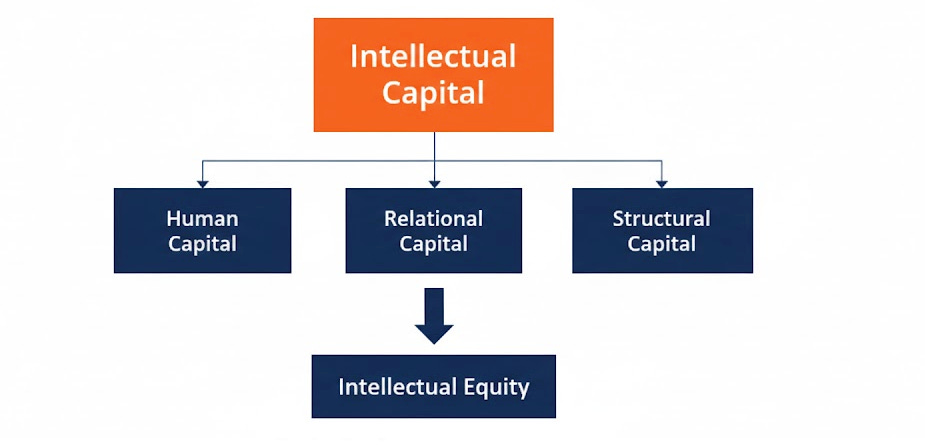 |
So what can be a better option? Not higher wages, but intellectual equity. The idea is simple: when human contribution continues to generate value through AI systems, compensation should be recurring, attributable, and durable.
In practice, this can take four main forms.
1. Royalties for AI-generated value
One prominent alternative model is to compensate contributors through royalties tied to the ongoing use of an AI system.
Instead of one-time payments for data, labeling, or training, contributors receive recurring micropayments whenever the system generates value. This mirrors how artists earn royalties from music streams or book sales and reframes human contribution as a long-term asset rather than a consumable input.
A concrete example is Codatta. Codatta turns expert human knowledge into structured data assets and tracks how those contributions are used during model inference. Every time an AI model powered by that data produces an output, contributors receive a micropayment via smart contracts.
This model aligns incentives across the entire AI lifecycle. Contributors are rewarded for quality and durability, not volume, and are treated as partial owners of the value the system creates over time.
At a conceptual level, this shifts AI work from a gig economy of tasks to an ownership economy of intelligence.
2. Inference-time compensation for domain expertise
A related proposal focuses on when value is actually created.
Much of an AI system’s economic value emerges after deployment, through millions of inferences, API calls, and downstream decisions. This brings the argument that compensation should therefore occur at inference time, not just during training.
In this model, contributions from skilled workers are tagged, logged, and traced. When a system applies patterns, heuristics, or judgment learned from a specific contributor’s data, that contributor receives a micropayment.
In effect, every time a system uses techniques learned from a worker’s expertise, the worker earns a share of the value generated.
While technically complex (inference from models is hard, but not impossible), this approach has clear precedents in industries like music streaming and software licensing. Most importantly, it reflects a deeper shift in how we think about work: from being paid to perform tasks, to being paid for the reuse of intelligence. I would also argue that if we cannot trace contributions precisely, companies will default to zero compensation - so an even stronger argument for redesigning work accordingly.
3. Equity, tokens, and collective ownership
Beyond royalties, some approaches treat contributors as stakeholders, not just licensors.
One proposal gaining traction among labor advocates is collective equity. For example, unions or pension funds could acquire minority stakes in AI or data-labeling companies, allowing workers to benefit from long-term growth rather than short-term contracts.
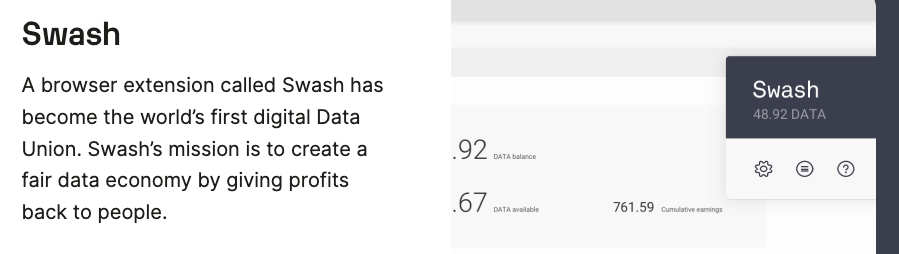
In decentralized ecosystems, this logic is already being tested. Platforms such as Streamr Data Union DAO issue tokens to users who contribute data. These tokens represent governance rights and a share of revenue when the data is licensed or used.
 |
The mechanism differs, but the principle is consistent: those who supply training data or system improvements should hold an economic claim on future returns, whether through profit sharing, voting rights, or ownership units.
This reframes contributors not as outsourced labor, but as capital partners in AI systems.
4. Attribution, licensing, and IP as compensation layers
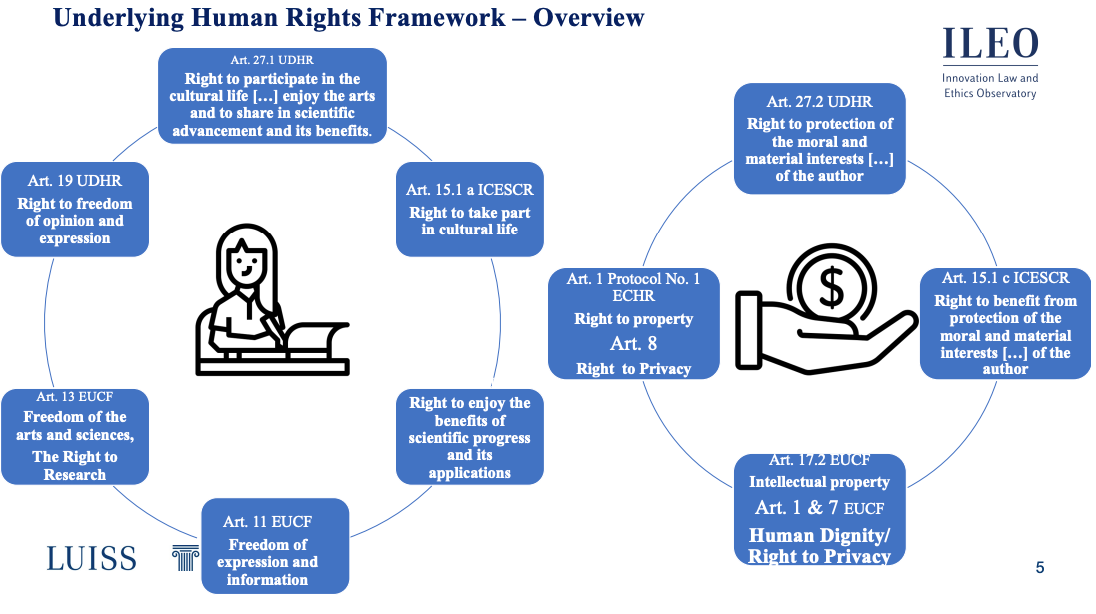 |
Money is not the only form of equity: attribution and intellectual property rights can become a second pillar of this shift.
In creative fields, there is growing consensus that AI training constitutes a distinct use of intellectual property and requires explicit consent and compensation.
LUISS Professor Christophe Geiger has argued this approach protects authors’ rights while preserving innovation, and has proposed statutory remuneration schemes for AI training data. This would imply that instead of forcing creators into litigation, AI developers would pay into collective funds whenever copyrighted works are used, with proceeds distributed directly to creators.
Similar ideas are appearing globally. Brazil’s draft AI Bill proposes mandatory remuneration tied to company size, aiming to prevent large platforms from extracting cultural value without proportionate compensation.
At the contractual level, industry groups are adapting: the Authors Guild has made clear that AI training rights are not covered by standard publishing agreements and must be negotiated separately. Their recommendation is to treat AI training as a subsidiary rights deal, with a defined revenue split. Creative contracts are beginning to include AI-specific clauses that regulate whether work can be used to train models, under what conditions, and with what royalty structure as derivative use expands.
Who wins, resists, and why this still happens
Is this utopia? Maybe. The main resistance is of course that this type of model would reduce value extraction and concentration from who is deploying the technology itself. Plus, it would also slow the current arms race, because it would require redesign, approvals and so on. On top of this, there are three other reasons:
It breaks the accounting model - Salary is simple. Royalties, usage-based compensation, and equity are not. They introduce long-tail liabilities, variable costs tied to success, questions about attribution and measurement. From a CFO perspective, this turns predictable labor costs into open-ended obligations. Even when companies acknowledge the fairness of the model, they struggle to fit it into payroll systems designed for industrial work, not compounding intelligence.
It weakens ownership and control - Traditional employment contracts assume a clean transfer of value. Intellectual equity challenges that assumption: if contributors retain economic claims on trained systems, companies no longer fully own the intelligence they deploy. That creates discomfort around IP, governance, and exit scenarios. In practice, many firms prefer to treat training, feedback, and supervision as usage rather than contribution, because usage does not come with rights.
It exposes uncomfortable power dynamics - Much of the work that trains AI is outsourced, anonymized, geographically distant, poorly paid. Recognizing it as value-generating intellectual labor would force companies to confront how much of their AI capability depends on invisible global workforces. Avoiding intellectual equity is often a way to avoid that conversation.
And yet, some organizations are moving and will move in the opposite direction - not out of altruism, but out of necessity.
The companies that experiment with intellectual equity tend to share a common constraint: they cannot succeed without sustained, high-quality human contribution. When an AI system depends on ongoing expert input, supervision, or refinement, contributors cannot be treated as disposable. One-off payments fail to align incentives.
This is why platforms like Codatta adopt royalty-based models. Their value proposition depends on experts continuing to contribute over time. Royalties reward durability and quality, not just participation, and create a direct link between contribution and downstream value.
A second group of early adopters operates in regulated or rights-heavy domains, where attribution and licensing are already part of the economic fabric. Creative industries understand residuals, secondary use, and long-tail value. Stock media platforms moved first not because they were idealistic, but because the logic was familiar. Shutterstock created a contributor fund to share revenue from AI training datasets. Adobe introduced bonuses for creators whose content trained its generative models. These companies did not invent new compensation models. They extended existing IP logic into AI.
A third category competes primarily on trust. In domains like voice, likeness, and creative identity, consent is not optional. Platforms such as ElevenLabs offer royalty-based voice licensing because without it, they would struggle to attract high-quality contributors willing to let their identity be replicated at scale. In these cases, intellectual equity is not a moral stance, but it is a market requirement.
Other actors can also step into the picture.
For example, labor movements and cooperative models are emerging as a parallel response to AI-driven value extraction. Across Europe and the US, data labor unions and cooperatives such as the European Data Union aim to give individuals collective bargaining power over how their data and training work are used, shifting compensation from isolated gigs to shared revenue and ownership.
In the Global South, where much of AI’s invisible labor resides, grassroots efforts like the Kenyan Data Labelers Association highlight how outsourced annotation and moderation work underpins advanced AI systems while remaining underpaid and unrecognized, pushing the conversation from wages toward profit-sharing, royalties, and IP claims.
TLDR: Who owns the future of intelligence of work?
As long as contributors are replaceable, anonymized, or distant, the system holds. As long as AI improvements appear incremental, the imbalance stays hidden.
But three forces are converging:
First, AI systems increasingly depend on expert judgment rather than raw data. The closer systems get to real decision-making, the harder it becomes to substitute the humans shaping them.
Second, contributors are becoming more aware of the value they are transferring. Creators, knowledge workers, and operators are starting to ask not just how AI helps them work faster, but who benefits from what they teach it.
Third, regulatory and contractual pressure is rising. From statutory remuneration proposals to AI-specific licensing clauses, the legal system is slowly catching up to what the technology already enables.
Together, these forces make the current model fragile.
By knitting human incentives into AI systems, we not only address issues of justice, but also potentially improve AI outcomes through sustained human engagement. In the long run, an AI ecosystem that rewards its human contributors is one that is likely to be more inclusive, trusted, and robust.
We’re only at the beginning, but these early frameworks and case studies provide a roadmap toward an AI future where value is shared – and that may be the key to unlocking AI’s full societal benefits.
Until next week!
Matteo
Invite your friends and earn rewards
| ||||||||||

