How Salesforce conquered the CRM market, why Tesla's first car was the Roadster, and how to use the Bowling Alley Strategy to dominate a market
One quote:
"You don't buy from a real brand. You join them." - Marty Neumeier
Bowling Alley Strategy
In 2000, Marc Benioff decided to declare war.
He founded Salesforce a year earlier and entered the competitive CRM market.
And Siebel Systems was the market leader with a 45% market share.
So Salesforce desperately needed to get known.
Benioff worked with an agency to come up with a bold campaign.
You know what was the big idea?
At the time, all software was on-premise.
So IT teams had to install them on their servers.
But Salesforce was aiming to change that.
It was in the cloud.
Nobody had to install anything.
You could just go on a website and start using it - like we do today with any application.
Benioff decided to use this as the main point of the campaign.
The on-premise software was going to die.
The cloud was the future.
And Salesforce was going to lead the war as the challenger.
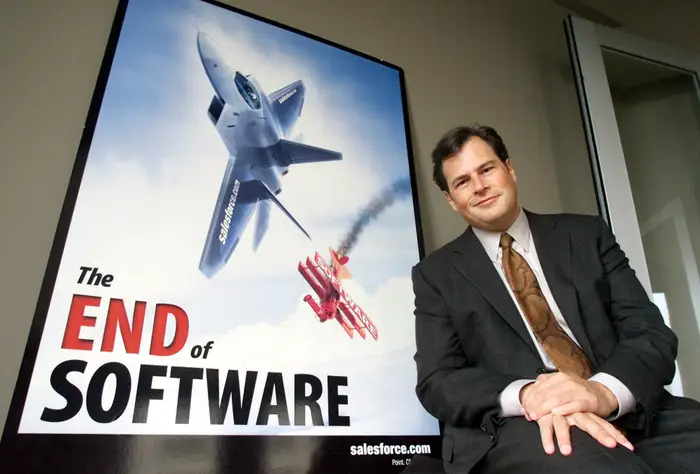
They called the campaign "The end of software."
But one move they made was even bolder than the idea behind it.
Benioff hired actors as protesters and sent them to Siebel's big annual conference's parking lot.
They held "Death to software" and "The cloud must go on" signs and shouted slogans.
And of course, it grabbed the media's attention.
They talked about it everywhere.
And it became free advertising for Benioff's upcoming startup.
Many people remember that campaign as the most important action that made Salesforce what it is today.
And don't get me wrong.
It was important.
But they forget another smart move Benioff made.
Benioff declared war on all CRM tools to get attention.
But he didn't go after all customers of Siebel, Oracle, and SAP behind the scenes.
Salesforce focused its sales effort only on the sales teams of mid-size, tech-savvy companies.
Why?
Benioff thought these companies would be the most open to giving Salesforce a try.
They had relatively big sales operations.
But they still couldn't afford big investments for on-premise CRMs.
So they'd be willing to take a risk with Salesforce's cloud CRM - unlike timid enterprises.
And Benioff was right.
They did give Salesforce a try.
And they liked it.
Focusing only on this segment gave Salesforce two big advantages:
First, Benioff's team quickly understood their needs.
That made Salesforce the perfect CRM for sales teams of mid-size companies.
And second, Salesforce became viral.
Salespeople told it to their friends from other companies.
And they asked for Salesforce when they switched to another company.
So Salesforce became the dominant tool in that segment in a few years.
Young Benioff in front of a Salesforce jet that hits Oracle plane
What did Benioff do next?
Only after conquering the first pond, he jumped to the next one: enterprises.
But now things were easier.
Salesforce was already a known tool with useful features.
Plus cloud was becoming the norm unlike a few years before.
So risk-averse enterprise IT teams didn't resist.
Salesforce also dominated the enterprise segment and became the leader CRM tool.
Benioff didn't stop there.
Now that Salesforce was the default tool for all sales teams, it was time to go horizontal.
So he created Salesforce Service Cloud as a ticket management tool for customer service teams.
New segment, same scenario.
He kept going one by one.
Then came the Marketing Cloud for marketing teams, and E-commerce Cloud for online sales teams...
Each new addition turned the Salesforce flywheel faster thanks to competitive advantages the company built over time - like distribution and high switching costs for customers.
And that's how a startup that hired 20 actors to protest in a parking lot became a 250+ billion company.
Dropping the bowling pins one by one
Here's the thing.
If Benioff had not focused on a specific (and carefully selected) segment early on, Salesforce could've died in the Dotcom bust like many others.
But he had the right strategy.
He chose a small segment he could dominate first.
And he focused his limited resources on that target (remember Blitzkrieg).
He didn't try to hunt in a big ocean.
He chose a small pond where he could eat all the other fish.
And he did it.
He jumped to a bigger pond only after that.
And he repeated this until Salesforce became one of the biggest SaaS companies in the world.
Geoffrey Moore calls this The Bowling Alley Strategy in his book Crossing the Chasm.
"We are actually better than the alternatives. But prospects don't get it."
This is a common phrase I hear in the discovery calls.
And when we dig deeper, weak positioning (hence weak messaging) is almost always the cause.
There is a good product/service.
But somehow the value is not communicated well in sales presentations, advertising, or on the website.
So customers don't get it.
And it's frustrating.
You do all the hard work to create a great product/service.
But customers don't see it that way.
So as we talked about above, sometimes the solution comes down to changing some factors to increase the perceived value and communicating it to customers.
Only then do customers see why they should choose your brand over others.
And everything else becomes easier.
Want to show your brand's real value with effective messaging?