Company analysis tells you where you have an edge.
Competition analysis tells you what others ignore.
The combination of all three allows us to make an informed positioning decision in our workshops.
Continuing with our example:
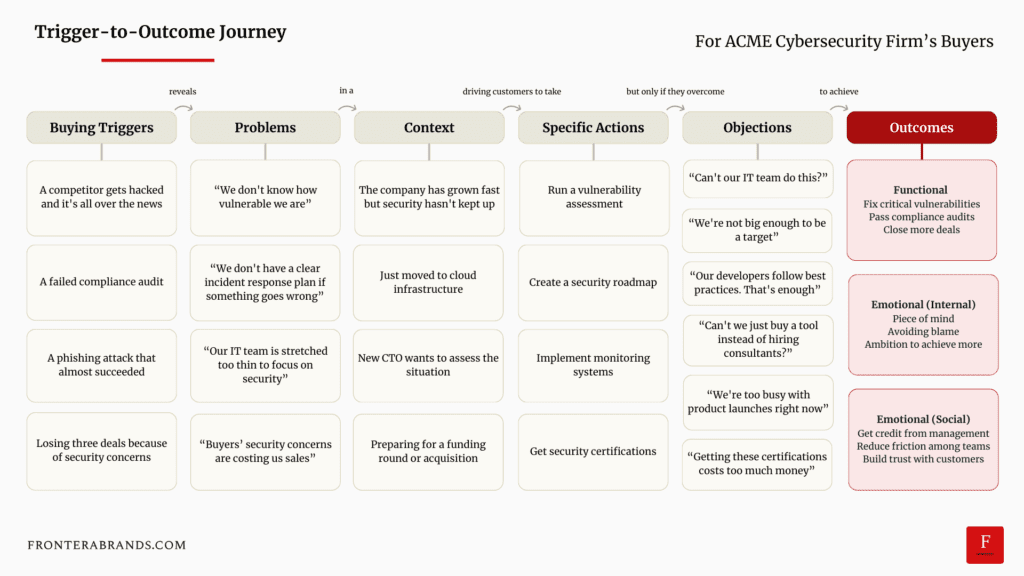
Competition: We notice that the majority of ACME's competitors focus on the risk reduction angle. Nobody leads with cybersecurity as a growth lever, focusing on ambition. So there's a gap.
Company: ACME's experience, case studies, and proprietary frameworks (hence strengths) are aligned to focus on the mid-market segment and their needs. Meanwhile, ACME's lean team (weakness) makes it hard to deal with long sales cycles in the enterprise segment.
3. Make decisions
During the analysis stage, we list as many points as possible without making assumptions.
So we end up with dozens of "problems" and "outcomes."
But then we have to prioritize the most important ones.
This part is tricky.
Because this is where we make decisions, hence sacrifices.
Saying "yes" to a few problems means saying "no" to many others.
If we were to position ACME for the enterprise segment, focusing on risk reduction:
We'd specialize in capabilities around risk mitigation.
Our website would say: "Know exactly where you're exposed, before the board asks."
Our content and ads would be around: "What every CTO should know before their next board meeting", "The 5 questions your board will ask after a competitor gets hacked", etc.
If we were to position ACME for the mid-market segment, focusing on ambition:
We'd specialize in capabilities around increasing our clients' win rate using cybersecurity.
Our website would say: "Turn cybersecurity into your competitive advantage."
Our content and ads would be around: "Why enterprise buyers won't sign until they see your SOC 2", "How to stop losing deals on cybersecurity", etc.
You see how everything changes.
The same firm.
But totally different value propositions.
These decisions always lead to interesting discussions between executives during our workshops.
Sometimes it becomes like a therapy session.
Everybody shares their opinions about what the firm should stand for.
But in the end, decisions are made.
So everybody is aligned around the value the firm creates for clients.
---
The moral of the story?
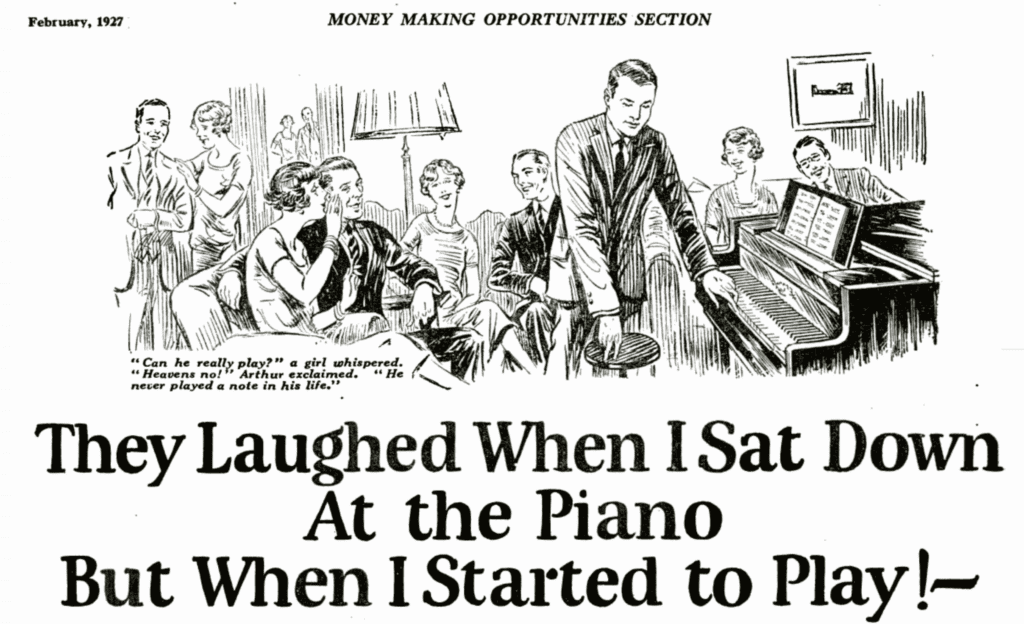
Caples's ad worked because he understood why people actually buy.
The same applies to your firm.
Yes, you deliver functional outcomes for your clients.