And just like a political party's ideology - some buyers believed in that, some others didn't.
But it differentiated Slack from all other group chat apps.
Using Slack in your organization gained meaning and its believers started converting others.
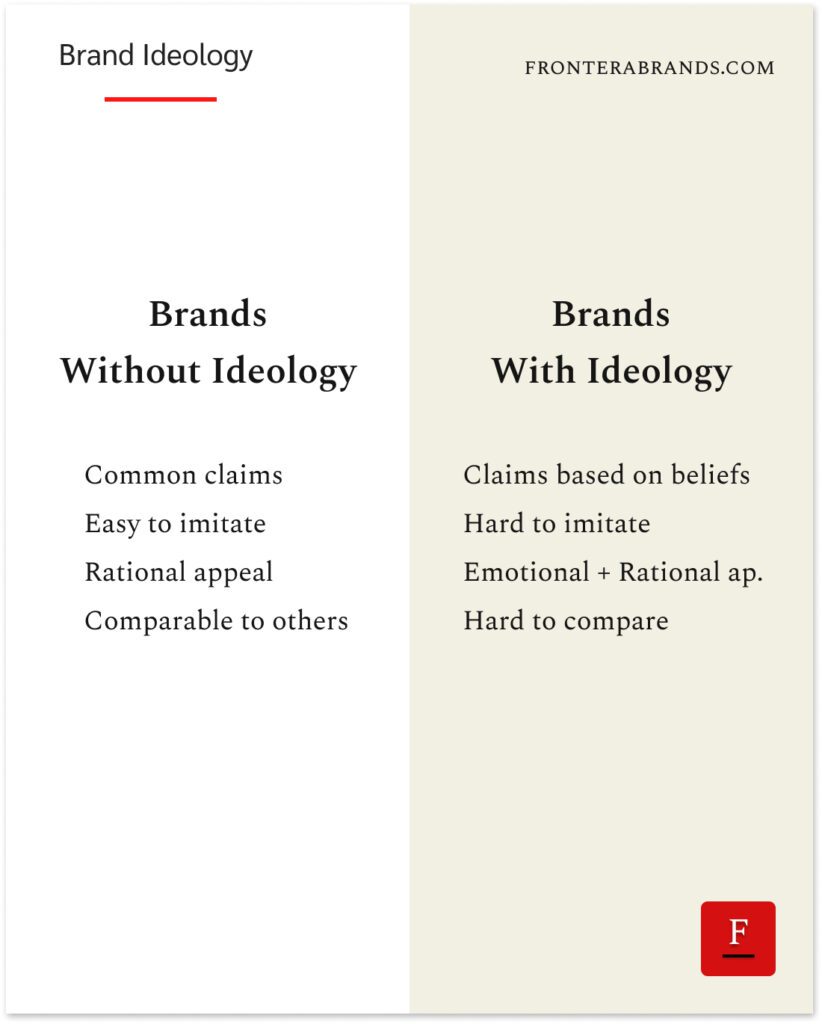
Brand Ideology
You see where I'm getting at?
If you want an emotional connection, your brand needs an ideology.
This is even more important in B2B where services are abstract.
Because ideology separates an authority from just another provider.
As competition keeps increasing in every category, buyers are more likely to buy from you if they believe in your ideas.
So a brand ideology does more than attract attention.
It shapes perception, increases your pricing power, and builds loyalty.
Clients don't choose you just for what you do - but for what you believe in.
In crowded B2B markets, that's a serious edge.
So how do you do it?
How can you go beyond cliché beliefs like "teamwork" and give customers a new point of view they can believe in?
Here are the three steps:
1. Start with your industry
Many B2B brands are afraid of taking sides.
They act like there's a "default" way to do things - and everyone must follow it.
Well, they are wrong.
Let's make a thought experiment.
Which one is better:
Data-driven decision-making or intuition?
Delegating everything like Buffett or micromanaging like Steve Jobs?
Operating in a transparent way like Patagonia? Or being secretive like Apple?
If we were to make a poll, I bet the results would be close to 50-50 for each question.
Because there is no right or wrong.
These are different ways of doing things - and they can all work.
So you shouldn't be afraid of taking sides.
On the contrary, you should express your "ideology" boldly.
To formulate a point of view, start with your industry.
Use these questions:
"What is our competition doing wrong? What's the right way to do it?"
"What should our customers know about their problems? What are they missing?"
"What's our opinion about our market and where it should be?"
But beware.
Not every answer to these questions can be a point of view.
To become part of your point of view, these ideas should:
Go against common assumptions: If not, why would anyone care?
Have a valid counterargument: If it doesn't have a counterargument, it's not a point of view - it's a virtue. Some people should disagree (or even hate) your point of view.
Shape how you do things: You should mean it. If it's for the sake of having an opinion, people see through it. Your services should be designed based on your ideology.
2. Turn your ideology into a manifesto
The Bible has 10 commandments.
The U.S. Bill of Rights has 10 amendments.
Numbered lists written as a manifesto make complex ideas clear and memorable.
So you can use them also for your brand's ideology.
It has two benefits.
First, it makes things clear for you and your employees.
You know what you stand for.
Second, it becomes much easier to convey it to the market and infuse it into your messaging.